Blog Cloud Computing
Azure Cobalt 200 Reaches Indonesia Central: Price vs. Speed
On this page· 7 sections
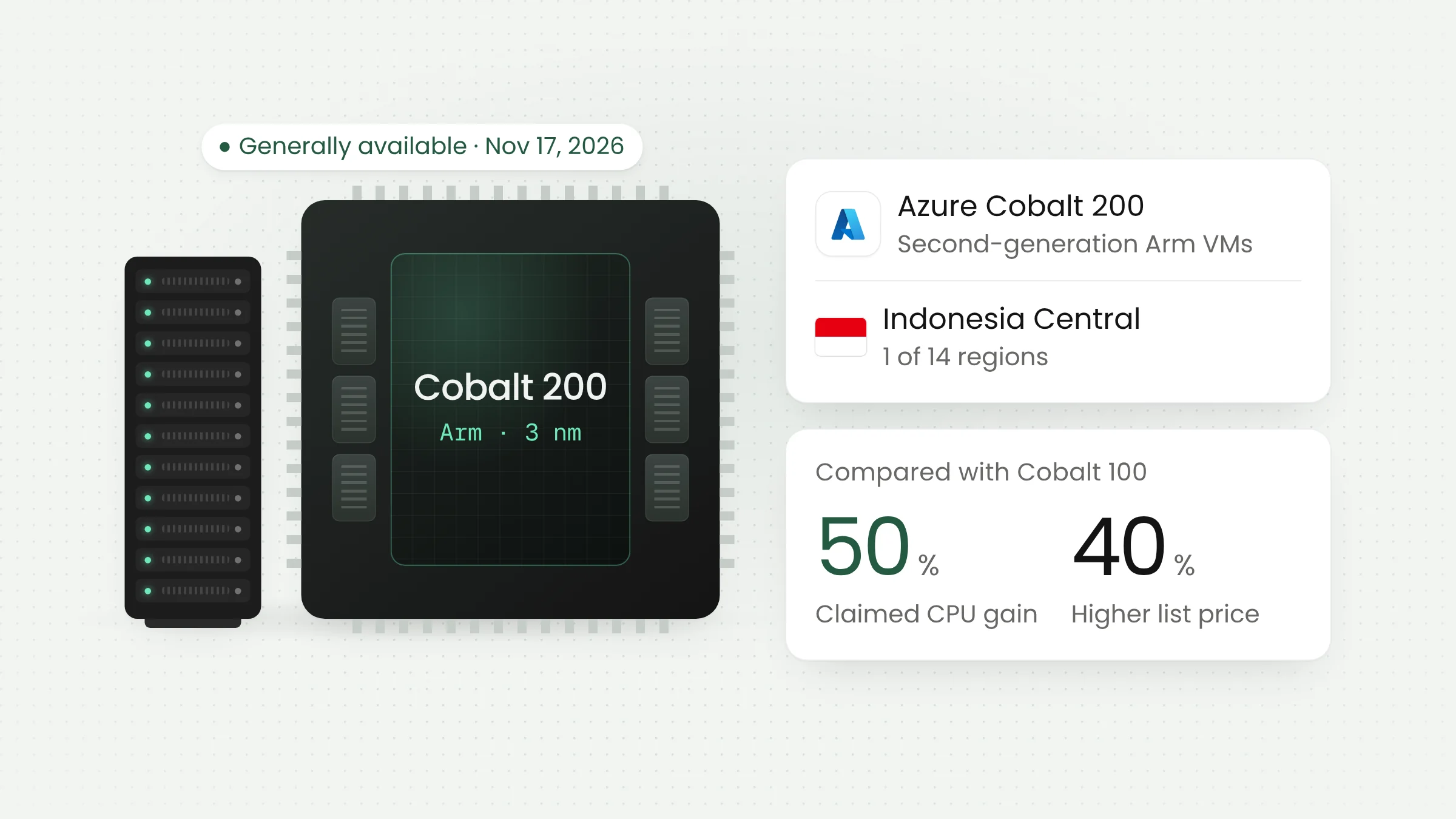
Microsoft made Azure Cobalt 200 virtual machines generally available on November 17, 2026, in 14 regions that include Indonesia Central. The company claims up to 50% better CPU performance than Cobalt 100. Azure’s own price list shows the hourly rate rising too, by about 40% for the same VM size.
Cobalt 200 is generally available in 14 regions
The announcement came on the first day of Microsoft Ignite 2026. In the launch post on the Azure blog, Rani Borkar, president of Azure Hardware Systems and Infrastructure, and Arun Kishan, corporate vice president of Azure Compute, describe Cobalt 200 as the highest-performing general purpose VMs on Azure.
Cobalt is the Arm-based server processor Microsoft designs for its own data centers. The second generation was introduced in November 2025, according to Arm’s account, and entered preview in June 2026. The preview post already listed Indonesia Central among eight initial regions.
At general availability the list grew to 14: Australia East, Canada Central, Central US, East US, East US 2, Indonesia Central, Italy North, Korea Central, South Central US, Spain Central, Sweden Central, UK South, West US 2, and West US 3. Indonesia Central is the only Southeast Asian region on it.
Two Microsoft documents give different expansion targets. The Azure blog says 23 regions by the end of 2026. The Ignite Book of News says 24 regions by year-end and names only 11 existing deployments, leaving out Canada Central, East US 2, and Korea Central.
Microsoft expects Cobalt 200 VMs to account for a significant share of new Azure compute capacity starting in 2027.
Inside the chip and the VM lineup
Microsoft says Cobalt 200 is built on TSMC’s 3-nanometer process and carries 132 Arm Neoverse V3 cores. Each vCPU on these VMs is a full physical core. On some x86 VMs a vCPU is a hardware thread that shares a core with a sibling thread, so equal vCPU counts do not always mean equal capacity.
Each core has 3 MB of private L2 cache, backed by 192 MB of system-level cache and 12 channels of DDR5 memory. Memory encryption is on by default, and Microsoft says the latency cost is negligible. Every server also includes the Azure Integrated HSM, a module that stores cryptographic keys, and Azure Boost, which moves network and storage processing off the host.
Cobalt 200 ships in five groups of VM series:
- Dplsv7 and Dpldsv7 for general purpose work, with 2 GiB of memory per vCPU.
- Dpsv7 and Dpdsv7 for web and application servers, with 4 GiB per vCPU.
- Epsv7 and Epdsv7 for databases and analytics, with 8 GiB per vCPU.
- Mpsv4 and Mpdsv4, a new high-memory series with 16 GiB per vCPU.
- Lpsv5, a new series for workloads that depend on local storage, with up to 23 TB of NVMe.
The D, E, and L series scale to 128 vCPUs. The operating systems named in the launch post are AlmaLinux, Azure Linux, Debian, Oracle Linux, Red Hat Enterprise Linux, Rocky Linux, SUSE Linux Enterprise Server, Ubuntu, and Windows 11 Client. Windows Server does not appear on that list.
Two processor modes
Cobalt 200 adds a setting called ProcessorMode. In Deterministic Mode, cores run at a consistent 3.2 GHz. In Opportunistic Mode, cores can climb to 3.6 GHz when power and thermal headroom allow. Microsoft claims the second mode adds up to 12% more performance, with more variable frequency.
A latency-sensitive service such as a payment API gets more predictable response times from the first mode. Batch work such as overnight report processing is a better fit for the second.
Performance claims and the price in Indonesia Central
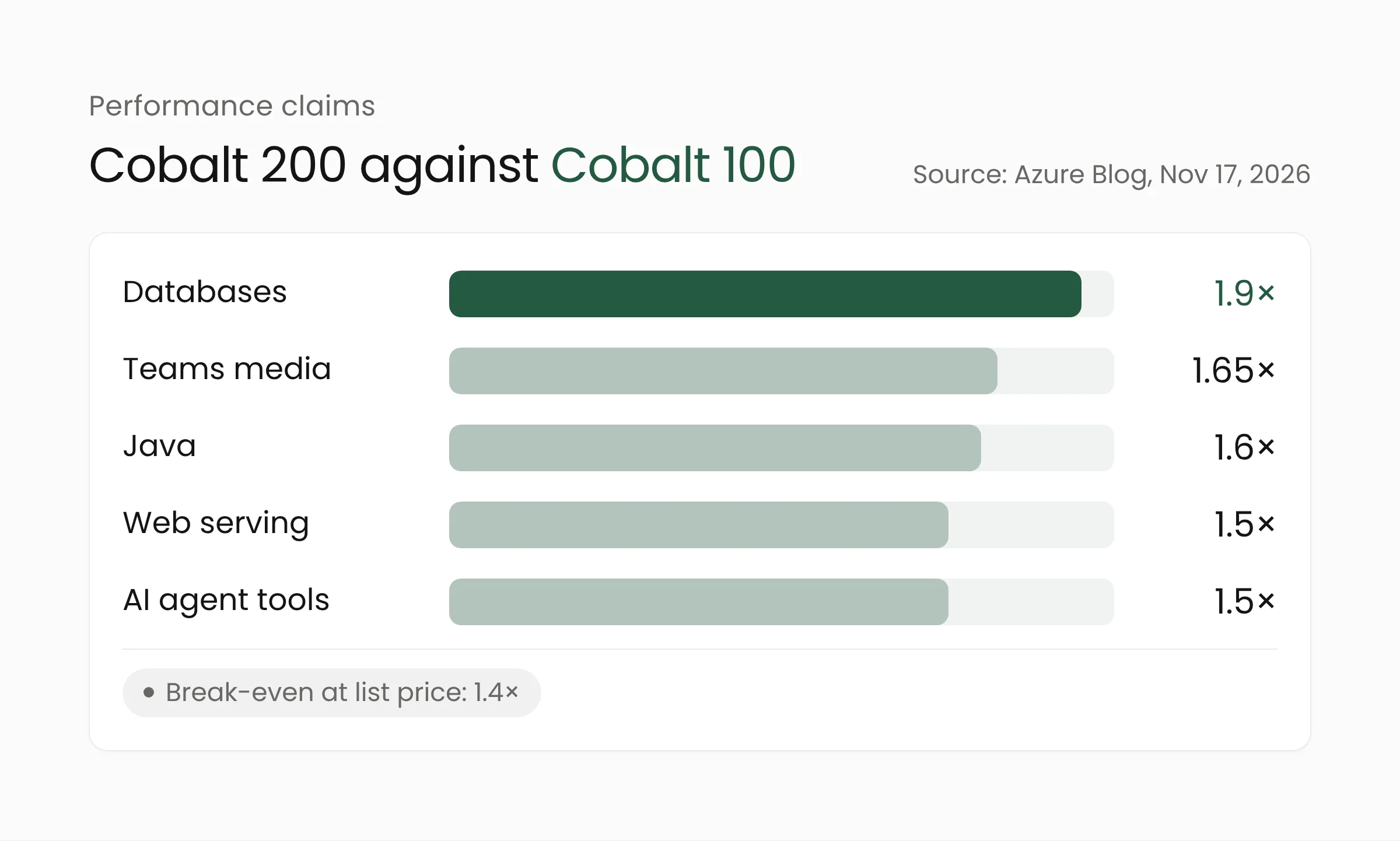
Every performance figure in the launch post comes from internal testing by Microsoft or its customers, and every one uses Cobalt 100 as the baseline. Microsoft cites up to 1.5 times for web serving, up to 1.6 times for Java workloads, up to 1.5 times for AI agent tool execution, and 1.9 times for database workloads. Microsoft Teams media processing is reported at 1.65 times Cobalt 100. Amadeus, the travel booking technology provider, reported flight search throughput more than 30% higher.
Microsoft also ties the chip to AI agents. The Book of News says Cobalt 200 was built for AI agents, which do much of their work outside the AI model. That work includes running code, calling tools, and retrieving data, all of which lands on CPUs. We covered the accelerators that run the models themselves in our piece on Microsoft’s Maia 300 AI chip.
The launch post calls Cobalt 200 the leader in price-performance across Azure’s general purpose fleet, yet it publishes no prices. TechTimes pulled Azure’s list prices for East US and found the Cobalt 200 rate about 40% above Cobalt 100. The outlet also pointed out that Microsoft has not disclosed its test configurations, benchmark suites, or which processor mode produced the figures.
We ran the same check for Indonesia Central through the Azure Retail Prices API on November 23, 2026. For a Linux VM with 4 vCPUs and 16 GiB on pay-as-you-go pricing, the rates are:
- D4ps v7 (Cobalt 200): $0.229 per hour.
- D4ps v6 (Cobalt 100): $0.164 per hour.
- D4as v6 (AMD): $0.205 per hour.
- D4s v7 (Intel): $0.282 per hour.
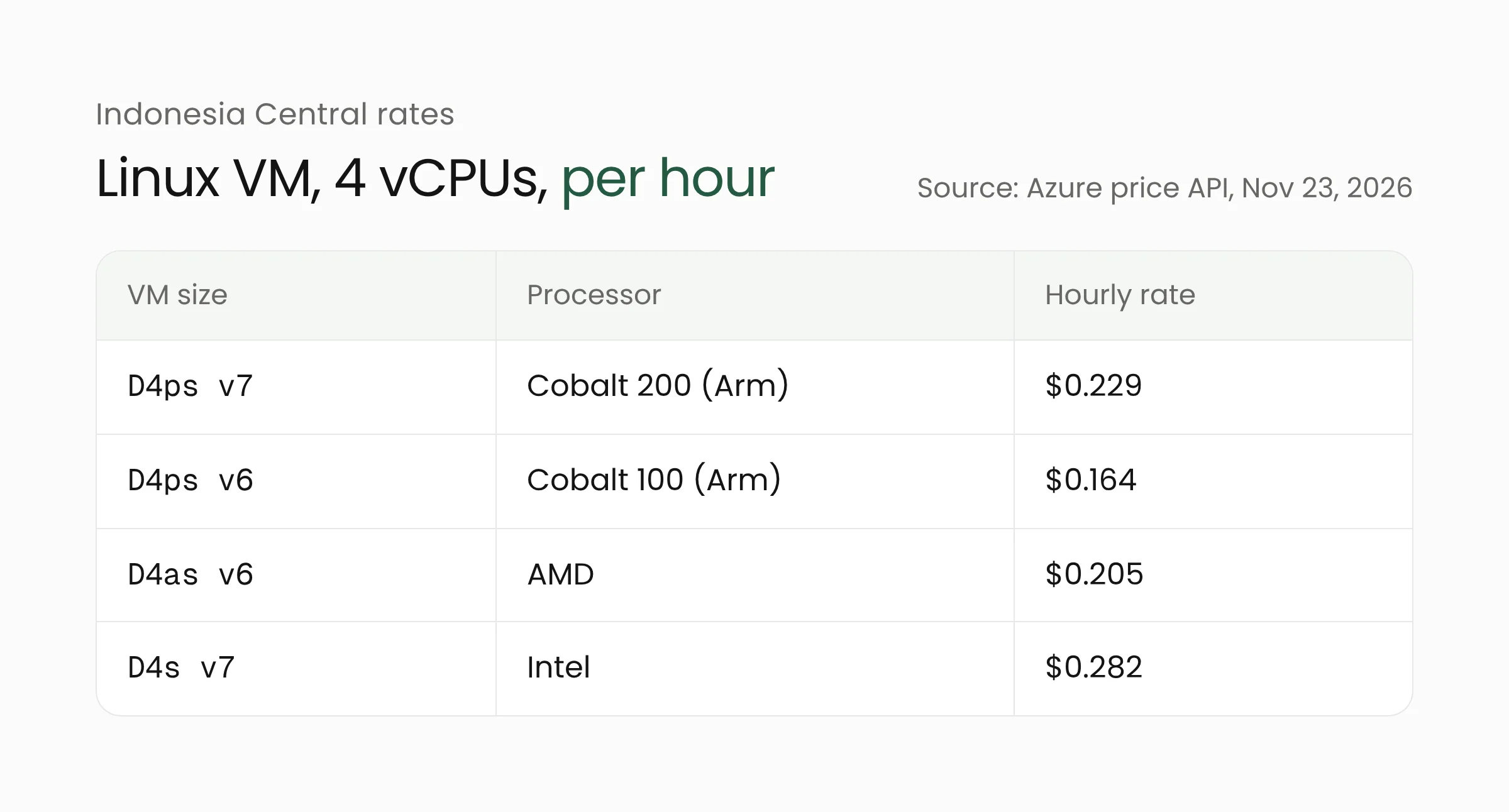
The gap matches the East US finding. Cobalt 200 costs about 40% more than Cobalt 100, about 12% more than the AMD series, and about 19% less than the Intel series.
Those numbers set a break-even point. A workload has to run at least 1.4 times faster per vCPU before its cost per unit of work on Cobalt 200 drops below Cobalt 100. The 1.9 times claim for databases clears that bar by a wide margin. The 1.5 times claim for web serving sits only slightly above it, and the words “up to” mean some workloads will land below.
What this means for IT teams and application owners
Cobalt 200 in Indonesia Central gives organizations that keep workloads in the country, such as banks, hospitals, and government agencies, a new option. Whether it pays off depends on tests with their own workloads.
- Check that the application is ready for Arm. Microsoft says workloads already running on Cobalt 100 are compatible with Cobalt 200. Applications still on x86 need to be rebuilt for Arm64. Libraries with native binaries and third-party container images have to be checked one at a time.
- Test with real workloads. Run a copy of the application on the same VM size in both generations, then measure requests per second and latency. If the starting point is Cobalt 100, use 1.4 times as the decision threshold.
- Try both processor modes. The extra 12% from Opportunistic Mode can decide whether a workload clears break-even. Services that need stable latency should be measured in Deterministic Mode.
- Use your own rates. The figures above are list prices. Organizations with reservations or negotiated pricing should redo the math with those rates and check whether existing commitments can move to the new series.
- Move in stages. Kubernetes clusters on Azure can mix x86 and Arm nodes, so one service can move first while everything else stays put. Teams that depend on Windows Server should confirm support with Microsoft before planning a migration.
Work like this falls within the cloud computing services we deliver with clients.
Organizations that use more than one provider may also want our review of the private AWS to Azure connection.
Frequently asked questions
Is Azure Cobalt 200 available in Indonesia?
Yes. Indonesia Central is among the 14 regions Microsoft named in its November 17, 2026 announcement. Availability of each series and size can differ by region, so the list in the Azure portal is still worth checking before planning a deployment.
Do applications need changes to run on Cobalt 200?
It depends on where they run now. Applications already on Arm VMs such as Cobalt 100 can move directly, according to Microsoft. x86 applications have to be rebuilt for Arm64, and every binary dependency needs an Arm version.
Is Cobalt 200 cheaper than Intel and AMD VMs?
For the 4-vCPU size in Indonesia Central, its list price is below the Intel D4s v7 series and above the AMD D4as v6 series. Per-vCPU comparisons need care because a Cobalt vCPU is a physical core, while a vCPU on some x86 VMs is a thread. Microsoft did not publish a performance comparison with x86 in its launch post.
Closing
Cobalt 200 gives teams in Indonesia access to Azure’s newest Arm generation on the same day as much larger regions. The performance claims still come from Microsoft and its customers, and the price has risen almost as much as the headline claim. Tests with your own workload are the safest basis for a decision.
Merakit helps organizations design, migrate, and cost their application infrastructure. If your team is weighing a move to Arm-based VMs, our cloud computing services are a good place to start the conversation.
Sources
- Microsoft Azure Blog: Azure Cobalt 200 VMs: Faster compute for modern agentic workloads (November 17, 2026)
- Microsoft: Ignite 2026 Book of News (November 17–20, 2026)
- Microsoft Learn: Azure Cobalt processor-based Virtual Machines (updated November 17, 2026)
- TechTimes: Azure Cobalt 200 VMs Launch: List Price Runs 40% Above Cobalt 100, So Speedup Must Top 1.4x (November 18, 2026)
- Azure Retail Prices API: Standard_D4ps_v7 rates in Indonesia Central (accessed November 23, 2026)
- Microsoft Azure Blog: New Azure Cobalt 200 VMs deliver 50% performance improvement (June 2, 2026)
- Arm Newsroom: post on Azure Cobalt 200 and Arm Neoverse CSS V3 (November 18, 2025)