Blog Artificial Intelligence
Businesses in ChatGPT: What Online Stores Can Claim Today
On this page· 7 sections
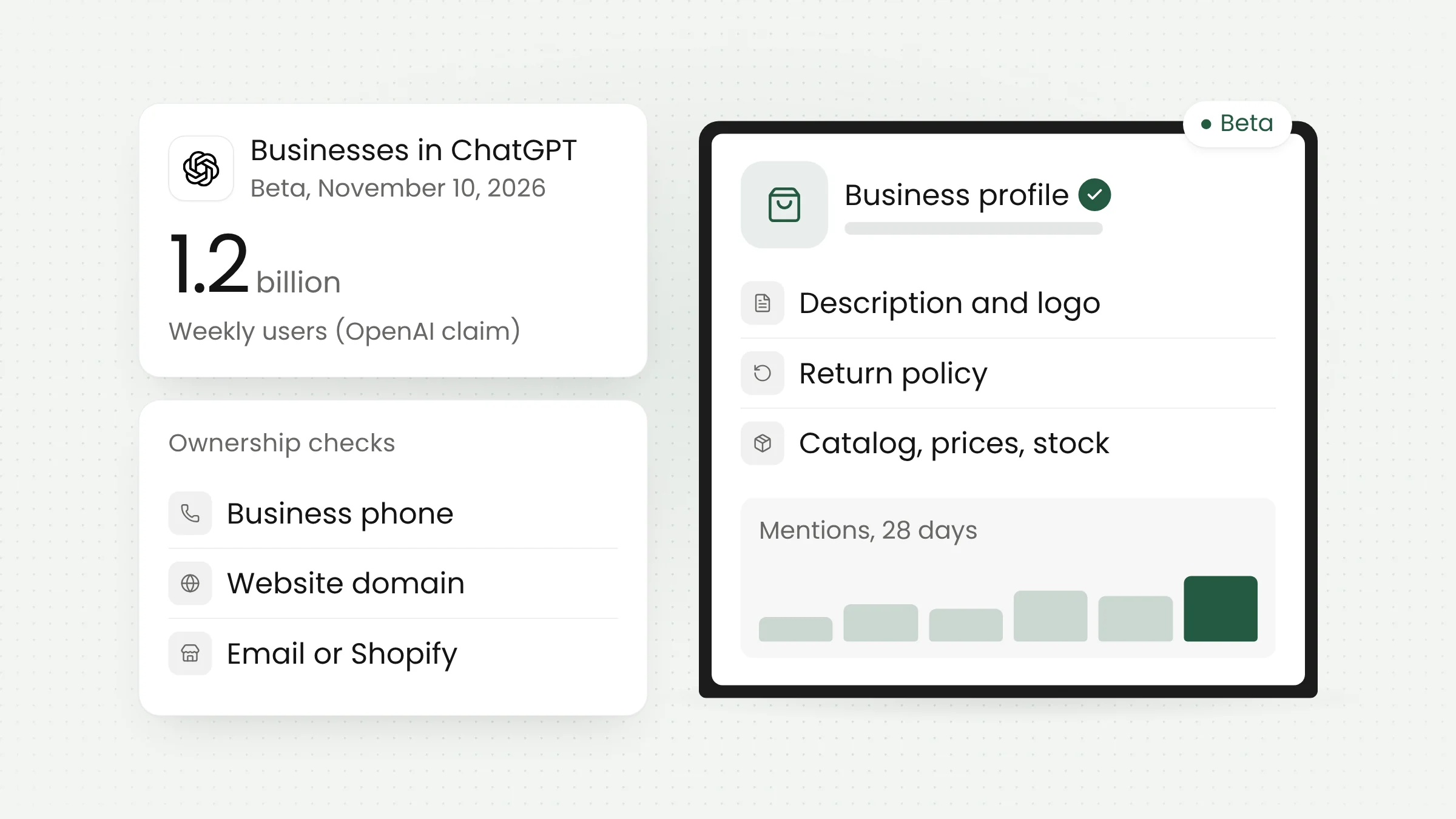
OpenAI launched Businesses in ChatGPT in beta on November 10, 2026. The program lets business owners claim their profile in ChatGPT, correct store details and product catalogs, and see how often the business comes up in answers. For online stores, ChatGPT now works like a storefront they can manage directly.
Until now, when people asked ChatGPT about a product or a shop, the answer was assembled from whatever information was available on the web. Owners had no official way to fix outdated details such as an old return policy or last season’s prices. According to Reuters, the program has two parts: Business Hub, where companies manage their profile, and Business Agents, which hold conversations with shoppers.
OpenAI says ChatGPT reaches 1.2 billion people a week, as cited by VentureBeat. The figure comes from the company and has not been independently verified. At that scale, sellers are starting to watch how they appear in AI answers in the same way they track search results.
How Business Hub works
Business Hub is a management page reached from inside ChatGPT. Applicants must own the business or be authorized to represent it. OpenAI does not require a ChatGPT Enterprise agreement or an ads account. Existing Enterprise customers and advertisers can claim through their OpenAI representative, and Shopify merchants can connect their stores from Business Hub or from the Shopify admin.
The process starts by signing in with a work account, opening Business Hub and searching for the business name. If the business is not listed, the applicant can type it in. VentureBeat lists four ways to prove ownership: a business phone number, a business email address, a website domain or a Shopify account. Search Engine Roundtable reports that phone checks use a text or call to the main business number, while domain checks rely on a DNS record.
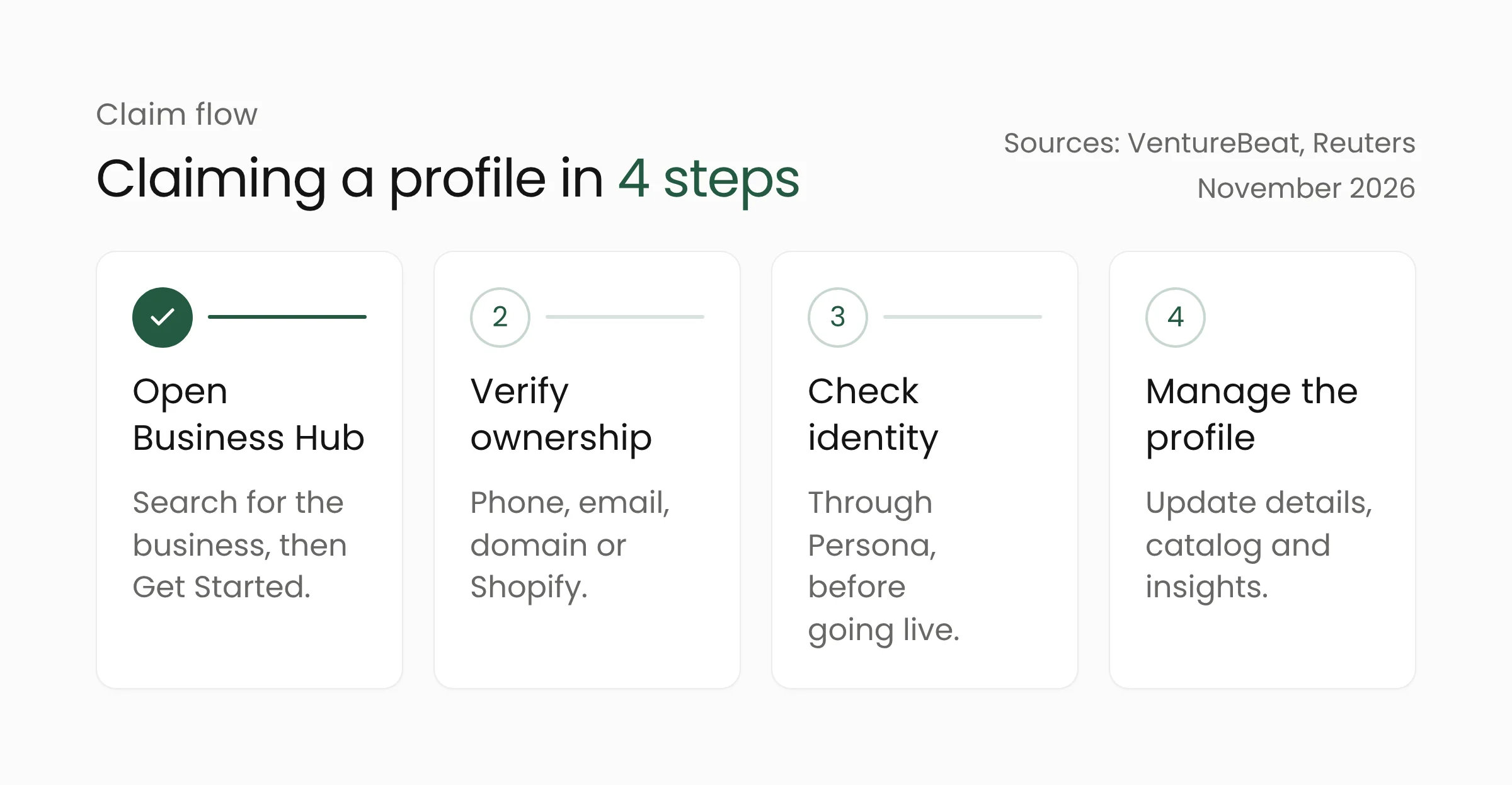
Once a claim is approved, the manager still has to pass an identity check through Persona, a third-party verification service. The check is required before publishing profile changes, connecting a catalog, viewing analytics or creating an agent. A blue check mark appears after the identity check is approved.
Owners can manage the business description, logo, delivery policy and return policy. They can also upload a product catalog with prices and stock levels, either directly or by syncing a Shopify store.
What owners get to see
Business Hub shows aggregated data for the past 28 days. It covers mentions, website clicks, profile views and the topics that come up in conversations involving the business. Numbers appear only after activity passes a minimum threshold, so smaller shops may see blank fields in the first weeks.
OpenAI also notes that a click is not the same as a visit. “Clicks don’t confirm website visits or conversions,” the company writes in its metric definitions, as quoted by Search Engine Roundtable. On privacy, OpenAI says it does not share users’ conversations or Business Agent chats with businesses.
Business Agents and the rules they follow
Business Agents are AI agents run by a business that ChatGPT users can talk to. When a business appears in an answer, users can open its profile and start a conversation with its agent. The agent answers questions about products and store policies using the data and instructions the owner provides. These chats are labeled and kept separate from ChatGPT’s own answers.
At launch, Business Agents are available only to eligible ecommerce and online service businesses in the United States. According to Digiday, as cited by VentureBeat, OpenAI is not charging to claim a profile or publish an agent at this stage. Benji Shomair, OpenAI’s vice president of monetization, did not rule out fees later.
The agents cannot complete purchases yet. The Next Web reports that buyers are sent to the brand’s own website for now, while OpenAI builds agent payments with Visa.
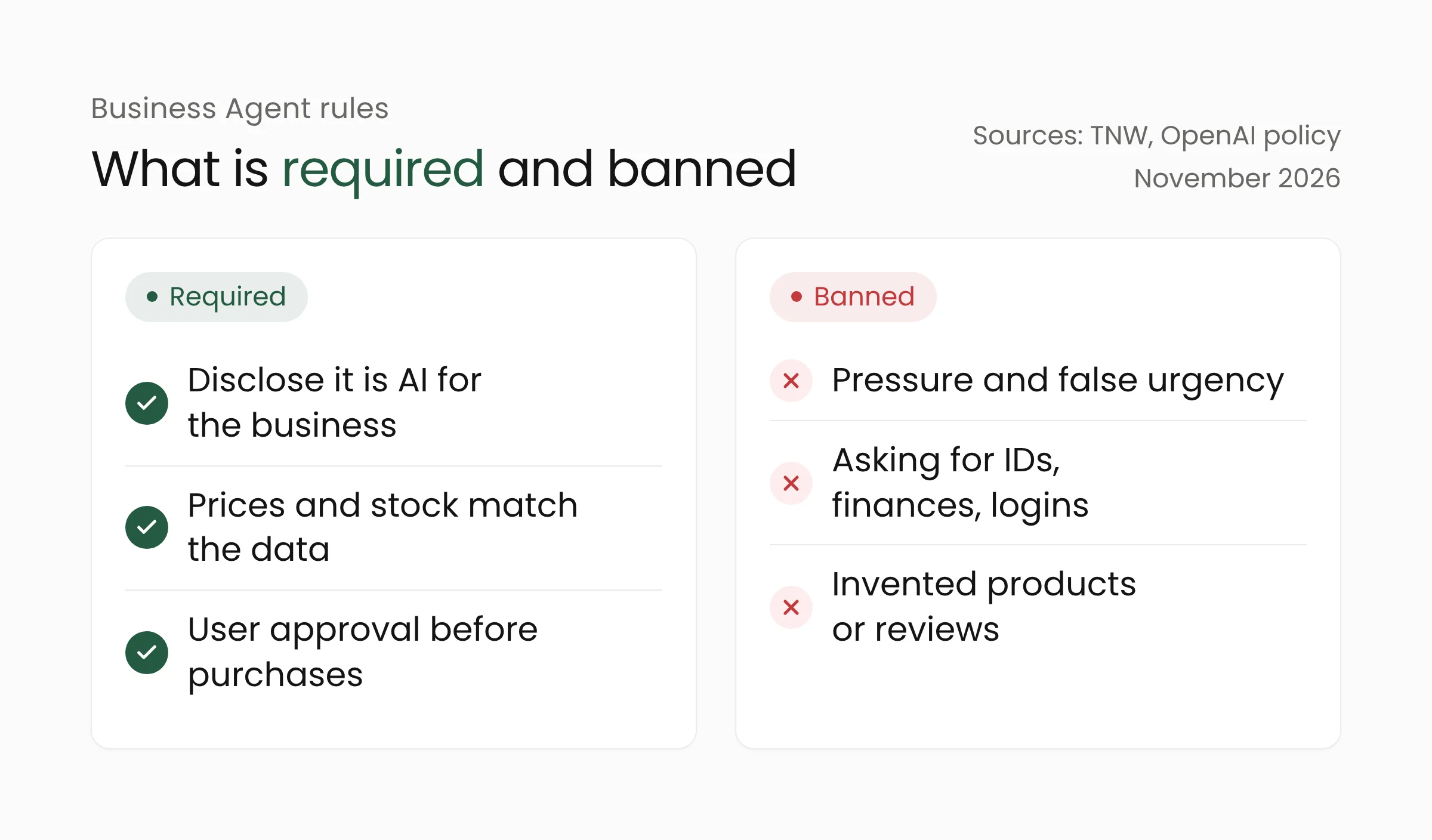
OpenAI has also set conduct rules. According to The Next Web, agents must disclose that they are AI, keep prices accurate and avoid pressure tactics. Purchases and sharing personal data require the user’s explicit approval. Developer Flavio Copes, in his review of OpenAI’s policy, adds that agents may not ask for health details, government IDs, financial information or login credentials. OpenAI reviews every agent when it is created and each time it is updated.
The link to ChatGPT ads
Businesses can make their Business Agent the destination of a ChatGPT ad. These paid placements carry a sponsored label. The format builds on Sponsored Agents, which OpenAI began testing in September. The Next Web notes that ChatGPT ads passed a $1 billion annual run rate in August and now count 100,000 advertisers.
OpenAI says claiming a profile does not guarantee higher placement or more sales, and that ChatGPT keeps making independent recommendations. According to Digiday, paying for ads does not change how often ChatGPT recommends a business either. The Next Web adds that the launch could squeeze startups such as Peec AI, which sell brands estimates of their visibility in ChatGPT.
Availability outside the United States
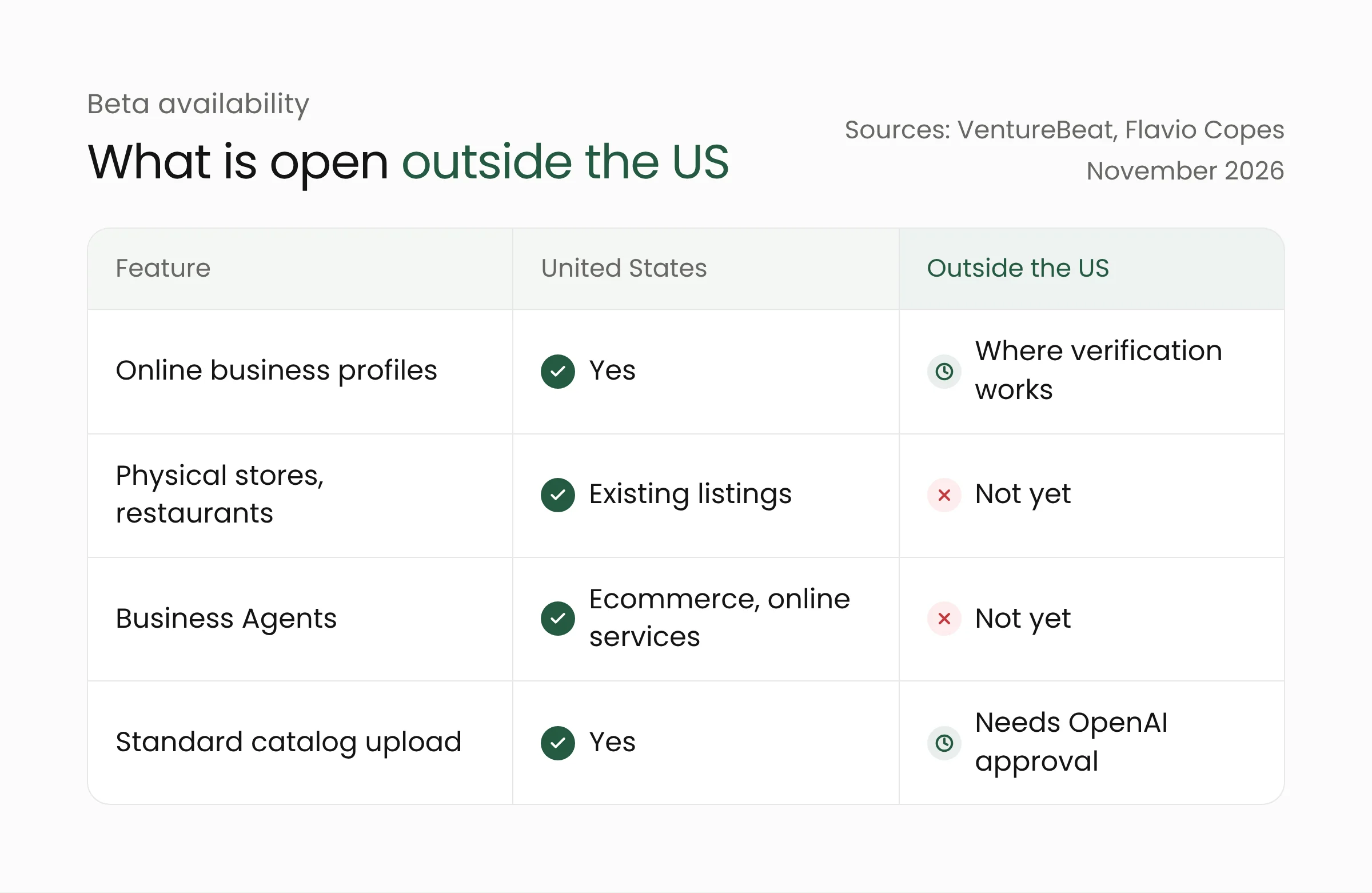
Profile claims are open in markets where ChatGPT is available, as long as OpenAI supports the verification method there. ChatGPT is available in Indonesia, but OpenAI has not published which verification methods work in each country. Owners who are interested will need to try the process in Business Hub.
Several parts remain limited to the United States. Physical stores and restaurants can claim only existing US listings, and Business Agents are US-only for now. Flavio Copes notes that the standard catalog upload targets the US market, while other markets need OpenAI to confirm the integration first. Service businesses such as consultants and freelancers do not have a dedicated path yet.
Companies with several brands face another limit. Each brand has to be claimed separately, and central management for a parent company is not available yet.
What this means for online stores in Indonesia
Business Agents have not reached Indonesia, but ChatGPT already reads information about local stores when it builds answers. Online sellers, small businesses and retail chains can take several steps now.
First, tidy up your own website. For online businesses, a mention counts when ChatGPT references the company’s website, so return policies, shipping costs and price lists need to be clear and current. Shops that rely entirely on marketplace pages may want an official site of their own, built through web application development.
Second, prepare proof of ownership. A domain you control and email addresses on that domain make verification easier. Search Engine Roundtable flagged concerns about false claims on other people’s businesses, and according to Flavio Copes, Business Hub includes an option to dispute ownership if that happens.
Third, structure the product catalog. Clean data on item codes, names, prices and stock status is useful across many channels at once, from marketplaces to point-of-sale systems and AI assistants. Connected inventory, such as a retail management solution, keeps prices and stock consistent everywhere.
Fourth, track traffic from ChatGPT. Flavio Copes notes that links from ChatGPT carry the utm_source=chatgpt.com parameter, so visits from ChatGPT can be separated in site analytics.
Fifth, set internal rules before using any AI agent. Decide who updates the data, what the agent may answer and which customer details it must never request. Visa’s test of AI shopping agents showed that agents still make frequent mistakes, so human review remains necessary.
Frequently asked questions
Does it cost anything to claim a business profile in ChatGPT?
At launch, OpenAI does not charge to claim a profile or publish a Business Agent. ChatGPT ads are a separate paid product. According to Digiday, OpenAI has not ruled out charging fees later.
Can stores in Indonesia use Business Agents yet?
No. At launch, Business Agents are limited to eligible ecommerce and online service businesses in the United States. Profile claims are open wherever ChatGPT is available, provided the verification method is supported.
Will a verified profile get a store recommended more often?
There is no guarantee. OpenAI says claiming a profile does not ensure higher placement or more sales. The main benefits are more accurate store information and data on how often the business is mentioned.
Conclusion
Businesses in ChatGPT marks OpenAI’s move to turn ChatGPT into a meeting point for buyers and sellers, complete with verified profiles, store agents and ads. For stores in Indonesia, the most useful preparation today is a well-kept website, a structured catalog and clear data rules. If your team wants a site and catalog that AI assistants can read accurately, the Merakit team is ready to talk it through.
Sources
- OpenAI lets businesses claim ChatGPT profiles, adds AI agents for US e-commerce firms, Reuters via Investing.com, November 10, 2026
- OpenAI lets you claim your business in ChatGPT and set up a custom agentic AI customer sales rep, VentureBeat, November 10, 2026
- OpenAI lets businesses claim ChatGPT profiles and launch their own agents, The Next Web, November 10, 2026
- Businesses in ChatGPT Business Hub Live With Click Data, Search Engine Roundtable, November 10, 2026
- A deep dive into Businesses in ChatGPT, Flavio Copes, accessed November 11, 2026