Blog OPPO Find X10
OPPO Find X10 Brings Manus Agent Mode to Daily Tasks
On this page· 7 sections
OPPO will launch its Find X10 series globally on October 21, 2026, in Mallorca, Spain. The phones debut Agent Mode, an AI assistant feature built with the AI agent platform Manus that can plan a trip or sort photos on the device. Pricing and markets have not been announced.
What OPPO announced
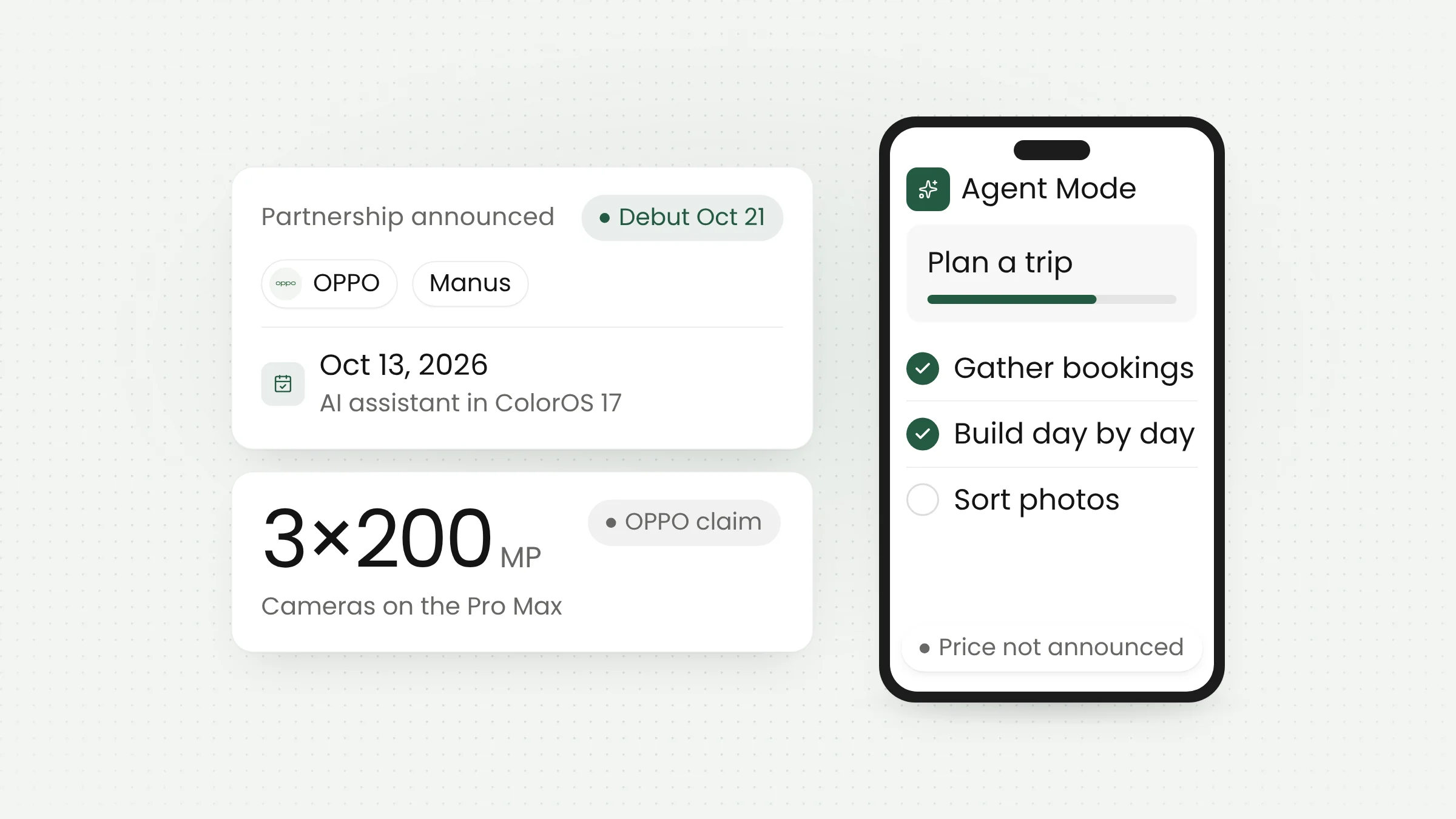
On October 13, 2026, in a press release on its newsroom, OPPO announced a collaboration with Manus to add agent capabilities to AI Mind Pilot, the assistant in its ColorOS 17 operating system. The new feature is called Agent Mode, and OPPO says the Find X10 Series is the first to carry it.
An AI agent differs from an ordinary chatbot. A chatbot answers questions, while an agent takes a goal, breaks it into steps, and carries them out until there is a result. Kai Tang, OPPO’s President of Software Engineering, put it this way in the release: “Agentic AI marks an important shift from answering questions to helping users get things done.”
OPPO gave two concrete examples. First, Agent Mode can gather flight, hotel, restaurant, and attraction bookings scattered across several apps and assemble a day-by-day itinerary. Second, it can organize trip photos, find specific images, and combine files with information from the internet into a presentation, proposal, or portfolio.
How Agent Mode works, and what OPPO says about privacy
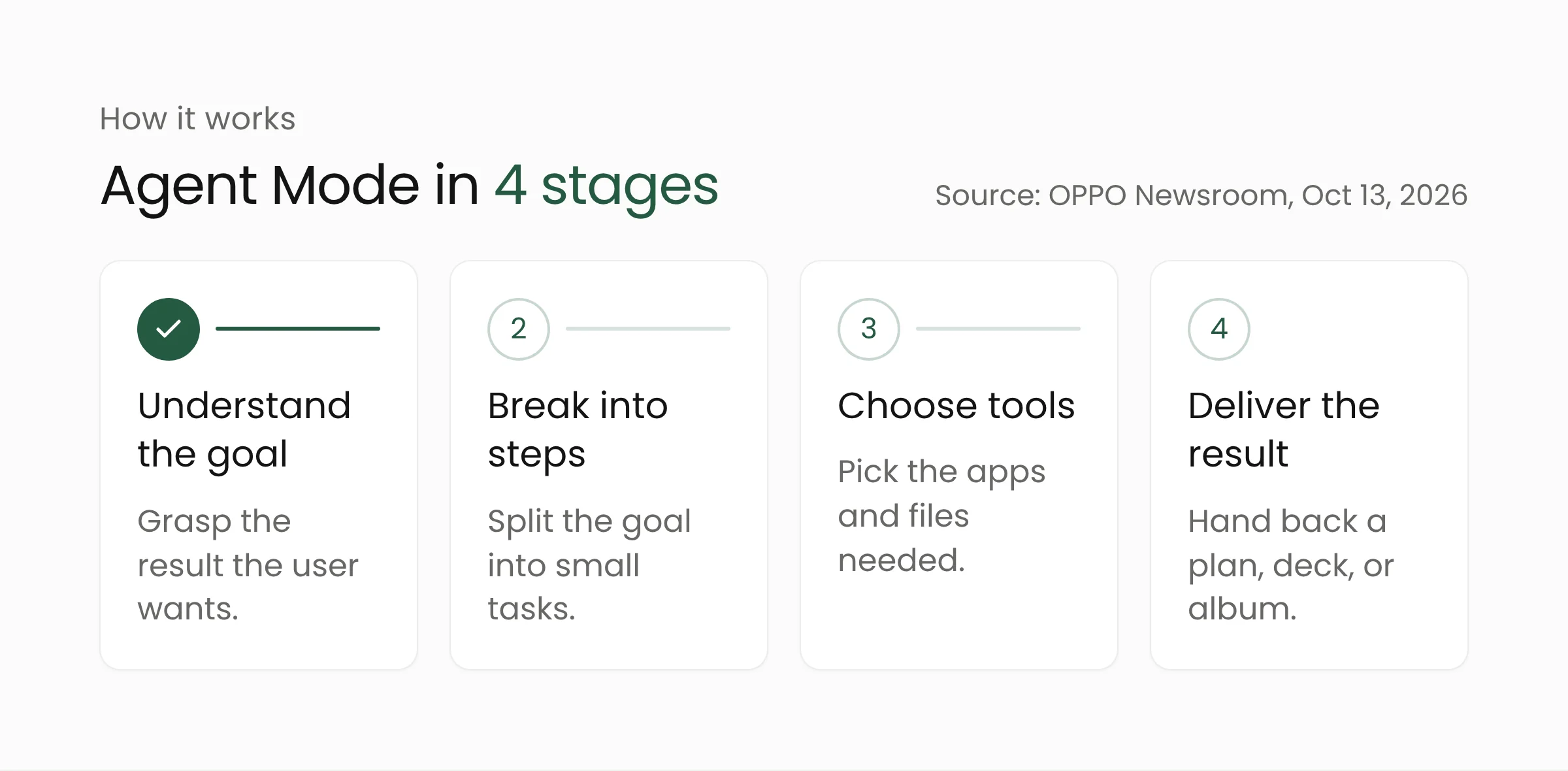
According to OPPO, Agent Mode works in four stages: it understands the user’s end goal, splits it into steps, selects the tools it needs, and hands back a finished result. Its working material includes files and photos stored on the device.
Because an agent touches personal files, privacy is the main point of scrutiny. OPPO states that ColorOS 17 uses on-device AI models to understand and organize information locally. For local tasks such as finding, sorting, or renaming files and photos, the original content stays on the phone and is not shared with Manus.
When a task needs processing outside the device, AI Mind Pilot asks for explicit confirmation before uploading or sharing anything. Users can also control what information is accessed, which actions are taken, and whether external processing is allowed. These are OPPO’s claims. We have found no independent testing on real phones, so accuracy and adherence to those settings can only be judged once devices ship.
A Gizchina review calls the privacy design sensible but notes that it depends on users reading each confirmation prompt carefully. Real-world tasks also tend to be messier than demonstration examples.
The 200 MP cameras and specifications released so far
Beyond the AI agent, OPPO has disclosed part of the hardware in a press release dated October 8, 2026. The Find X10 has two 200 MP cameras co-developed with Hasselblad. The Find X10 Pro Max has three 200 MP cameras covering the ultra-wide, main, and telephoto lenses, which OPPO says is an industry first. No third party has verified that claim.
Both models use the LUMO True Image Engine for image processing. The Pro Max’s rear cameras support 4K video at 120 fps and 8K at 30 fps, and both models offer Open Gate Capture, which records the sensor’s full imaging area so footage can be reframed during editing.
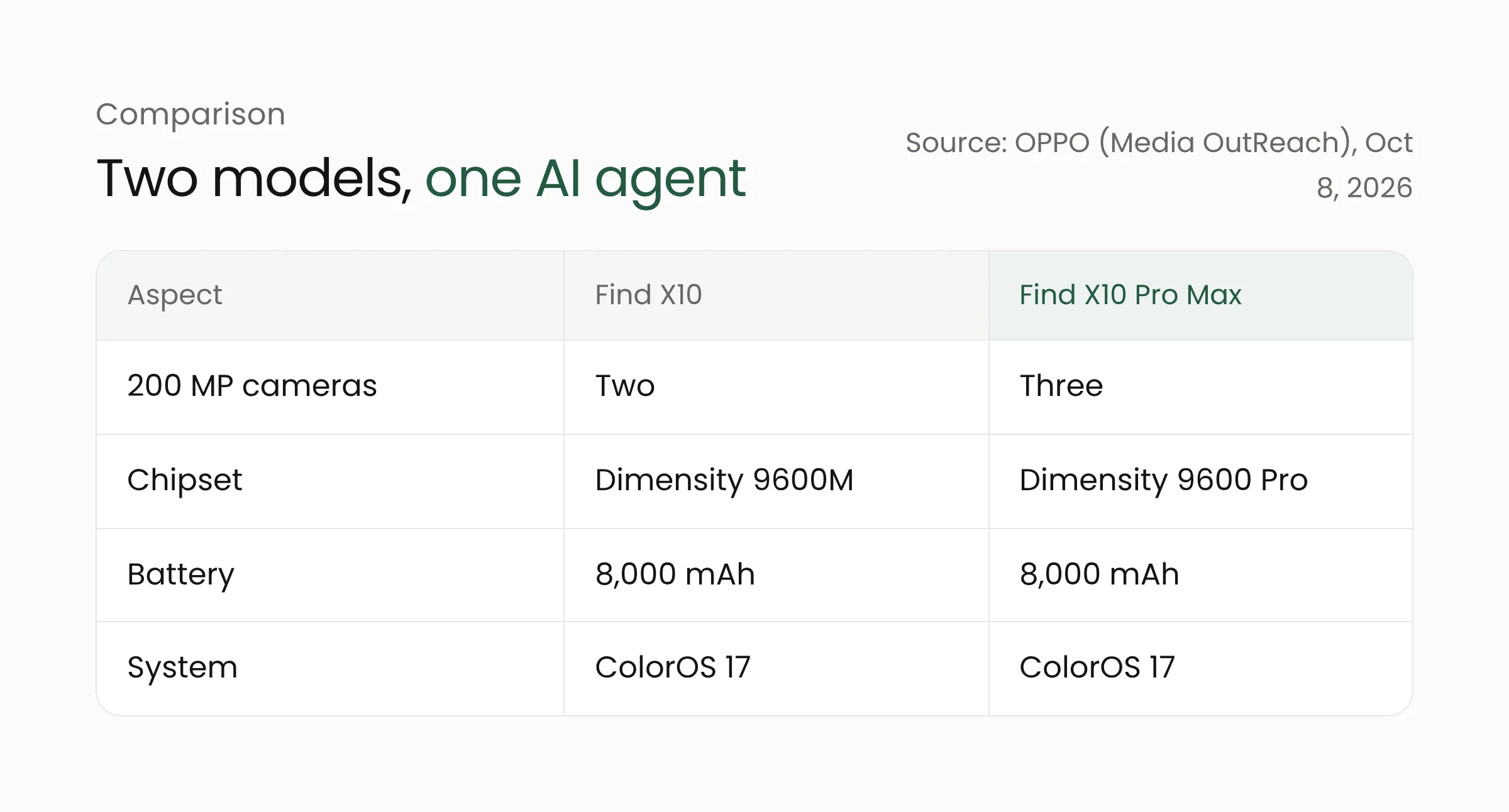
On the processing side, the Find X10 uses the MediaTek Dimensity 9600M, while the Pro Max uses the Dimensity 9600 Pro, which OPPO says is built on a 2 nm process. The 8,000 mAh silicon-carbon battery is rated for up to two days of typical use and for keeping more than 80 percent of its capacity after five years, based on OPPO’s own lab data. OPPO also notes that capacity may be 7,150 mAh in some markets.
What remains unannounced matters just as much. OPPO says full specifications, pricing, and availability will be revealed at the launch event. Which markets get Agent Mode, whether older OPPO phones will receive it, and whether it carries a fee are all undisclosed. One Chinese outlet speculated that the Manus feature may be limited to overseas markets, but that is a guess that OPPO has not confirmed.
What this means for businesses and app teams
For everyday users, the main value is work that crosses apps: one instruction can pull data from email, ticketing apps, and the photo gallery. For businesses, some customers may soon ask an assistant to check an order, a schedule, or a service status without opening your app themselves.
Interested users should wait for independent reviews before handing important files to an agent. Start with low-risk tasks, such as sorting photos, and read each confirmation prompt before allowing processing outside the device. An agent-built result, such as an itinerary, still needs to be checked against the original bookings.
Businesses and app teams can start on these steps now, whatever the phone brand:
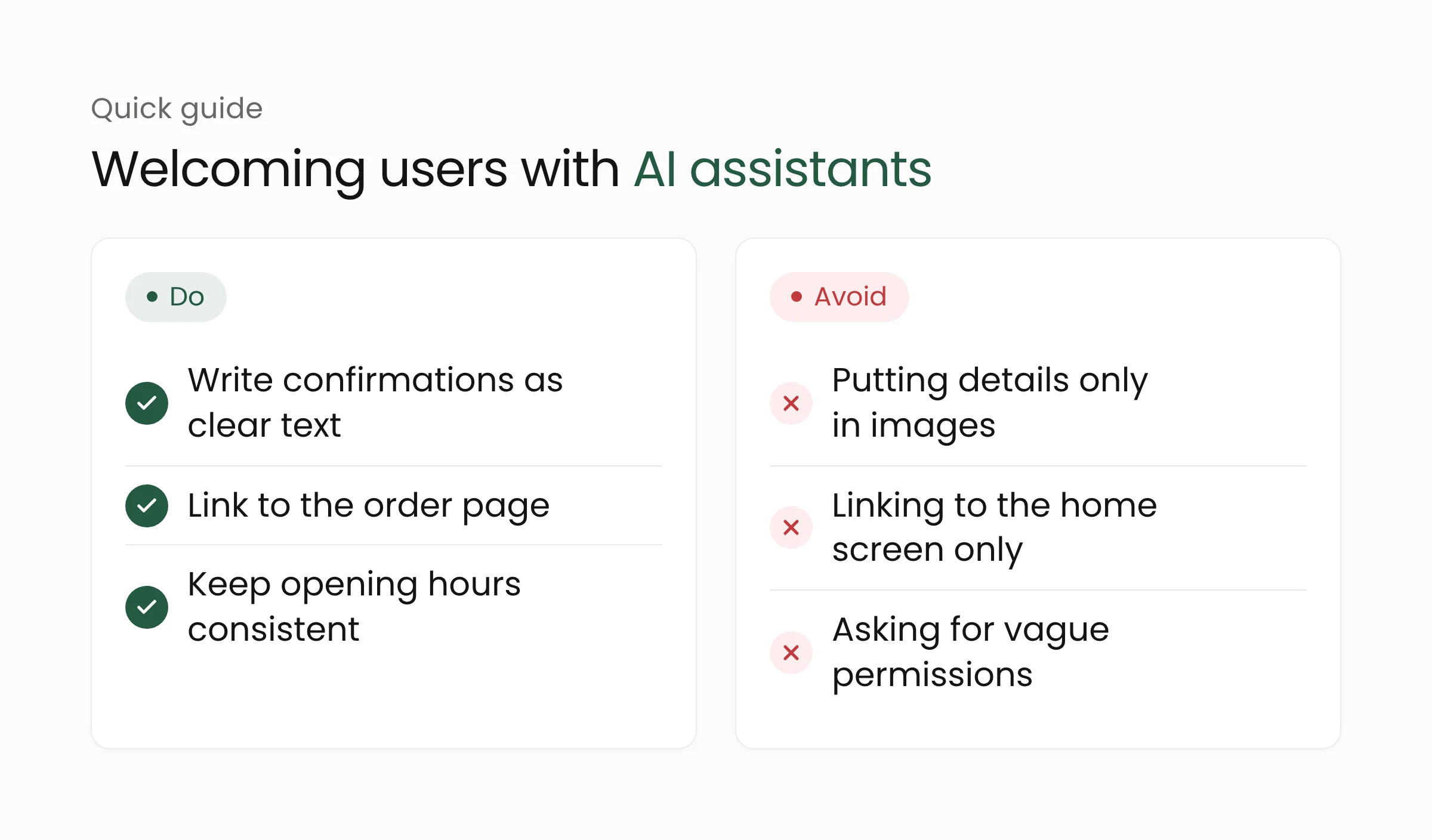
- Make sure order, ticket, and reservation confirmations state the date, time, location, and order number clearly as text. An agent reads written information more easily than details embedded in a poster image.
- Make sure links in emails and messages open the right page, such as the order detail, and do not stop at the app’s home screen.
- Keep basic business information, such as opening hours, address, and cancellation policy, in one consistent place across your website, maps listing, and messaging apps.
- Test your app on a phone with an agent assistant once devices are available, especially flows that need user permission.
- Review the permissions your app requests. When an assistant acts on a user’s behalf, vague permission requests are easier to question.
The direction matches the Personal Agent Protocol from Meta and Sierra, an open standard that opens the way for personal AI agents to enter business services. Devices keep changing shape as well, as with the iPhone Duo, Apple’s foldable phone that demands readiness from mobile app teams. For phone retailers, prices still need watching because global smartphone shipments fell 22 percent amid the memory crisis.
Merakit’s mobile development and artificial intelligence teams can help assess how ready your apps and services are for users assisted by AI agents.
Frequently asked questions
What is Agent Mode on the OPPO Find X10?
Agent Mode is a feature of AI Mind Pilot, the assistant in ColorOS 17, developed with Manus. It takes a goal from the user, breaks it into steps, selects tools, and hands back a result, such as a trip itinerary or a presentation.
Will the OPPO Find X10 be sold in Indonesia?
Not yet announced. OPPO says availability, supported markets, and pricing will be revealed at the global launch on October 21, 2026, in Mallorca, Spain. Watch official OPPO Indonesia announcements for confirmation.
Are my photos and files sent to Manus?
According to OPPO, for local tasks such as finding, sorting, or renaming files and photos, the original content stays on the phone and is not shared with Manus. If a task needs external processing, the assistant asks for explicit confirmation first. This is OPPO’s claim and has not been tested independently.
Conclusion
Agent Mode on the OPPO Find X10 points to a new direction for phone assistants, from answering questions to finishing work across apps. The privacy and accuracy claims will only be proven once the device is tested in the field. If your organization wants its apps and services ready for users assisted by AI agents, please contact us to talk it through.
Sources
- OPPO Newsroom, “OPPO Partners with Manus to Bring Agentic AI Experiences to Smartphones” (October 13, 2026)
- Media OutReach Newswire via The Manila Times, “OPPO Find X10 Series to Launch Globally on October 21 with Next-Generation True-to-Life Imaging” (October 8, 2026)
- Gizchina, “OPPO and Manus Announced a New AI Agent for The Find X10 Series” (October 14, 2026)
- Gadget Pilipinas, “OPPO AI Mind Pilot Adds Agent Mode via Manus” (October 13, 2026)