Blog Cybersecurity
Check Point Flaw CVE-2026-123039: Install the Jumbo Hotfix
On this page· 7 sections
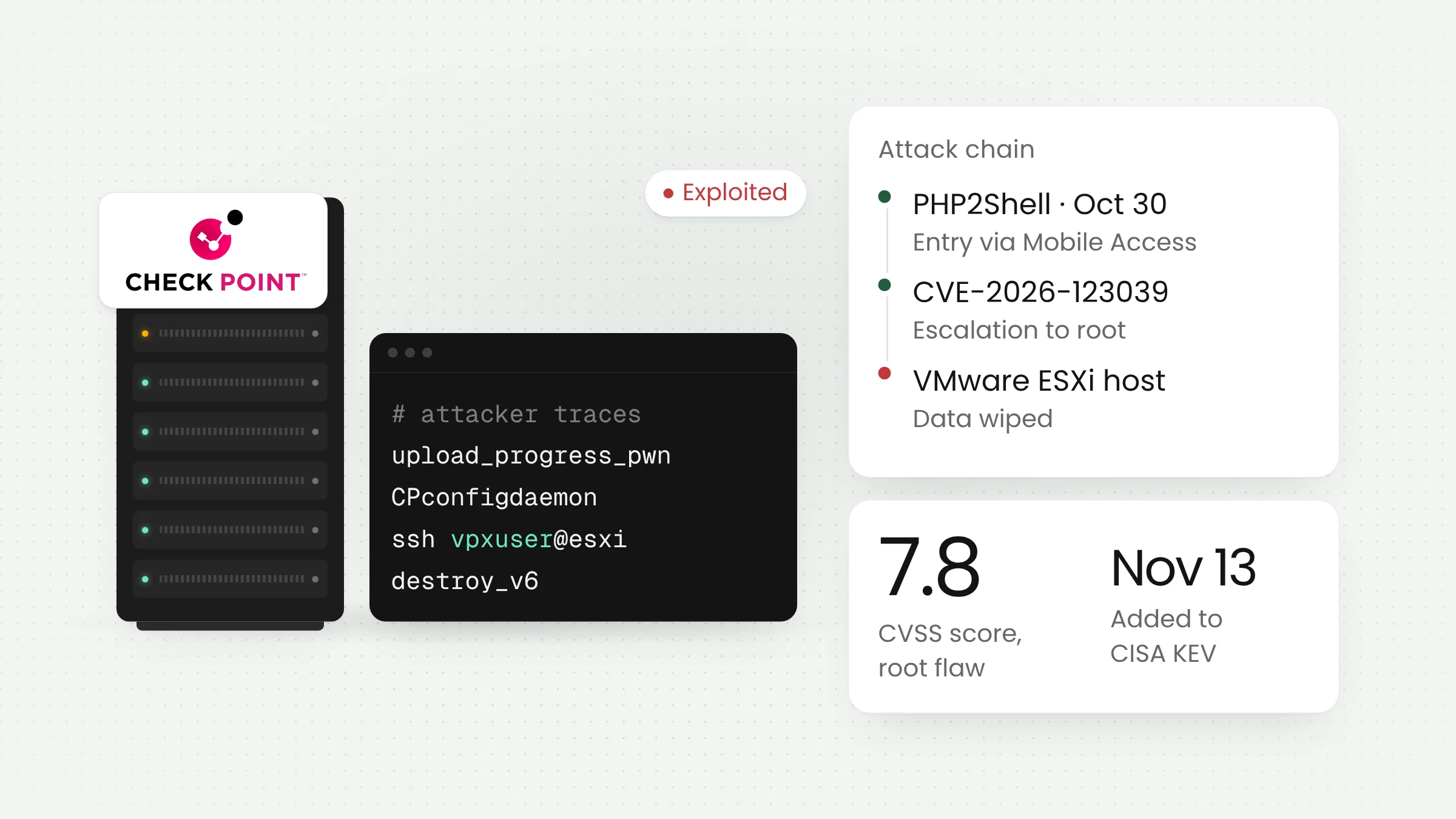
Attackers are exploiting the Check Point flaw CVE-2026-123039 to gain root on Check Point security gateways. They break in through the Mobile Access portal using the PHP2Shell bugs, then use CVE-2026-123039 to take over the device. CISA added the flaw to its exploited vulnerabilities catalog on November 13, 2026, and Check Point has shipped a November Jumbo Hotfix.
The attack chain, from the Mobile Access portal to root
Check Point firewalls and security gateways guard the network edge at many companies, banks and government agencies. One of their features, Mobile Access, offers a web portal that lets employees reach the office network from outside. Because that portal faces the internet, it was the first target in this campaign.
According to a Check Point Research report published on November 12, 2026, the attackers got in through PHP2Shell, a pair of PHP vulnerabilities tracked as CVE-2026-109618 and CVE-2026-109619. The Mobile Access portal runs on PHP, so gateways that had not been updated were exposed. CSO Online reports that both flaws are rated 9.2 and allow code execution without an account.
PHP2Shell only gave the attackers the limited rights of the portal’s service account. To take full control, they used a second bug, CVE-2026-123039. It sits in DynamicCLI, a background service in Gaia OS, the operating system on Check Point gateways, that accepts administrative commands from other processes.
BleepingComputer cites Check Point’s advisory on the root cause. The dynamic_server daemon runs as root and listens on a local socket that any user can write to, and it does not check who is sending commands. Anyone who can already run code on the appliance can therefore have the daemon execute commands as root.
Check Point rates CVE-2026-123039 at 7.8 on the CVSS scale, which is high severity and just below critical. The score is lower than PHP2Shell’s because an attacker must already be on the device. In this campaign PHP2Shell met that condition, so the two bugs together opened a path from the internet to root. Check Point says the flaw was exploited against roughly two dozen customers starting in late October.
What the attackers did once inside
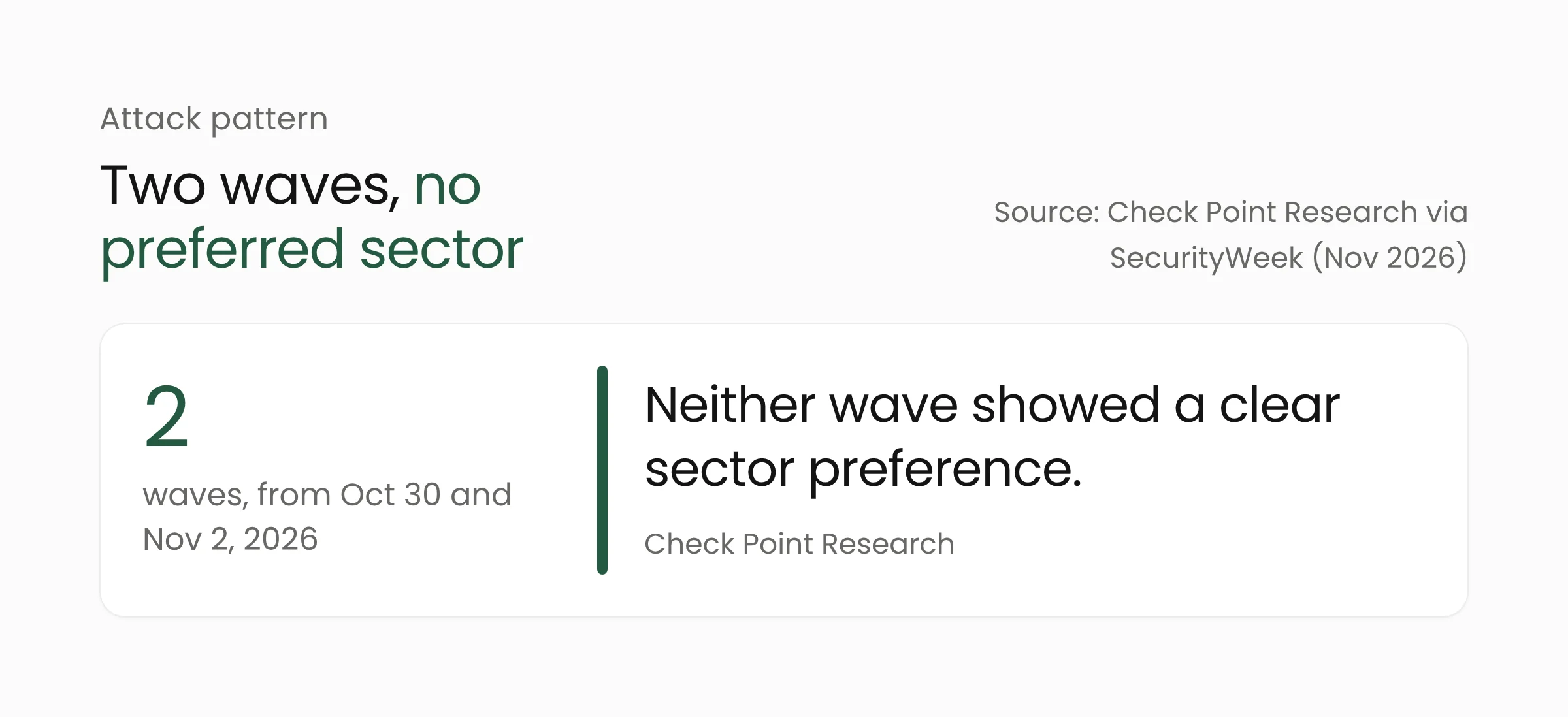
Check Point Research describes two waves. The first began on October 30, 2026, hit organizations in Israel and in some cases ended in data destruction. The second started on November 2, 2026, and was broader, reaching organizations in multiple countries and sectors with no destructive activity observed. The first wave came roughly a week after a fix for PHP2Shell became available.
With root access, the attackers planted webshells, small scripts that allow remote control of a server, in the template folder the portal uses to build its login pages. They also installed a backdoor called TSGA with a component called TSProxy. According to Check Point Research, these tools can steal configuration, persist in backups and snapshots, and tamper with firewall logs.
From the gateway, the attackers scanned the internal network with a tool called gogo and then moved over SSH to a VMware ESXi host using the vpxuser service account. ESXi is the platform that runs many virtual machines on one server. There they launched a wiper called destroy_v6, which overwrites files with zeros and then deletes them. They also left a note rejecting any ransom negotiation.
On attribution, Check Point Research offers only a low-confidence assessment. The backdoor resembles components previously linked to a China-nexus group, but the destructive activity and the targeting pattern do not match that group’s known behavior. For network teams in Indonesia and elsewhere, the more useful detail is the nature of the second wave. As SecurityWeek quotes the researchers, “Neither wave showed a clear sector preference.” In other words, a vulnerable gateway can be hit regardless of where it sits.
Affected products and fixed versions
BleepingComputer lists Firewall, Security Gateway, Security Management Server, Multi-Domain Security Management Server and Scalable Platforms as affected by CVE-2026-123039. The Hacker News names the affected releases as R82.20, R82.10, R82, R81.20, R81.10 and R81, including Management and Log Servers and the Maestro Orchestrator.
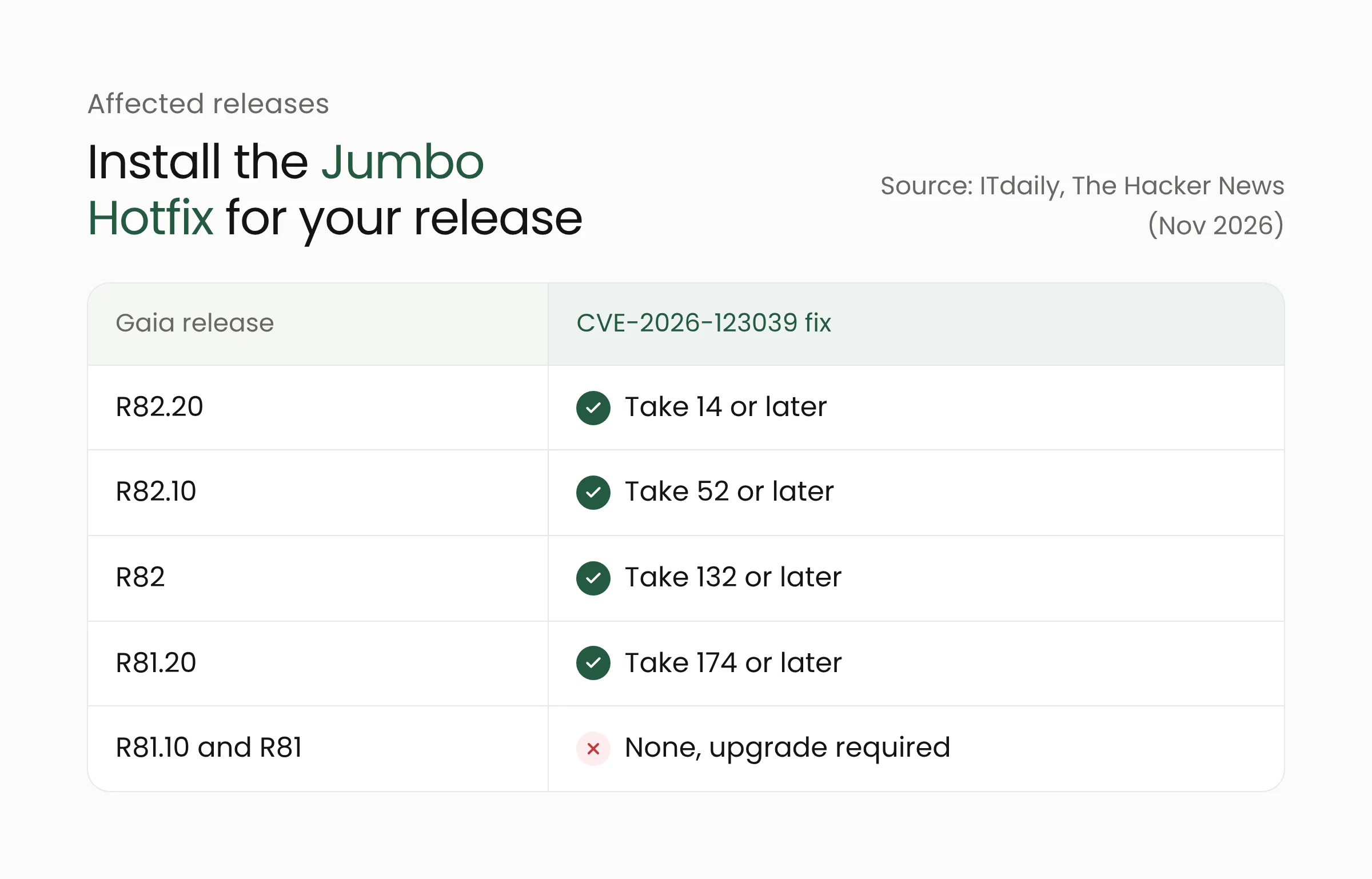
The fix ships in the Jumbo Hotfix Accumulator, Check Point’s cumulative update package. According to ITdaily, it is included from R82.20 Take 14, R82.10 Take 52, R82 Take 132 and R81.20 Take 174. R81.10 and R81 are out of support and get no fix, so the only remedy there is an upgrade to a supported release. Spark Firewalls and Smart-1 Cloud are listed as not affected.
A second BleepingComputer report on the campaign says the November Jumbo Hotfix addresses both PHP2Shell and the DynamicCLI flaw. The official list of products, releases and mitigation steps is in Check Point advisory sk1000362, which administrators should read directly.
What this means for network and security teams
The flaw matters most to organizations running Check Point gateways with the Mobile Access portal exposed to the internet. Users such as banks, finance companies, hospitals, universities and government agencies often hand the management of these devices to an integrator or managed service provider. In that case, the patch status needs to be confirmed rather than assumed.
Install the November Jumbo Hotfix, starting with exposed gateways
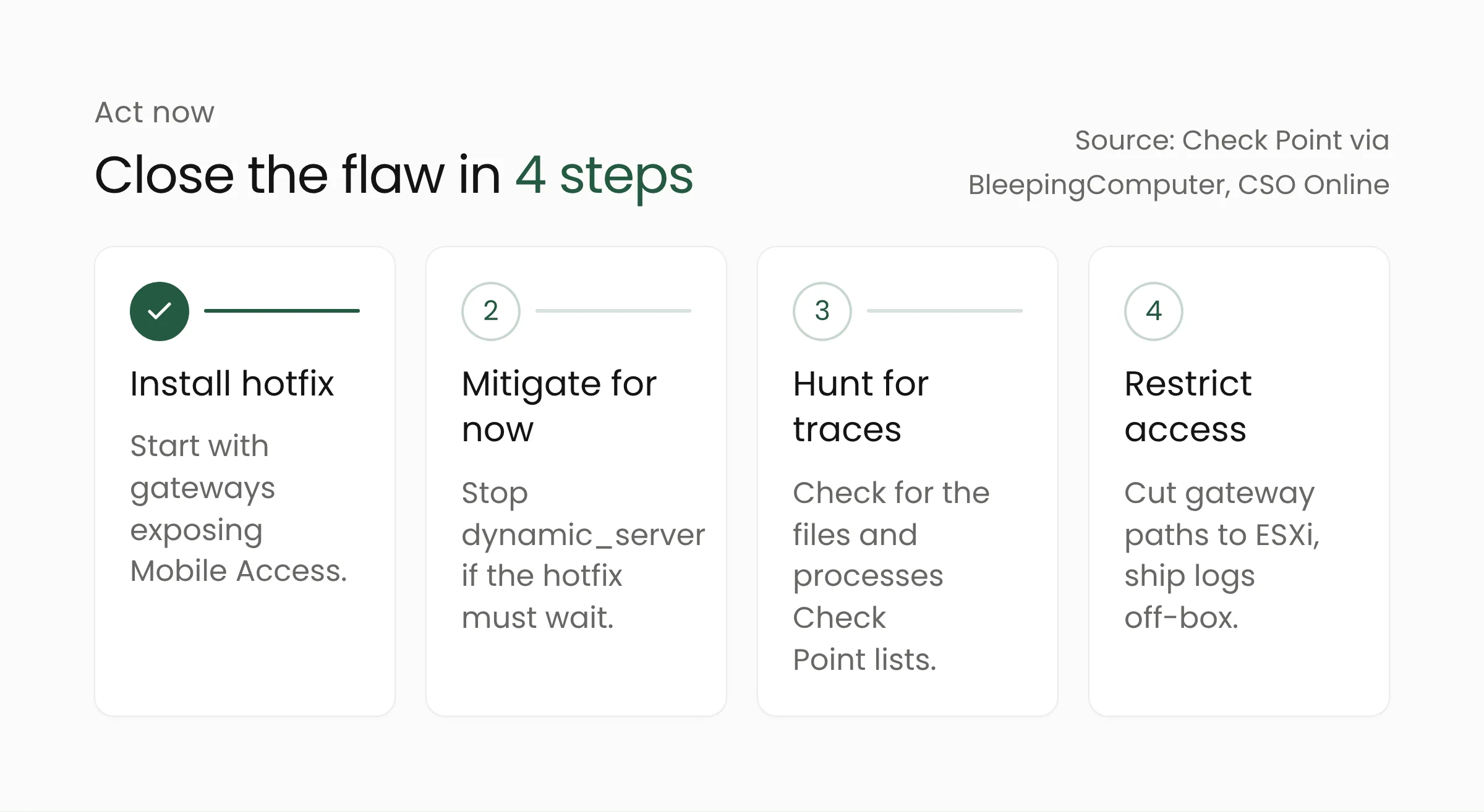
Check Point asks customers to install the November Jumbo Hotfix on all Security Gateways and Management Servers, beginning with gateways whose Mobile Access portal is reachable from the internet. Compare the installed Take number with the list above. Devices still on R81.10 or R81 need an upgrade plan, because neither release will be fixed.
Stop dynamic_server if the update has to wait
If the hotfix cannot go on right away, Check Point recommends stopping the dynamic_server process and preventing it from restarting. Some Dynamic CLI commands will stop working until the service is turned back on. CSO Online also advises disabling Mobile Access on gateways that do not need it.
Hunt for signs of compromise on exposed gateways
Patching does not remove an attacker who is already inside. According to BleepingComputer, Check Point asks administrators to look for session files containing upload_progress_pwn, unknown CPconfigdaemon processes or binaries, and unexplained gaps in firewall logs. SSH connections from a gateway to internal ESXi hosts are a clear sign of a breach. ITdaily adds that Check Point recommends reviewing the Dynamic CLI log, especially commands that create users or download files.
Narrow the paths from the gateway to core systems
CSO Online summarizes several hardening steps. Keep management interfaces off the internet, remove any trusted path from gateways to ESXi, and forward firewall logs in real time to a separate system the gateway cannot reach. Devices confirmed as compromised should be rebuilt from trusted images, since patching alone does not evict an attacker who is already inside.
In financial services, a compromised firewall puts an attacker between the internet and transaction systems, so these checks belong on the incident track rather than in the routine maintenance window. Teams working on financial services solutions can use this moment to review who holds access to network devices. The campaign also repeats a lesson from our overview of PHP2Shell and the safe PHP versions: PHP also runs inside security appliances, well beyond ordinary web servers. Government agencies can also refer to our guide on responding to Komdigi’s cyber alert, published in early November.
Frequently asked questions
Do gateways without Mobile Access still need the update?
Yes. In this campaign, PHP2Shell in the Mobile Access portal provided the initial foothold. CVE-2026-123039, however, lives in Gaia OS and affects Security Gateways as well as Management Servers. Anyone who gains a foothold on the device by another route could use it, which is why Check Point asks for the Jumbo Hotfix on every gateway and management server.
How can we tell whether our device has been compromised?
Start with the indicators Check Point published: session files containing upload_progress_pwn, unknown CPconfigdaemon processes, firewall logs with unexplained gaps, and SSH connections from the gateway to ESXi. Check Point Research also released attacker IP addresses and file hashes. If anything matches, treat it as an incident and bring in your incident response team.
We run R81.10. What should we do?
R81.10 and R81 are out of support and will not receive a fix for CVE-2026-123039. While you prepare an upgrade to R81.20 or R82.x, apply the temporary mitigation by stopping dynamic_server, restrict or disable the Mobile Access portal, and watch for indicators of compromise more closely.
Closing thoughts
The attacks on Check Point gateways show that security appliances need the same care as any other server: timely updates, monitored logs and limited paths to core systems. The Jumbo Hotfix is available, so the bigger task now is taking inventory of devices and checking them for traces of the attack. If your organization needs support with network device audits and incident handling, Merakit’s cybersecurity services team is ready to help.
Sources
- Check Point Research: PHP2Shell Exploitation on Check Point Gateway, November 12, 2026
- CISA: CISA Adds Two Known Exploited Vulnerabilities to Catalog, November 13, 2026
- BleepingComputer: Check Point warns of zero-day flaw exploited for root access, November 13, 2026
- BleepingComputer: Check Point gateways hacked via PHP2Shell to deploy VMware ESXi wiper, November 13, 2026
- The Hacker News: Hackers Exploit PHP2Shell Flaws in Check Point Gateways, November 13, 2026
- SecurityWeek: PHP2Shell Exploited in Destructive Check Point Gateway Attacks, November 13, 2026
- CSO Online: The firewall becomes the foothold, November 13, 2026
- ITdaily: Check Point patches exploited flaw in firewalls and management servers, November 13, 2026