Blog Cybersecurity
SAP ICM2SHELL Flaw (CVSS 10): Kernel Fixes and Workarounds
On this page· 7 sections
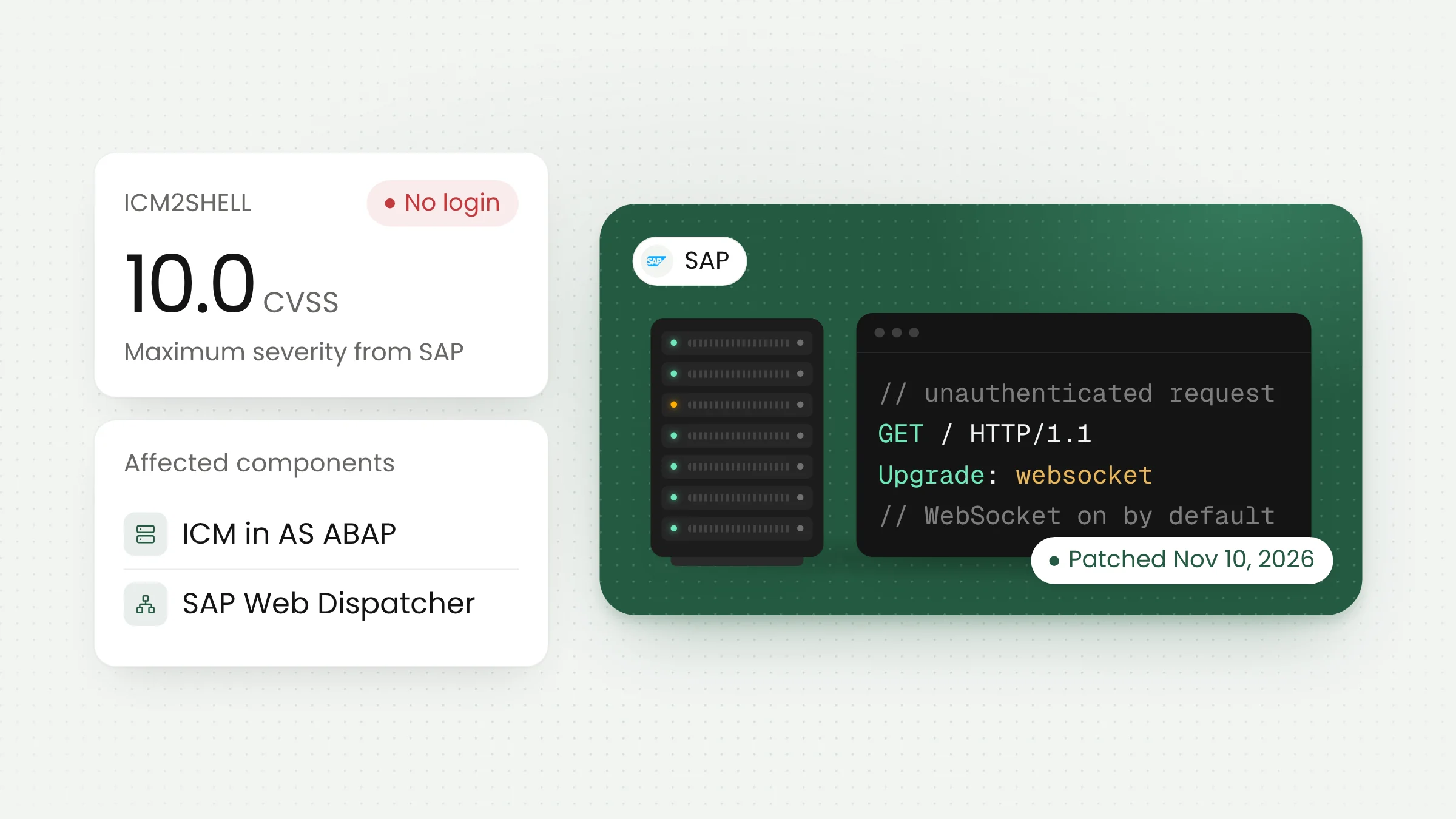
The SAP ICM2SHELL flaw lets an attacker run commands on an SAP server with no account and no user interaction. SAP fixed it on its November 10, 2026 Security Patch Day and rated it CVSS 10.0, the maximum score. The bug sits in the Internet Communication Manager (ICM) and SAP Web Dispatcher, the two components that receive web traffic for SAP systems.
A memory bug in the SAP kernel’s WebSocket handling
For many large manufacturers, distributors, and retailers, SAP is where orders, warehouse stock, production, and finance are recorded. BleepingComputer reports that SAP serves 99 of the world’s 100 largest companies and that Web Dispatcher is deployed in almost every enterprise SAP environment. Web Dispatcher is a load balancer and reverse proxy that forwards requests from browsers and apps to the SAP servers behind it.
Onapsis Research Labs found ICM2SHELL and reported it to SAP through coordinated disclosure. The name covers two CVEs. CVE-2026-76964 affects the ICM in SAP NetWeaver Application Server ABAP and is fixed by SAP Note 3778530. CVE-2026-89126 affects SAP Web Dispatcher and is fixed by SAP Note 3778556. SAP also published Note 3778788 with technical FAQs.
According to the Onapsis advisory, the problem lies in how the SAP kernel reassembles WebSocket messages that arrive in fragments. WebSocket is a protocol for two-way connections that stay open, commonly used to refresh application screens in real time. A memory-handling error during that reassembly can be triggered with crafted traffic. ICM and Web Dispatcher share the same code, so both are affected.
The impact is twofold. An attacker can execute operating system commands as the <sid>adm account, the administrative account that controls the entire SAP system. A single connection can also crash the ICM or Web Dispatcher process, a condition Onapsis reproduced on every kernel release it tested. The Hacker News notes that a crashed Web Dispatcher cuts off every SAP system behind it while it restarts.
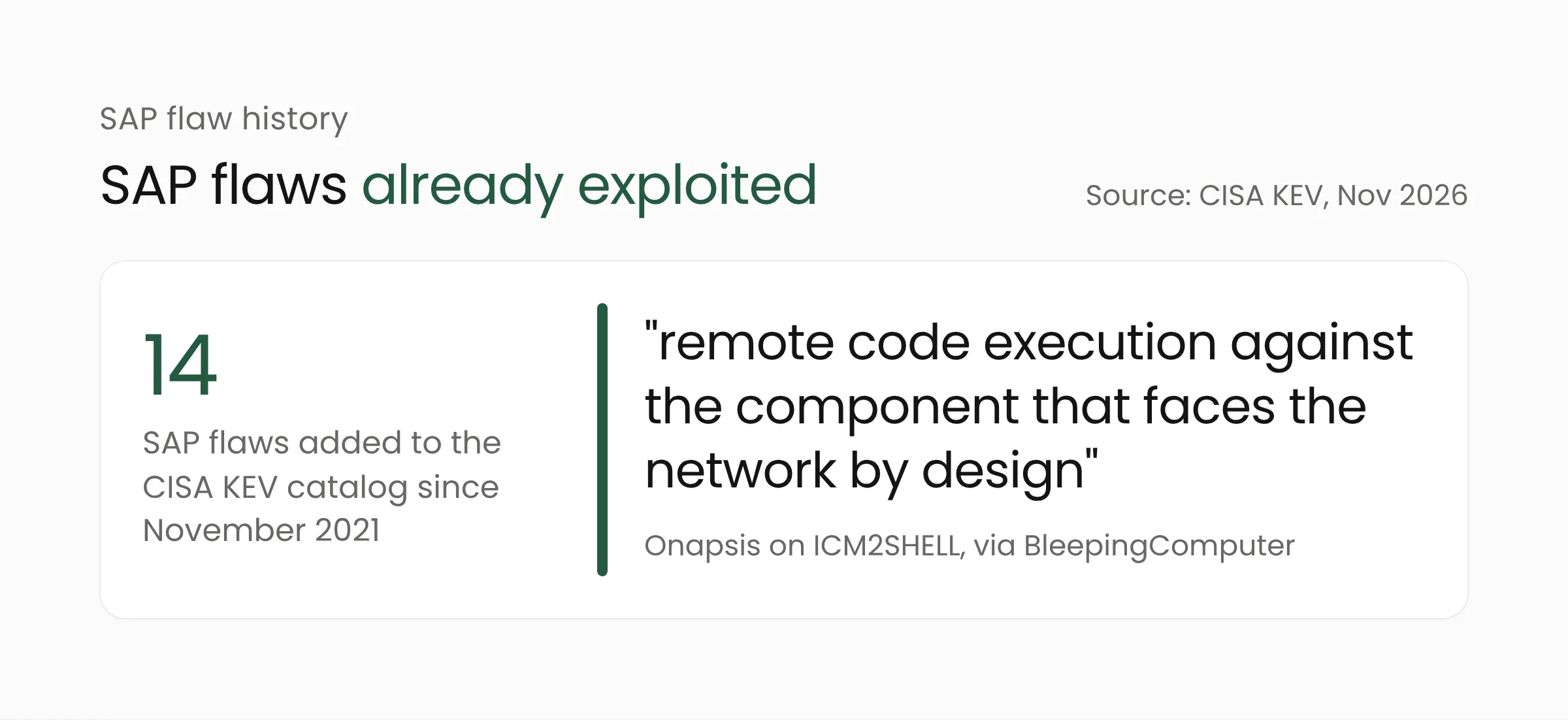
Onapsis, as quoted by BleepingComputer, said the flaw gives “remote code execution against the component that faces the network by design”. WebSocket support is enabled by default in both ICM and Web Dispatcher, so a system is exposed even if no application uses WebSocket.
Exploitation status
Onapsis handed SAP a fully working exploit but deliberately withheld the technical details from its write-up. At publication, Onapsis had not observed the flaw being exploited in the wild. Field Effect said no exploitation had been reported as of November 11, 2026. When we checked CISA’s Known Exploited Vulnerabilities (KEV) catalog on November 15, 2026, neither ICM2SHELL CVE was listed.
SAP’s track record argues against waiting. The KEV catalog has listed 14 SAP flaws since November 2021, three of them marked as used in ransomware campaigns. BleepingComputer and Field Effect both report that the SAP Commerce Cloud flaw CVE-2026-58231, patched in August 2026, was exploited within days of its fix.
Affected systems and fixed versions
Onapsis says exposure depends on the kernel, not on the application release. Affected systems are SAP NetWeaver AS ABAP on kernel 7.40 or later and every Web Dispatcher, including the one embedded in SAP HANA XS. Systems running only NetWeaver AS Java are not affected, while dual-stack systems are exposed through their ABAP stack. Kernel 7.22 is also not affected.
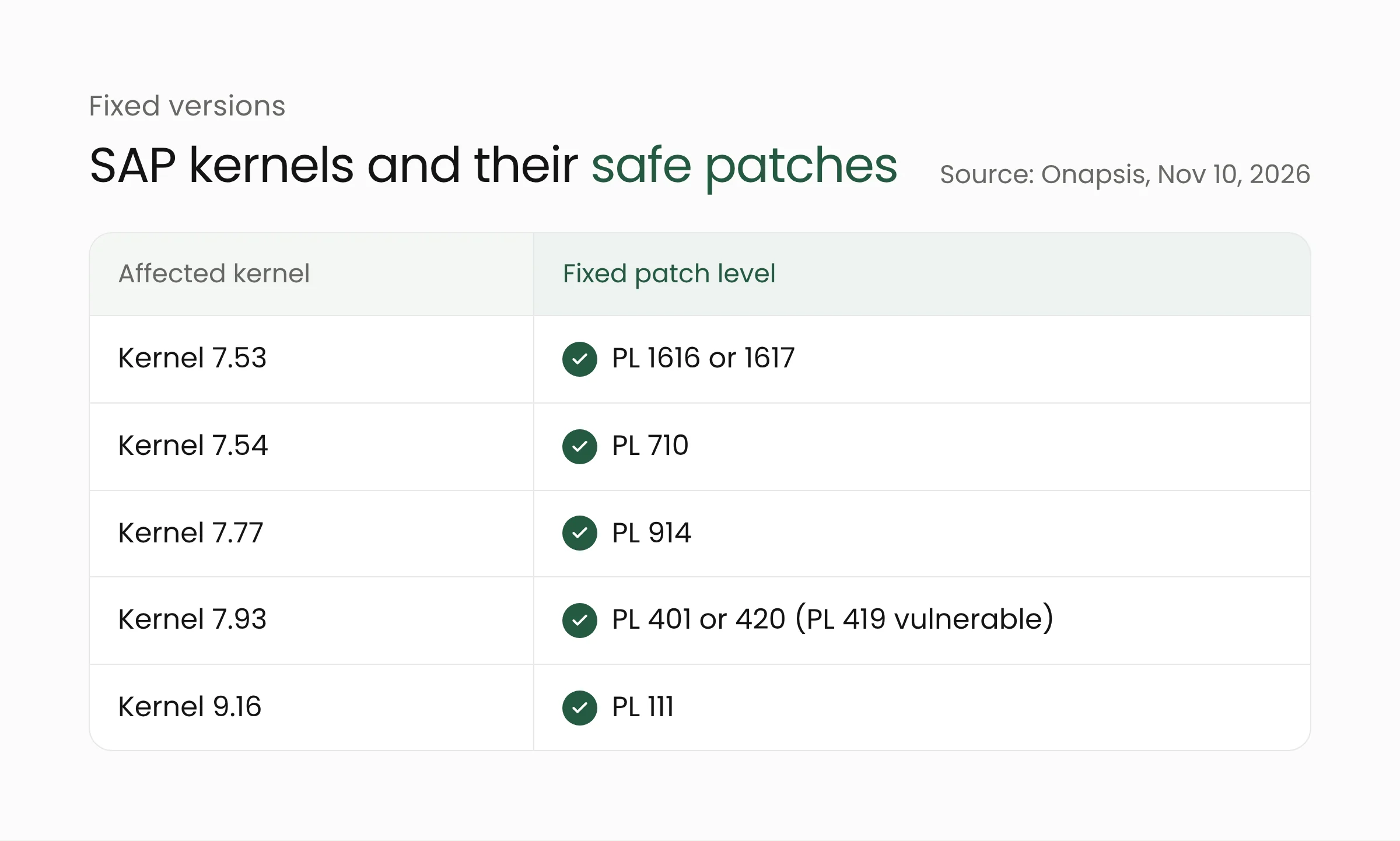
Onapsis lists the following kernel patch levels (PL) as containing the fix.
- Kernel 7.53: PL 1616 or 1617
- Kernel 7.54: PL 710
- Kernel 7.77: PL 914
- Kernel 7.93: PL 401 or 420, while PL 419 remains vulnerable
- Kernel 9.16: PL 111; kernel 9.18: PL 37; kernel 9.20: PL 11 or 13
- SAP HANA 2.0 for the Web Dispatcher in XS Classic: revision 2.00.079.11 or 2.00.089.05
For XS Advanced, Onapsis points to SAP Extended Application Services 1.0 SP05 Patch 4, while The Hacker News cites version 1.5.4 or later. Onapsis recommends installing the latest patch for each release, since the exact levels above may no longer be available for download.
Out-of-maintenance kernels 7.40, 7.41, 7.42, 7.45, 7.49, 7.73, 7.81, 7.85, and 7.89 are also affected and may not receive a fix. Owners need to move to a supported, downward-compatible kernel, following the guidance in Note 3778788. Onapsis directs customers of SAP’s private cloud operations, including RISE with SAP, to SAP Note 3849055.
Two more maximum-severity flaws in the November release
BleepingComputer reports that SAP fixed 35 vulnerabilities on its November Patch Day, four of them rated CVSS 10.0. Besides the two ICM2SHELL CVEs, there is PROXYGATE (CVE-2026-89103) in SAP Gateway, fixed by Note 3798345. Also found by Onapsis, it causes Gateway to treat an outside attacker as a trusted internal application server.
The fourth, CVE-2026-120017, sits in the SAML2 Service Provider component of NetWeaver AS ABAP and is fixed by Note 3849308. Field Effect says vulnerable systems accept forged assertions, letting an attacker log in as any user, including privileged accounts. It affects systems that use SAML2 single sign-on for the Fiori Launchpad or SAP GUI for HTML. The Hacker News says there is no workaround, so the correction instructions or listed support package are the only fix.
RedRays, whose guidance The Hacker News cites, advises updating the kernel and all Web Dispatchers in a single rollout.
What this means for industrial companies
At factories and distribution companies, SAP often connects to several channels at once: supplier portals, warehouse apps, production systems, and Fiori apps that staff open from outside the office. Web Dispatcher is usually the internet-facing door for all of them. If it goes down, orders, goods receipts, and production schedules stall. If it is taken over, an attacker reaches the company’s most sensitive data.
Inventory every kernel and Web Dispatcher
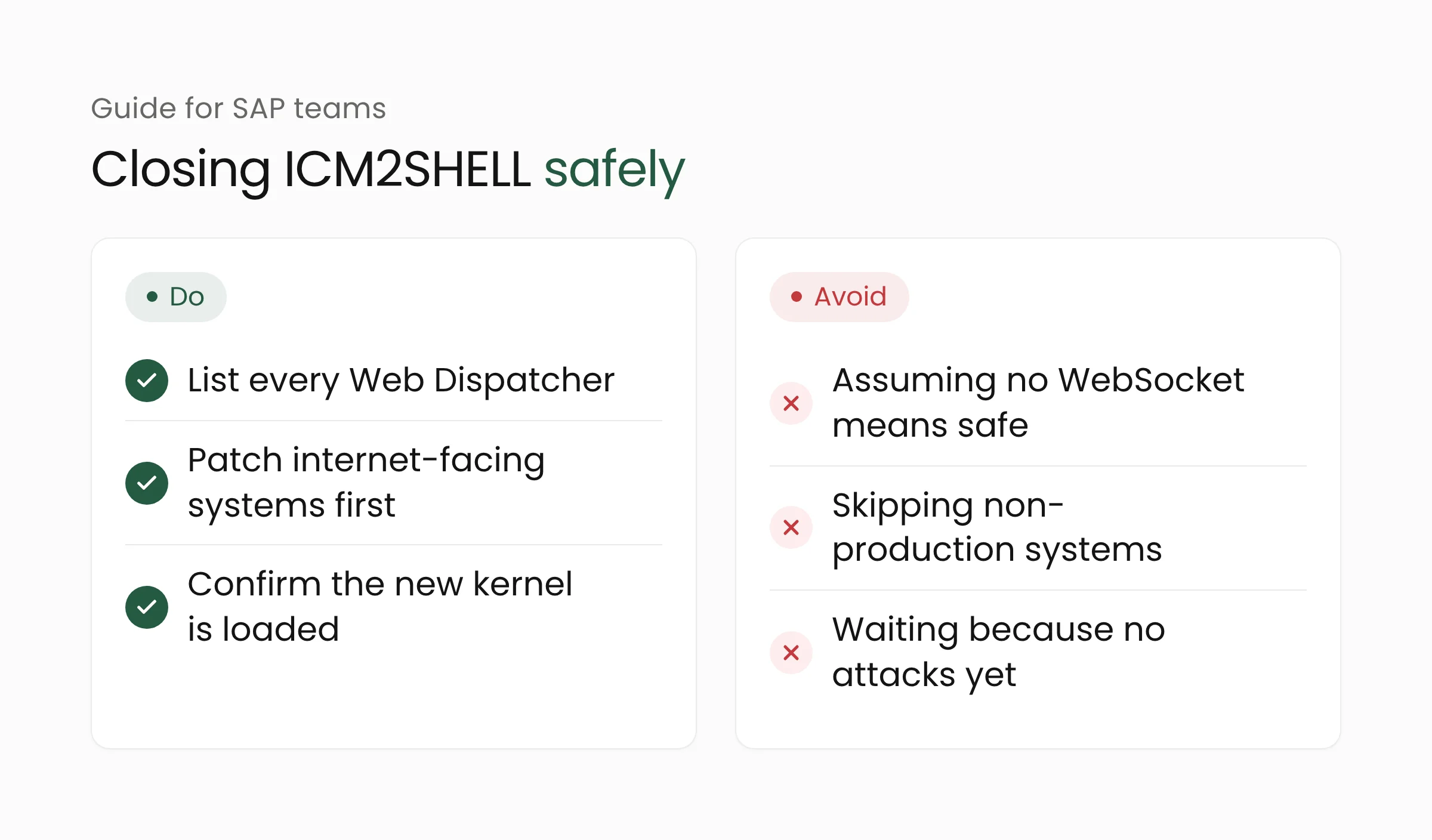
Record the kernel release and patch level of every AS ABAP system and every Web Dispatcher. Onapsis advises including standalone Web Dispatchers, those embedded in HANA XS Classic and XS Advanced, non-production systems holding copies of production data, and legacy kernels. As The Hacker News puts it, a single missed Web Dispatcher leaves the flaw open.
Patch internet-facing systems first
Onapsis recommends starting with ICMs and Web Dispatchers reachable from the internet, then moving to internal systems, prioritizing production and sensitive data. After replacing the kernel, Field Effect advises restarting instances and confirming that the patched kernel is actually loaded.
Use temporary workarounds with care
If patching has to wait, there are two stopgaps. First, a Web Dispatcher on 7.53 PL 1629, 7.54 PL 723, 7.93 PL 430, 9.16 PL 200, or higher can shield the servers behind it. That only holds if those servers are reachable exclusively through that Web Dispatcher and the Web Dispatcher is not configured as a router (PROT=ROUTER).
Second, setting icm/HTTP/support_websocket_upgrade=FALSE and restarting the component removes the vulnerability. According to Onapsis, SAP warns that this significantly affects interactive and integration scenarios. The Hacker News lists ABAP Push Channels and some Fiori features among the casualties, so the change needs testing first. The parameter lives in different places for AS ABAP, standalone Web Dispatcher, HANA XS Classic, and XS Advanced.
Watch for unusual signs
Onapsis recommends monitoring for unexpected restarts recorded in dev_icm or dev_webdisp, and for changes in the icman or Web Dispatcher process ID outside planned maintenance. Access to HTTP and HTTPS ports should also be limited to the networks and users that need it. That reduces exposure, although it does not fix the flaw.
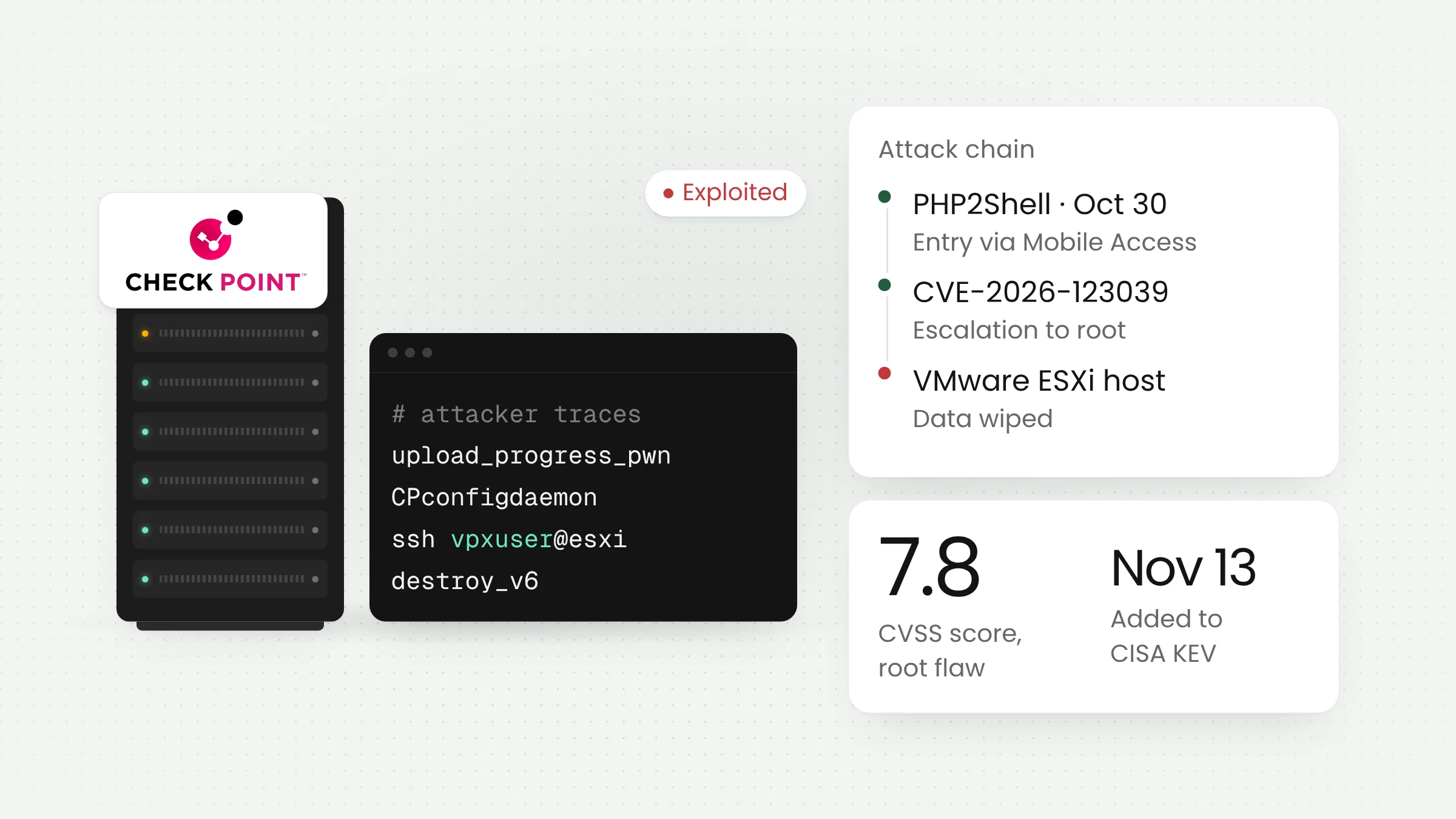
The risk pattern resembles this week’s attacks on Check Point gateways. In that case, an internet-facing component was the entry point, and the first attacks came about a week after the initial fix was released. Companies building out industrial automation solutions should put SAP on the same risk map, especially when production and sensor data from the factory floor flows into the ERP.
Frequently asked questions
Is a system that does not use WebSocket safe?
Not necessarily. WebSocket support is on by default, and Onapsis stresses that not using WebSocket does not make a system safe. To see whether WebSocket is in use, look for status code 101 in the ICM or Web Dispatcher HTTP log.
Has ICM2SHELL been used in attacks?
No exploitation had been reported when the Onapsis and Field Effect advisories were published, and as of November 15, 2026 the flaw was not in CISA’s KEV catalog. Still, Onapsis has proven that its exploit works without credentials. The SAP Commerce Cloud flaw from August, attacked within days of its patch, shows how short the safe window can be.
What about old kernels that are no longer supported?
Kernels 7.40, 7.41, 7.42, 7.45, 7.49, 7.73, 7.81, 7.85, and 7.89 are affected and may not get a fix. While preparing an upgrade to a supported kernel, protect those systems behind an updated Web Dispatcher, or disable WebSocket after testing the impact, and restrict access from outside networks.
Conclusion
ICM2SHELL has not been exploited yet, but researchers have already shown a working exploit. The best time to patch is before the technical details circulate, starting with the list of internet-facing Web Dispatchers. If your team needs support with system inventory and perimeter hardening, Merakit’s cybersecurity services can help.
Sources
- Onapsis: ICM2SHELL (CVE-2026-76964 and CVE-2026-89126), a Critical Pre-Authentication Vulnerability in SAP NetWeaver’s ICM and Web Dispatcher, November 10, 2026 (updated November 12, 2026)
- The Hacker News: SAP Patches Four CVSS 10.0 Flaws, Including Two Enabling Remote Code Execution, November 10, 2026
- BleepingComputer: SAP patches ICM2SHELL and PROXYGATE maximum severity flaws, November 10, 2026
- CISA: Known Exploited Vulnerabilities Catalog, checked November 15, 2026 (catalog release of November 13, 2026)
- Field Effect: SAP patches ICM2SHELL, PROXYGATE and SAML2 authentication bypass flaws, November 13, 2026