Blog Robotics
Tesla Optimus Enters Early Production, Factories Come First
On this page· 7 sections
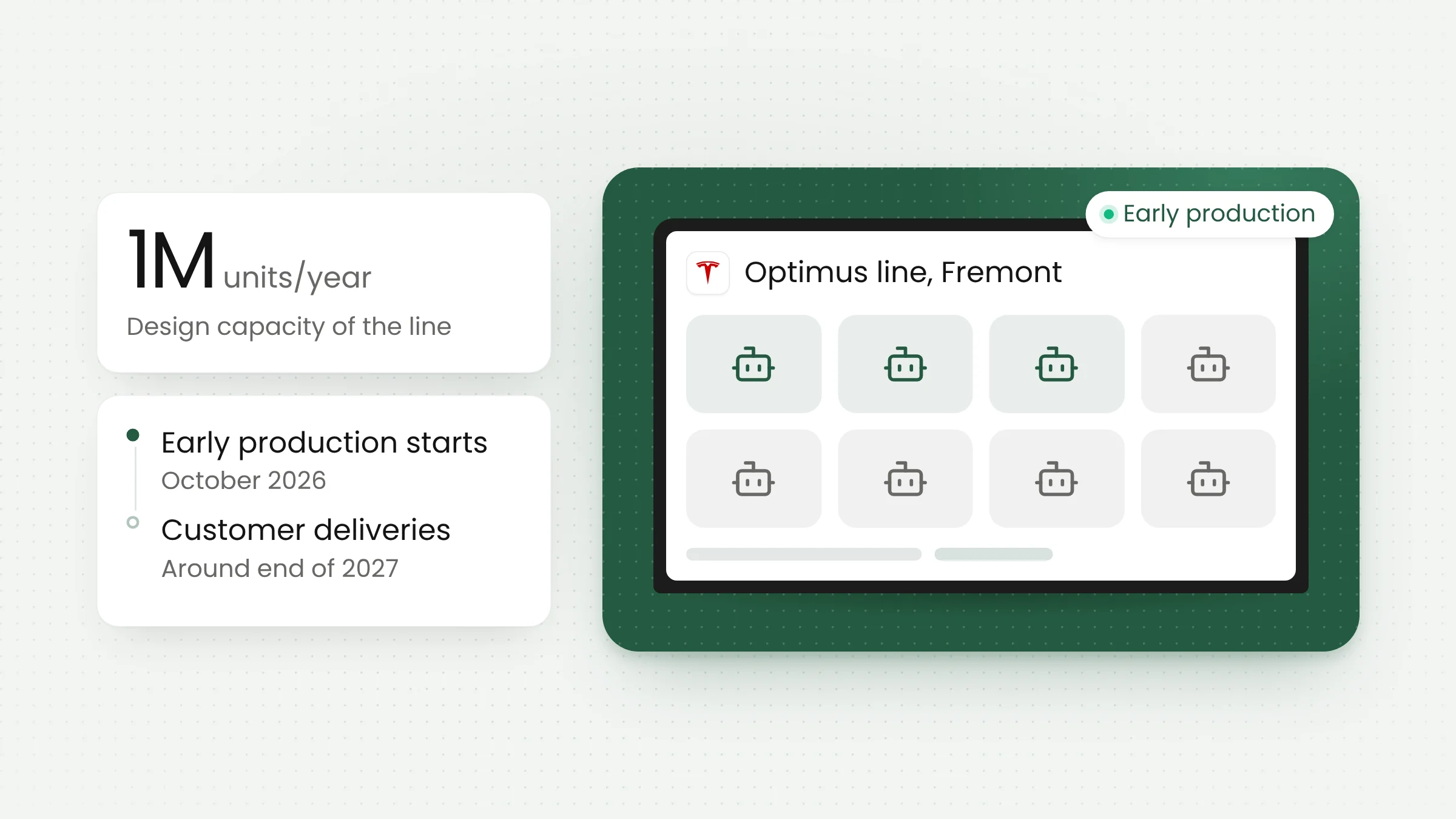
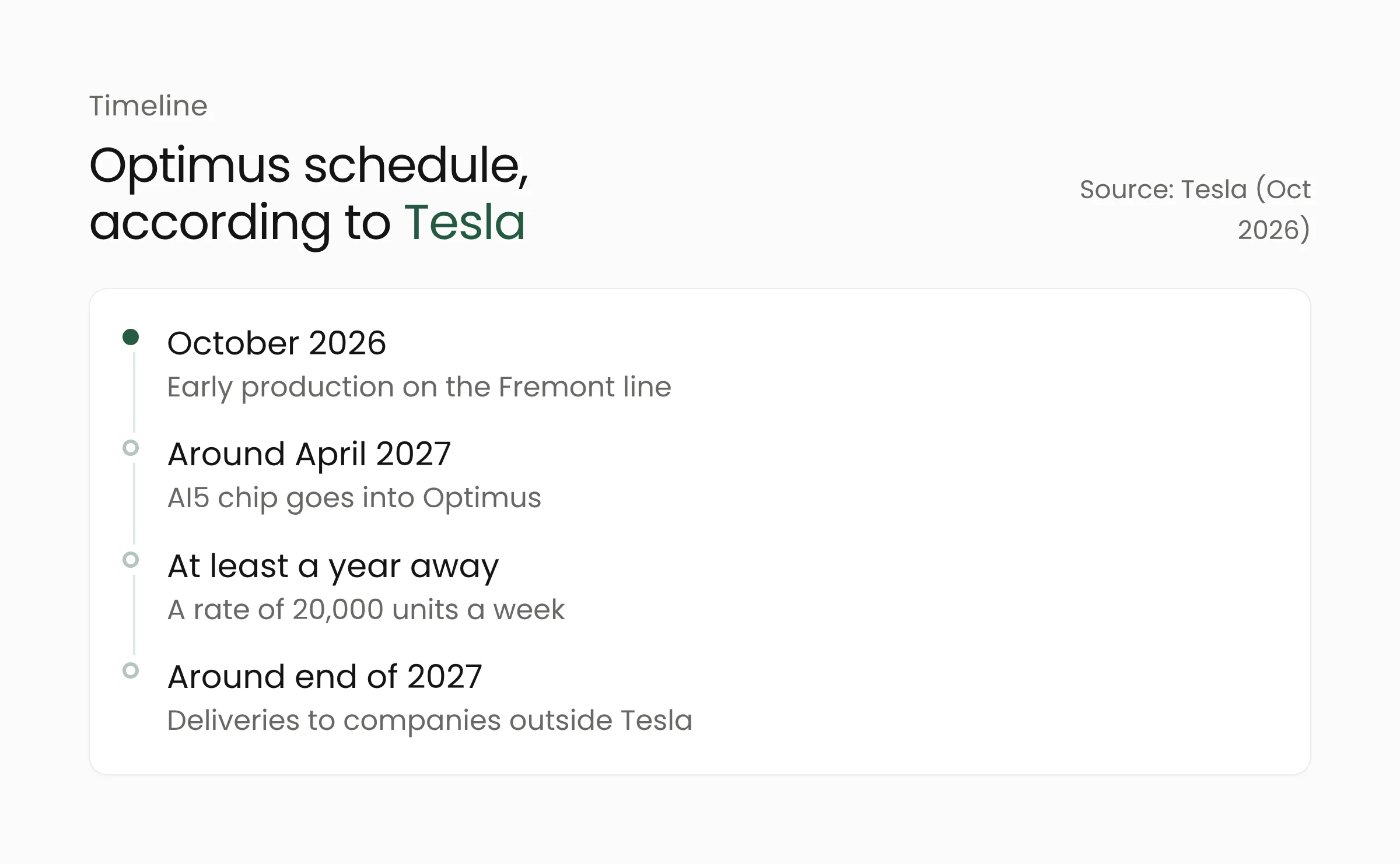
Tesla has begun early production of its Tesla Optimus humanoid robot on a high-volume line at its Fremont, California factory. Elon Musk shared the update on the company’s third-quarter 2026 earnings call on October 21. The line is designed for one million units a year, but deliveries to outside companies are only expected around the end of 2027.
Early production on the Fremont line
According to the earnings call transcript, Musk said, “we’ve started like what I’d call early production on our high-volume line in Fremont.” He added that most of the equipment for a line with a capacity of one million units has already arrived in Fremont.
Not a Tesla App reports that the line occupies space freed up by tearing down the Model S and Model X assembly lines, a job completed in 46 days over the summer. The same outlet says production starts with the third-generation Optimus design. Musk said a new Optimus video could be ready in about a month, and that he wants it to show the robot doing tasks that were not programmed in advance.
Optimus is a robot shaped like a person, with two arms, two legs and hands that can grip. The form is meant to let it work in spaces built for people, using the same shelves, carts and tools. Most industrial robots in factories today are arms bolted to one spot that repeat a single type of motion.
The news came alongside a weaker set of financial results. Electrek reported third-quarter revenue of $28.05 billion, roughly flat year over year. Net income fell 43% to $787 million, while research and development spending rose 69% to $2.76 billion as Tesla funds its AI work, Optimus and the Cybercab. The revenue and net income figures match Tesla’s quarterly filing with the SEC.
A slow start to the production ramp
The one-million-unit figure describes what the line is designed to do, and Musk tempered near-term expectations himself. He said Tesla will need at least a year, possibly longer, to reach a rate of 20,000 units a week. He described the start of the production curve as shallow and bumpy, because Optimus is a new product and parts of its design are still changing.
The hands remain one of the hardest problems. Konstantinos Laskaris of Tesla called the hand one of the most challenging hardware areas, and Musk acknowledged that the robots now being built do not yet have perfected hands.
The next step is the computer inside the robot. Musk expects Tesla’s AI5 chip to go into Optimus around April 2027 if things go to plan, and he described it as offering far more compute than the current AI4 chip. On cost, Tesla executive Vaibhav Taneja said Optimus costs are trending toward the company’s expected Cybercab costs. The call did not cover a selling price.
Taneja also said Tesla has started building a factory in Austin, Texas. Not a Tesla App reports that a larger line, with a capacity of 10 million units a year, is planned for Giga Texas, and that Tesla plans to move to a fourth-generation design by the time that capacity comes online. Plans on that scale still depend on how the Fremont line performs.
Heavy industry as the first market
Musk said the remaining issues in AI, electromechanical design, reliability and durability should be solved around the end of 2027. That is when Tesla plans to begin delivering Optimus to companies outside Tesla. Ashok Elluswamy, a Tesla AI executive, said the highest-value use will likely be heavy industry and dangerous tasks. Robots for the home would come later, once production scales.
The order fits how factories work. Jobs that are dangerous, repetitive and run around the clock are the most expensive to staff and the easiest to measure. Factory floors are also more structured than homes, which makes them a better place to test a new kind of machine.
For a sense of scale, the International Federation of Robotics (IFR) says global installations of industrial robots rose 11% to more than 600,000 units in 2025, as reported by Australian Manufacturing. The number of industrial robots in operation reached five million, and the IFR projects installations of 655,000 units in 2026 and 806,000 in 2029.
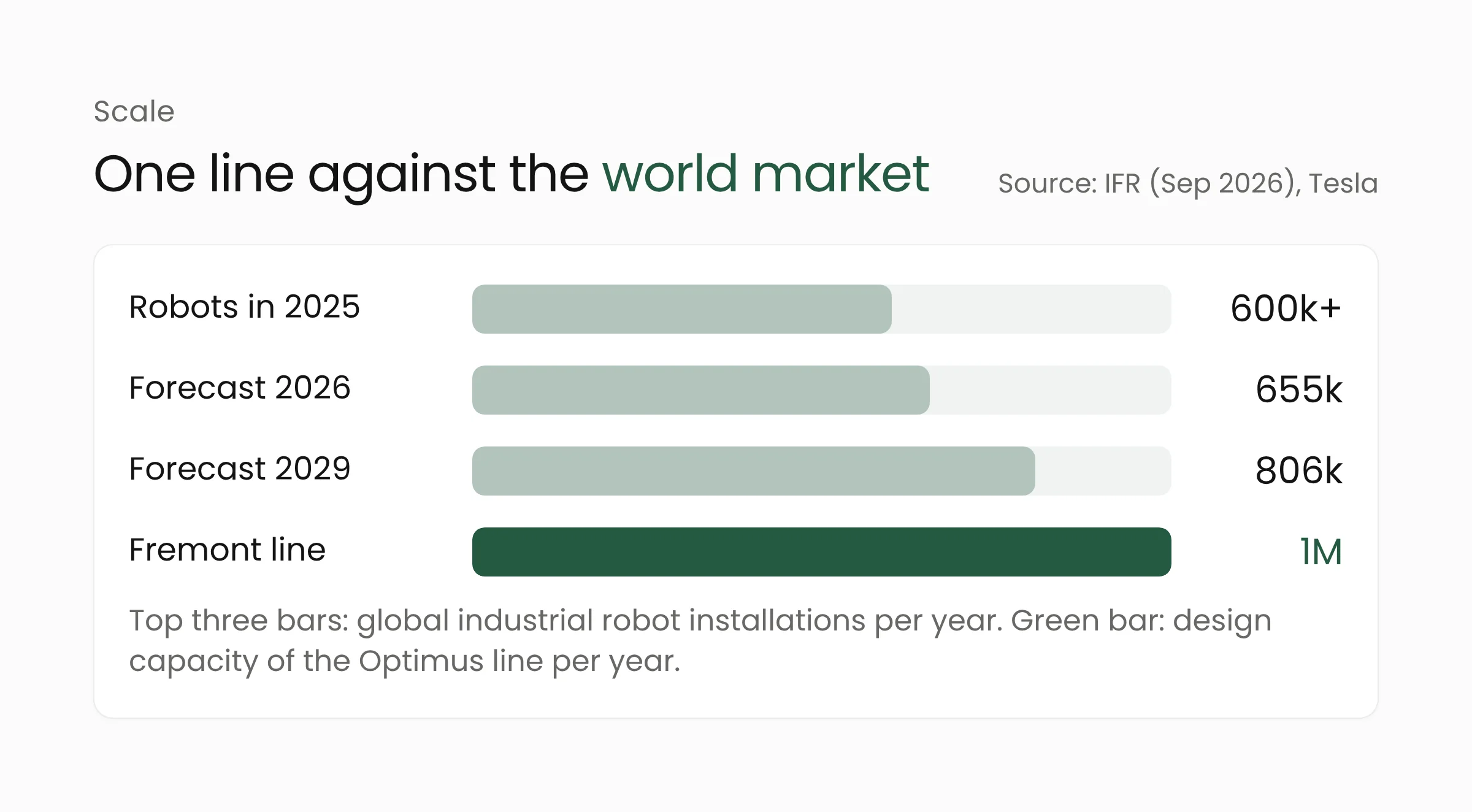
The comparison needs care. The IFR figures count robots actually installed, mostly robotic arms, while the Optimus figure is the design capacity of a line that has only just started. Even so, it shows the size of Tesla’s bet: a single line in Fremont is designed to build more robots a year than all industrial robot installations worldwide in 2025.
What this means for factories in Indonesia
Tesla has not announced a selling price for Optimus or which countries it will ship to. With deliveries expected around the end of 2027 and industrial customers first in line, manufacturers in Indonesia will likely judge the robot by how it performs for other companies. That waiting period is a chance to build foundations that remain useful whichever robot a plant eventually chooses.
Practical steps for people who run plants, warehouses and production lines:
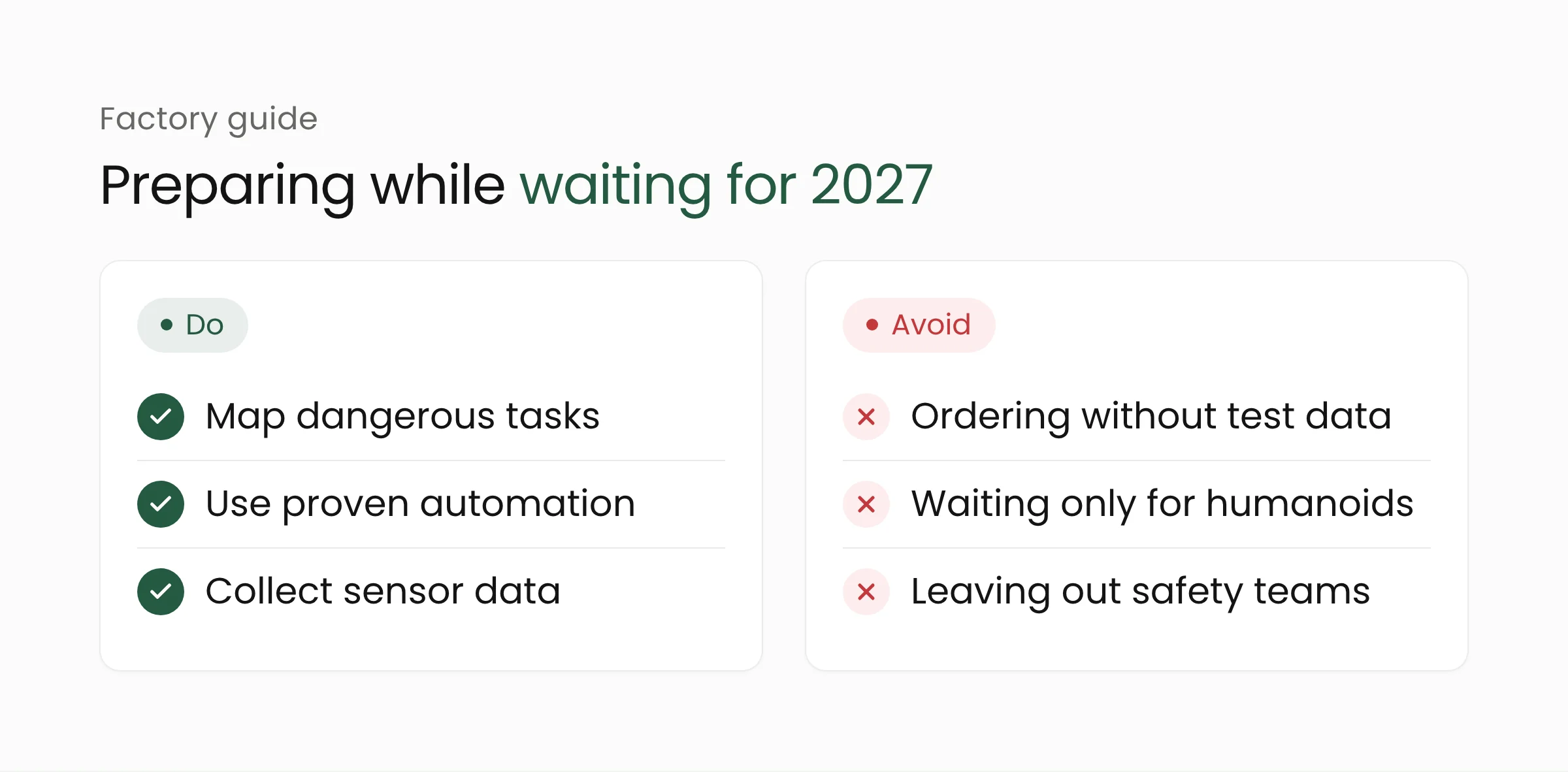
- Map jobs that are dangerous, repetitive or run across three shifts, with cycle times, defect rates and incident records. This data is the basis for judging any kind of automation.
- Start with automation that is already proven, such as robotic arms, conveyors or camera-based visual inspection. These technologies already have local suppliers, spare parts and technicians.
- Add sensors to machines and material flows to collect condition data in real time. Any robot needs clean data about its surroundings.
- Bring in your occupational health and safety team early, because robots that move among workers require clear zone rules and emergency procedures.
Our earlier piece on Standard Bots’ AI platform for programming factory robots from an iPad points in a similar direction: software is making robots easier for production teams to manage. The difference is that today’s industrial robots can be bought and tested now, while humanoid robots are still waiting for proof from their first production lines.
For companies that want to prepare, the most valuable work right now is in data and integration. Merakit’s industrial automation solutions team helps plants connect machines, sensors and production dashboards, and our IoT services cover sensor installation and equipment condition monitoring. That groundwork pays off whether a plant chooses robotic arms today or humanoid robots in a few years.
Frequently asked questions
When can other companies buy Tesla Optimus?
Musk expects deliveries to companies outside Tesla to begin around the end of 2027, once AI, design, reliability and durability issues are resolved. The first customers are likely to come from heavy industry. No exact date has been announced.
How much will an Optimus robot cost?
The price has not been announced. On the third-quarter 2026 call, Tesla only said that production costs are trending toward its expected Cybercab costs, without giving a figure.
Is Optimus already working in Tesla’s factories?
Tesla says early production has started in Fremont, but the earnings call did not say whether robots from that line are already being used on Tesla’s own production lines. Musk said an Optimus video showing the robot doing tasks could be released in about a month.
Conclusion
Early production of Optimus moves humanoid robots from the demo stage toward a factory line, but Tesla’s own timeline is still long. For manufacturers in Indonesia, the time until 2027 is best spent organizing production data and automating the riskiest jobs with technology that is already available. If you want to start with that mapping, the Merakit Indonesia team is ready to talk.
Sources
- Tesla (TSLA) Q3 2026 Earnings Call Transcript, The Motley Fool, October 22, 2026
- Tesla Officially Begins Optimus Robot Production; Demo Coming Soon, Not a Tesla App, October 22, 2026
- Tesla (TSLA) releases Q3 2026 financial results: margins rebound, profit still falls, Electrek, October 21, 2026
- Tesla, Inc. Form 10-Q for the quarter ended September 30, 2026, SEC, October 2026
- Industrial robot installations rise 11% as global stock hits 5 million, Australian Manufacturing, September 28, 2026