Blog Artificial Intelligence
Claude Fable 5.2 Arrives 20% Cheaper and Faster Than 5.1
On this page· 7 sections
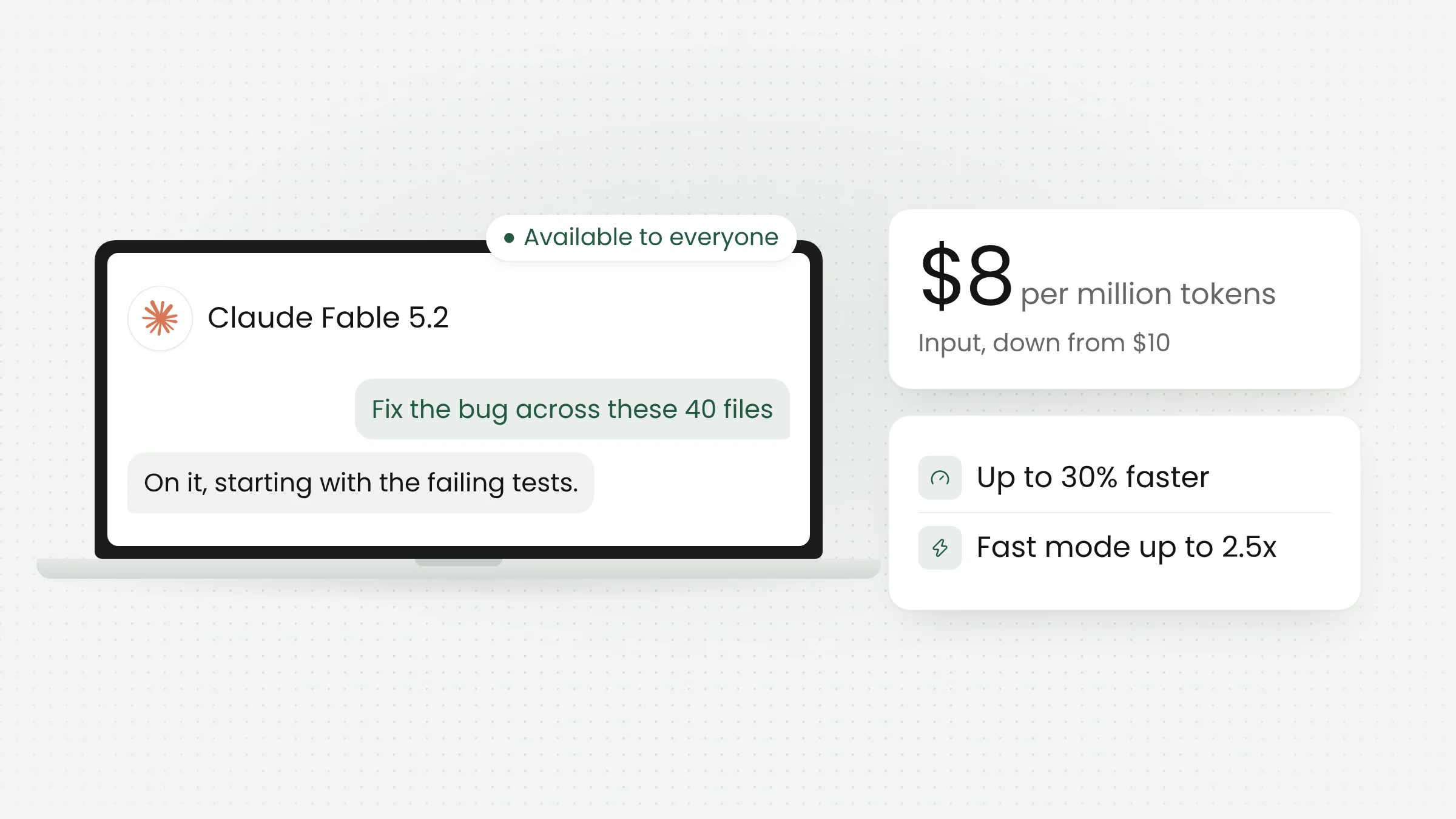
Anthropic released Claude Fable 5.2 and Claude Mythos 5.2 on 9 November 2026. Claude Fable 5.2 is available to all users from day one, with API prices 20% lower than the 5.1 generation and output up to 30% faster. Anthropic says the model is built for the hardest technical work, such as software engineering, mathematics, and robotics.
One model with two routes to access
According to Anthropic’s announcement, Fable 5.2 and Mythos 5.2 share the same underlying model. The difference lies in the safeguards and in who can use each one.
Fable 5.2 carries additional cybersecurity and biology safeguards, which lets Anthropic open it to everyone. Mythos 5.2 runs without those limits and is available only to organizations that pass verification through the Cyber Verification Program for security professionals or the Life Sciences Verification Program for life sciences researchers. Claude Enterprise customers can also use Mythos 5.2 through Claude Security.
This two-track approach dates back to the start. According to CNBC, Mythos first appeared in April 2026 with a limited rollout because of its cybersecurity capabilities. Fable, a public version of Mythos with added safeguards, followed two months later.
Cybersecurity and biology safeguards
Fable 5.2 blocks high-risk cyber activity and most research biology tasks. Anthropic says blocked cyber queries are routed to Claude Opus 4.8 and blocked biology queries to Claude Opus 5. Compared with Fable 5.1, Fable 5.2 produces about 55% fewer blocks overall, with about 60% fewer in cybersecurity and 40% fewer in biology.
Anthropic says the models went through safety and alignment testing, including by external groups such as the UK AI Security Institute and METR. Eligible customers can use zero data retention, while other customers are subject to 30-day data retention for safety monitoring.
Price, speed, and fast mode
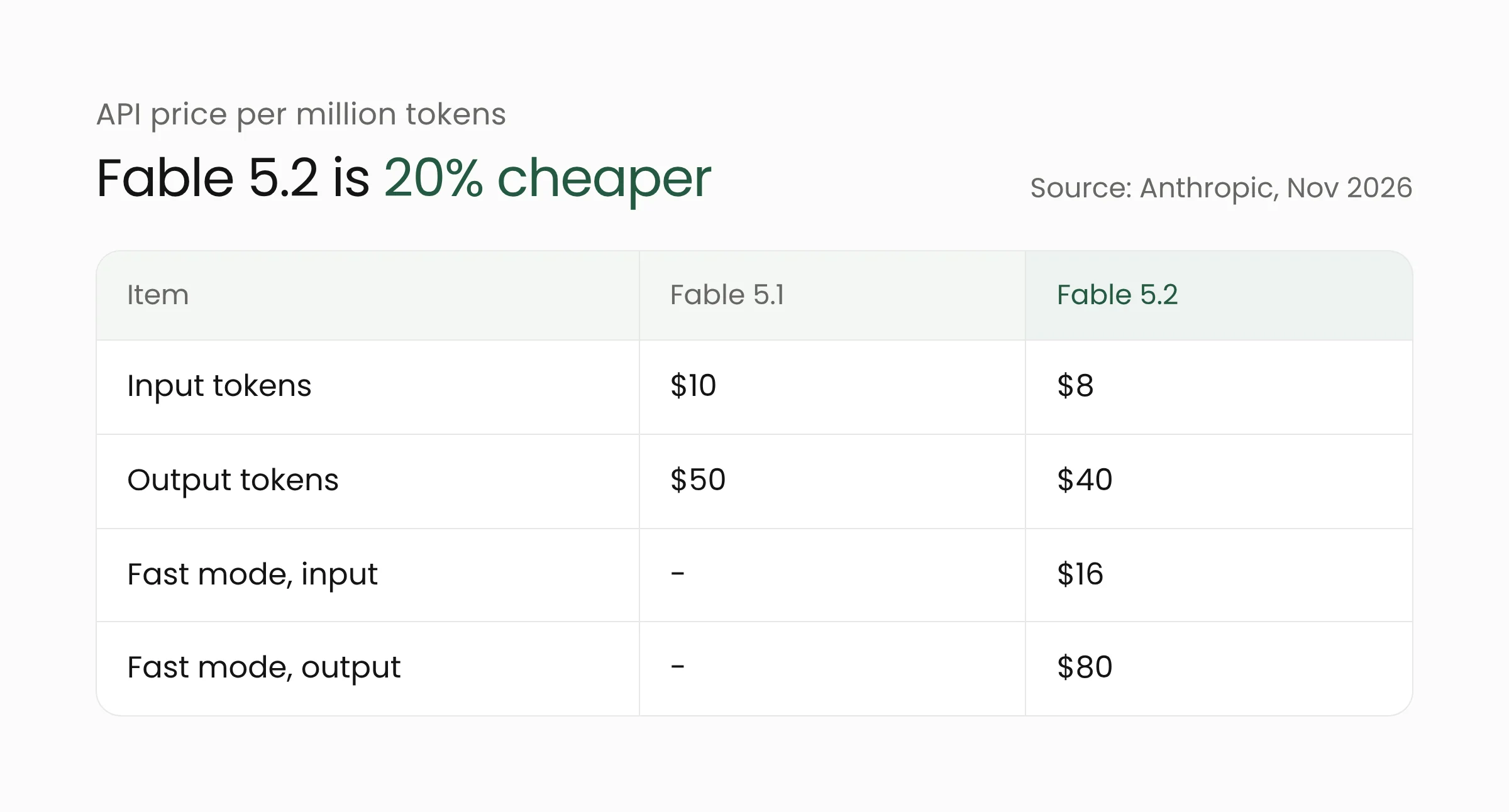
Fable 5.2 costs $8 per million input tokens and $40 per million output tokens on the API, down from $10 and $50 for Fable 5.1. For comparison, Claude Opus 5.5 costs $4 and $20, which makes Fable 5.2 twice as expensive per token, as summarized by eesel AI. A token is a chunk of text the model counts, roughly a fragment of a word.
Anthropic also offers a fast mode that speeds up token generation by up to 2.5 times, priced at $16 per million input tokens and $80 per million output tokens. It is available in Claude Code, the Claude Platform, Claude Models on Google Cloud, and Microsoft Foundry.
Fable 5.2 is available on all of Anthropic’s platforms, including Amazon Web Services, Google Cloud, and Microsoft Azure. In the Claude apps, eligible paid subscribers receive extra Fable usage during launch week. According to MacRumors, Fable can account for up to 50% of weekly usage limits on Pro plans and standard Team seats.
Benchmarks and launch context
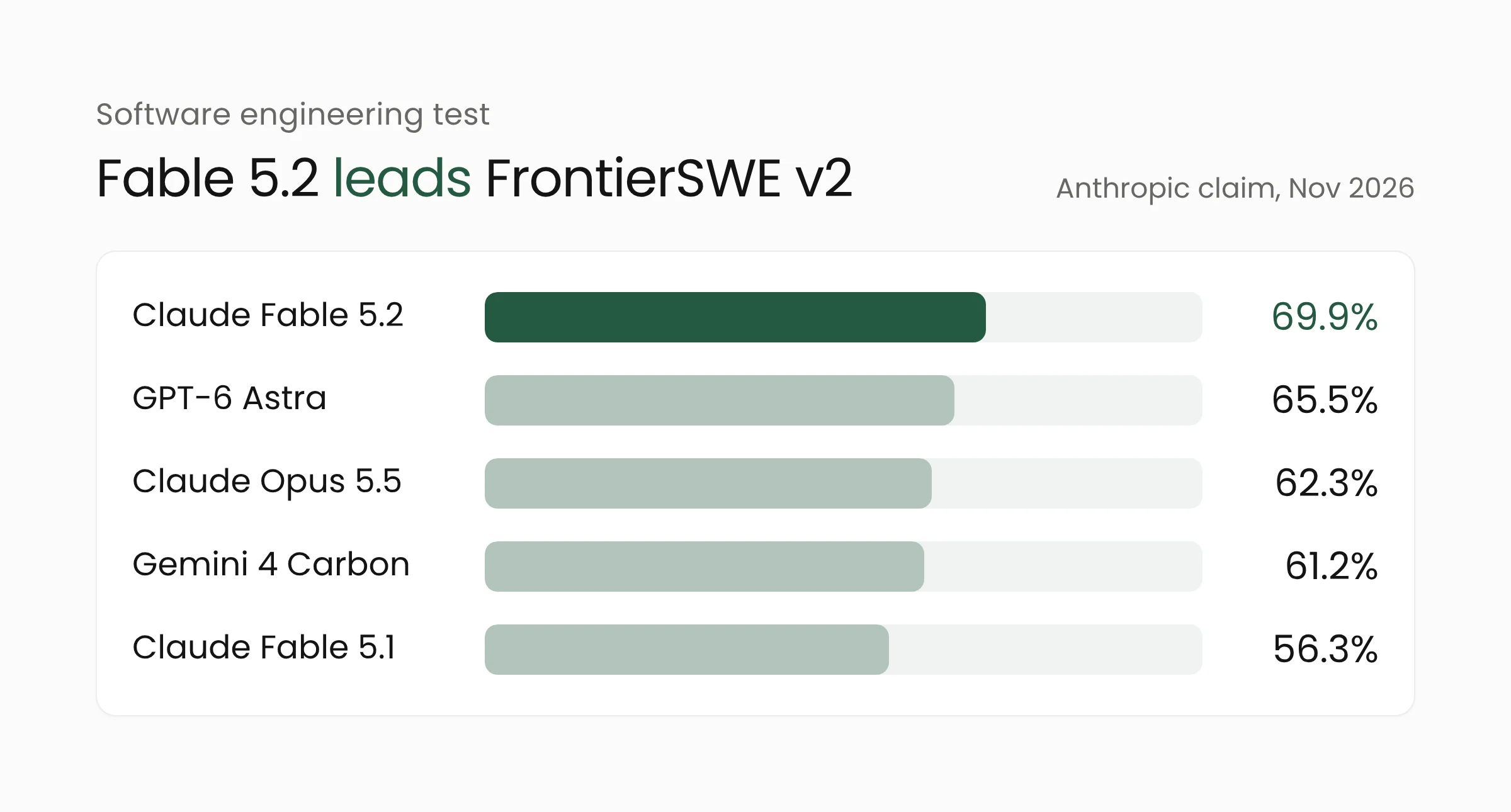
Anthropic published a comparison against Fable 5.1, Claude Opus 5.5, OpenAI’s GPT-6 Astra, and Google’s Gemini 4 Carbon. All figures below come from Anthropic and use each model’s highest available effort setting unless noted.
On FrontierSWE v2, a software engineering test, Fable 5.2 scored 69.9%. That puts it ahead of GPT-6 Astra (65.5%), Claude Opus 5.5 (62.3%), Gemini 4 Carbon (61.2%), and Fable 5.1 (56.3%). On FrontierCode 2.0, Fable 5.2 scored 49.1% against 45.5% for Opus 5.5.
Fable 5.2 does not lead every test. On AutomationBench, a workflow automation test, Gemini 4 Carbon scored 53.9% against 51.4% for Fable 5.2. Anthropic also points to cost efficiency: at high effort, Fable 5.2 scored 45.3% on FrontierCode 2.0, close to Opus 5.5’s 45.5%, at roughly half the cost per task.
Independent assessments are starting to appear. On launch day, Vals AI ranked Fable 5.2 first of 36 models on its Vals Index with a score of 71.31%. More independent results are needed to see whether Anthropic’s claims hold across different kinds of work.
A launch ahead of a planned IPO
The release comes as Anthropic prepares for its initial public offering. CNBC reported that the IPO could take place as soon as next week, with a target valuation of $1 trillion to $1.5 trillion. The company also reported revenue of $33.24 billion for the nine months ended 30 September 2026.
CNBC noted that this is Anthropic’s first frontier model launch since CEO Dario Amodei called for slowing AI development in September. Dianne Penn, head of product management for research at Anthropic, described that stance to CNBC: “We called for pacing, not pausing.”
What this means for development teams and organizations
Anthropic positions Fable 5.2 for power users and demanding use cases, while Claude Opus 5.5, released in September, is described as better suited to everyday work. For teams in Indonesia that use or plan to use AI models, a few points are worth weighing:
- Match the model to the task. Fable 5.2 suits long, complex work, such as fixing code across many files or AI agents that run for hours. For routine tasks like summarizing documents or answering customer questions, a cheaper model is often enough.
- Measure cost per completed task. Fable 5.2 costs more per token than Opus 5.5, but Anthropic claims its cost per task can be lower on some problems. Test with real work samples before moving workloads.
- Check data retention rules. The 30-day retention for safety monitoring needs to fit internal policy, especially for banks, hospitals, and agencies that handle personal data.
- Plan an alternative path for security work. Security teams whose legitimate tasks hit the safeguards can consider the Mythos verification programs or another suitable model.
Merakit helps organizations choose, test, and integrate AI models into existing systems through its artificial intelligence services. For a comparison with an earlier competing release, see our coverage of Gemini 4 Argon and its million-token context.
Frequently asked questions
What is the difference between Claude Fable 5.2 and Claude Mythos 5.2?
Both come from the same underlying model at the same price. Fable 5.2 carries cybersecurity and biology safeguards and is open to all users. Mythos 5.2 runs without those limits and is reserved for organizations that pass Anthropic’s verification programs.
How much does Claude Fable 5.2 cost?
API pricing is $8 per million input tokens and $40 per million output tokens, 20% lower than Fable 5.1. Fast mode costs $16 and $80 per million tokens.
Can I use Claude Fable 5.2 in the Claude apps?
Yes, on eligible paid plans. Fable can account for up to 50% of weekly usage limits on Pro plans and standard Team seats, with extra usage during launch week.
Conclusion
Claude Fable 5.2 lowers prices while raising capability at the frontier, but its performance claims still need testing against each organization’s real work. If your team is weighing which AI model best fits a specific need, we are happy to help design the trial.
Sources
- Claude Fable 5.2 and Claude Mythos 5.2 (Anthropic, 9 November 2026)
- Anthropic releases Claude Fable 5.2 and Claude Mythos 5.2 ahead of IPO (CNBC, 9 November 2026)
- Anthropic Launches Claude Fable 5.2 and Mythos 5.2 (MacRumors, 9 November 2026)
- Claude Fable 5.2: pricing, benchmarks, and changes from 5.1 (eesel AI, November 2026)
- Claude Fable 5.2 Benchmarks, Cost and Capabilities (Vals AI, 9 November 2026)