Blog App Development
Discord Drops Electron for Rust, Early Build Uses 290MB RAM
On this page· 8 sections
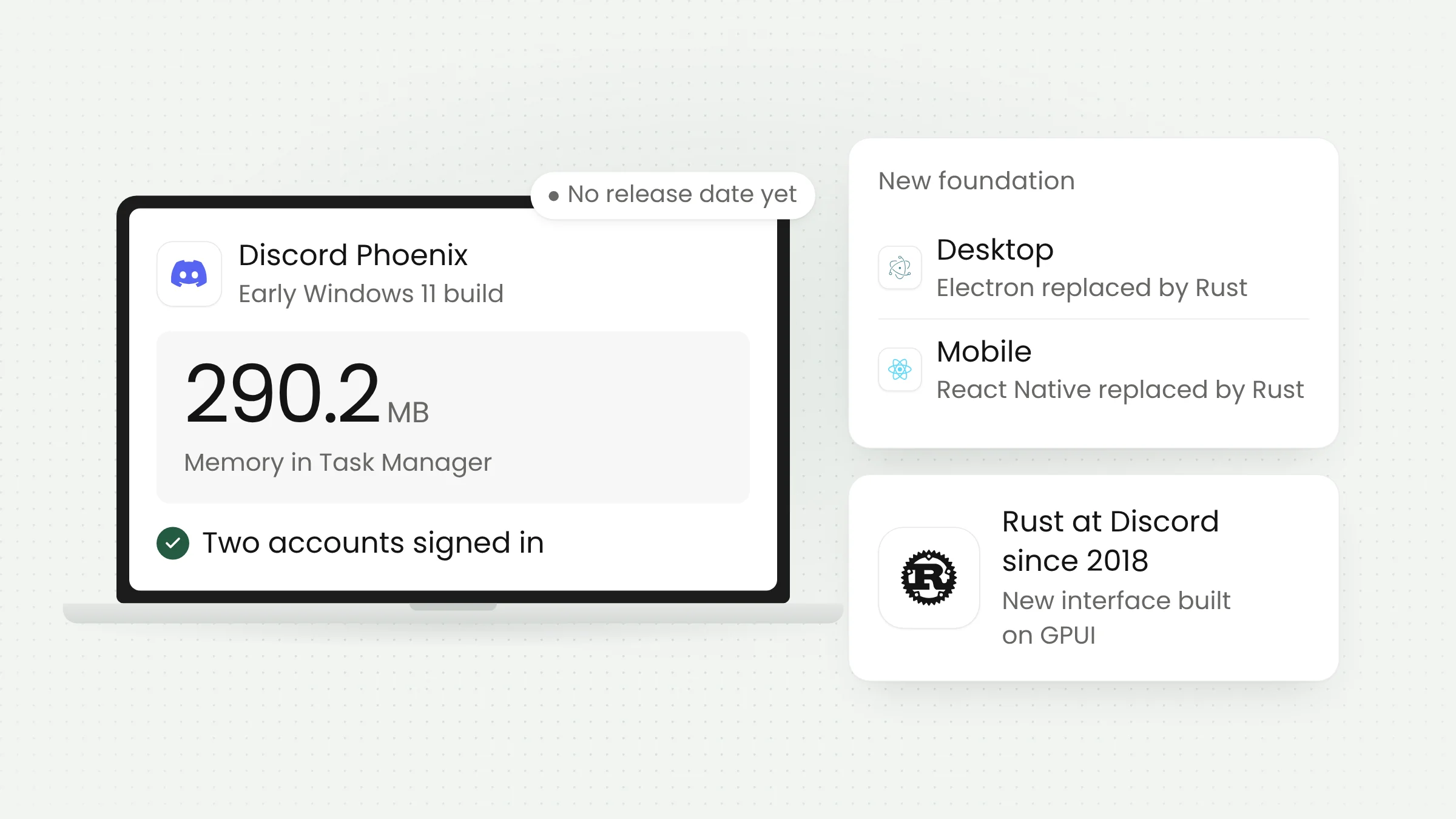
Discord is rewriting its entire client in the Rust programming language. Co-founder and CTO Stanislav Vishnevskiy confirmed on November 4, 2026 that Electron on desktop and React Native on mobile are on their way out. A screenshot of an early build called Discord Phoenix showed 290.2MB of memory use on Windows 11.
The news spread quickly because Discord’s desktop app has a long reputation for heavy memory use. For teams that build software, the decision also reopens an old question: when are web technologies good enough for a desktop app, and when does an app need native code?
What Discord’s CTO confirmed
Vishnevskiy laid out the plan in a series of posts on X. According to Inven Global, he said Discord has used Rust since 2018 for its infrastructure, its voice technology and parts of the current client. Moving the whole client over was the next goal. He summed up the consequence plainly: “That means Electron goes away, and so does React Native.” On mobile, the interface stays native, while the app code is shared with desktop through Rust.
For the desktop interface, Discord is using GPUI. Vishnevskiy specifically corrected users who had guessed Tauri. He said the new app is native, and that the operating system’s webview, the built-in browser component, is used only for content such as YouTube videos and Activities. Discord carries its own patches on GPUI and plans to see which ones could be contributed back to the project.
Asked about rendering, Vishnevskiy said the new app looks and works the same as the current one. On performance, he said Discord expects it to be better. He gave no release date, saying only that the company hopes to get the client into testing with users soon. Inven Global noted that Discord has not published a formal announcement beyond those posts.
Why Electron apps use so much memory
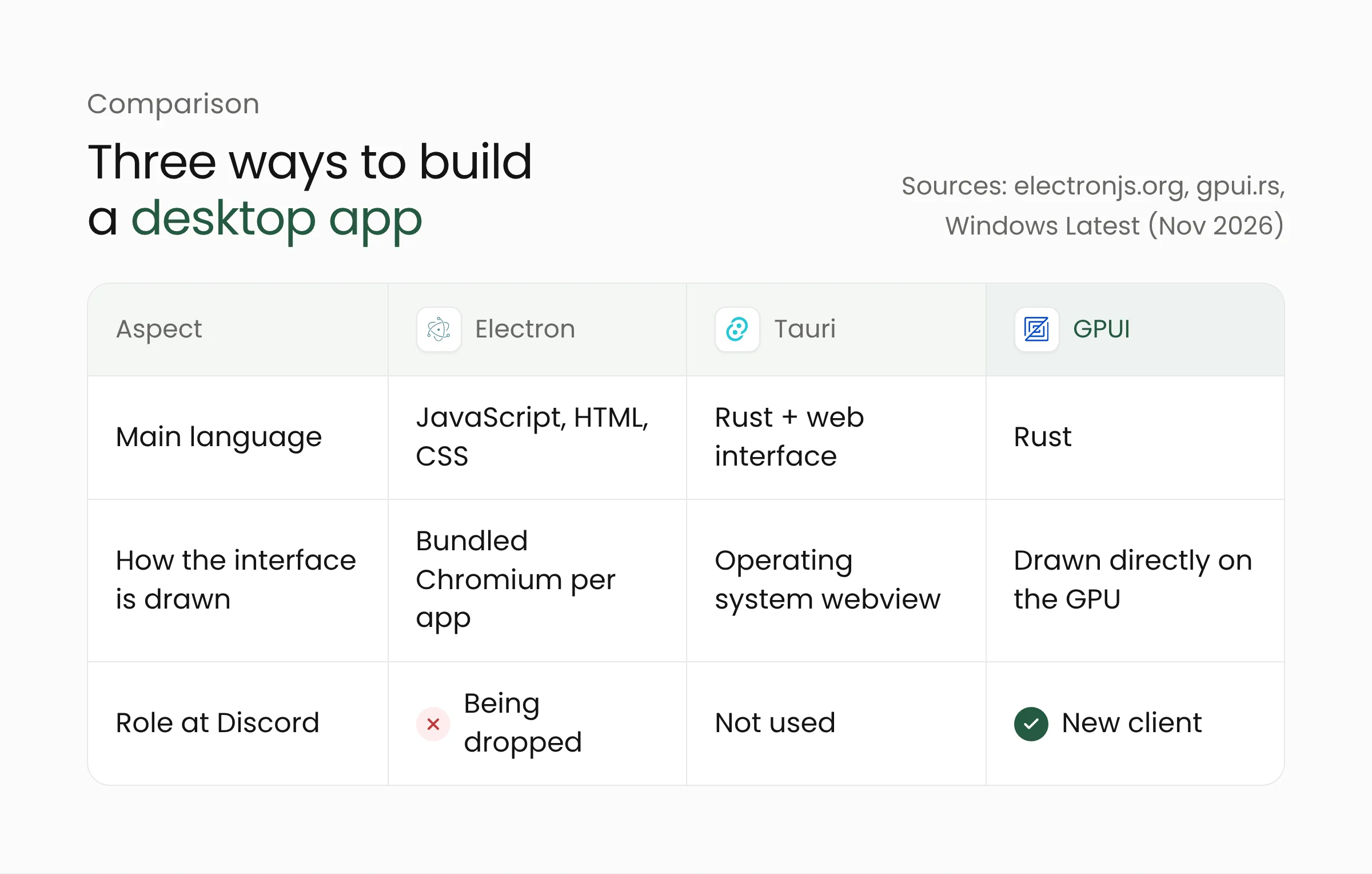
Electron is a framework for building desktop apps with JavaScript, HTML and CSS. Its official site says it embeds Chromium and Node.js, which means every Electron app ships with its own browser engine and JavaScript runtime. The site lists Discord, Slack, Visual Studio Code, Figma, Notion and Signal among the apps built on it.
That approach lets a team use a single web codebase for Windows, macOS and Linux. The cost is memory, because each app runs its own copy of Chromium. Windows Latest contrasts this with WebView on Windows, which shares resources with Microsoft Edge.
Discord has been fighting the problem for some time. In December 2025, PCWorld reported that Discord was testing an automatic restart of its Windows app once memory use passed 4GB. The restart would fire only if the app had been running for at least an hour, the user had been inactive for at least 30 minutes and no voice or video call was active, and at most once a day. A Discord employee said at the time that normal usage stays below 1GB.
GPUI and Discord’s history with Rust
GPUI comes from the team behind the Zed code editor. Its official site describes it as a GPU-accelerated UI framework for Rust and says that, for now, its development remains tied to Zed. Citing GPUI’s documentation, WindowsForum explains that the framework draws interfaces directly on the GPU instead of embedding a browser or relying on the operating system’s native controls. On Windows, it uses DirectX 11.
The difference from Tauri lies in how the interface is drawn. Tauri is also built on Rust, but it usually renders a web interface through the operating system’s webview. By choosing GPUI, Discord removes the web layer from most of its app, which is why the GPUI detail matters more than the word “Rust” on its own.
Rust has also proven itself on Discord’s servers. In a February 2020 engineering post, the Discord blog described moving its Read States service, which tracks which channels and messages each user has read, from Go to Rust. The Go version suffered latency spikes every couple of minutes caused by garbage collection, the process that reclaims unused memory. After the rewrite in Rust, which frees memory without that process, the service came out ahead on latency, CPU use and memory.
The 290MB figure still needs testing
The 290.2MB number comes from a single Task Manager screenshot, not from a formal benchmark. Vishnevskiy added that the app in the image was signed in to two accounts at once, a feature the new client supports. WindowsForum points out that the workload, running time and scope of the measurement are unknown, so the figure cannot yet be treated as a benchmark.
Comparisons with the current app call for the same care. The Windows Latest writer said Discord’s Electron app on the writer’s own PC uses 1 to 2GB while idle. That is one person’s experience. Discord, for its part, reported in 2025 a 5% reduction in p95 memory, the level that 95% of measurements stay below, after a round of fixes. Both numbers were measured differently and cannot be set directly against 290.2MB.
Several questions remain open. Discord has not said whether the browser version will change, or what happens to third-party client modifications built on Electron. Windows Latest expects the “Starting” screen to disappear because the app will no longer load Electron libraries, but Discord has not confirmed this.
For users, the impact shows up on machines with limited memory. Many offices, schools and service counters still run laptops with 8GB of RAM, the same class of hardware targeted by the Windows 11 26H2 update for 8GB PCs. A chat app that stays open in the background all day has a real effect on whether such a laptop remains pleasant to use.
What this means for app development teams
Discord’s move does not mean every Electron app needs a rewrite. Electron still makes sense for products that must ship quickly across several operating systems with an existing web team. The useful lesson lies in how Discord arrived at its decision.
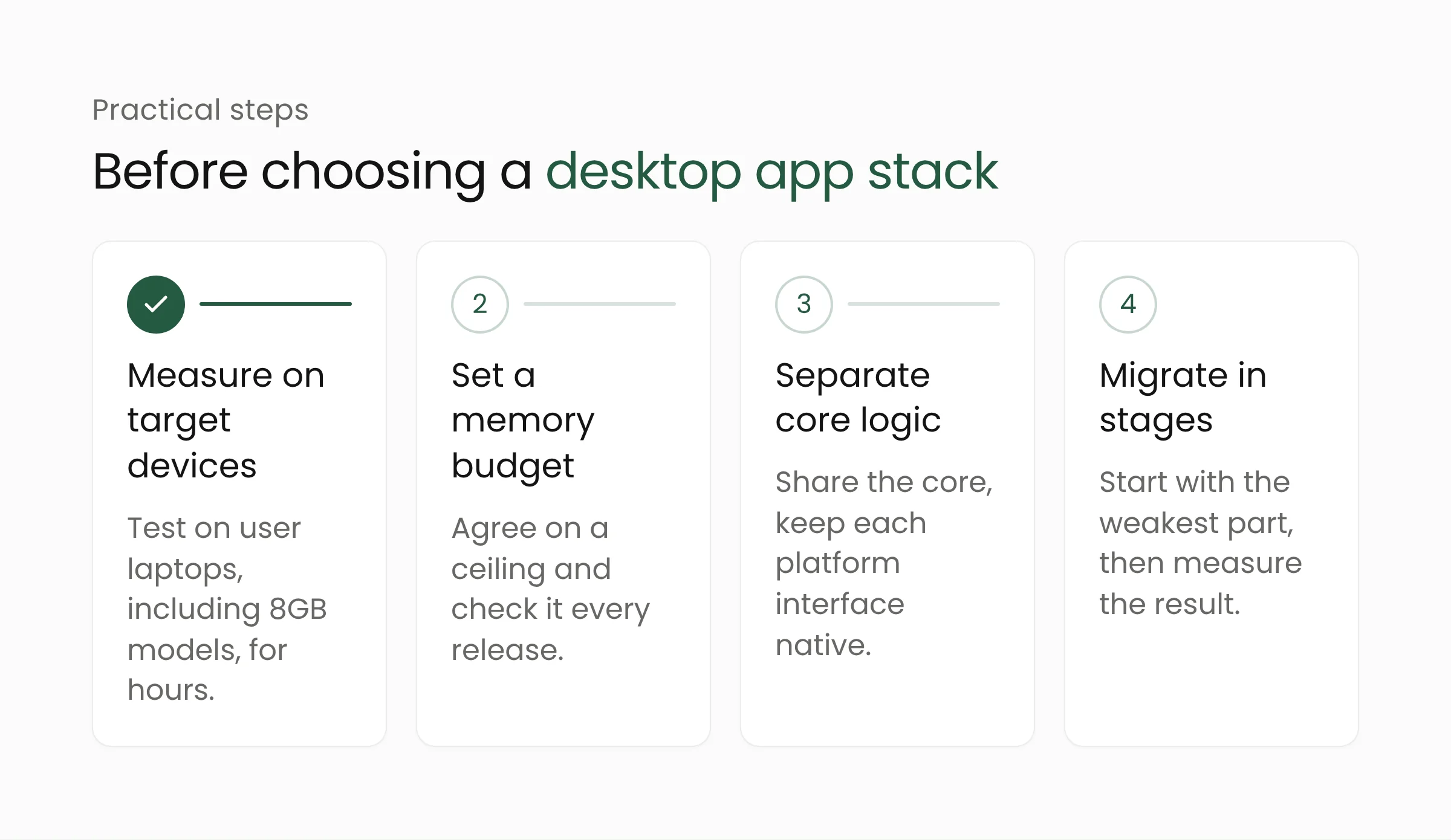
- Measure on the devices people actually use. Test the app on the laptops your users have, such as 8GB machines in branch offices, in addition to developer workstations. Record memory after the app has run for hours, since leaks often surface only over time.
- Set a memory budget early. Apps that stay open all day, such as chat, point-of-sale or queue monitoring tools, should have an agreed memory ceiling that is checked in every release.
- Separate core logic from the interface. Discord shares its Rust code between desktop and mobile while keeping each platform’s interface native. A similar structure makes a later change of technology possible without tearing down the whole app.
- Migrate in stages and prove it with data. Discord used Rust on its servers and in specific components for years before moving the full client. A total rewrite is high risk, so start with the part that causes the most trouble and measure the result.
The choice between a web app, Electron, Tauri or a native client depends on who the users are, what devices they have and how often the app changes. Those conversations work best with a web development or mobile app development team that is used to measuring performance on the hardware people in Indonesia actually own.
Frequently asked questions
When will the Rust version of Discord be available?
There is no release date. Discord’s CTO said only that the company hopes to bring the new client into user testing soon, and Discord has not published a formal announcement beyond his posts on X.
Will Discord look different?
According to Vishnevskiy, the new app looks and works the same as the current one. Content such as YouTube videos and Activities will still appear through the operating system’s webview.
Does rewriting an app in Rust automatically make it lighter?
Not automatically. Rust gives developers tighter control over memory and does not rely on garbage collection, but the final result depends on how the app is designed. Discord’s 290.2MB figure also still needs independent testing.
Conclusion
Discord’s decision shows that performance on users’ own devices can justify replacing an app’s foundation, even when the work takes years. For organizations whose apps run every day on modest laptops, memory measurement deserves a regular place in the development cycle. The Merakit team can help you weigh the technology that best fits your application.
Sources
- Windows Latest: Discord is killing its Electron app that can eat 4GB of RAM on Windows 11, and the Rust rebuild uses just 290MB (November 5, 2026)
- Inven Global: Discord CTO confirms the desktop and mobile apps are being rebuilt in Rust (November 4, 2026)
- WindowsForum: Discord Phoenix: Rust and GPUI Replace Electron on Windows, but 290MB RAM Claims Need Testing (November 4, 2026, updated November 5, 2026)
- PCWorld: Discord admits Windows 11 app hogs RAM, tries solving it with auto-restarts (December 9, 2025)
- Discord Blog: Why Discord is switching from Go to Rust (February 4, 2020)
- GPUI official site
- Electron official site