Blog Artificial Intelligence
AI Prompt Leaks: Dragos Canaries Find 3 Providers Breached
On this page· 7 sections
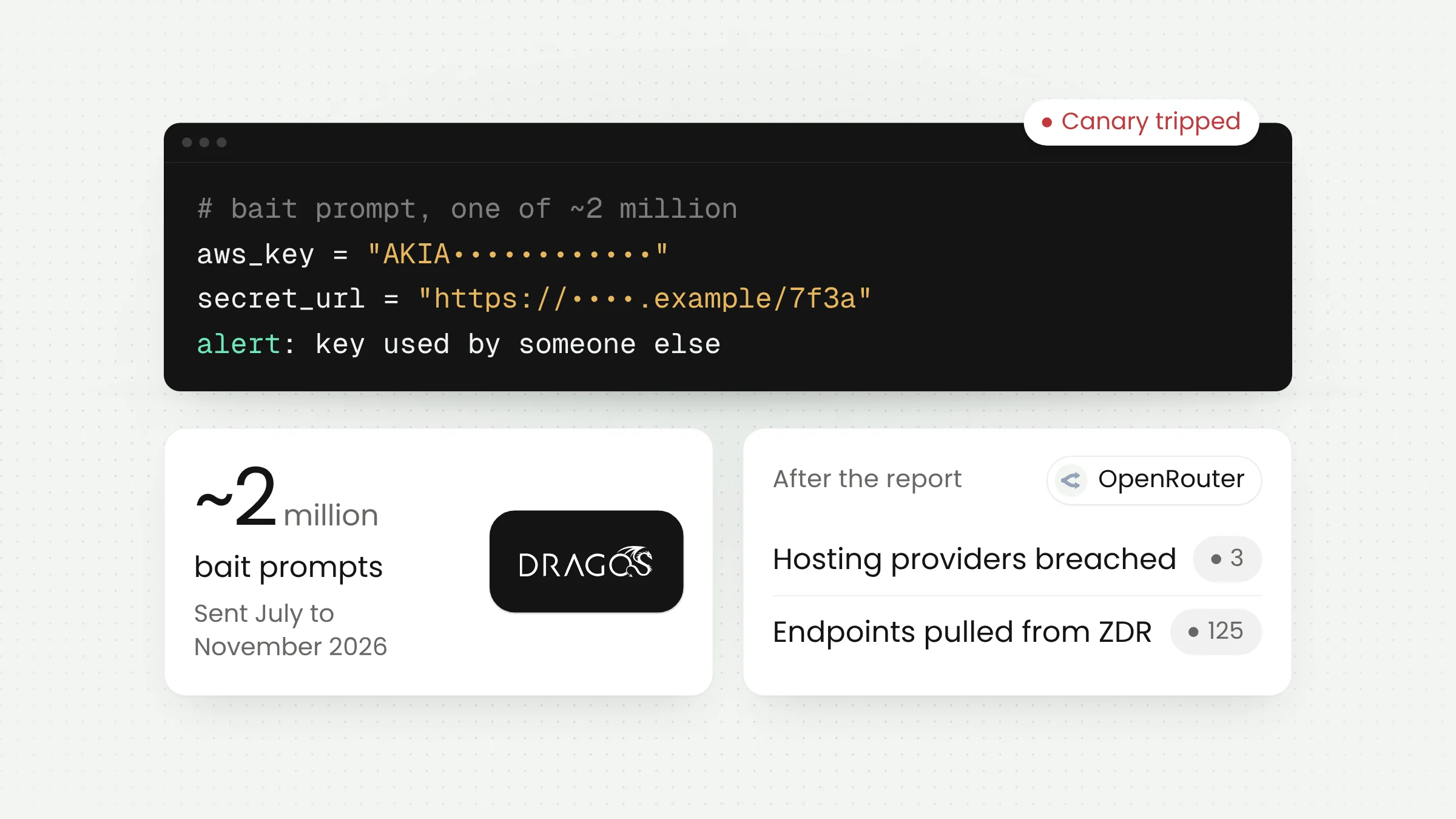
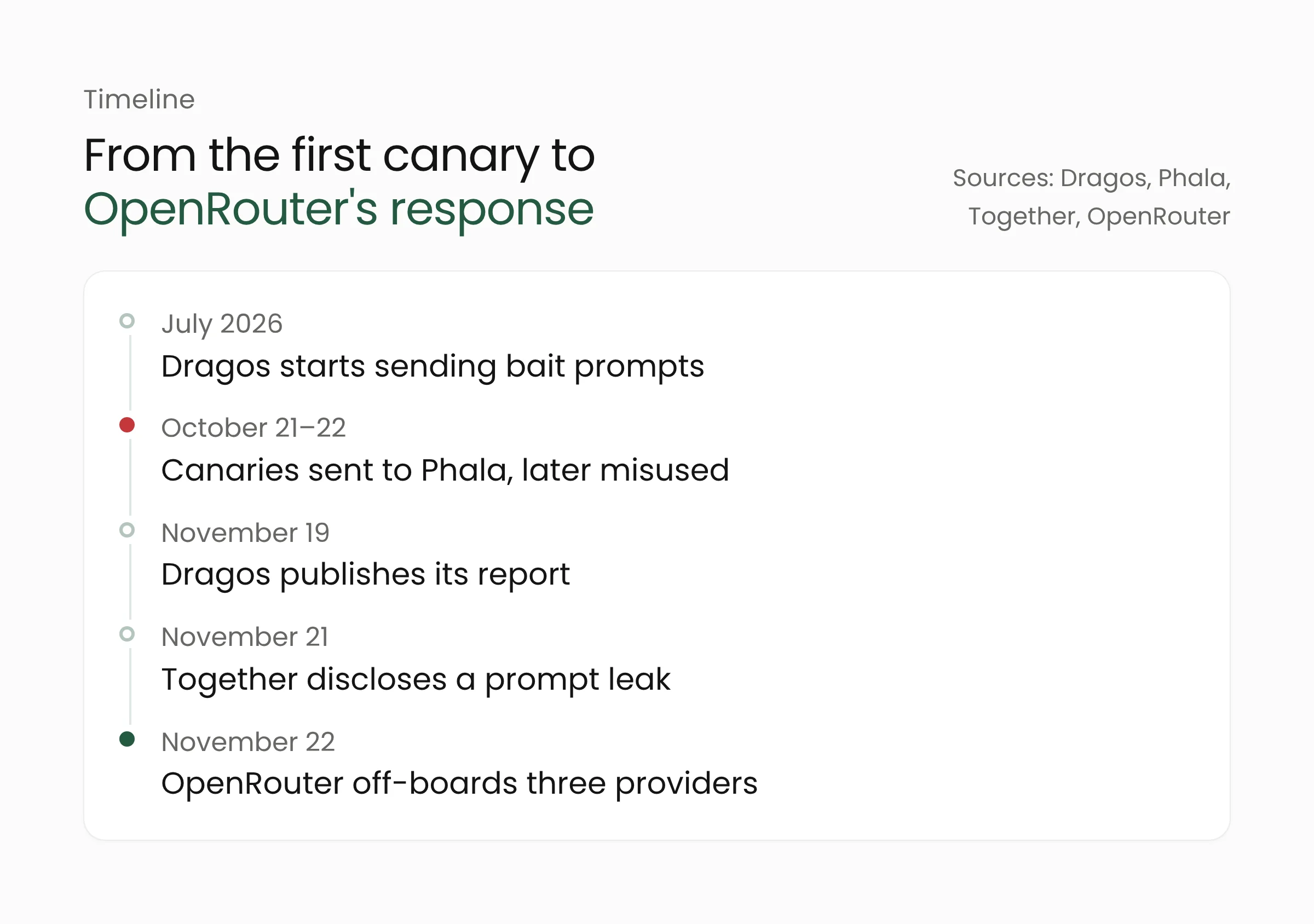
AI prompt leaks have been documented at several inference providers. Researchers at Dragos sent nearly two million prompts seeded with bait secrets over five months and watched who used them. Three hosting providers turned out to be breached, and on November 22, 2026, OpenRouter removed three providers from its platform.
Nearly two million bait prompts in five months
The research was led by HD Moore, chief research officer at Dragos and the creator of Metasploit. In a report published on November 19, 2026, his team said it submitted roughly two million prompts to widely used AI services between July and November 2026. Each prompt carried URLs and credentials that existed nowhere else.
Dragos argues that prompts and replies are often worth more than the GPU time used to process them, because they contain source code, customer data, and credentials.
How canary tokens work
A canary token is a fake secret that exists in exactly one place. If anyone uses it, the owner knows that place has been exposed. Every Dragos request carried an AWS key, a DNS name, and a URL that had never appeared anywhere before. The AWS keys were real but tied to empty accounts with full logging, so every attempt to use them was recorded.
A prompt passes through many hands
Many applications do not call an AI model directly. They send prompts to an AI router, a service that offers a single API address and forwards requests to a pool of models and hosting providers under one bill. Dragos notes that a request often crosses more than one router before it reaches the server hosting the model, and that every hop can see the full prompt and response.
Some routers are open marketplaces where the seller with the lowest price gets the request. The strictest privacy setting is known as Zero Data Retention (ZDR), which specifies that prompts and responses are not stored.
The three main findings
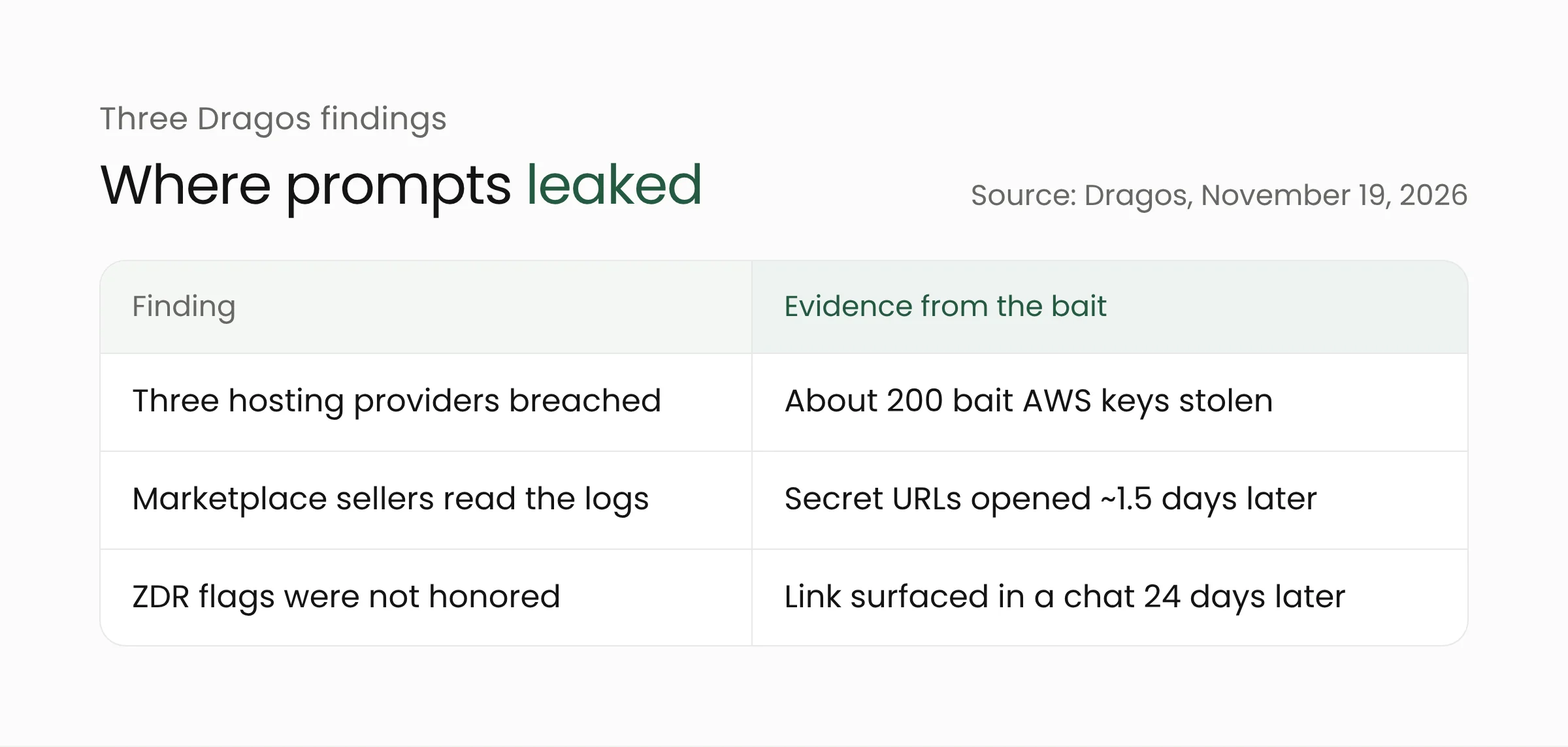
Three hosting providers were breached
The most serious finding is that attackers were actively stealing data from three hosting providers. The earliest incident dates to mid-July, and Dragos says none of the three knew about the intrusion until the researchers told them.
The largest breach involved a couple hundred bait AWS keys sent to a single provider in late October. Some of the stolen keys came from requests the provider rejected before a model ever ran, which led Dragos to conclude the attacker was copying requests at the provider’s front door. In the other two breaches, some stolen requests were marked ZDR. Moore wrote, “A privacy flag doesn’t help when the attacker is already inside.”
Once the attackers held the keys, they tested them, in some cases within hours of the request. They then searched S3 and Secrets Manager for data and tried to enable models in AWS Bedrock. The bait keys were used for tens of thousands of AWS API calls. The bait prompts were processed alongside real customer requests, and Dragos believes those were almost certainly copied as well.
Marketplace sellers read prompts through logging
The second finding required no exploit. Sellers on an inference marketplace only had to list a model at the lowest price, turn on request logging, and wait. In one case, about a day and a half after two prompts went through a single seller, someone on a home broadband connection opened both secret URLs.
Privacy settings were ignored
No credential was used in the third finding. The secret URLs inside prompts were visited repeatedly by companies that should never have seen them. The clearest example involves an unnamed Chinese AI lab. Its systems fetched the secret URLs from more than half of the prompts sent to its models between July and October, including roughly two-thirds of the requests marked as no data collection or ZDR.
The same thing happened to prompts sent to several U.S. hosting providers that resell the lab’s models. In one incident, a secret link appeared in a company’s Feishu chat channel 24 days after the ZDR-flagged prompt was sent.
How OpenRouter and the providers responded
OpenRouter, an AI router named in the Dragos report and in the providers’ notices, published a statement on November 22, 2026. The company said the findings did not show any breach or unauthorized access of OpenRouter itself. It took three actions: it off-boarded three providers, removed 125 endpoints from ZDR eligibility, and notified all potentially affected customers. The three off-boarded providers are not named.
Three providers have published their own notices:
- Phala. In a preliminary report dated November 10, Phala said an attacker took control of an inference virtual machine on a new GPU server that was running without the company’s full production security hardening. Phala asks customers to treat request contents as exposed for DeepSeek V4 Flash 0731 requests routed by OpenRouter between October 21 and November 8, 2026. Phala says the incident was contained on November 8.
- Together AI. A November 21 notice says an AI coding agent committed a credential to the company’s public GitHub repository. An unauthorized party used it to download prompt samples from June and July 2026 that were stored in a private repository. Five of the credentials that party later tested were Dragos canaries.
- Novita. A November 22 notice confirms that some MiniMax model requests were forwarded to MiniMax’s official API because of a routing configuration issue. The window runs from May 28 to November 11, 2026, and includes requests that arrived through OpenRouter.
Limits worth keeping in mind
Dragos does not name most providers in its report, so any link between a finding and a company can only be taken from each provider’s own notice.
The test is also based on sampling. Phala notes that only canaries sent on October 21 and 22 were shown to be misused, yet it keeps a wider precautionary window because the tests did not monitor every request. Both Phala and Together are still investigating. Crypto Briefing points to a different concern: the breached providers did not detect the theft on their own for months.
What this means for teams that use AI services
Dragos is explicit that none of this means organizations should stop using AI services. Teams that rely on a router for chatbots, coding assistants, or document summaries need to decide where prompts go.
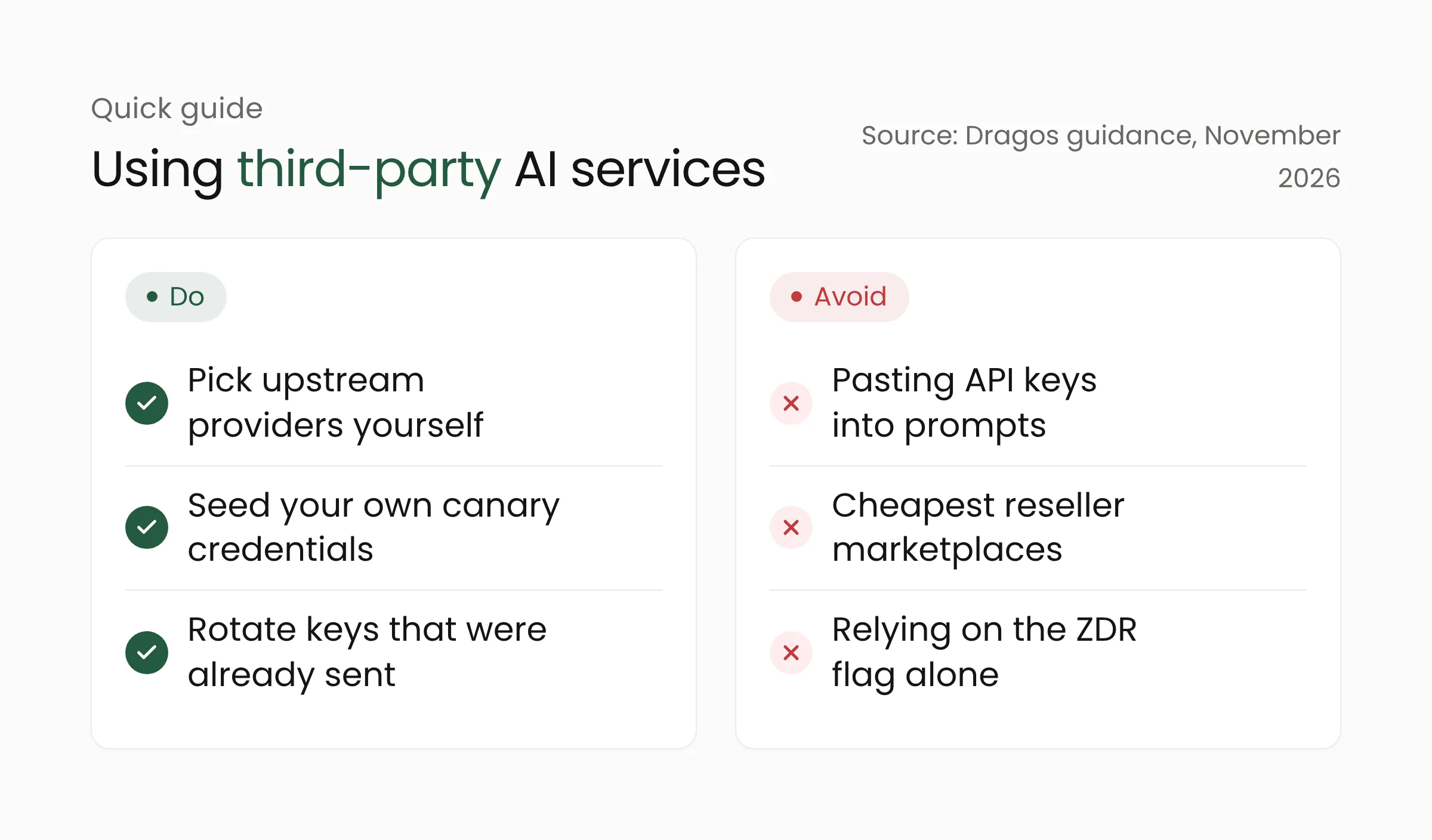
- Map the path your prompts take. On a router, pick the upstream providers yourself instead of accepting the default pool, then verify that your privacy settings actually change where requests go.
- Keep secrets out of context. Dragos warns that AI agents send whatever they can read, including credentials. Do not paste API keys, passwords, or customers’ personal data into prompts, and limit the folders an agent may read. We covered a related risk in our article on fake AGENTS.md files.
- Rotate credentials that were already sent. Phala and Novita advise customers to revoke and rotate any credentials included in requests during the affected windows.
- Seed your own canaries. Add a fake credential to the context your agents already send and treat any use of it as an incident. Dragos says a free Canarytoken from Thinkst is enough to get started. It also shared two attacker tool user agents,
artex-agentandartex-judge-r121, that teams can search for in AWS CloudTrail logs. - Match the path to the sensitivity of the data. For the most sensitive work, Dragos suggests self-hosted models or a direct contract with a single first-tier provider. Dragos notes the hardware is not cheap and cites an eight-GPU B300 server at $570,000 or more.
For teams in Indonesia, prompts that contain personal data also fall under Undang-Undang Nomor 27 Tahun 2022 tentang Pelindungan Data Pribadi (the Personal Data Protection Law), so legal and compliance staff should take part in mapping data flows. An architecture review through our artificial intelligence services and cybersecurity services is one place to start.
Frequently asked questions
Was OpenRouter breached?
No, according to OpenRouter. The findings concern inference providers that receive requests from routers, and the company says there is no evidence of a breach or unauthorized access to its own systems.
Is Zero Data Retention still worth enabling?
Yes, but it is not enough by itself. Dragos cautions that a privacy flag only binds the first hop. The setting does not protect data if a provider further down the chain is breached or ignores it.
How can I tell whether my prompts were affected?
OpenRouter says it has notified all potentially affected customers. Compare your usage history with the models and time windows disclosed by Phala, Together, and Novita. If in doubt, rotate any credential that was placed in a prompt.
Closing
The Dragos canary test shows that the supply chain behind an AI service is longer than a pricing page suggests. More disclosures may follow. Dragos says it is working with about a dozen providers, and Phala has promised a full root cause analysis. If your team would like to review the data path of an AI application it is building, the Merakit team is ready to talk.
Sources
- Three breaches, endless leaks: Your AI supply chain needs canaries, Dragos, November 19, 2026
- Data Processing Incidents on Inference Providers, OpenRouter, November 22, 2026
- Security event: Prompt leakage for requests in June and July of 2026, Together AI, November 21, 2026
- Phala November preliminary incident report, Phala, November 10, 2026
- Privacy notice regarding MiniMax requests on Novita, Novita, November 22, 2026
- HD Moore’s canary experiment exposes data leaks across the AI supply chain, Crypto Briefing, November 20, 2026