Blog Artificial Intelligence
Apple's Health AI Study and What It Means for Hospitals
On this page· 7 sections
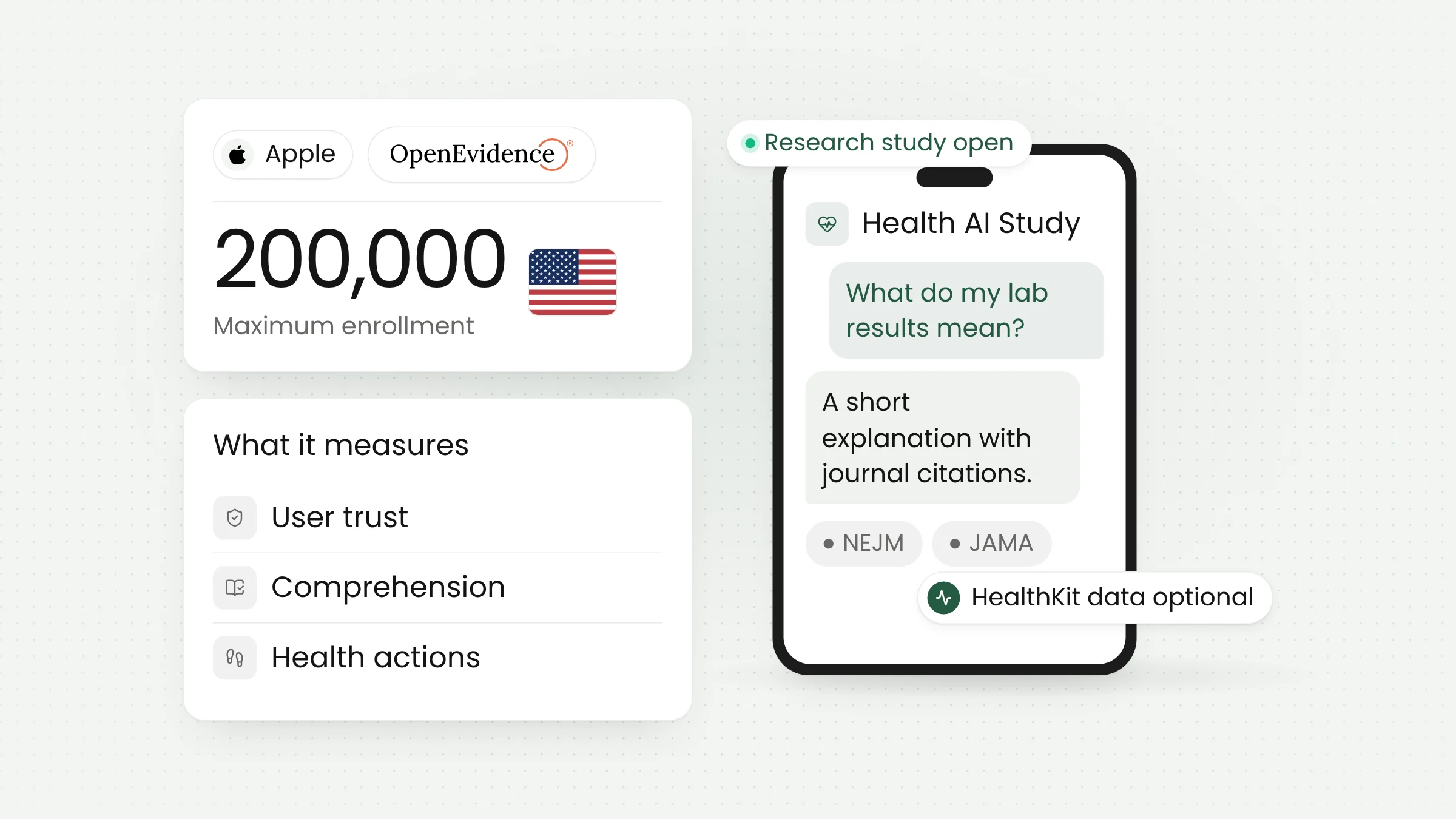
Apple launched the Apple Health AI Usage Study, a health AI study run with the clinical AI platform OpenEvidence, on November 15, 2026. The virtual US study will enroll up to 200,000 people who ask health questions through a dedicated app. Its goal is to learn how much people trust and understand AI answers.
The announcement came at the HLTH conference in Las Vegas, according to Healthcare Dive. The approach stands out because Apple chose to study user behavior first, while several other technology companies have already released AI health assistants to the public. For hospitals, clinics, and health app developers in Indonesia, the study design offers a template for testing a health chatbot before patients use it.
Inside Apple’s health AI study with OpenEvidence
According to Apple’s announcement, participants download the Apple Health AI Study App from the App Store, read about the study, and decide whether to enroll. In the app, they can ask health questions ranging from basic to complex and receive answers in plain language.
Eligibility is narrow. Participants must be 21 or older, live in the United States, and use an iPhone that supports Apple Intelligence, meaning an iPhone 15 Pro or later running iOS 26 or later. Enrollment is capped at 200,000 people. Apple has not said how long the study will run.
Apple is also clear about what the app does not do. It is not intended to diagnose or treat any condition and does not replace medical advice. The Next Web, citing Engadget, reported that the app is not integrated with Siri or Apple Intelligence. It works as a standalone research app, separate from the iPhone’s built-in features.
The four things the study measures
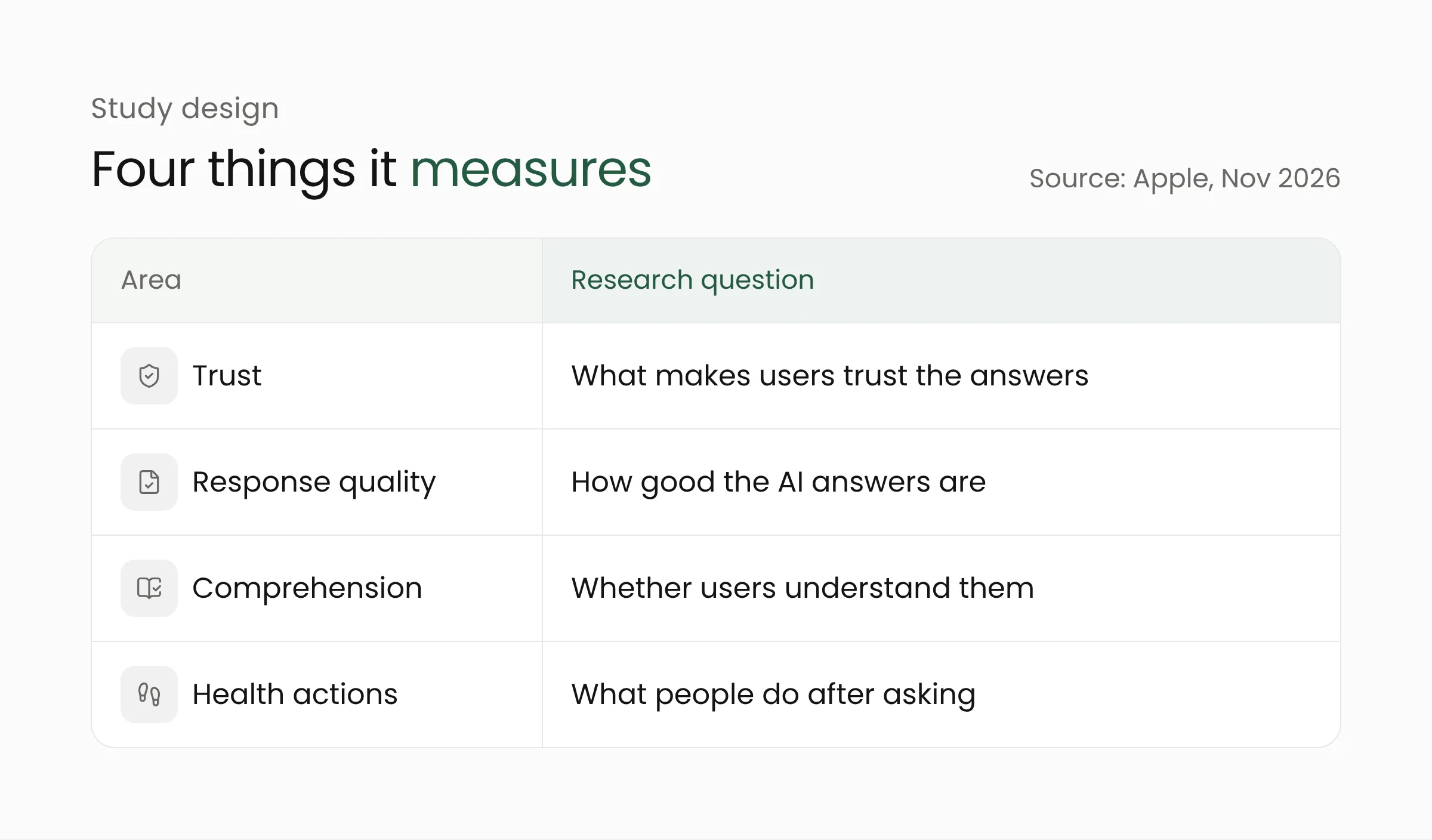
Apple says the study examines what drives user trust in health AI, the quality of the responses, how well users understand them, and which everyday health actions they take afterward. The four are linked. An accurate answer is not always understood, and an answer that is understood is not always trusted or acted on.
The study also tests how personal data shapes the answers. Participants can share data from HealthKit, where the iPhone stores health records, such as resting heart rate, activity, sleep, or lab results. Apple wants to know whether that data makes answers more relevant and easier to understand.
Another area is preparing for doctor visits. Apple wants to see whether AI can help participants plan their questions and understand their condition before they meet a clinician. OpenEvidence CEO Daniel Nadler told Healthcare Dive that short appointments can leave patient concerns unaddressed, and that the app could help bridge that gap.
OpenEvidence, data privacy, and the limits of the claims
Answers grounded in medical journals
OpenEvidence is a clinical AI platform widely used by healthcare professionals. Its answers draw on sources such as The New England Journal of Medicine, the Journal of the American Medical Association (JAMA), and Nature, with linked citations. Healthcare Dive cited a 2026 NBC News report saying OpenEvidence’s AI search tool is used by almost two-thirds of US physicians.
Apple chose the partner for its clinical grounding. The study app also includes guardrails that detect certain concerning questions and suggest that participants follow up with a provider or other resources. Apple has not explained in detail how those guardrails work.
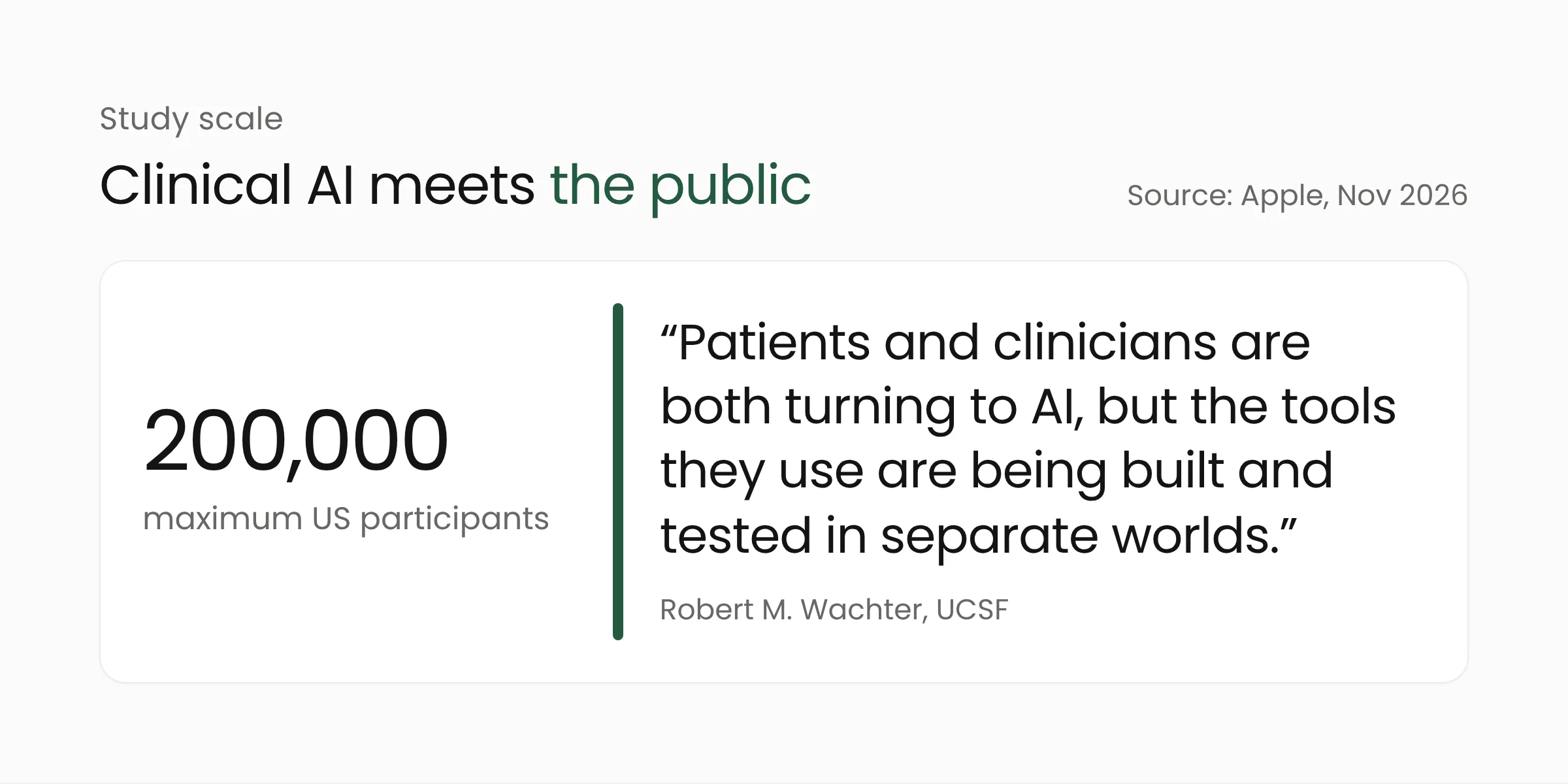
Robert M. Wachter, professor and chair of the Department of Medicine at the University of California, San Francisco, pointed to the gap between patient tools and clinician tools in Apple’s announcement: “Patients and clinicians are both turning to AI, but the tools they use are being built and tested in separate worlds.” The study tries to close that gap by putting a platform built for doctors in front of the general public.
Participant data stays out of AI training
Apple says study data will not be used to train AI models. Participants decide which HealthKit metrics and survey responses they share. Apple also says it has implemented security measures to protect the study data it maintains, although the announcement does not describe them.
No results yet, and a limited pool
The study has only just started, so there are no accuracy or trust figures to assess. Chief Healthcare Executive also noted that requiring an iPhone 15 Pro or later could skew the participant mix, since people with older phones cannot join. Any findings will need to be read with that limitation in mind.
The field is crowded. A KFF poll cited by Healthcare Dive found that roughly one-third of US adults have used an AI chatbot to discuss their health. The Next Web noted that OpenAI launched ChatGPT Health in January, followed by Microsoft’s Copilot Health and Perplexity Health in March. Concerns about fabricated or incomplete answers and weak safety guardrails in AI health tools remain common.
What this means for digital health providers
Hospitals, clinics, and health app companies in Indonesia are starting to weigh AI assistants that answer patient questions, from follow-up schedules to explanations of lab results. Apple’s study design offers several practical lessons.
Measure patient comprehension as well as accuracy. Chatbot pilots often stop at asking whether the answer was correct. Add a short survey after each conversation to check whether patients understood the answer and know what to do next, such as when to go to the emergency department.
Ground answers in clear references. Answers should cite their sources, such as current clinical practice guidelines or the hospital’s official patient education material. Patients and doctors can then trace where the information came from, and medical teams can review wrong answers more easily.
Build guardrails and referral paths. Questions about severe symptoms or self-harm should be routed to clinicians or emergency services instead of receiving a long machine-written reply. Test the list of triggers with doctors before the app opens to the public.
Ask for consent for each type of data. Indonesia’s Undang-Undang Nomor 27 Tahun 2022 tentang Pelindungan Data Pribadi (Personal Data Protection Law) classifies health data and information as specific personal data. As in Apple’s study, let patients choose which data they share, and keep service data separate from any data used to train models. If data is not used for training, say so in writing in the privacy policy.
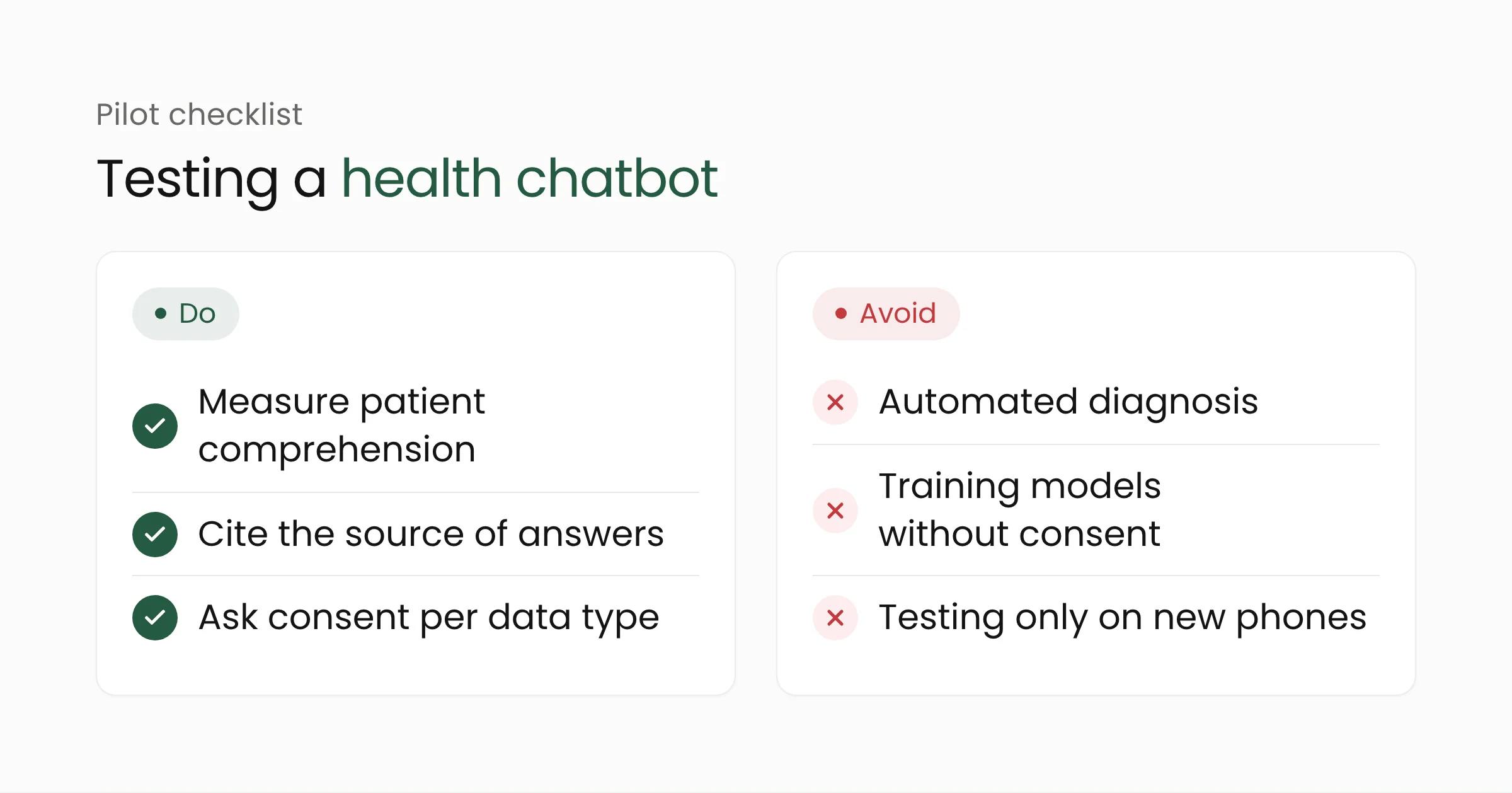
Test with a diverse group of users. The weakness noted in Apple’s study, a participant pool limited to owners of recent phones, can happen here too. Include older adults, people on low-end phones, and patients with limited digital literacy in pilots. Indonesia’s health app inclusivity guidelines work well as a checklist.
Merakit’s healthcare solutions team helps hospitals and clinics design this kind of rollout, from limited pilots to monitoring once patients are using the app. On the model side, our artificial intelligence services team can help set up testing for answer quality and guardrails.
Frequently asked questions
Can people in Indonesia join Apple’s health AI study?
Not at the moment. Apple says the study is open only to US residents aged 21 or older who use an iPhone 15 Pro or later running iOS 26 or later. Apple has not announced plans to expand it to other countries.
Does the study app give diagnoses?
No. Apple says the study app is not intended to diagnose or treat any condition and does not replace medical advice. For certain concerning questions, the app suggests that participants contact a healthcare provider.
Will participants’ health data be used to train Apple’s AI?
According to Apple, no. Study data will not be used to train AI models, and participants choose which HealthKit data or survey responses to share. The claim comes from Apple and has not been independently audited.
Closing thoughts
The Apple Health AI Usage Study has not produced any findings yet, but the questions it asks matter to anyone building digital health services: do patients trust the AI’s answers, understand them, and act on them correctly? Hospitals and clinics in Indonesia can use the same questions as a benchmark before opening a chatbot to patients. If you are planning an AI assistant for healthcare services, the Merakit team is ready to talk.
Sources
- Apple Newsroom: Apple launches research study to explore the use of AI for health (November 15, 2026)
- Healthcare Dive: Apple, OpenEvidence launch conversational health AI study and app (November 16, 2026)
- Chief Healthcare Executive: Apple plans to study how consumers use AI for health needs (November 16, 2026)
- The Next Web: Apple and OpenEvidence test whether people trust AI with health questions (November 16, 2026)