Blog Digital Health
Eko CORE 300 AI Stethoscope and What It Means for Clinics
On this page· 7 sections
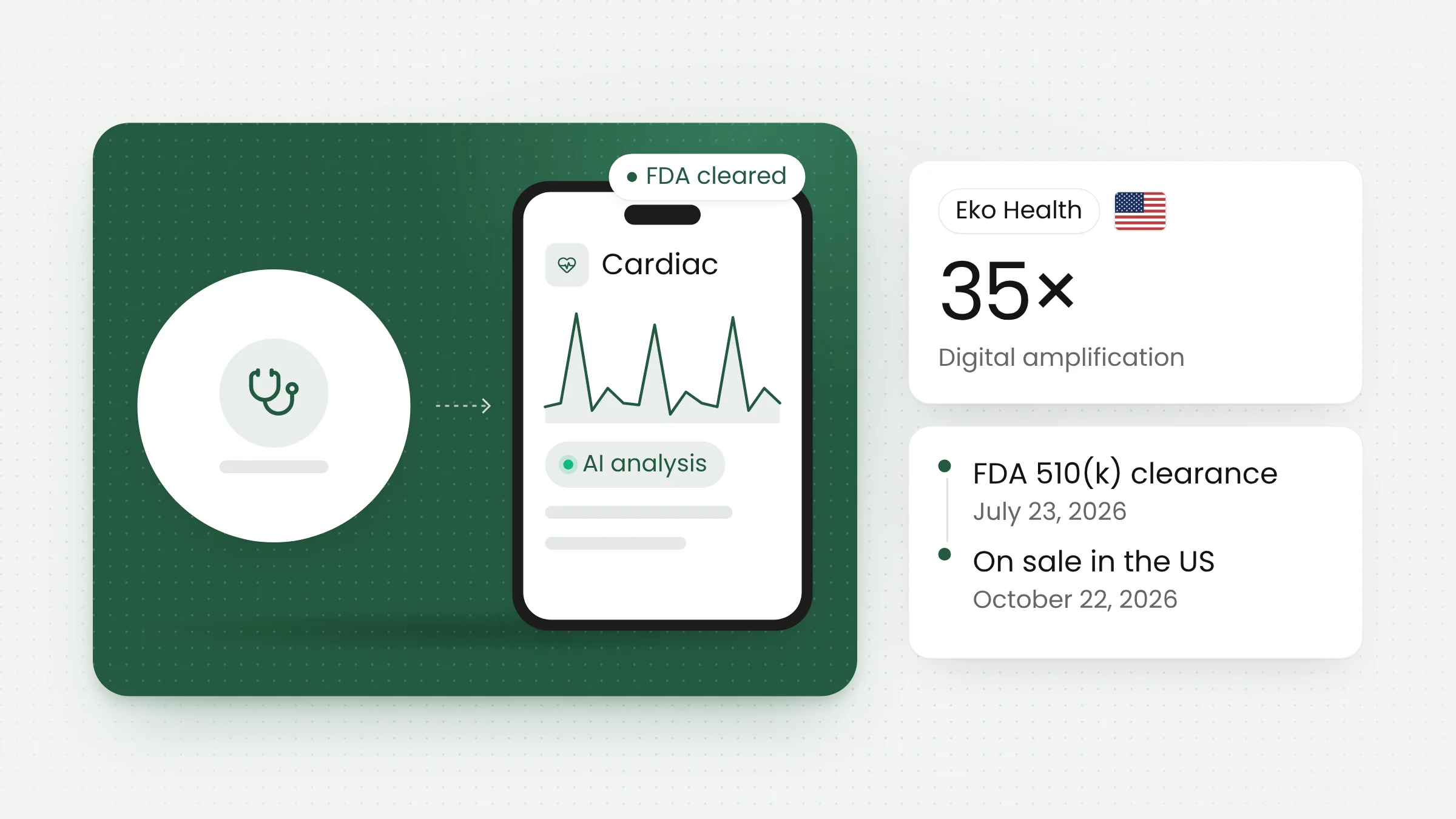
Eko Health began selling the Eko CORE 300 AI stethoscope in the United States on October 22, 2026. The $199 device combines analog and digital listening in a single chestpiece and, when paired with the Eko app, can flag heart murmurs using FDA-cleared AI.
Analog and digital listening in one chestpiece
The stethoscope is part of almost every physical exam, from a general practitioner’s office to a hospital ward. Digital stethoscopes have been on the market for years, but most of them depend on a battery to work at all. In its launch press release, Eko Health describes the CORE 300 as the first stethoscope to integrate traditional and digital listening modes directly into one chestpiece.
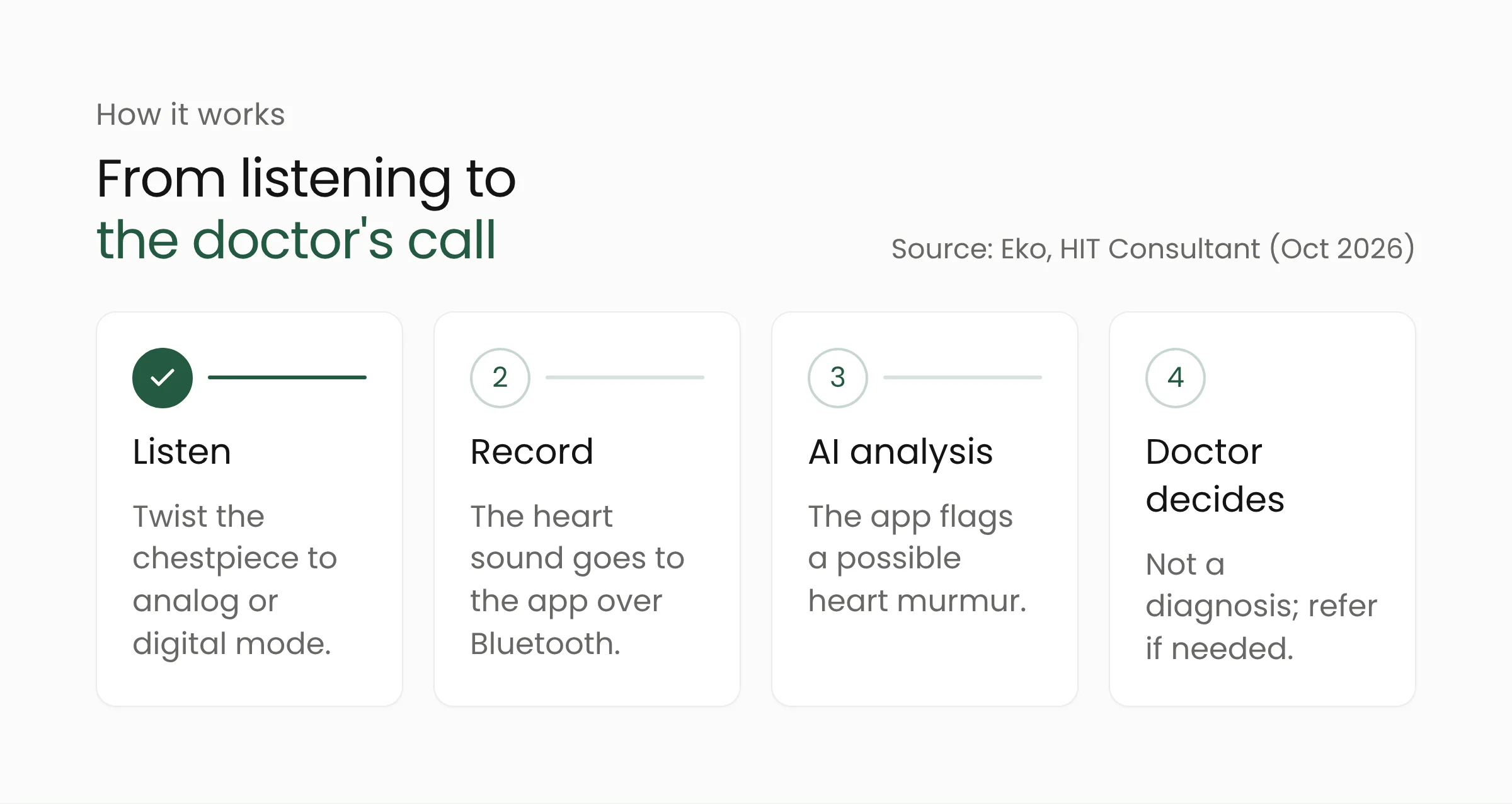
Clinicians switch modes by twisting the chestpiece. In analog mode the device behaves like a conventional acoustic stethoscope, and HIT Consultant notes that this mode still works when the battery is completely drained. In digital mode, sound is amplified up to 35 times with active noise cancellation, and users can choose among three filters: Cardiac, Pulmonary, and All Purpose.
The chestpiece carries a shatter-resistant monochrome display that shows heart rate as the exam happens. According to Eko’s product page, the device weighs 150 grams, is 69 centimeters long, and has an IP22 water resistance rating. It ships with a 45 mm adult diaphragm, and a 36 mm pediatric diaphragm is available. It charges over USB-C and offers up to 120 hours of clinical use per charge.
Recording is the other half of the design. Heart, lung, and body sounds can be recorded, visualized, and saved, then shared over Bluetooth Low Energy. For a physician, that means a sound can be replayed later or sent to a colleague for a second opinion.
How the heart murmur detection works
A heart murmur is an extra sound beyond the normal beats of the heart. Many murmurs are harmless, but some point to a structural problem, such as a faulty heart valve. Picking them up by ear takes a trained listener and a reasonably quiet room, and busy clinics cannot always offer either.
With the CORE 300, the analysis is handled by a separate algorithm that has FDA clearance for detecting structural murmurs. It runs in the Eko app on a phone, not inside the stethoscope. The stethoscope records the heart sound and sends it to the app, where the AI model checks whether the recording contains a murmur pattern worth a closer look. The result appears in the app and on the stethoscope’s display.
Eko is explicit about the limits. Its product page states that Eko AI is intended for licensed healthcare professionals only and that its findings are not a diagnosis. The clinical decision stays with the physician, who would typically order a follow-up test such as an echocardiogram if something looks wrong.
Eko’s chief medical officer, Steven Steinhubl, described the aim of the feature to HLTH: “The goal is to help clinicians recognize signs of heart disease earlier, during an exam patients already receive.” For patients, the extra check needs no additional visit or equipment.
The CORE 300 also has clear gaps. It does not detect atrial fibrillation, an irregular heart rhythm; Eko’s product page says that feature requires the CORE 500, the company’s higher-end model. The launch materials do not give accuracy figures for the murmur algorithm, and no independent evaluation of the CORE 300 has been published so far.
Price, subscription, and availability
According to HLTH, the CORE 300 received FDA 510(k) clearance on July 23, 2026, and went on sale in the United States on October 22, 2026. The clearance covers adult and pediatric patients. Eko’s press release says only that the device is priced in line with premium traditional stethoscopes, while HIT Consultant and Eko’s product page list the price at $199.
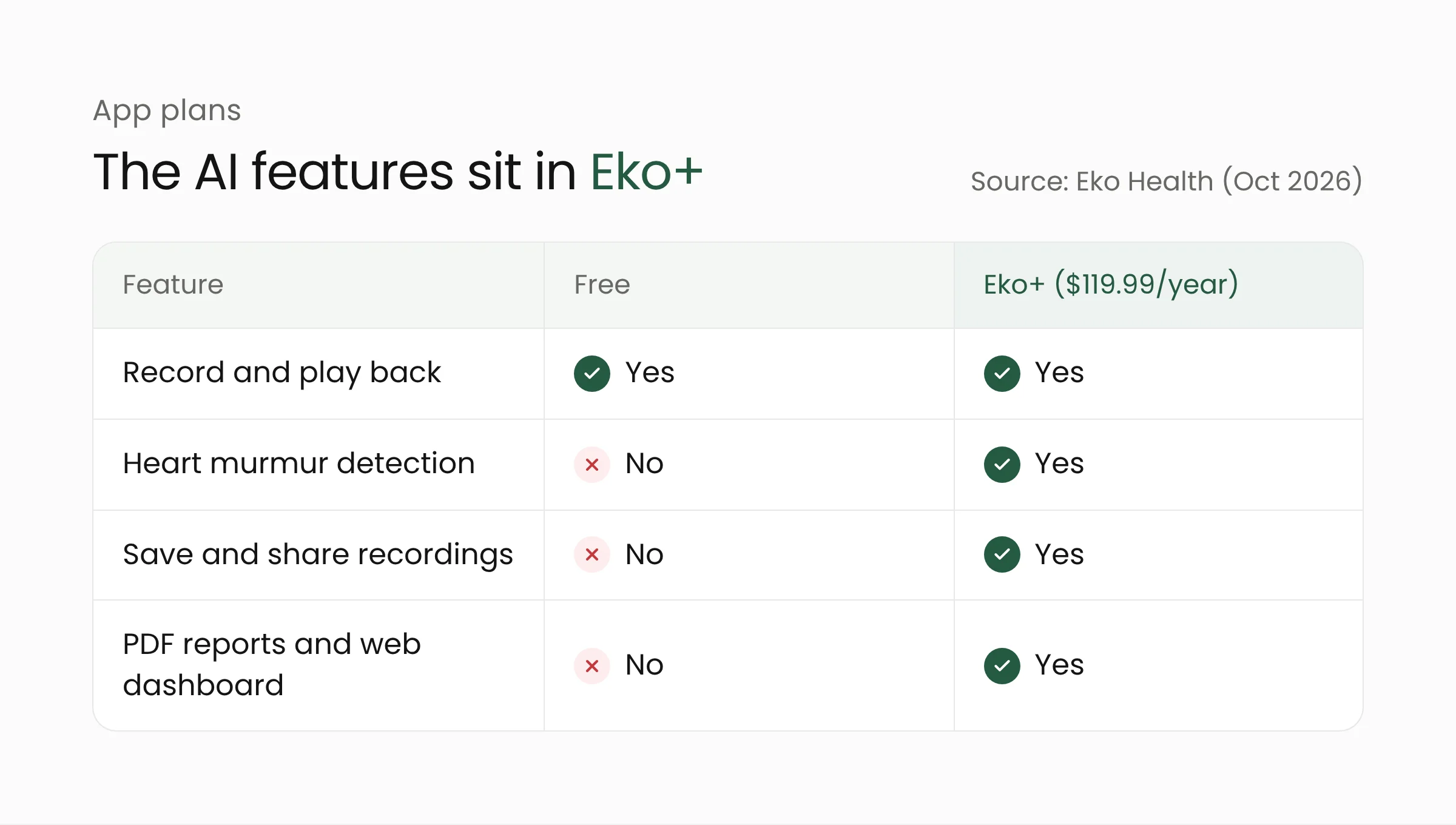
The AI features are not included in the hardware price. Buyers get a 14-day free trial of the Eko+ plan, after which the subscription renews automatically at $119.99 a year. Without Eko+, users keep a free plan that covers live sound visualization, wireless listening, and recording with playback.
Outside the United States, Eko plans launches in Canada, the United Kingdom, and selected European markets. HIT Consultant reports that regulatory filings are underway in Asia-Pacific and Latin America, without naming specific countries. Availability in Indonesia has not been announced, and Eko’s product page says Eko AI is offered only where local regulators have approved it.
Eko is not a newcomer. The company, headquartered in Emeryville, California, says it has delivered more than 750,000 devices worldwide across digital stethoscopes, ECG devices, software, and AI-powered analysis.
What this means for clinics and community health centers
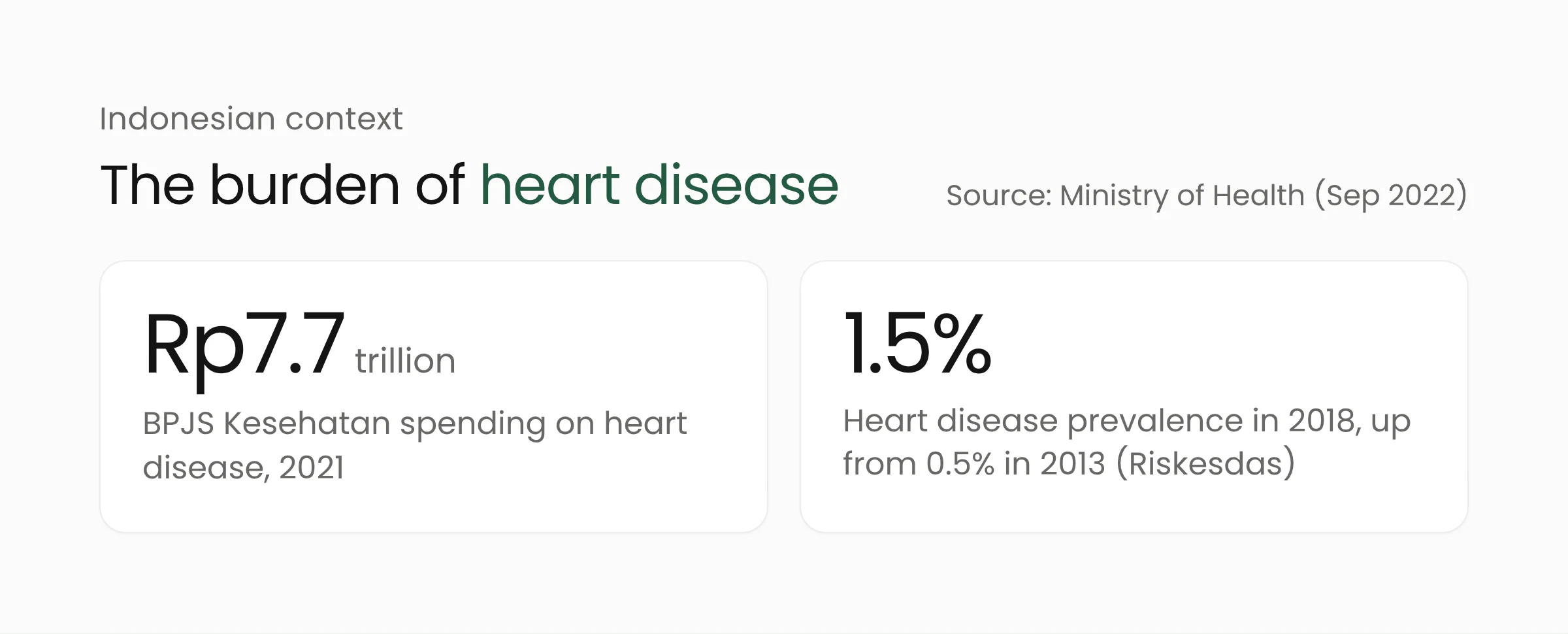
Heart disease weighs heavily on Indonesia’s health system. In a Ministry of Health release from September 2022, the ministry named heart disease the leading cause of death in the country, citing Global Burden of Disease and IHME data for 2014 to 2019. The same release noted that heart disease prevalence rose from 0.5 percent in 2013 to 1.5 percent in 2018, according to the national Riskesdas survey, and that BPJS Kesehatan, the national health insurer, spent Rp7.7 trillion on heart disease in 2021, more than on any other condition.
The ministry’s response has been to strengthen primary care, including screening for the 14 leading causes of death. That is where a smart stethoscope becomes relevant. Community health centers, known as puskesmas, already use a stethoscope at nearly every visit, so a tool that flags possible murmurs could add a layer of screening without changing the flow of care. Before a device like the CORE 300 is used, though, providers should work through several practical questions:
- Market authorization. Imported medical devices sold in Indonesia need a distribution permit from the Ministry of Health, based on Minister of Health Regulation No. 62 of 2017 (Peraturan Menteri Kesehatan Nomor 62 Tahun 2017). Until that permit exists, the device cannot be officially purchased or used in a health facility.
- Annual cost. Add the device price to the yearly subscription for each unit, then compare it with the number of patients examined and the referral costs it could save.
- Phones and connectivity. The AI analysis runs in the app, which Eko says requires iOS 18 or Android 13 or later. Facilities need suitable phones and a reliable connection, especially in remote areas.
- Patient data. Heart sound recordings are health data. Storage and sharing must follow Indonesia’s Personal Data Protection Law (Undang-Undang Pelindungan Data Pribadi), and the results need a clear place in the electronic medical record.
- Referral pathway. Decide in advance what happens when the AI flags a murmur: who re-examines the patient and where the patient goes for an echocardiogram.
The last point is often overlooked. A screening tool only helps if its results lead to action. Hospitals and clinics that have already linked their electronic records to SATUSEHAT, as covered in our piece on hospital readiness, have a clearer path for recording findings from devices like this.
Integration is the real work. Merakit helps healthcare providers build digital healthcare solutions, from medical records to patient queues, and connects medical devices and sensors to those systems through its IoT services.
Frequently asked questions
Can the Eko CORE 300 AI stethoscope diagnose heart disease?
No. Eko states that Eko AI is intended for licensed healthcare professionals and that its findings are not a diagnosis. The feature flags a possible structural murmur, and the physician decides whether further tests are needed.
Can the AI features be used without a subscription?
No. Murmur detection is part of the Eko+ plan, which costs $119.99 a year after a 14-day free trial. Without a subscription, the stethoscope still works in analog and digital modes, including recording and playback.
Is the Eko CORE 300 available in Indonesia?
Not yet announced. Eko currently sells the CORE 300 in the United States and plans launches in Canada, the United Kingdom, and parts of Europe. Regulatory filings in Asia-Pacific are reported to be underway, but Indonesia was not named.
Closing thoughts
The Eko CORE 300 shows where everyday medical devices are heading: a tool physicians already know now records data and offers an early AI flag, at a price close to a premium conventional stethoscope. For healthcare providers in Indonesia, the most valuable preparation lies in the systems behind the device, namely how results are recorded, how data is protected, and how referrals work. If you are planning those steps, the Merakit Indonesia team is ready to talk.
Sources
- Eko Health Launches CORE 300 to Bring AI-Enabled Stethoscopes to Every Healthcare Professional, PR Newswire, October 22, 2026
- Eko Health Launches CORE 300: FDA-Cleared AI Stethoscope, HIT Consultant, October 23, 2026
- Eko Health Launches FDA-Cleared CORE 300 Stethoscope with AI-Assisted Heart Murmur Detection, HLTH, October 23, 2026
- CORE 300 Digital Stethoscope, Eko Health, accessed October 25, 2026
- Penyakit Jantung Penyebab Utama Kematian, Kemenkes Perkuat Layanan Primer, Ministry of Health of Indonesia, September 29, 2022
- Apa Itu Izin Edar Alat Kesehatan?, izin.co.id, August 18, 2026