Blog Flutter
Flutter 3.50 Release: Migration Steps for App Owners
On this page· 7 sections
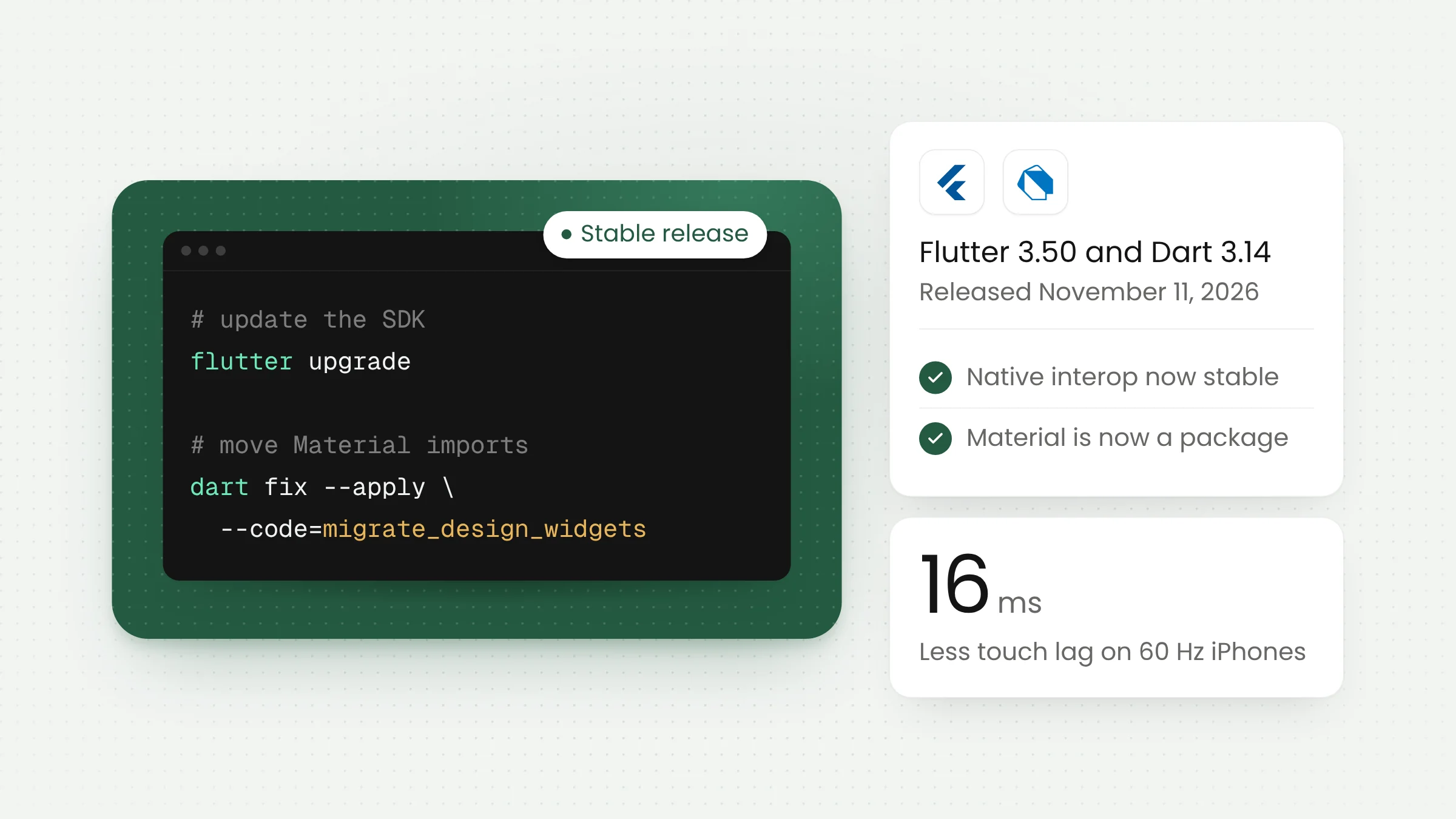
Google released Flutter 3.50 alongside Dart 3.14 on November 11, 2026. The stable release moves the Material and Cupertino design libraries into separate packages, makes direct native interop production-ready, and cuts touch latency on iPhones. For teams that own Flutter apps, it also sets a migration deadline worth putting on the calendar.
What shipped in Flutter 3.50 and Dart 3.14
Flutter is Google’s framework for building Android, iOS, web, and desktop apps from a single codebase, written in the Dart language. According to the official Flutter blog, the 3.50 cycle drew 188 contributors, 69 of them first-timers, who landed more than 1,200 commits. Developers can install it with flutter upgrade.
The framework has a large footprint. The Flutter team says more than one million Flutter apps are now published on Google Play. One showcase it highlights is Holafly, an eSIM provider with more than 2 million monthly users that unified its apps in three months.
The biggest changes fall into five areas. Native code can now be called directly, the design libraries are split from the core, iOS gets faster touch response, Android closes a configuration hole, and WebAssembly support reaches more browsers.
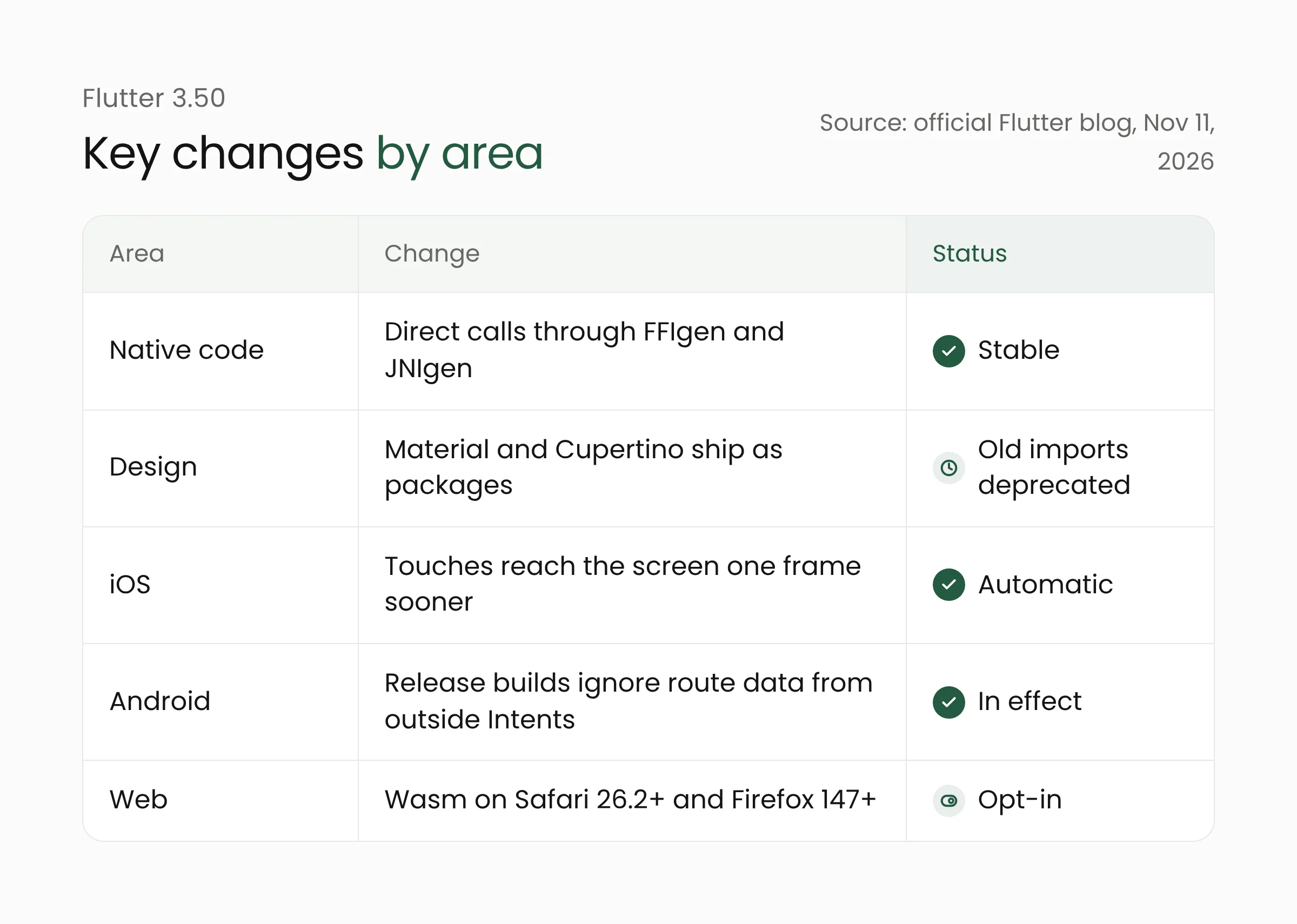
Direct native interop is the change many developers have waited for. Until now, Flutter apps talked to Android or iOS code through platform channels, which serialize data into messages and decode it on the other side. In 3.50, FFIgen (for C and Objective-C) and JNIgen (for Java and Kotlin) are stable, so Dart code can call native functions without that layer. Very Good Ventures notes that the widely used shared_preferences package has already moved to the new approach.
Dart 3.14 landed the same day. The Dart release notes list automated SDK migrations through dart migrate, a re-engineered DartPad, and faster WebAssembly as its headline features. The dart migrate command upgrades code to the next Dart version and fixes what would otherwise break.
Material and Cupertino move out of the Flutter core
Material is Flutter’s Android-style component library, and Cupertino is its iOS-style counterpart. Almost every Flutter app imports one of them, usually through import 'package:flutter/material.dart'. Flutter 3.50 formally deprecates those built-in imports and moves the widgets into the standalone material_ui and cupertino_ui packages. New projects created with flutter create now use material_ui by default.
Deprecation does not mean removal. Existing apps still compile, but as Very Good Ventures puts it, “Deprecated is not removed, but every app and package that imports the built-in libraries will have to move eventually.” The Flutter team provides dart fix --apply --code=migrate_design_widgets to update imports and localization delegates automatically.
The split lets design components ship updates without waiting for the next Flutter release. Teams that maintain several apps, such as a point-of-sale app, a product catalog, and a courier app for one retail chain, should schedule the migration app by app so testing stays manageable.
Changes users will feel on iOS and Android
On iOS, touch input now reaches the screen a full frame sooner. The Flutter blog puts the gain at roughly 16 milliseconds on 60 Hz iPhones and 8 milliseconds on 120 Hz ProMotion displays, with benchmarks reaching back to the iPhone 6s. Shoppers will notice it when scrolling a product list or swiping through promo cards. These figures come from the Flutter team’s own testing and have not been independently verified.
The more urgent iOS change concerns CocoaPods, the long-standing dependency manager for iOS projects. The CocoaPods blog schedules its central trunk to stop accepting new Podspecs on December 2, 2026, while noting that the dates are not set in stone. Existing builds will keep working, but dependency updates from trunk will stop. Flutter 3.50 now prints a warning on every CLI command when Swift Package Manager is turned off, and the opt-out will eventually be removed. Flutter has also stopped testing on Intel-based Macs.
On Android, release builds now ignore the route, dart_entrypoint, and cached_engine_id values that other apps pass in through Intents, and they reject engine flags such as --dart-flags. Intents are Android’s mechanism for sending instructions between apps. The Flutter team says the change closes a security hole. Very Good Ventures explains that the hole let other apps pass startup configuration to yours, while deep links keep working as before. Debug builds log a warning whenever a value is ignored.
New Android projects also get newer defaults: compileSdkVersion and targetSdkVersion at API 36, minSdkVersion at API 24, and Java 17 as the minimum.
WebAssembly expands to Safari and Firefox
For web apps, Flutter 3.50 widens support for WebAssembly (Wasm), a binary code format that browsers can run directly. Wasm is already on by default in Chrome and Edge 137 and later. Safari 26.2+ and Firefox 147+ can now be enabled through the wasmAllowList setting in flutter_bootstrap.js. The Flutter team claims both browsers deliver more than twice the frame rate of the JavaScript build on heavy widget benchmarks.
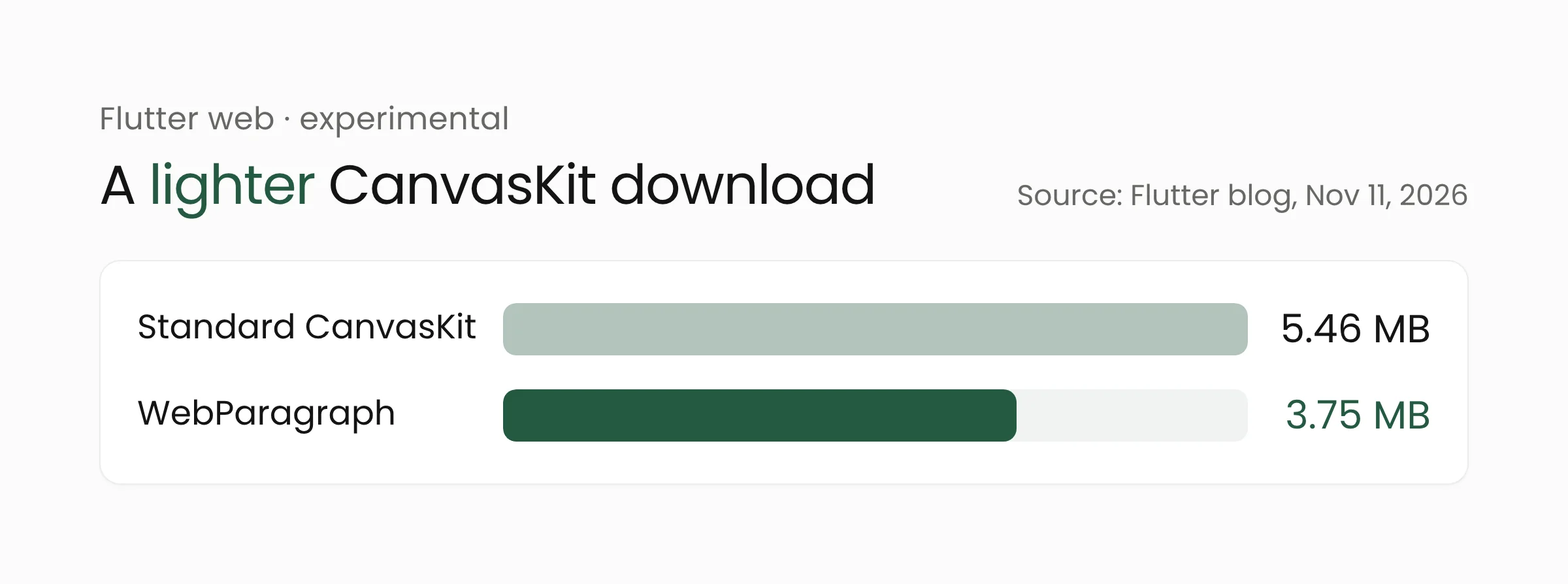
An experimental feature called WebParagraph hands text layout to the browser. As a result, the initial download of CanvasKit, Flutter’s web rendering engine, shrinks from about 5.46 MB to 3.75 MB, and color emoji render natively. For an online store, a smaller first download means catalog pages open faster on mobile networks.
At the same time, the older dart:html, dart:js, dart:js_util, and package:js libraries are now deprecated and scheduled for removal, replaced by dart:js_interop and package:web. Running flutter build web --no-deprecated-js-interop flags legacy code that blocks a move to Wasm. Teams running customer portals on Flutter web should audit this early, ideally with a web development partner.
What this means for app owners
Most Flutter 3.50 changes do not force an update today. Still, the December 2026 CocoaPods deadline and the deprecated Material imports mean migration work is coming. For retail apps that get busy at year-end, the best window is before the big promotional season begins.
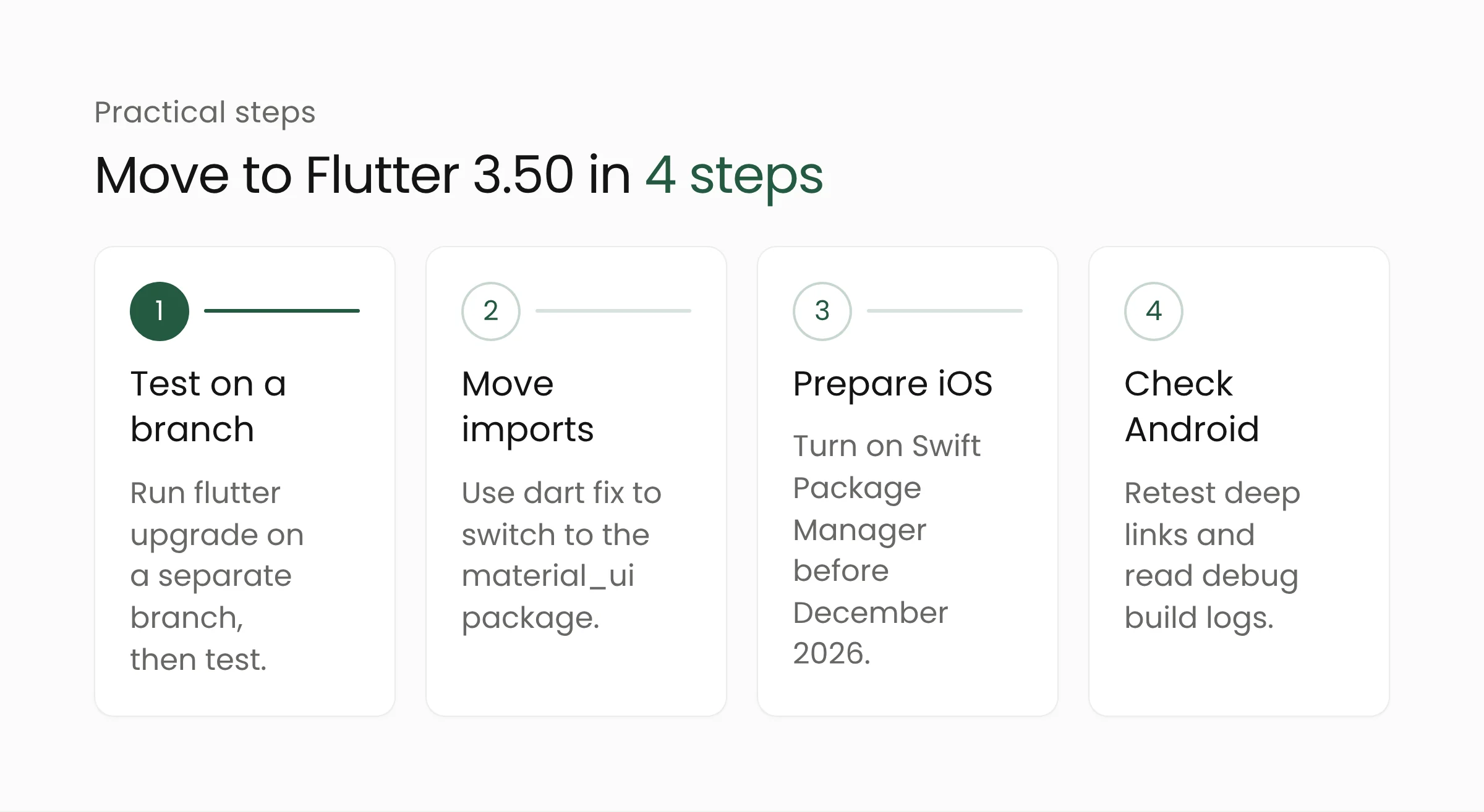
Practical steps for teams:
- Test the upgrade on a separate branch. Run
flutter upgradeon a dedicated branch, then run the full automated test suite and manually test critical flows such as checkout and sign-in. - Move the design imports. Run
dart fix --apply --code=migrate_design_widgetsand review visual changes, especially on forms and buttons. Very Good Ventures recommends tryingdart migrate --dry-runon a single package first. - Prepare the iOS project. Turn on Swift Package Manager and confirm every plugin in use supports it before December 2026. Plugins that are no longer maintained need replacements.
- Check Android and web. Retest deep links from notifications, ads, and promo links, and read debug build logs to see which Intent values are now ignored. For web, run the legacy JavaScript interop check.
Owners whose apps were built by a vendor should ask for the migration schedule in writing, along with the list of plugins in use. In apps that have gone a long time without updates, third-party plugins are often the hardest part to migrate.
Merakit helps business teams prepare upgrades like this through its mobile app development service, including plugin audits and pre-release testing. For store chains running point-of-sale and ordering apps, the upgrade can be paired with retail management solutions so sales data stays connected.
Frequently asked questions
Will older Flutter apps stop working after Flutter 3.50?
No. Apps already installed on users’ phones are unaffected. The old Material imports still compile because they are deprecated, not removed. The impact appears only when a team builds a new version of the app with the latest SDK.
When do iOS projects need to switch to Swift Package Manager?
CocoaPods plans to stop accepting new Podspecs on trunk on December 2, 2026. After that, plugins that still depend on CocoaPods will not receive new versions from trunk. Teams should test the switch before that date.
Is Wasm enabled automatically in every browser?
Not yet. Wasm is on by default in Chrome and Edge 137 and later. For Safari 26.2+ and Firefox 147+, developers must opt in through wasmAllowList. Older browsers still receive the JavaScript build as a fallback.
Closing thoughts
Flutter 3.50 brings improvements users will feel right away, such as more responsive touch on iPhones, along with homework for development teams. The most pressing item is moving iOS projects to Swift Package Manager before December 2026. If you want to map what this release means for your store, service, or internal apps, the Merakit team can help you plan the migration.
Sources
- What’s new in Flutter 3.50, official Flutter blog, November 11, 2026
- Flutter 3.50 and Dart 3.14: Key Changes and Migration Steps, Very Good Ventures, November 11, 2026
- What’s new, official Dart documentation, November 2026
- CocoaPods Trunk Read-only Plan, CocoaPods blog, November 30, 2024 (updated May 2025)