Blog Gemini 4 Hydrogen
Gemini 4 Hydrogen and the New Cost of AI in Education Apps
On this page· 8 sections
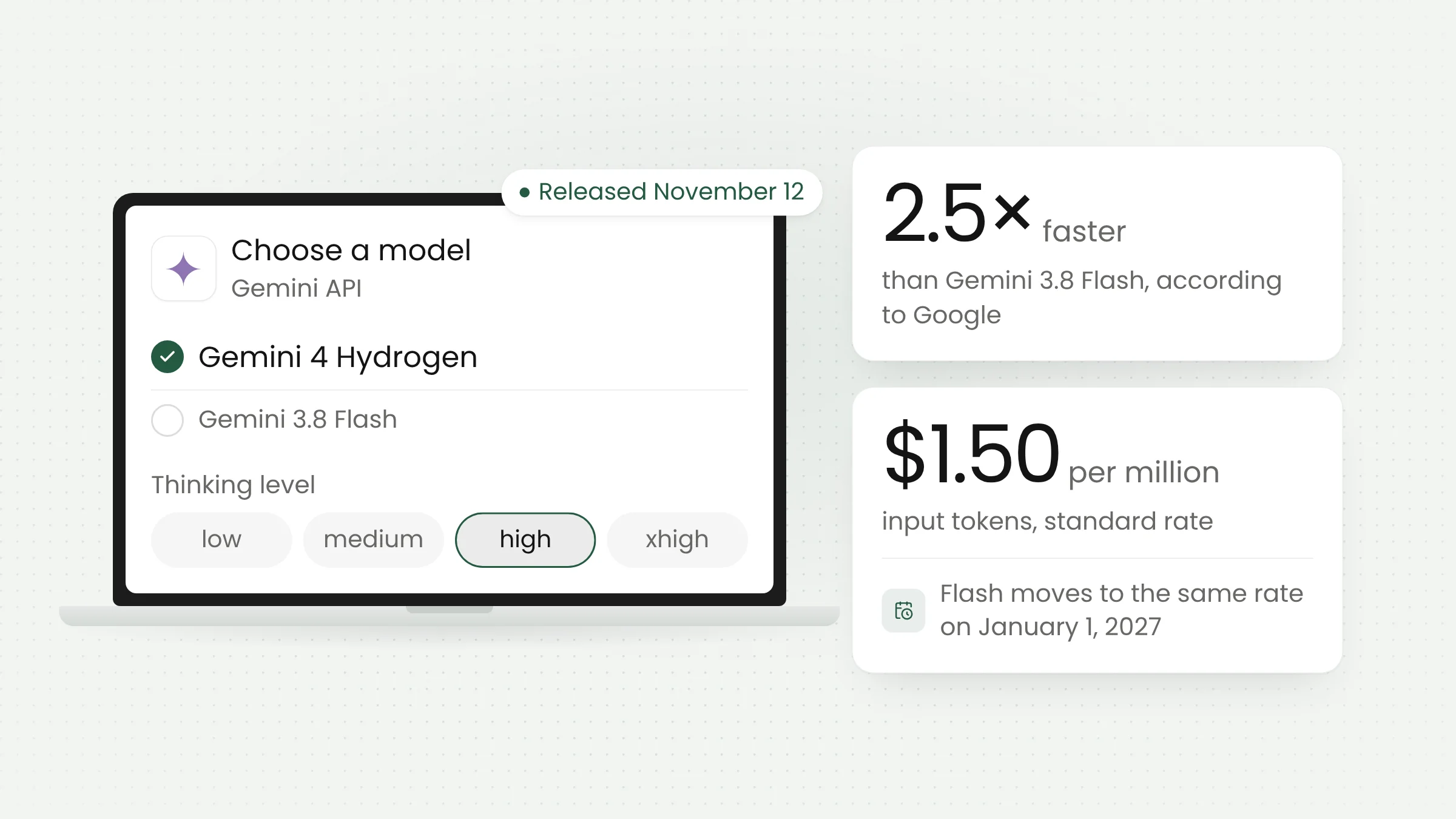
Google released Gemini 4 Hydrogen on November 12, 2026, as its fast everyday model and the successor to Gemini 3.8 Flash. It costs $1.50 per million input tokens, twice the current Flash rate. Flash itself moves to the same price on January 1, 2027, so developers of education apps will need to rework their AI budgets.
What Google launched
Gemini 4 Hydrogen is the third member of the Gemini 4 family, after Gemini 4 Argon and Gemini 4 Carbon. In Google’s announcement, Koray Kavukcuoglu, Google’s Chief AI Architect, positions Argon and Carbon for long-horizon reasoning on the hardest problems. Hydrogen is built for speed and efficiency in everyday coding and agentic workflows, where an AI system carries out several steps of a task on its own by calling other tools.
The model can work alone or as the “executor” alongside Carbon and Argon. In Google Antigravity, Google’s agent-based coding tool, a new feature called Orchestrator splits the work between them. Carbon plans, and Hydrogen edits code and runs tests. According to the Antigravity team blog, the pairing came close to Carbon’s task success rate while using about 24% less quota and finishing about 19% faster.
Hydrogen became available on launch day across several products:
- developers: the Gemini API, Google AI Studio, and Android Studio;
- businesses: Gemini for business, plus Gemini in Google Sheets for eligible business subscriptions;
- consumers: the Gemini app, including free users through automatic model selection, and Google Search for all users;
- Google Antigravity for paid Google AI Pro and Ultra subscribers.
Google also announced changes to Search. Robby Stein, VP of Product for Google Search, wrote on Google’s blog that Hydrogen helps Search handle complex or multi-part questions, show more comparison tables and images, and link to a broader range of sources. “This is the biggest model upgrade to Search yet,” Stein wrote. Google said the improvement applies across all languages supported by AI Mode, without listing them.
Speed and capability claims
Google says Hydrogen completes tasks 2.5 times as fast as Gemini 3.8 Flash at its default reasoning setting. On Terminal-Bench 4.1, a test of coding tasks run in a terminal, Hydrogen completed 57% of tasks against 18.2% for Flash. Google also claims fabricated claims in answers fell by more than five times.
Independent scoring comes from Artificial Analysis, which publishes a composite index for comparing AI models. According to VentureBeat, Hydrogen scored 51 at the high reasoning setting, one point above Gemini 4 Argon, while Gemini 3.8 Flash scored 31 at the same setting.
Early customer results are also appearing. Box CEO Aaron Levie posted a chart showing that the accuracy of Box’s agent on an internal evaluation rose from 74% with Flash to 79% with Hydrogen. Levie said Hydrogen took less than half as long on a typical task and used about 12% fewer tokens.
Limits of the claims
Most of these figures come from Google’s launch materials. The Box result comes from early access and a social media post and has not been published as a study. VentureBeat also notes that Google’s Terminal-Bench 4.1 differs from the Terminal-Bench 4.0 suite used by Artificial Analysis, so the numbers cannot be compared directly. Organizations still need to test with their own data and languages.
Hydrogen pricing and the Flash price change
According to Google AI Studio’s pricing page, Hydrogen’s standard rate is $1.50 per million input tokens and $7.50 per million output tokens, including tokens spent on thinking. The rate is flat across the full 1 million token context window. For work that does not need an immediate answer, the Batch and Flex modes cut both rates in half.
Gemini 3.8 Flash currently costs $0.75 for input and $3.75 for output. The same page states that from January 1, 2027, Flash’s standard rates rise to $1.50 and $7.50, matching Hydrogen. Flash’s Batch, Flex, and cache rates also rise on that date.
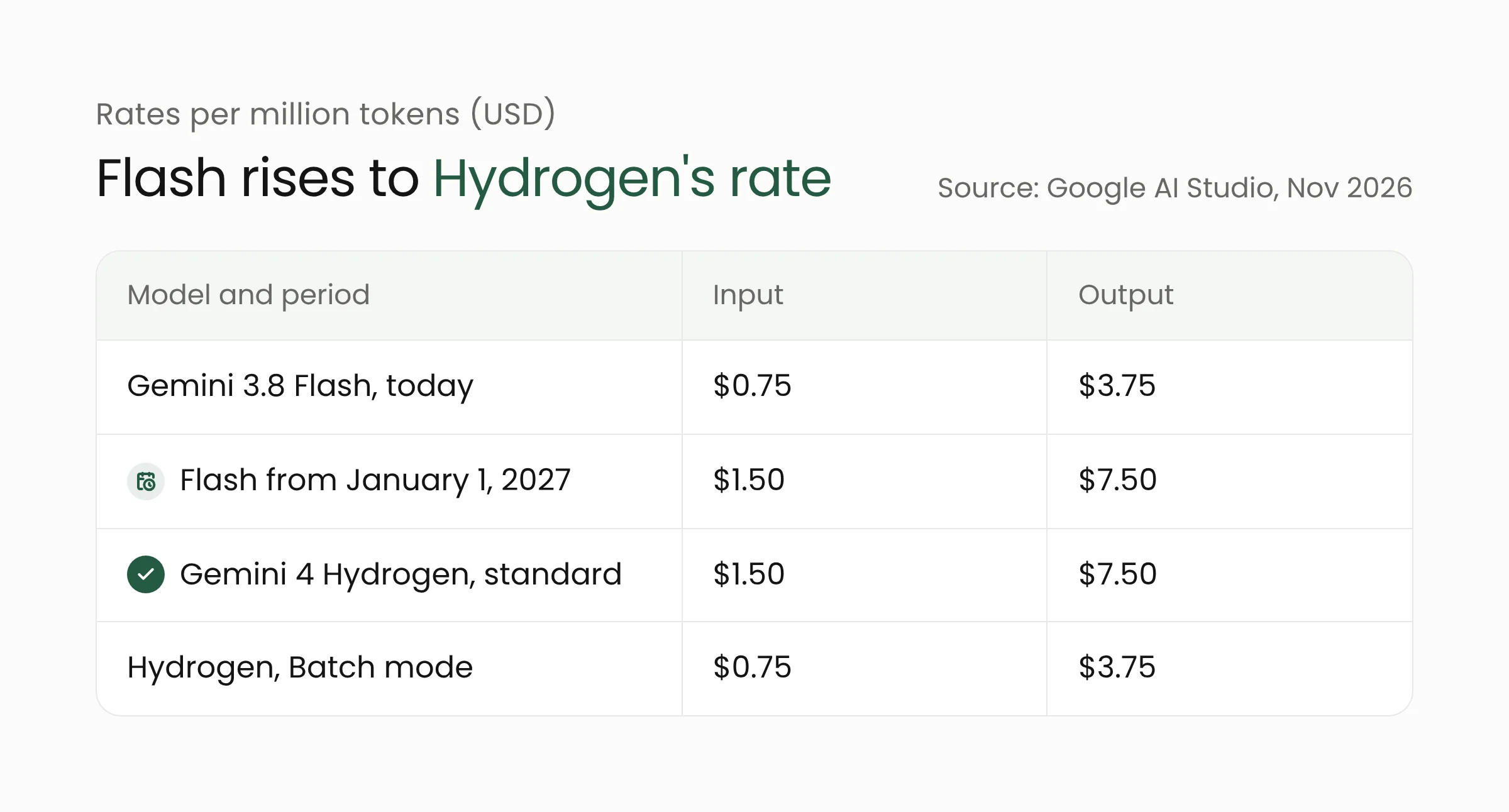
As a rough illustration, take a platform that processes 100 million input tokens and 20 million output tokens a month. At today’s Flash rates the bill is about $150. At Hydrogen’s standard rates, or Flash rates after January 2027, it becomes about $300. If most of that work can move to Batch mode, the figure falls back to about $150.
Hydrogen is also far more expensive than budget models from rivals. VentureBeat calculates that Hydrogen costs 15 times as much per token as the lowest standard rates of Claude Haiku 5.5, GPT-6 Luna, and Meta’s Muse Ember, each priced at $0.10 per million input tokens. Google appears to be betting that speed and agent reliability justify the gap, since failed tasks that must be retried also cost money.
Four thinking levels and cost per task
Hydrogen offers four thinking levels: low, medium, high (the default), and a new xhigh setting. Higher levels spend more tokens weighing an answer, so the cost per task rises with them. Flash defaulted to medium. Hydrogen defaults to high, which means an app that switches models without adjusting its settings may use more tokens than expected.
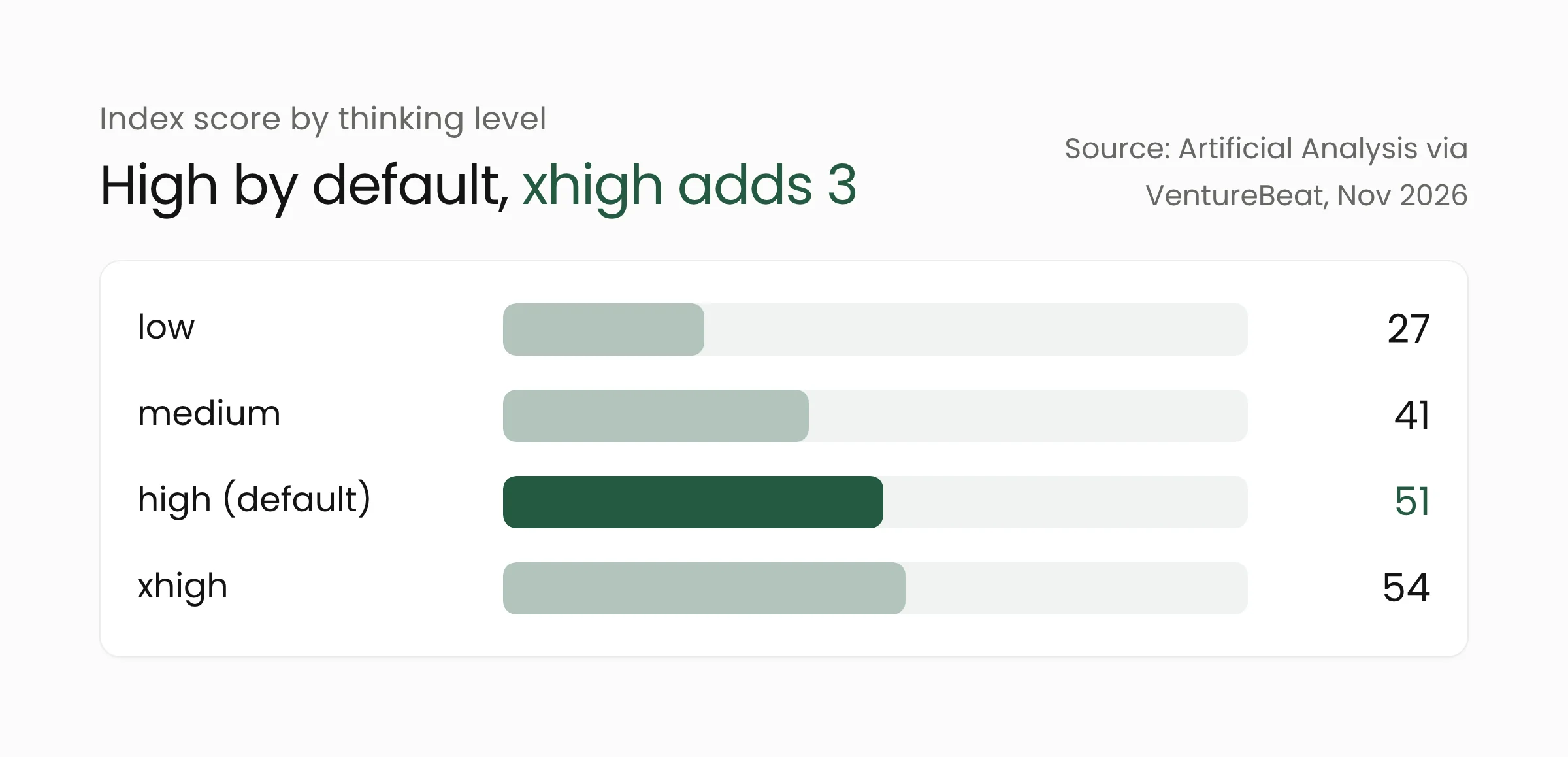
Artificial Analysis data cited by VentureBeat shows the spread. Hydrogen’s index score is 27 at low, 41 at medium, 51 at high, and 54 at xhigh. On Terminal-Bench 4.0, xhigh gave no improvement over high, yet the estimated cost of the full test suite rose from $1.87 to $3.16. The highest setting is not automatically the best choice for every task.
Parameters have changed as well. VentureBeat reports that Hydrogen rejects the thinking_budget parameter and the MINIMAL setting used by earlier models. Teams that rely on them should review their code before switching.
What this means for learning platforms
Education platforms are heavy, seasonal users of AI. A single class can submit hundreds of essays for overnight feedback, and in the run-up to exams a study assistant can field thousands of questions an hour. Per-token price changes show up directly in their monthly bills.
These steps are worth considering before January 2027:
- Map usage by feature. Record how many input and output tokens each feature uses, such as essay feedback, grade summaries for teachers, or an academic services chatbot.
- Test Hydrogen on your own content and language. Run a real sample, for instance 100 student essays in Indonesian, through both Flash and Hydrogen, then compare answer quality, time, and token counts. Vendor speed claims may not hold for local content.
- Choose a thinking level per task. Short factual questions can run at low or medium. Reserve high or xhigh for work that needs extended reasoning, such as grading written answers to math problems.
- Move non-urgent work to Batch. Bulk essay grading, question bank generation, and weekly progress summaries do not need to finish in seconds. Batch mode halves the rate.
- Compare against other models. For simple tasks such as classification or data extraction, budget models from other providers can be far cheaper.
Student data also needs care. According to VentureBeat, the cheaper Contributor mode is invite-only and requires letting Google use request data to improve products and train models. For essays, grades, or student identities, that condition should be weighed against the school’s data protection policy.
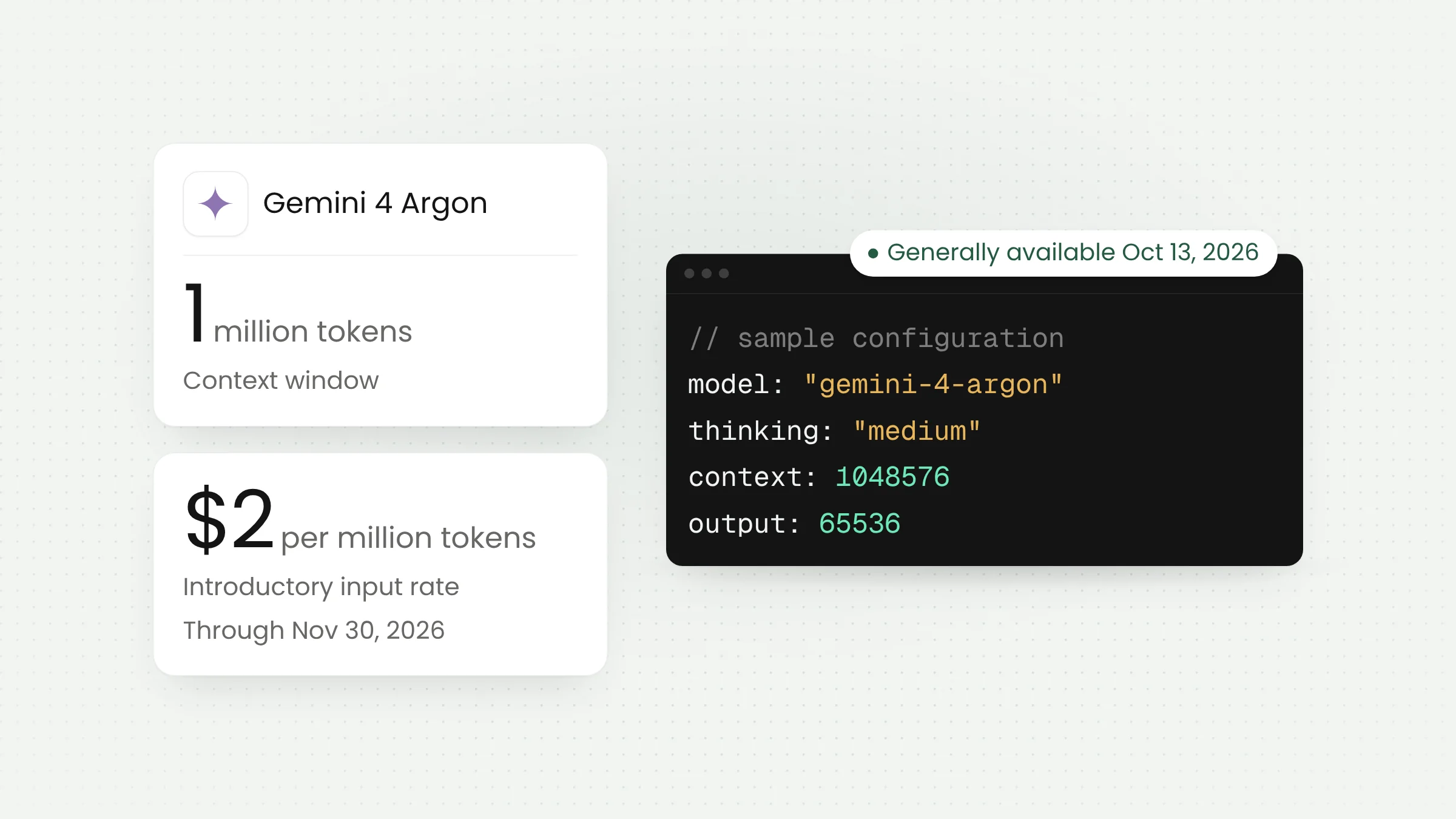
Teams building education technology solutions can use this price change to tidy up their AI architecture: separating features that need fast responses from those that can wait, and making it possible to switch models without rewriting much code. We covered a similar pattern when Gemini 4 Argon became generally available with introductory pricing that doubles after November 30, 2026.
Frequently asked questions
Can Gemini 4 Hydrogen be used for free?
Free users of the Gemini app get Hydrogen through automatic model selection when it suits the prompt, and Google Search uses it for all users. Google AI Studio’s pricing page also lists a free tier for the Gemini API. Production apps pay the standard rates of $1.50 and $7.50 per million tokens.
Do apps built on Gemini 3.8 Flash need to switch right away?
The official sources we reviewed do not give a retirement date for Gemini 3.8 Flash. What is confirmed is that Flash rates rise on January 1, 2027, to the same level as Hydrogen. With prices set to match, many teams are likely to test Hydrogen before that date.
How does Hydrogen differ from Gemini 4 Argon and Carbon?
Google positions Argon and Carbon for long-horizon reasoning on the hardest problems, and Hydrogen for fast everyday work. On the Artificial Analysis index, Hydrogen at the high setting scored 51 against Argon’s 50. Hydrogen’s standard rates are lower than the Argon and Carbon rates listed by VentureBeat.
Conclusion
Gemini 4 Hydrogen offers a faster model that Google says is more reliable for AI agents, at twice the current Flash price. The Flash price increase in January 2027 means AI cost estimates need another look, especially for high-volume education platforms. Testing on your own data and choosing the right thinking level will shape the final bill more than the per-token rate alone.
Merakit Indonesia can help you estimate costs and test model options for the AI features in your app through our artificial intelligence services. Contact us to discuss what your platform needs.
Sources
- Introducing Gemini 4 Hydrogen for Agentic Workflows, Google blog, November 12, 2026
- Google Search gets a major upgrade with Gemini 4 Hydrogen, Google blog, November 12, 2026
- Gemini 4 Hydrogen: everyday coding and agentic workflows for developers, Google blog, November 12, 2026
- Gemini 4 Hydrogen and Orchestrator, Google Antigravity blog, November 12, 2026
- Gemini API pricing, Google AI Studio, accessed November 15, 2026
- Google launches Gemini 4 Hydrogen, a faster, smarter, pricier Flash successor, VentureBeat, November 12, 2026