Blog Artificial Intelligence
Microsoft Maia 300: New AI Chip and What It Means for Costs
On this page· 7 sections
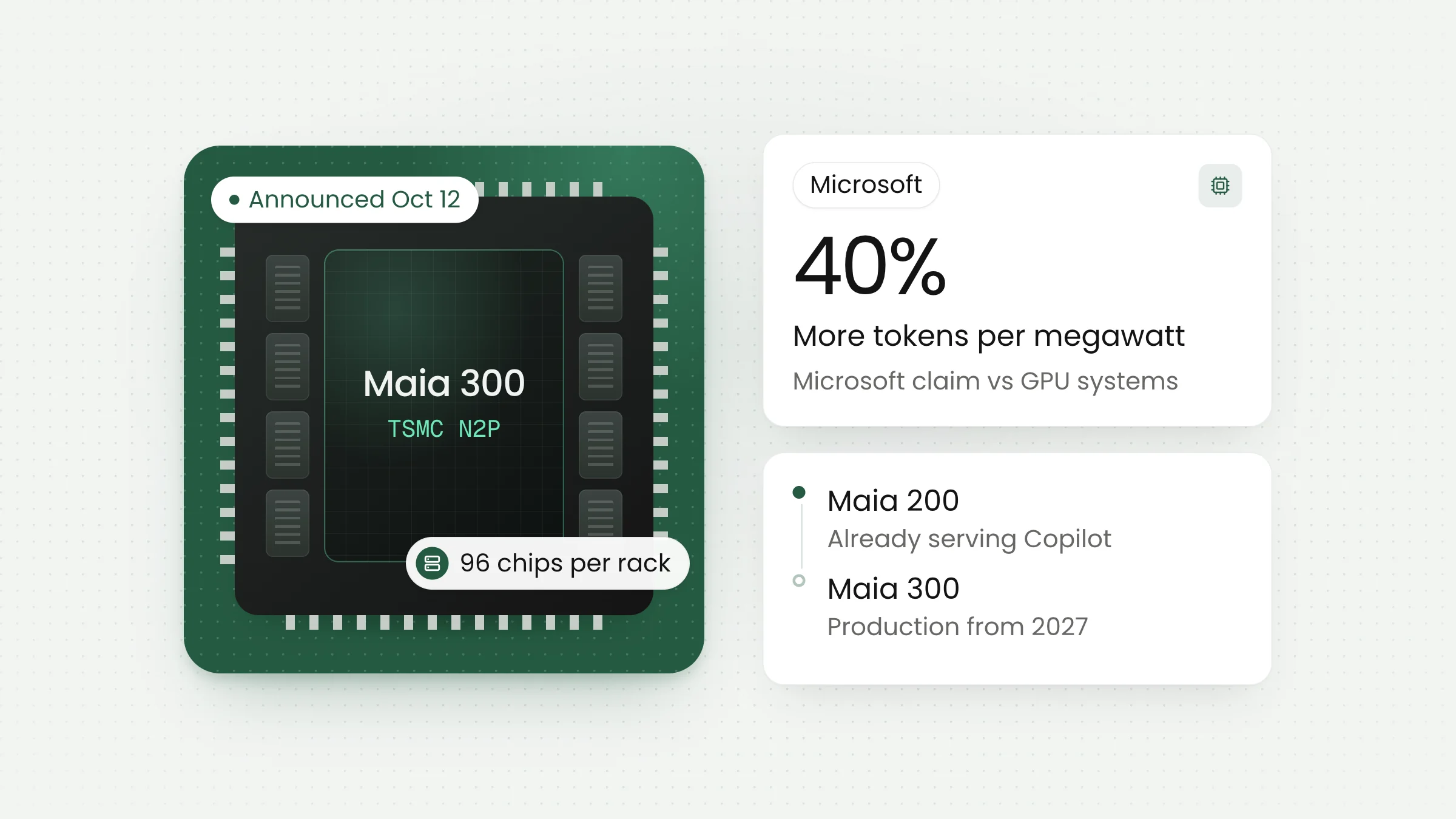
On October 12, 2026, Microsoft unveiled Maia 300, the third generation of its in-house AI chip. Microsoft claims it delivers 40% more tokens per megawatt than leading GPU-based systems, with data center deployment starting in 2027. For any organization using AI, the news touches one thing that matters: what AI costs.
What Microsoft announced
The announcement came from Scott Guthrie, Executive Vice President of Cloud + AI, on the official Microsoft blog. Maia 300 is an AI accelerator, a chip designed specifically to run AI models. Microsoft plans to begin multi-gigawatt Maia deployments in 2027, and Maia 300 enters production deployment the same year.
The chip is not sold to the public. Microsoft uses it in its own data centers to run AI services. According to the same post, the previous generation, Maia 200, already serves Microsoft Copilot and runs OpenAI models, Microsoft’s own MAI models, and several open-source model families. Maia 200 is being deployed across the United States, Europe, and Australia, with GitHub Copilot and Microsoft Foundry scheduled to follow by the end of 2026. Maia 300 is planned for GitHub, Microsoft Foundry, the MAI team, and Dragon Copilot.
Microsoft also shared results from the earlier generation. For built-in AI features in Teams and Copilot, it says Maia 200 delivers up to 1.7 times more tokens per watt than leading GPU infrastructure. That track record is what gives Microsoft the confidence to scale up the next generation.
The focus is inference: the stage where a finished AI model is put to work answering questions, summarizing documents, or running AI agents. Microsoft says Maia 300 is built for long-context conversations, reasoning, and AI agents that work through many steps.
Why tech giants build their own chips
Until now, most AI services have run on GPUs bought from chip vendors. According to UPI, Maia 300 is part of Microsoft’s plan to reduce its reliance on Nvidia chips. Even so, Microsoft has not fully moved away from Nvidia, and it also works with AMD.
The logic is simple. GPUs are general purpose, which makes them good at many kinds of work. A custom chip can be designed around the workloads a company runs most often. At the scale of millions of requests a day, small efficiency gains can add up to large savings in power and cost. Constellation Research notes that, like other hyperscalers, Microsoft is building its own processors to bring AI costs down.
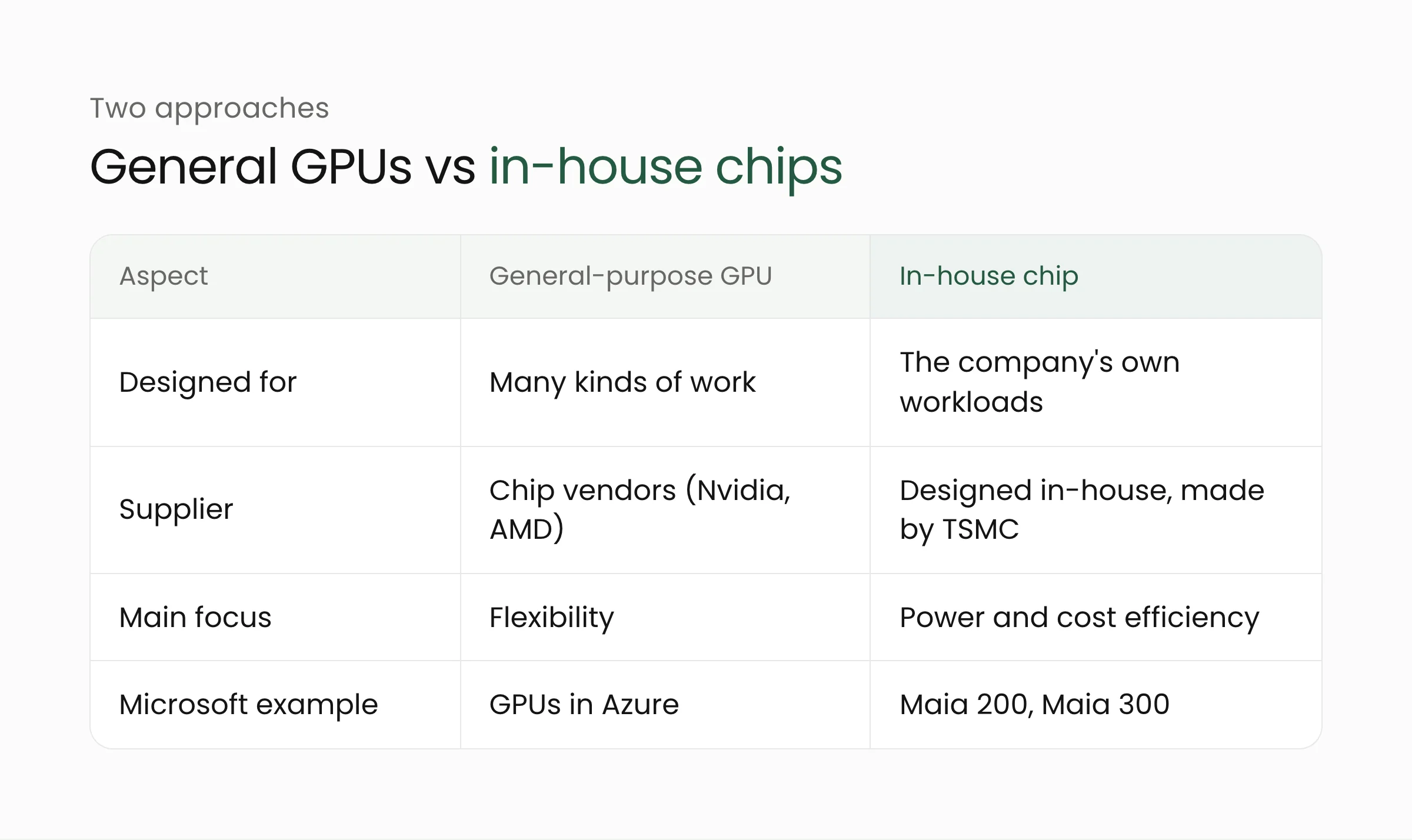
Scott Guthrie summed up the strategy in one line: “The future will not be defined by a single model or a single piece of silicon or a single innovation.” In other words, Microsoft will keep using several kinds of chips and models at once rather than betting on just one.
The Maia 300 numbers, and how to read them
The technical details are laid out on the Azure architecture blog. The compute portion is built on TSMC’s N2P process. Each chip uses eight stacks of HBM4 memory (high-speed memory stacked close to the chip), giving 288 GB of capacity and 18 TB per second of bandwidth. A rack holds 96 chips within a 167-kilowatt power envelope, and its liquid cooling removes more than 80% of the rack’s heat. Up to 128 racks can be linked into one large group of 12,288 chips, so very large models can run as a single system.
Compared with Maia 200, Microsoft claims 2.5 times the memory bandwidth, 33% more memory capacity, roughly twice the HBM bandwidth per watt, and up to seven times the rack-level token throughput in the full 96-chip configuration.
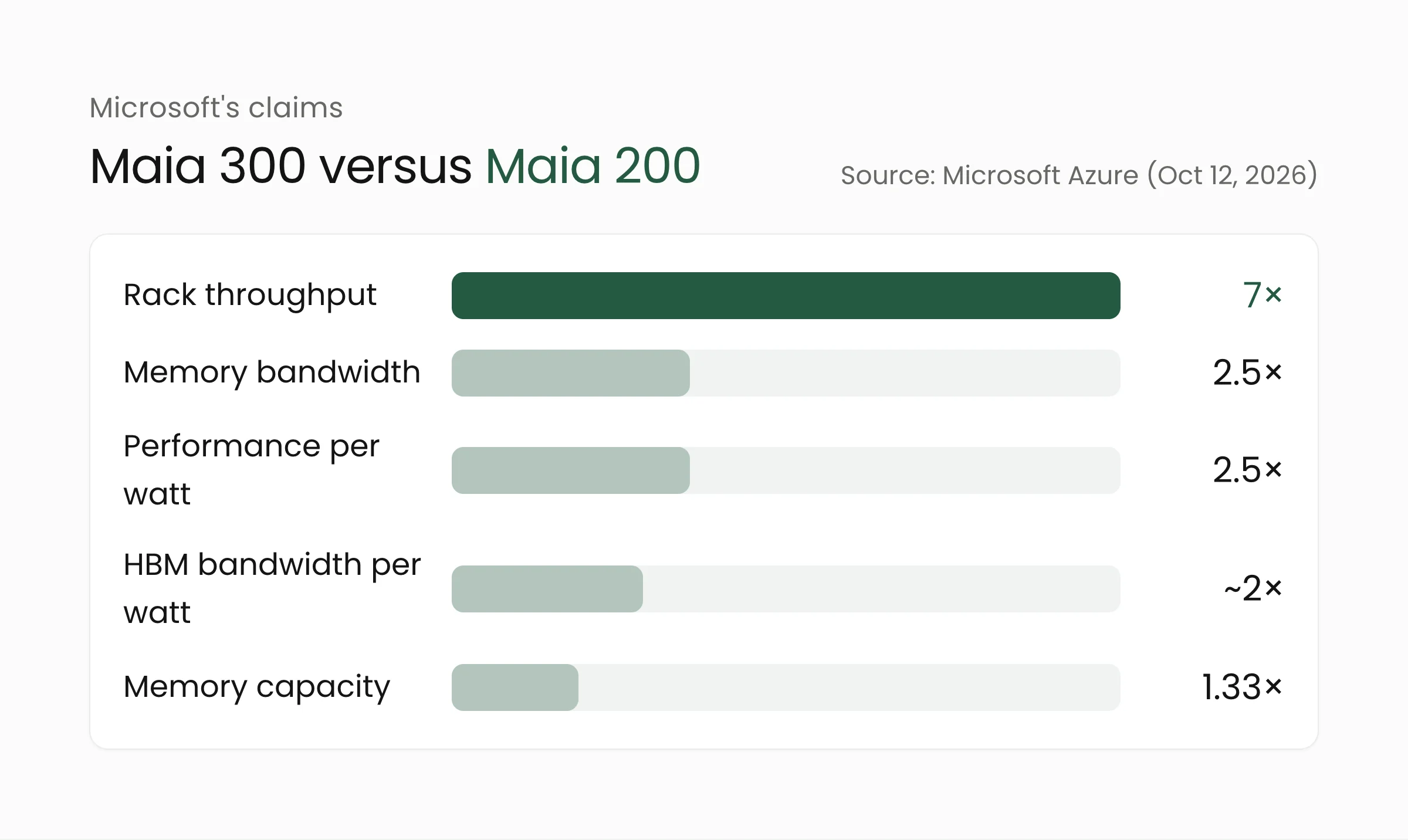
Two caveats before getting impressed. First, every number above is Microsoft’s own claim. UPI reported that no third party had tested Maia 300 at the time of the announcement. Second, the chip only enters production in 2027, so you will not feel its impact on the services you use anytime soon. “Tokens per megawatt” is also not a price. It measures power efficiency, and whether any savings are passed on to customers is a business decision for Microsoft.
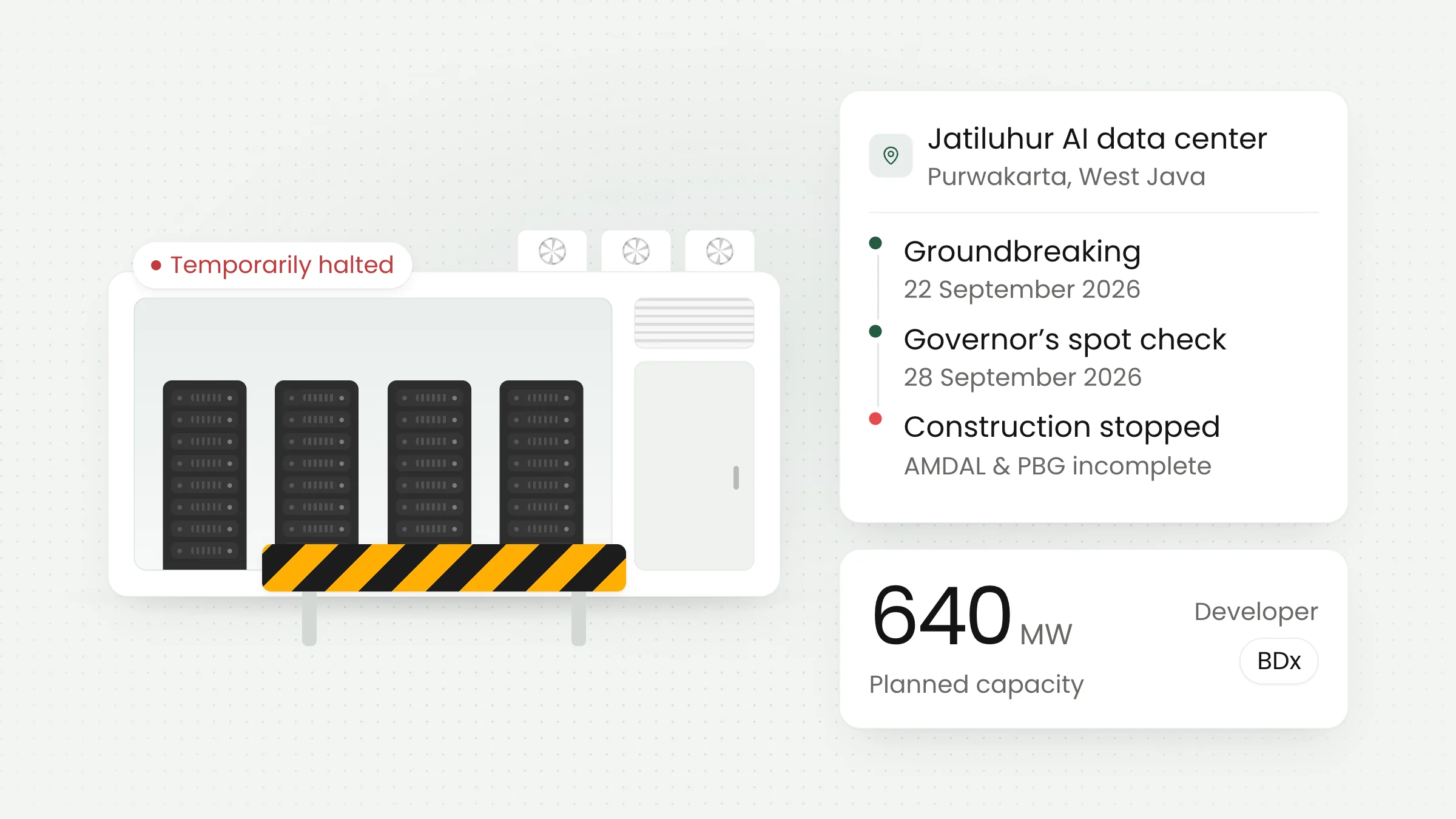
Still, the direction is clear. Power has become one of the biggest constraints on building AI data centers, as the Jatiluhur AI data center case showed. Chips that produce more answers per megawatt help cloud providers serve more users with the same power supply.
What this means for your organization
Schools, universities, public agencies, and companies will not be buying Maia 300. What you buy is the AI service running on top of it: Copilot, cloud model services, or applications built on either. So the lessons are about how you manage your AI usage.
Take an education office that uses AI to summarize school reports and answer teachers’ questions. Today the cost may feel small. But once usage spreads to hundreds of schools, the differences in efficiency and pricing between providers start to show up in the annual budget. That is where today’s technical choices shape tomorrow’s costs.
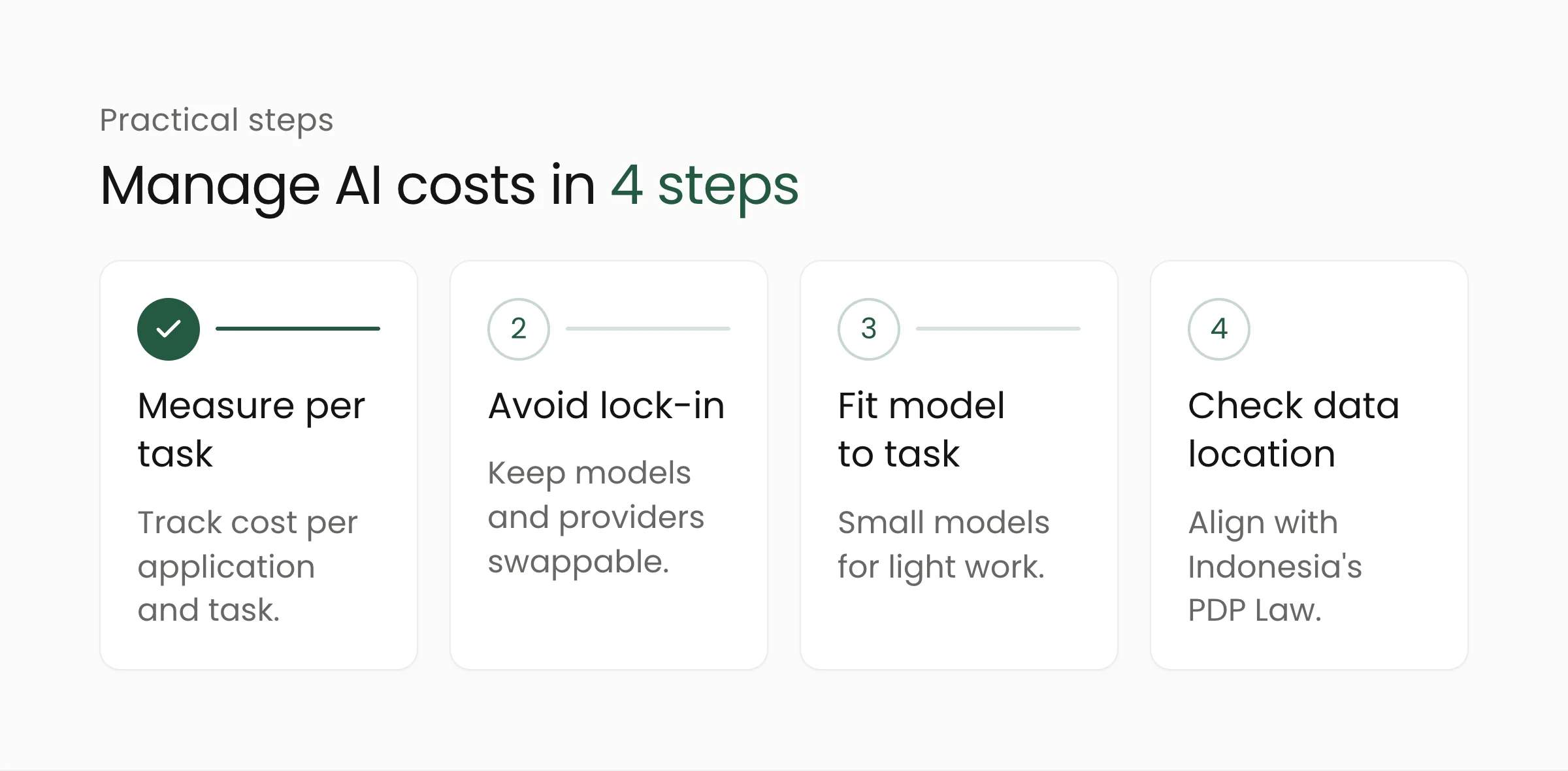
Measure usage and cost per task. Many organizations know their total AI bill but not what a single meeting summary or customer service answer costs. Track usage per application and per task, so you can judge whether new pricing actually works in your favor.
Avoid lock-in to a single provider. Competition in chips keeps shifting the price and capability of AI services. Design applications so the model or provider can be swapped without rebuilding everything, for example through an integration layer kept separate from business logic.
Match the model to the task. Not every job needs the biggest model. Light tasks such as sorting emails or short summaries are often fine with a smaller model that is cheaper and faster. Save large models for work that genuinely needs long reasoning.
Ask where your data is processed. Maia 200 is currently deployed in the United States, Europe, and Australia. For personal data of Indonesian citizens, the processing location needs to be checked against obligations under Indonesia’s Undang-Undang Pelindungan Data Pribadi (Personal Data Protection Law) and your own internal policies.
If you are shaping an AI strategy or moving applications to the cloud, our artificial intelligence and cloud computing teams can help you model costs and design an architecture that does not depend on a single vendor.
Frequently asked questions
Can Maia 300 be bought or rented directly?
There is no information on that. Microsoft says Maia runs its own AI services, such as Copilot, GitHub, and Microsoft Foundry. Customers benefit through those services rather than by renting the chip directly.
Will Copilot or Azure AI services get cheaper?
No pricing has been announced. Better power efficiency gives providers room to lower costs, but pricing remains Microsoft’s call. Keep an eye on official announcements from 2027, when Maia 300 enters production.
What does tokens per megawatt mean?
A token is a small piece of text processed by an AI model, roughly part of a word. Tokens per megawatt measures how much text a chip can produce for each unit of electrical power. The higher the number, the less power it takes to produce the same answer.
Closing thoughts
Maia 300 shows that the AI race now runs through chips and electricity, not just models. For organizations, the good news is more choice. The condition is knowing exactly what AI costs you per task and not being locked into one provider. If you would like a partner to work through the numbers, feel free to get in touch.
Sources
- Microsoft, “Microsoft to expand Azure Maia system to multi-gigawatt deployments” (October 12, 2026)
- Microsoft Azure, “Deep dive into Azure Maia 300 architecture” (October 12, 2026)
- UPI, “Microsoft announces new AI chip Azure Maia 300” (October 12, 2026)
- Constellation Research, “Microsoft to launch Maia 300 inference chip in 2027” (October 12, 2026)