Blog Gemini
Gemini for Government Services: AI Agents for Agencies
On this page· 7 sections
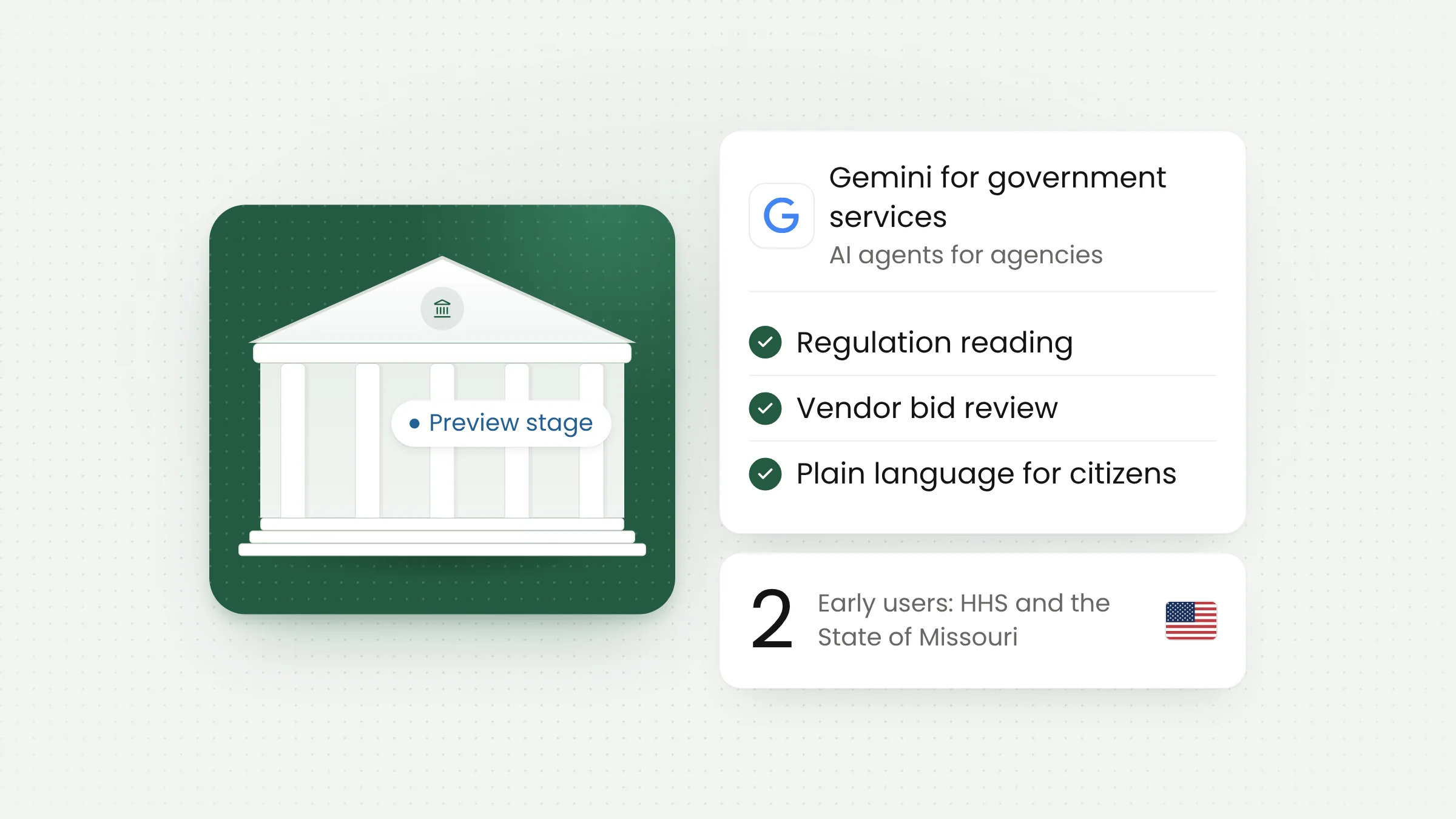
Google Public Sector launched Gemini for government services on October 20, 2026. The AI agent package is aimed at federal, state, and local agencies in the United States and is still in preview. The State of Missouri and the US Department of Health and Human Services (HHS) already use Gemini for government services.
What Google announced
The announcement came at the Google Public Sector Summit in Washington, D.C. According to Google’s press release, the package follows Gemini for legal and Gemini for financial services, both launched in August 2026. Each industry package bundles agents, skills, data connectors, and model optimizations tuned to its sector.
A “skill” here is a set of work rules prepared in advance so that Gemini carries out one task according to procedure. Chris Hein, field CTO at Google Public Sector, described them to Nextgov as a way to keep Gemini on script. Staff choose a skill from the Gemini prompt bar, for example to analyze regulations or audit expenses.
FedScoop reported that Google calls the package an agentic solution, meaning AI that does more than answer questions and carries out a chain of tasks across other systems. Preview status means Google is still accepting early-adopter agencies to gather feedback. General availability is expected later this year, with no firm date.
At the same event, Google Public Sector CEO Karen Dahut said Gemini has been used across the federal government, including supporting flight readiness and astronaut safety for NASA’s Artemis II mission and across the Defense Department. FedScoop presents this as a company statement with no independent verification.
What is in the package and how it works
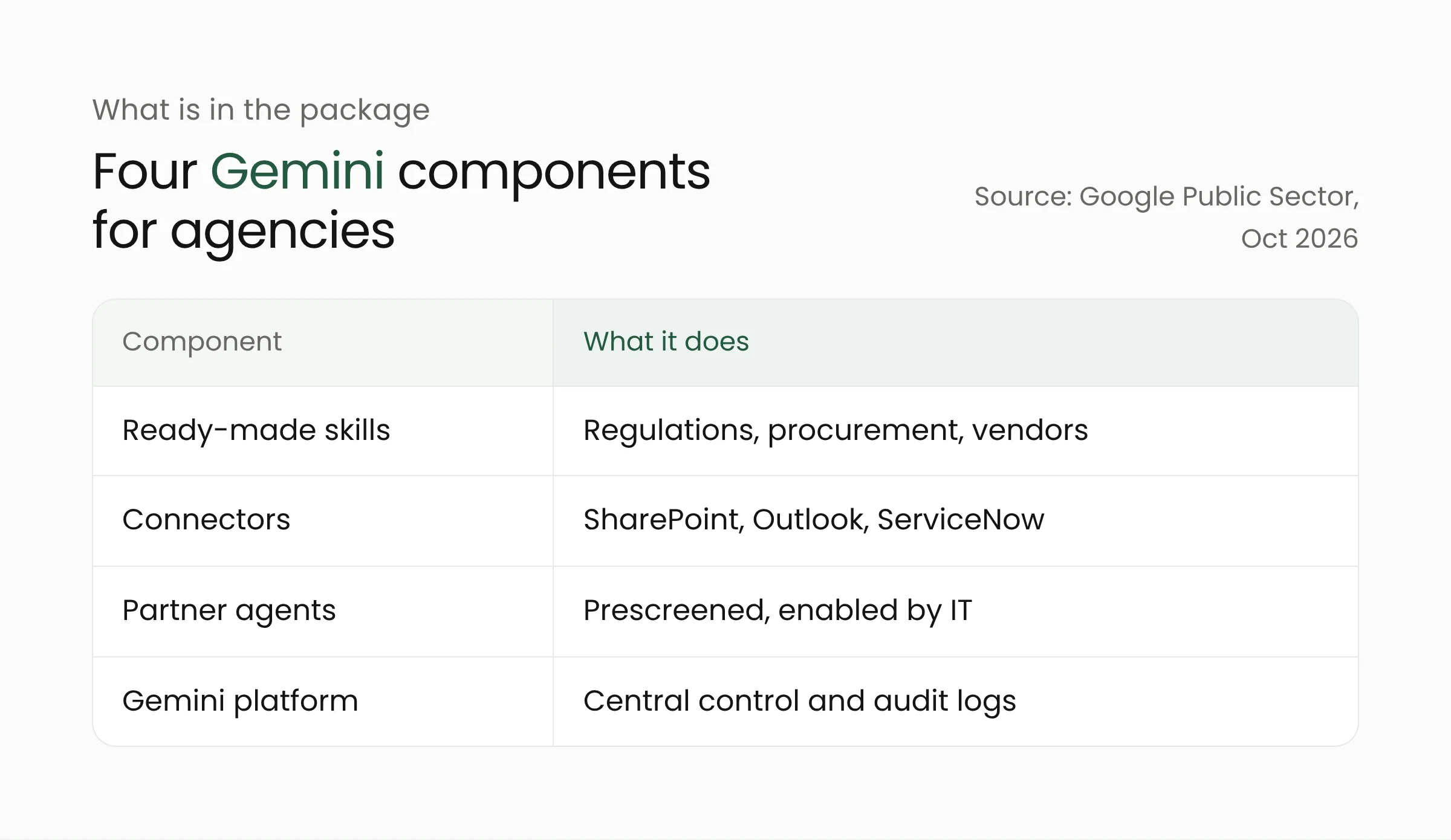
Google’s release lists four main components.
- Ready-made skills for complex administrative work, such as digesting federal and state regulations, optimizing procurement, and evaluating vendor qualifications.
- Connectors to Google Workspace, Microsoft SharePoint, Outlook 365, Salesforce, and ServiceNow. A connector built by BLEN searches eCFR, regulations.gov, and the Federal Register. A custom connector covers Oracle enterprise applications.
- Third-party agents from government technology providers and 13 consulting and systems-integration partners, among them Accenture Federal Services, Deloitte, SAIC, and Slalom. Google prescreens them, and only agency IT leaders can enable them, through a portal. Nextgov notes that some agents are available now and most are not.
- The Gemini platform, with a central control plane for IT and risk teams, including audit logging and governance.
On workflows, Google names three groups of tasks. The first is policy interpretation: staff query statutes, state administrative codes, and internal policy documents, and receive answers that cite the specific pages and paragraphs. The second is procurement support: cross-referencing vendor bids against request-for-proposal guidelines and the Federal Acquisition Regulation, scoring them against rubrics, and producing auditable justifications. The third is constituent services: classifying and validating documents residents submit, such as paystubs, W-2 forms, and lease agreements, and rewriting regulatory language into plain-language notices.
Nextgov described one demonstration. A compliance analyst in a state chief information security officer’s office used a policy and statute skill to review federal cybersecurity regulations. The analyst then asked Gemini to draft a ServiceNow incident ticket to bring contracts into compliance, and the ticket could be edited before it was sent.
Security claims and what remains unproven
Google says the package inherits the identity and access controls an agency already has through integrations with its core systems of record. Answers, it says, are grounded in official regulations and agency files, with links to sources for verification. Agency and citizen data, prompts, and outputs are said to stay inside the organization’s cloud perimeter, and the base models are not trained on customer data without consent.
Google Cloud CEO Thomas Kurian said the package “provides a secure environment for agencies to automate workflows”, according to Nextgov. In the press release, he also pointed to non-negotiable standards for security, confidentiality, and data sovereignty.
All of these claims come from Google. Both Nextgov and FedScoop note that the security, compliance, and performance claims have not been independently verified, and the release includes no quantitative results from early adopters. A preview that has run for a few weeks with two users also says little about behavior at scale. Most partner agents are not yet available, and the price of the package has not been announced.
On cost, Nextgov writes that federal agencies can access Gemini for $0.47 per agency per year through November 15 under an extended OneGov deal. Nextgov does not say whether that price covers the new package, or what applies after that date.
What this means for agencies
The package is built for US rules and systems, so it cannot simply be adopted by local governments elsewhere, including in Indonesia. The pattern it offers still matters to agencies weighing AI agents for administrative work. The tasks it demonstrates, which are reviewing rules, assessing bid documents, and answering residents, exist in every agency.
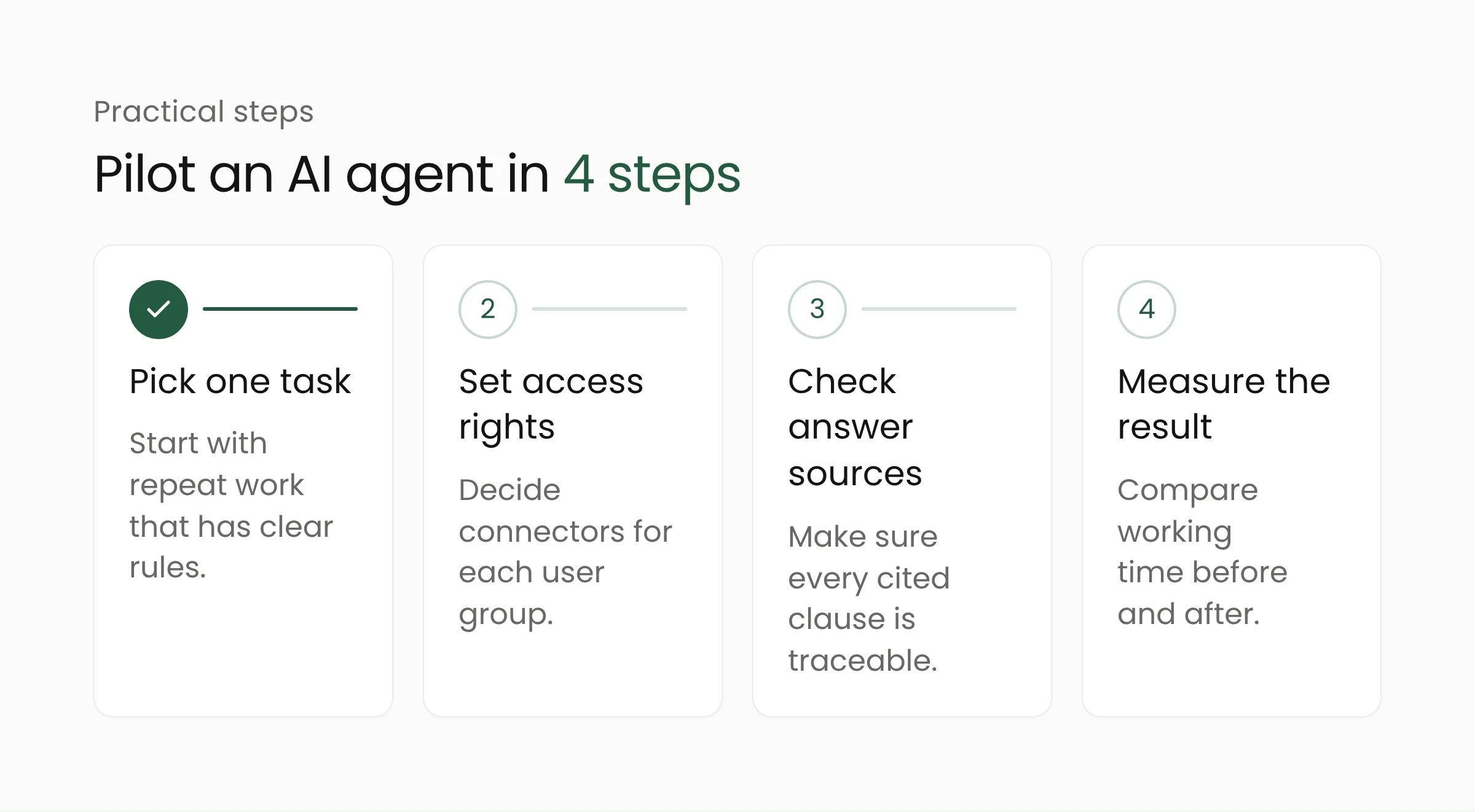
Some practical points for a pilot:
- Start with one task that has clear rules. Reviewing procurement documents or sorting incoming letters is easier to measure than work that depends on an official’s judgment.
- Decide who may connect data sources. In Google’s package, IT teams enable connectors and partner agents. An agency needs a similar rule so an agent cannot reach files it should not.
- Require traceable references. Answers that cite clauses and pages let staff check them before use, and the final decision stays with a person.
- Check where data lives and how it is handled. Confirm that resident data and agent outputs stay in an environment that meets data protection rules and agency policy, and get that assurance in writing from the provider.
- Measure before scaling. Compare working time and error rates before and after the pilot.
Tidy, connected data is what makes an agent like this useful. Our article on Indonesia’s One Data Law explains the government data policy that will shape that readiness. On the security side, the same questions are now being weighed in banking, as in US banks blocking AI agents from customer accounts.
Frequently asked questions
Is Gemini for government services generally available?
No. It is in preview for federal, state, and local agencies in the United States. Google says general availability is expected later this year without giving a date, and the press release does not state a price.
Is resident data used to train Google’s models?
Google states that its base models are not trained on customer data without consent, and that data and outputs stay inside the agency’s cloud perimeter. The statement comes from Google and has not been independently verified, so agencies should confirm it through their own contracts and audits.
Who is already using it?
The press release names the State of Missouri and HHS. According to Nextgov, both have tested it over the past few weeks. No measured results from either have been published.
Closing
AI agents for agencies are moving from demonstrations to packages that can be switched on, but the evidence of results is still to come. Agencies that want to prepare can start with data hygiene, access rules, and one measured pilot. Merakit helps organizations design such pilots through its artificial intelligence services and digital government solutions. Get in touch to talk it through.
Sources
- Google Public Sector Launches Gemini for Government Services, Google Public Sector press release, October 20, 2026
- Google Public Sector unveils Gemini for government services, Nextgov/FCW, October 20, 2026
- Google launches Gemini for government services as new “agentic solution”, FedScoop, October 20, 2026