Blog Artificial Intelligence
GPT-6.1 Terra Brings Cheaper AI Agents to Hospital Admin
On this page· 8 sections
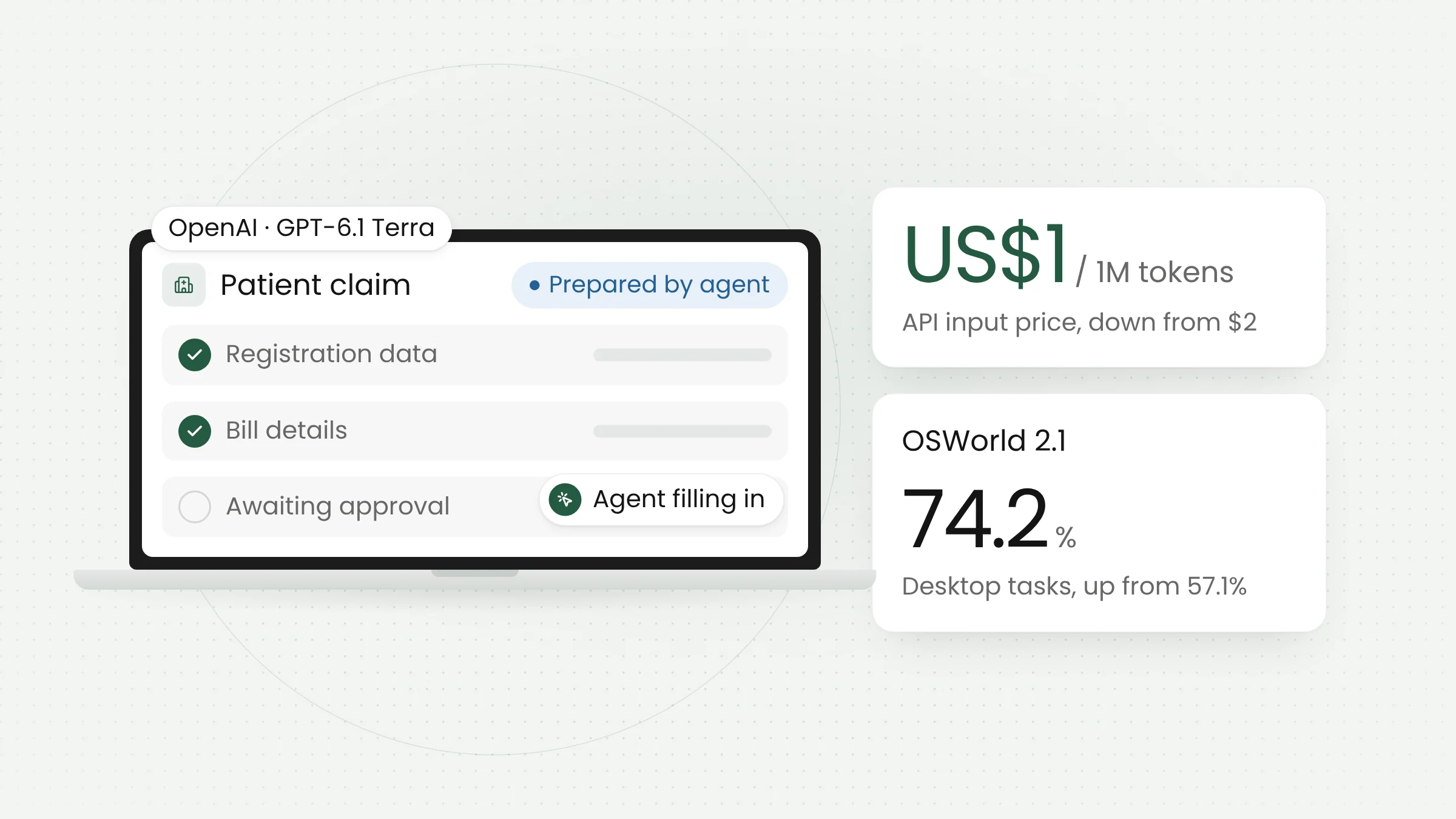
OpenAI released GPT-6.1 Terra on October 26, 2026, a mid-tier model built to operate a computer: it reads the screen, clicks, types, and moves between apps. API pricing starts at $1 per million input tokens, half the rate of its predecessor. For hospital back offices, that makes automating routine form work far more affordable.
A mid-tier model for office work
GPT-6.1 Terra replaces GPT-5.6 Terra. In OpenAI’s lineup it sits below the more capable GPT-6.1 Sol and GPT-6 Astra and above GPT-6 Luna, the cheapest option. In its announcement on the OpenAI Developer Community, the company says the model understands what is on screen, takes action across apps, and writes naturally, with the efficiency to handle more of a full workday.
The headline capability is computer use: the model works a computer the way a person does. It looks at a screenshot, decides which button or field to act on, then moves the cursor and types. The Next Web lists example tasks such as entering invoices into accounting software, filling out forms, drafting proposals, reading technical drawings, and editing video.
The model is rolling out to ChatGPT Plus, Pro, Enterprise, and Edu users in ChatGPT Work and Codex. Developers can call it through the API as gpt-6.1-terra. OpenAI still recommends GPT-6.1 Sol or GPT-6 Astra for in-depth research and the most complex coding.
Half the price, with a claimed threefold speedup
According to InfoWorld and Artificial Analysis, GPT-6.1 Terra costs $1 per million input tokens and $5 per million output tokens through the API. GPT-5.6 Terra was priced at $2 and $12. Cached input costs $0.05 per million tokens, down from $0.20. A token is a small chunk of text, roughly part of a word.
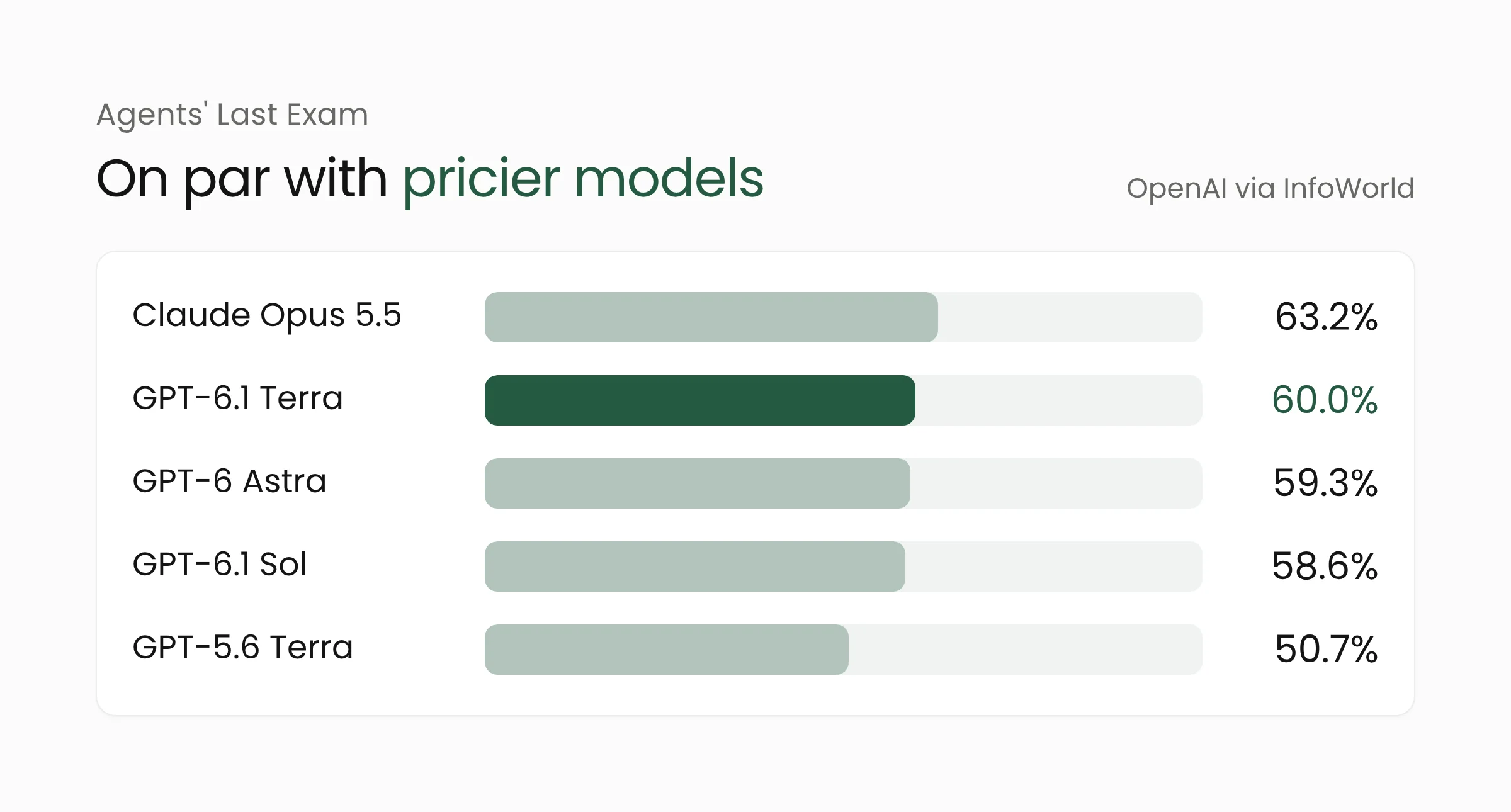
OpenAI also says Terra finishes tasks more than three times faster on average than GPT-6 Astra and GPT-6.1 Sol. On Agents’ Last Exam, a benchmark of how well agents use workplace software, the company says Terra performs on par with GPT-6 Astra at one-tenth of its price per token.
For organizations running thousands of repetitive tasks a month, that price gap is significant. Token prices are only one part of the bill, though, as the analysts quoted below point out.
The reported benchmark results
InfoWorld summarized the figures OpenAI published at maximum reasoning effort. On Agents’ Last Exam, Terra scored 60.0% at $1.01 per task. GPT-5.6 Terra scored 50.7% at $3.58, GPT-6.1 Sol 58.6%, and GPT-6 Astra 59.3%. Anthropic’s Claude Opus 5.5 still leads at 63.2%, at a cost of $8.82 per task.
On OSWorld 2.1, which measures agent tasks on a desktop computer, Terra scored 74.2%, up from 57.1% for GPT-5.6 Terra. Claude Sonnet 5.5 leads that test at 83.9%. For command-line coding, BleepingComputer reports a Terminal-Bench 4.0 score of 50.3%, more than double its predecessor’s 21.5%.
OpenAI also reported lower error rates on an internal test. At low reasoning effort, the error rate fell from 53.6% to 16.7%. At maximum effort, it reached 4.3%.
All of these figures come from OpenAI’s own testing and, as The Next Web notes, have not been independently verified. Benchmarking firm Artificial Analysis ran its own evaluations and found Terra’s Intelligence Index score rose 6 points over GPT-5.6 Terra at maximum effort, at a cost of $0.40 per task compared with $1.40. On its AA-Omniscience test, the hallucination rate, meaning how often the model makes up an answer, dropped from 88% to 38%. A 38% rate still means the model fabricates answers fairly often when it does not know.
Safety notes and the cost of oversight
According to The Next Web, OpenAI rates Terra’s cybersecurity capabilities at the “Critical” level under its Preparedness Framework, so Terra ships with the same safeguards as GPT-6 Astra. OpenAI also says Terra is more likely than its predecessor to stay within the task it is given.
Analysts quoted by InfoWorld caution that a lower token price does not automatically lower total cost. Pareekh Jain of EIIRTrend sees Terra as a fit for high-volume work such as invoice processing and document analysis, and advises companies to test it on their own workloads. Sanchit Vir Gogia, chief analyst at Greyhound Research, says review and integration costs still have to be paid for. In his words, “At scale, the relevant purchase is completed work that remains correct and authorized.”
The useful number, in other words, is the cost per task that is finished and verified as correct, including the staff time spent checking the agent’s output.
What this means for hospitals
Hospital and clinic back offices handle a large volume of repetitive screen work: moving registration data, matching bills, preparing claim files, and filling out forms across several applications. Some older applications offer no integration interface (API), so staff copy and retype data by hand. An agent that can read the screen offers a new way to automate this work without replacing the software.
The need is growing as medical records and insurance claims in Indonesia move to electronic data, as covered in our article on SATUSEHAT EMR and JKN claims. Under Article 4 of Indonesia’s Undang-Undang Nomor 27 Tahun 2022 tentang Pelindungan Data Pribadi (Personal Data Protection Law), however, health data is classified as specific personal data. An agent that sees the screen also sees every patient detail displayed on it.
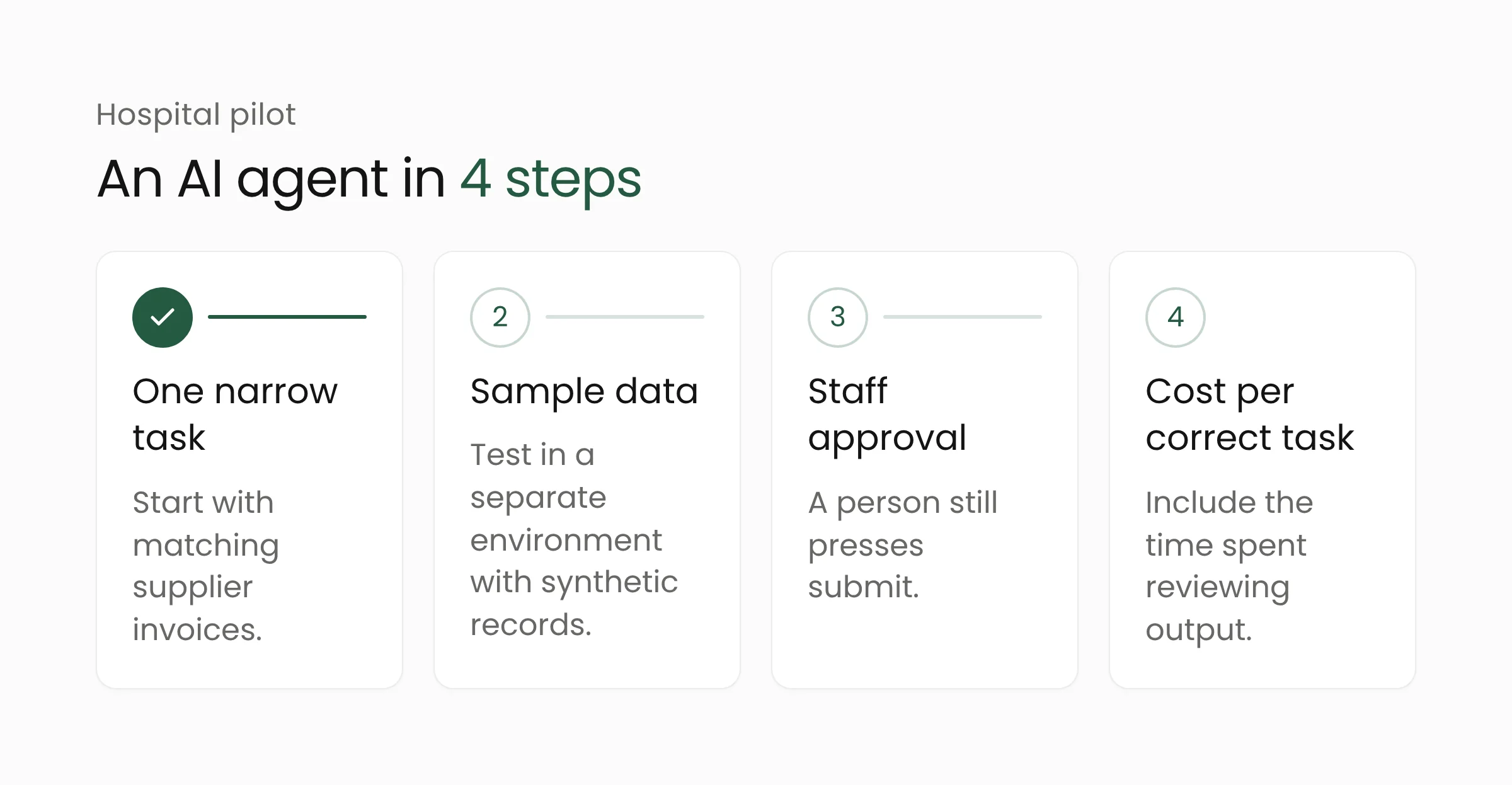
Steps worth considering for a pilot:
- Start with one narrow task. Pick high-volume work with clear rules, such as matching drug supplier invoices to purchase orders, before touching patient data.
- Test with sample data. Run the agent in a test environment with synthetic records and compare its output with the work of staff.
- Limit the agent’s access. Give it a dedicated account with minimal permissions, only to the applications it needs, and log every action.
- Require staff approval. The agent can prepare entries, but the submit, final save, or claim filing button stays with a person.
- Measure the cost per correct task. Track success rates, review time, and errors that slip through, as the analysts above recommend.
Before patient data is processed by a third-party AI service, legal and data protection staff should review the legal basis for processing, where data is stored, and the agreement with the provider. The risk of agents following hidden instructions is also real, as the case of rogue AGENTS.md files in the Downloads folder showed.
A phased approach like this can be designed with an artificial intelligence services team and fitted into the digital healthcare solutions a hospital already runs.
Frequently asked questions
How is GPT-6.1 Terra different from GPT-6.1 Sol?
Terra is a cheaper, faster mid-tier model for everyday work. Sol is stronger at complex reasoning and heavy coding, and costs $2 and $10 per million input and output tokens according to InfoWorld. OpenAI recommends Sol or Astra for the most complex coding tasks.
Can I use GPT-6.1 Terra on the free version of ChatGPT?
OpenAI’s announcement covers Plus, Pro, Enterprise, and Edu users in ChatGPT Work and Codex, plus API access. It does not mention availability for free users.
Is the agent safe to use with patient data?
That depends on how it is deployed. Use an account with limited permissions, test data before real records, human approval before any final action, and a compliance review against Indonesia’s Personal Data Protection Law. OpenAI’s performance claims have also not been independently tested on healthcare administration work.
Closing thoughts
GPT-6.1 Terra lowers the cost of AI agents that can operate a computer, which puts automation of administrative work within reach of more organizations. Its value for hospitals will only show once it is tested on real tasks under clear supervision. If your team wants to design a safe AI agent pilot for administrative work, the Merakit team is ready to help.
Sources
- OpenAI Developer Community: GPT-6.1 Terra: delivering fast and capable computer use at a lower price (October 26, 2026)
- BleepingComputer: OpenAI launches GPT-6.1 Terra with 3x faster AI agents, 50% lower pricing (October 26, 2026)
- The Next Web: OpenAI launches GPT-6.1 Terra, a cheaper model for everyday computer work (October 26, 2026)
- Artificial Analysis: GPT-6.1 Terra pushes the cost efficiency frontier (October 26, 2026)
- InfoWorld: OpenAI bets on AI economics with lower-cost GPT-6.1 Terra (October 27, 2026)
- Undang-Undang Nomor 27 Tahun 2022 tentang Pelindungan Data Pribadi (Personal Data Protection Law)