Blog Cloud Computing
OpenAI Models on Google Cloud: Model Garden Preview
On this page· 7 sections
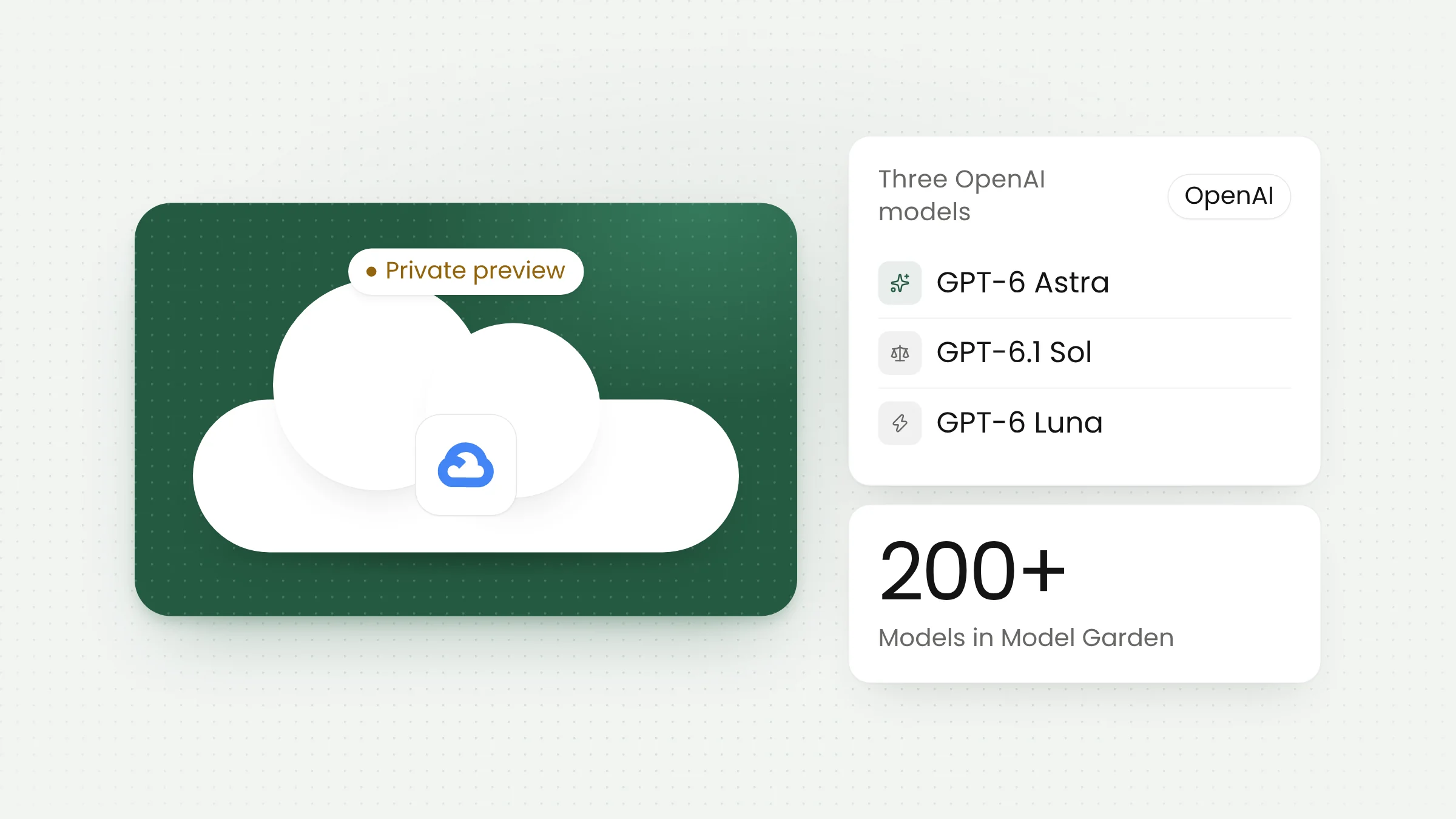
Google Cloud has begun offering three OpenAI models, GPT-6 Astra, GPT-6.1 Sol, and GPT-6 Luna, through Model Garden. The announcement on October 21, 2026 is a private preview for selected enterprise customers. Usage appears on a single Google Cloud invoice, while per-model pricing has not been announced.
What Google Cloud announced
In its announcement on the Google Cloud blog, Michael Gerstenhaber, Vice President of Product Management for Gemini, said the three models are rolling out in stages to select enterprise customers. Other companies can register interest through a form. Model Garden already lists more than 200 models from Google, third parties, and open-model providers.
Google also said it is now the only hyperscale cloud provider offering access to all three leading closed-source model families. That is Google’s own claim and has not been assessed independently. According to Techzine, the two companies’ relationship had centered on computing capacity, and this is the first time OpenAI models join the model lineup on Google Cloud.
Gerstenhaber wrote, “Google Cloud has always been defined by choice, enterprise-grade governance, and market-leading price-performance.” The point is that customers can choose a model for each task without changing cloud provider.
Google adds that customers can pick and swap models for each use case based on performance, latency, and cost efficiency, without separate vendor contracts. The main target is companies building AI agents and production workloads that need to compare several models before deciding.
Box is one of the parties quoted in the announcement. Yashodha Bhavnani, Vice President of AI Products at Box, said the company will give customers access to OpenAI models alongside Google Cloud’s security and compliance capabilities so they can get more value from enterprise content. The statement shows the kind of buyer being courted: software providers and organizations that manage large volumes of documents.
The news follows the general release of Gemini 4 Argon, which we covered in our article on the million-token context for agencies. If Gemini 4 Argon shows where Google’s own models are heading, this step shows Google opening its platform to rival models.
Three models and how they are billed
Google describes GPT-6 Astra as the model for demanding work such as coding, computer use, professional tasks, and scientific research. GPT-6.1 Sol is said to offer near-Astra intelligence at lower cost. GPT-6 Luna is built to be fast and economical for everyday work at scale. These roles come from Google and have not been tested by third parties.
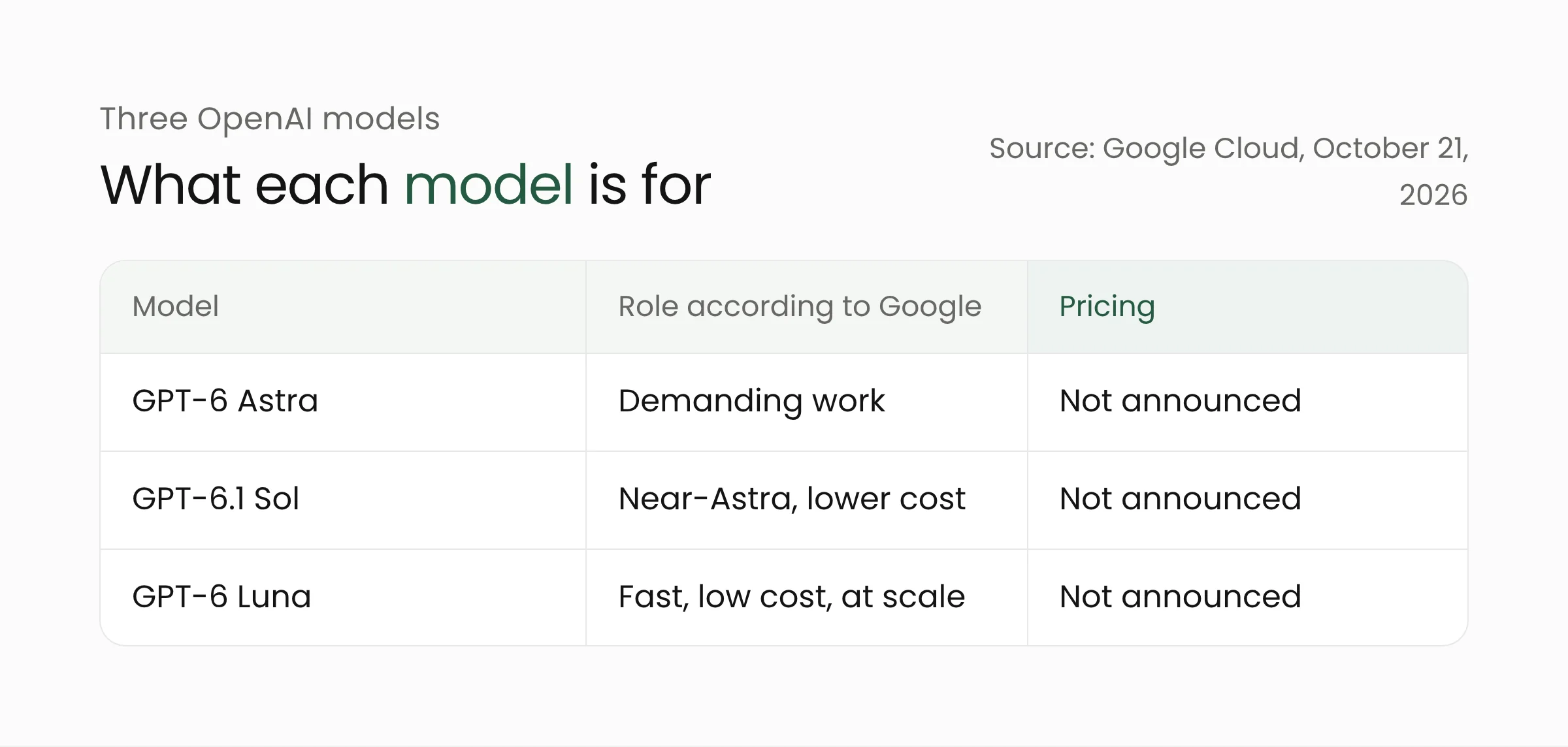
On cost, Google says the OpenAI models are sold directly through Google Cloud Marketplace and appear on one Google Cloud invoice. Usage can draw down existing cloud commitments and counts toward Flexible Savings Plans across model providers. For finance teams, that means no separate contract with OpenAI is needed to try the models.
The announcement page lists no per-token rates. Launch regions have also not been announced, according to TechNode. Organizations in Indonesia should ask their Google Cloud representative about both before building a budget.
Data controls and what is not yet available
Google writes that customer prompts, context, and outputs stay within the customer’s designated data perimeter and are never used to train foundation models. The OpenAI models run on dedicated Google Cloud infrastructure, and queries pass through isolated gateways. Every agent and model interaction runs under an authenticated identity, is protected by VPC Service Controls, and is recorded in centralized audit logs.
Two further features are still to come: Zero Data Retention options and Confidential Compute, which Google labels “coming soon”. Integrations with Gemini for business and Google Antigravity are also pending. Developers, on the other hand, can already connect their Codex CLI and Codex Desktop workflows to Google’s platform for inference from the day of the announcement.
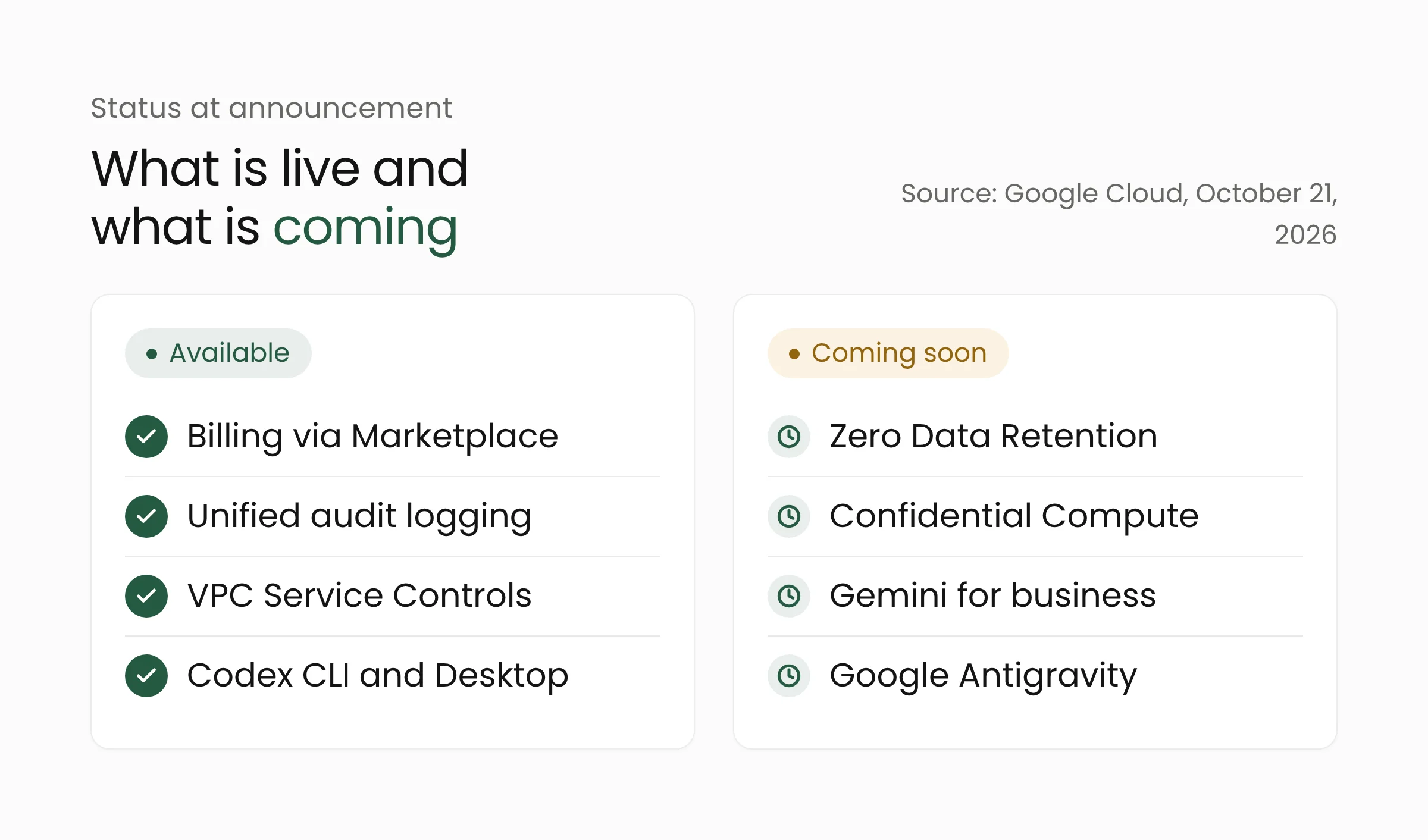
FinanceFeeds reported that OpenAI said general availability is planned within weeks, with no firm date. Until a date is set, the private preview is best treated as a chance to test, not as a basis for a service launch schedule.
What this means for your organization
For banks, cooperatives, finance companies, and government agencies already on Google Cloud, this opens a new route without moving data to another provider. A few concrete considerations:
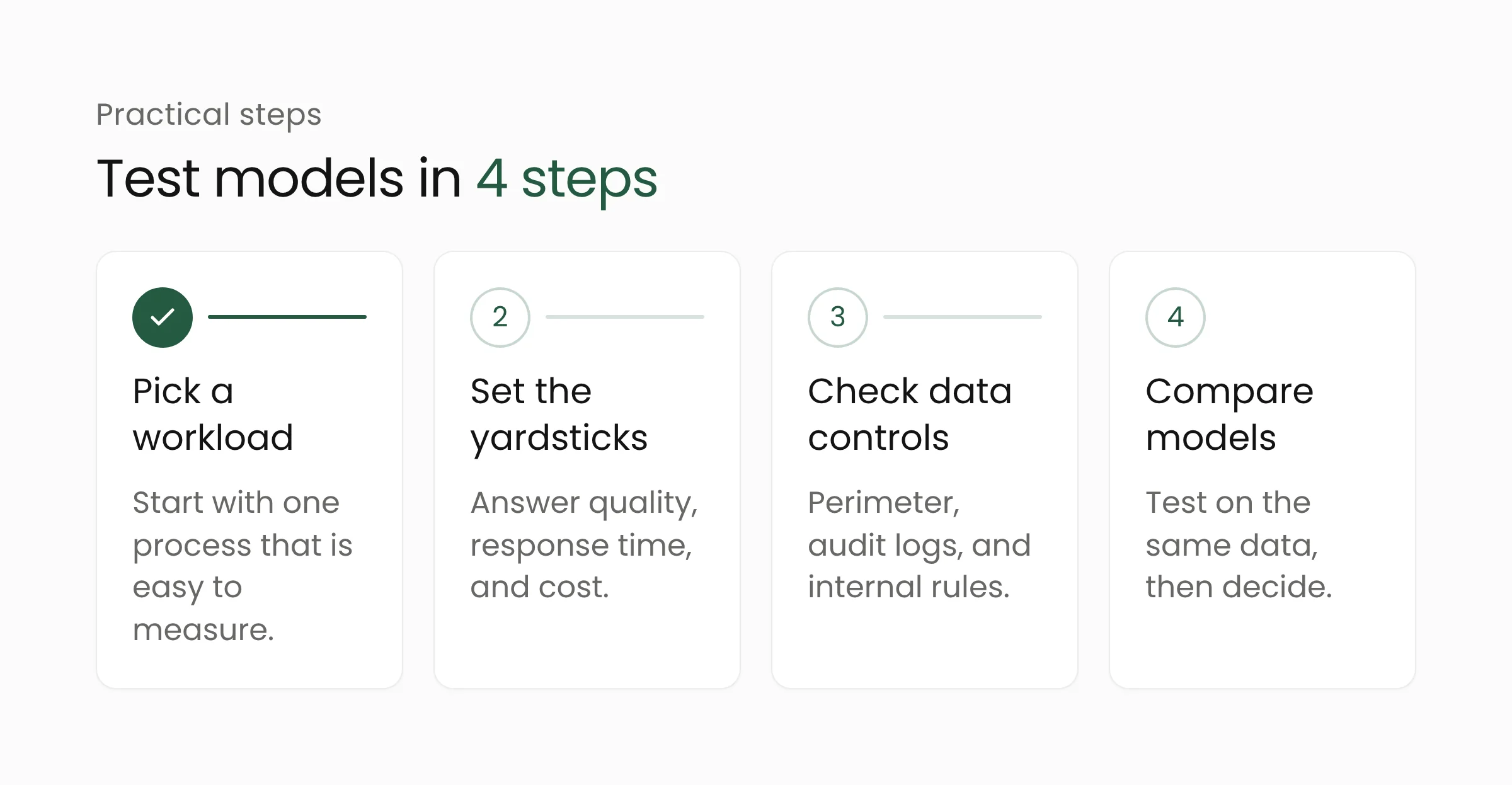
- Pick one workload with clear measures, such as summarizing loan application files or answering customer service questions.
- Set three yardsticks before testing: answer quality, response time, and cost per request.
- Review data controls with your compliance team, especially the data perimeter, audit logs, and the personal data protection rules that apply to your organization.
- Compare models on the same test data, including Google’s own, then decide based on results.
Legal and compliance teams should be involved from the start. They can check whether the kinds of data to be processed, such as customer or residency records, may be sent to a third-party model, and who is accountable for the model’s output. These questions are easier to answer before a pilot runs than after a service is public.
A private preview also means access is granted by selection. Quotas, request rate limits, and service terms for the OpenAI models were not described in the announcement, so results from testing today may differ from conditions at general availability. Record the model version, test date, and configuration used so the results can be repeated when final terms arrive.
Vendor dependence is another consideration. A platform that offers many models makes switching easier, but applications still need to be designed so that model choice lives in one configuration layer instead of being scattered through the code. That way, changing models after pricing is announced takes a settings change, not a rewrite.
Organizations not yet on a major cloud need not rush. Start from the business need, then choose the platform. Our team in cloud computing services and artificial intelligence services can help map suitable workloads, and the needs of the financial sector, such as auditing and access control, are covered on the financial services solutions page.
Frequently asked questions
Can all customers use OpenAI models on Google Cloud yet?
Not yet. According to Google, the three models are rolling out in private preview to selected enterprise customers. Other customers can fill in an interest form. FinanceFeeds reported that OpenAI plans general availability within weeks, but gave no date.
How much do the three models cost?
Pricing has not been announced. Google’s announcement page lists no per-token rates. It says only that usage is billed through Google Cloud Marketplace and can draw down existing cloud commitments.
Will my data be used to train models?
Google states that prompts, context, and outputs are never used to train foundation models and stay inside the customer’s data perimeter. Zero Data Retention and Confidential Compute were not yet available at announcement, so organizations with strict requirements should check their latest status.
Closing
Bringing OpenAI models to Google Cloud widens the choice for organizations that want to compare models on one platform. The real value will only be clear once pricing, regions, and data control features are fully announced. In the meantime, preparing a test workload and scoring criteria is already a useful step. If you would like to talk it through, the Merakit Indonesia team is happy to help.
Sources
- Google Cloud brings OpenAI models to customers, Google Cloud, October 21, 2026
- OpenAI’s models are finally fully supported on Google Cloud, Techzine Global, October 21, 2026
- Google Cloud to offer OpenAI models through Model Garden, TechNode, October 23, 2026
- OpenAI GPT-6 Models Hit Google Cloud a Week Before Earnings, FinanceFeeds, October 22, 2026