Blog Higher Education
Indonesia Launches a Digital Maturity Index for Universities
On this page· 7 sections
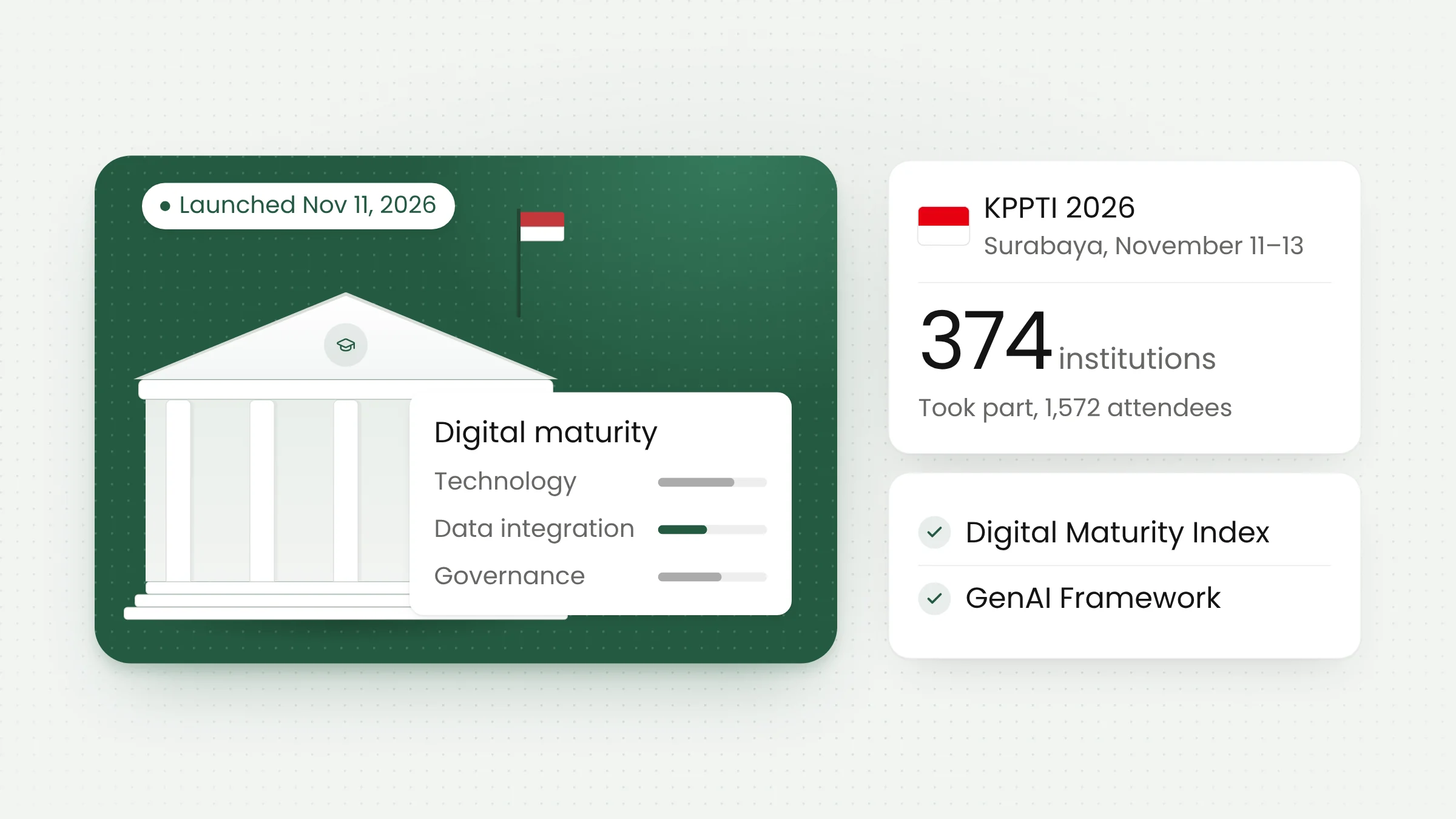
Indonesia’s Ministry of Higher Education, Science and Technology (Kemdiktisaintek) has launched a Digital Maturity Index for universities and a GenAI Framework at the Indonesian Higher Education Summit (KPPTI) 2026 in Surabaya. The index will gauge how digitally ready a campus is, while the framework guides the use of generative AI.
Six programs launched at KPPTI 2026
The launch took place on Wednesday, November 11, 2026, at the Airlangga Convention Center on Universitas Airlangga’s (UNAIR) MERR-C campus. According to UNAIR News, Minister of Higher Education, Science and Technology Brian Yuliarto launched six programs at once, joined by ministry officials and the university’s leadership. Director General of Higher Education Khairul Munadi walked the audience through each of them.
The six programs are:
- the Digital Maturity Index for Higher Education (Indeks Maturitas Digital Perguruan Tinggi);
- the GenAI Framework;
- a consortium of university hospitals (Konsorsium Rumah Sakit Perguruan Tinggi, RSPT);
- a book of lessons from the HETI (Higher Education for Technology and Innovation) project;
- a book on science and technology talent;
- SatuBeasiswa, a platform that gathers scholarship and higher education funding information in one place.
KPPTI 2026 ran from November 11 to 13. A report by LLDIKTI Region VI, one of the ministry’s regional service offices, said the summit drew 1,572 participants from 374 higher education institutions. It opened at the Sepuluh Nopember Institute of Technology (ITS) alongside KSTI Indonesia 2026 before moving to UNAIR. Over three days, participants produced 40 memoranda of understanding on good practices and submitted 36 papers.
The second day was organized into four discussion clusters: governance and leadership; learning and digitalization; partnerships for regional development; and access and inclusion. The summit closed on November 13 with the Surabaya Communique 2026, read by Eduart Wolok, chair of the Council of Rectors of Indonesian State Universities (MRPTNI). One of its five commitments is to use technological progress to improve the quality and relevance of education, research and community service.
How the Digital Maturity Index assesses campuses
Digital maturity describes how well an organization actually uses digital technology. A university can run dozens of applications and still score low if its data is scattered across units and rarely informs decisions.
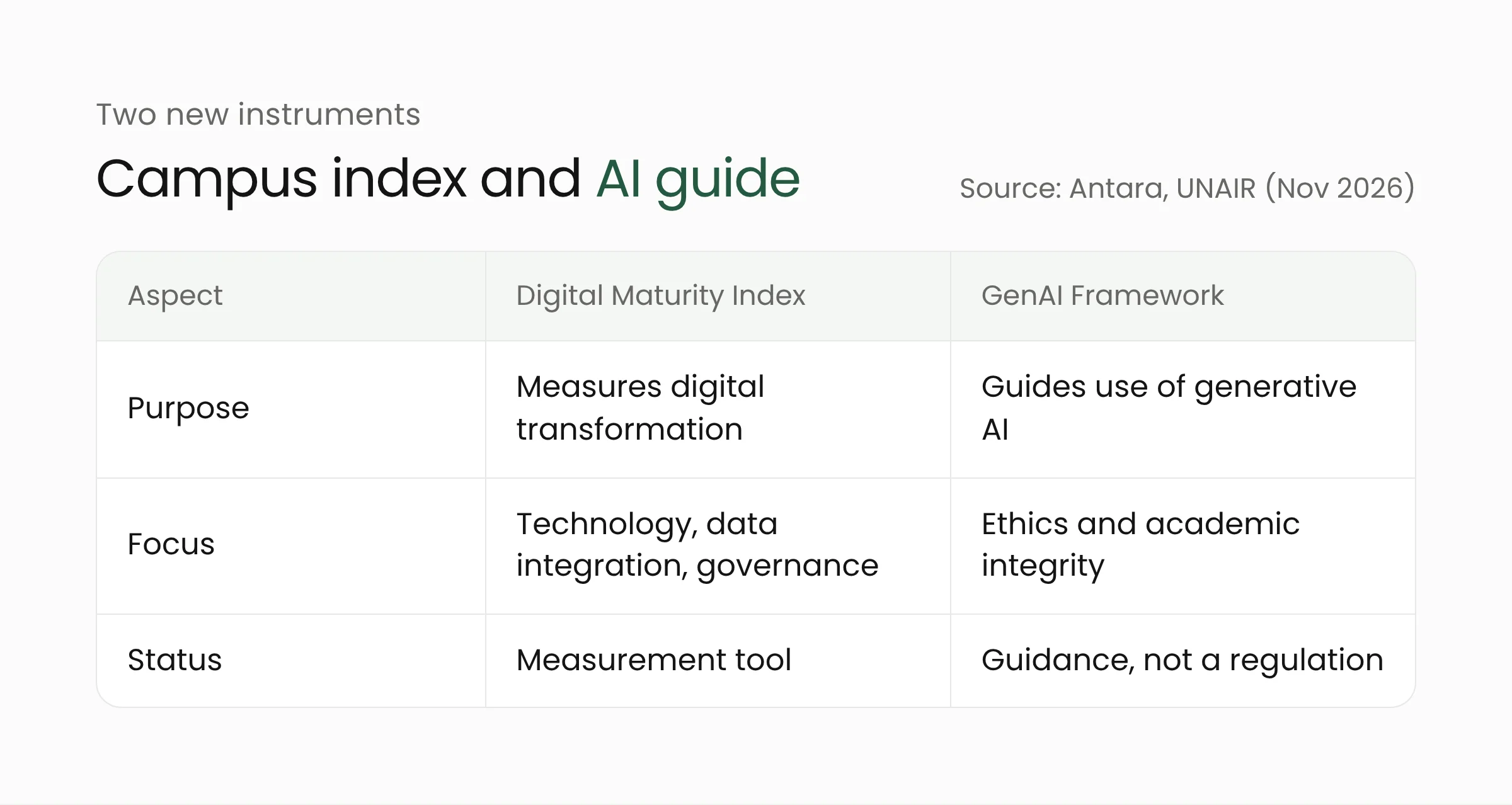
According to ANTARA, the index will measure digital progress on campus. It covers the use of technology as well as data integration that supports decision-making and institutional governance. UNAIR News described it as a measurement matrix for each institution’s level of digital readiness.
Coverage of the launch did not specify the index’s dimensions, its maturity levels or when campuses will be asked to complete it. The ministry has also not said whether results will feed into supervision, accreditation or funding. University administrators should wait for official technical guidelines before drawing conclusions about how each area is weighted.
A similar instrument already exists for PDDikti data
The ministry already runs a maturity assessment for how universities manage their reporting to PDDikti, the national higher education database. LLDIKTI Region III held a briefing on it for private universities on March 26, 2025, following a letter from the ministry’s data and IT center dated March 19, 2025. That assessment focuses on how institutions manage the data they report to PDDikti.
The ministry has not explained how the new index relates to the PDDikti assessment. In practice, campuses that report cleanly to PDDikti tend to have a stronger data foundation, because student, lecturer and course records are already maintained in an orderly way.
Regional service offices are going digital too
In the same presentation, Khairul said the ministry is expanding digital services, including through its regional higher education service offices (LLDIKTI). University administrators no longer need to visit those offices in person for certain services, which saves time and money. The move follows the earlier SAPA Diktisaintek portal, which brings 48 higher education services online.
The GenAI Framework as an ethics guide
The GenAI Framework is guidance on generative AI, the kind of AI that produces text, images or code from a prompt. It is meant to strengthen ethics and academic integrity while encouraging constructive uses of AI in teaching and campus administration.
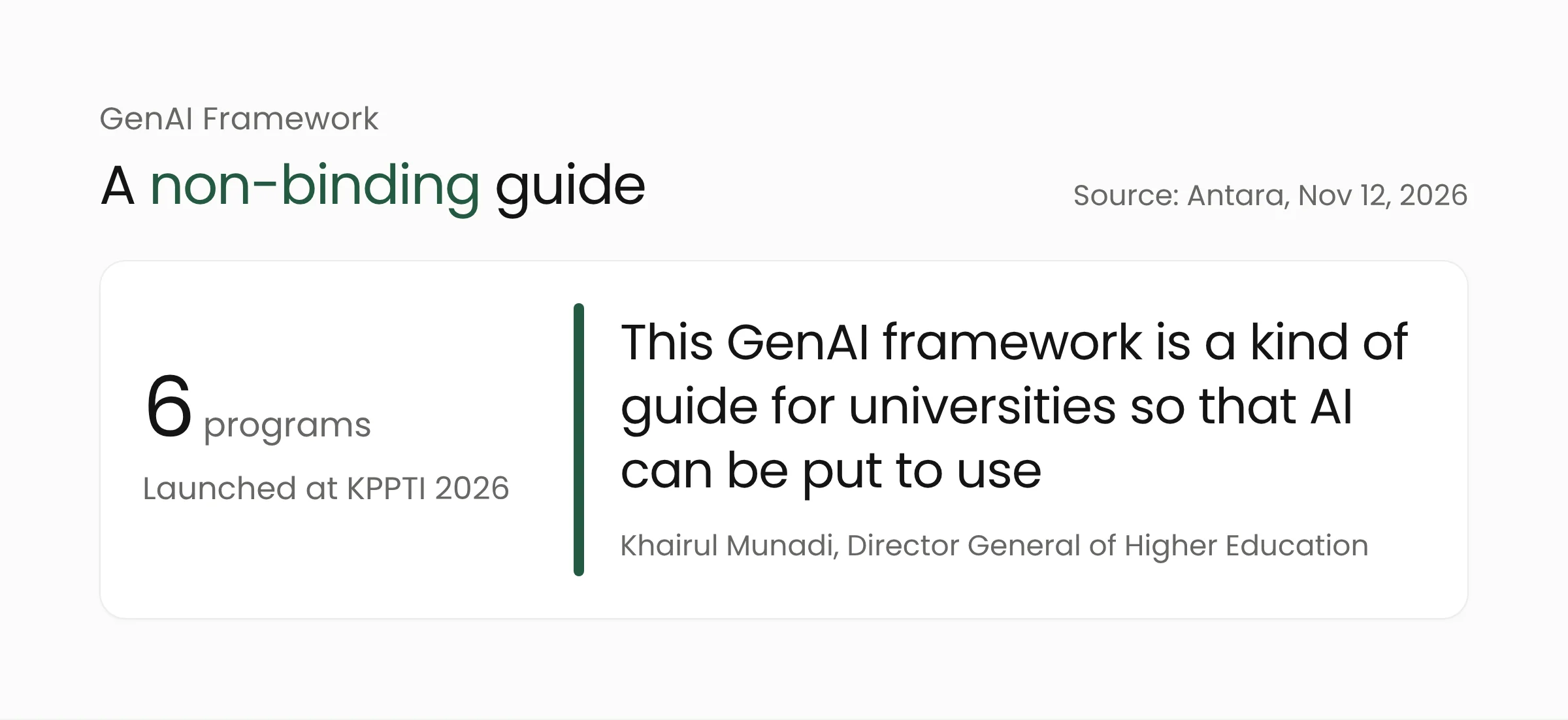
Khairul stressed that the document is guidance and does not carry the force of regulation. ANTARA quoted him describing it as “a kind of guide for universities so that AI can be put to use” (translated from Indonesian). That status leaves each university free to write internal rules that suit its own needs.
What the earlier GenAI handbook already says
The full text of the GenAI Framework has received little coverage so far. For a sense of direction, the Directorate General of Higher Education previously published a handbook, Guidelines for the Use of Generative Artificial Intelligence (GenAI) in Higher Education Learning (in Indonesian). Its second printing of the first edition came out in 2025.
The handbook groups the ethics of using GenAI in learning into four areas: academic integrity, data security and protection, equity and accountability, and environmental impact. It also asks every university to set its own GenAI policy as part of its academic regulations.
Several of its practical recommendations are useful for campuses getting ready now:
- lecturers state in writing when GenAI is allowed or prohibited for a given assignment;
- students who use GenAI acknowledge it, including the prompts they used, following the applicable citation style;
- study programs can add GenAI literacy to the curriculum;
- campus policy is treated as a living document that is revised as the technology changes.
The handbook also warns that banning GenAI outright could worsen what it calls digital poverty and keep GenAI literacy low. It is not yet clear how much of the handbook carries over into the newly launched framework.
What this means for universities
The two instruments touch areas that are often handled separately on campus: information systems run by the IT unit, and academic policy set by faculties. The index looks at data and governance, while the framework looks at how lecturers and students behave. Universities that prepare for both at the same time will be in a better position once the technical guidelines arrive.
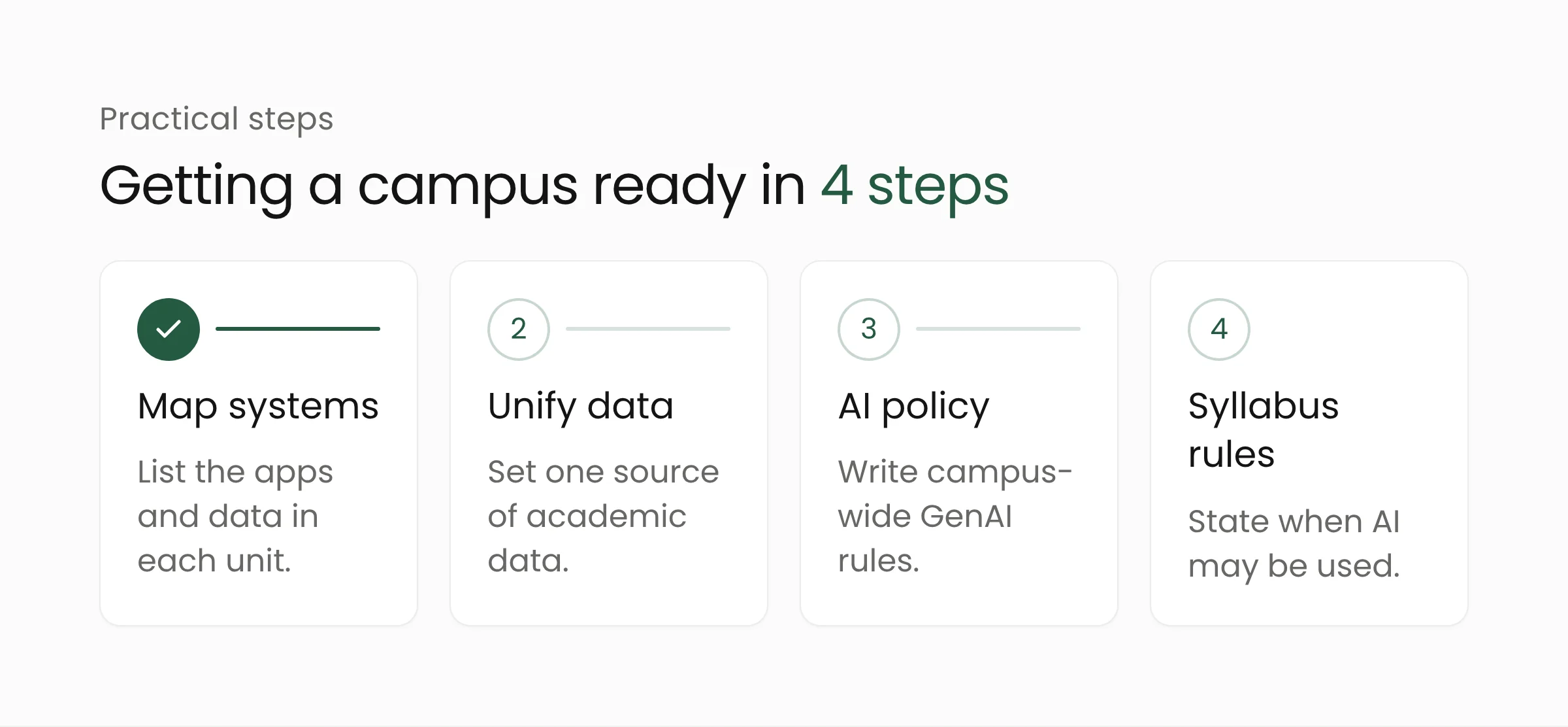
Steps that can start now:
- Map systems and data. List the applications each unit uses, from student admissions and finance to human resources and the library. Flag any data that is recorded in more than one place.
- Set a single source of academic data. Student, lecturer and course data should flow from one core system into PDDikti reports and leadership dashboards. A data analytics team can help build dashboards that read from that single source.
- Write a campus-wide GenAI policy. Involve the academic senate, the quality assurance unit and student representatives. Use the ministry’s handbook as a reference until the full GenAI Framework document is available.
- Set AI rules in each syllabus. Ask lecturers to spell out the AI rules for every assignment, including how to cite prompts when AI is used.
For small private universities, the first two steps are often the hardest, because their systems were built piece by piece by different vendors. Education technology solutions that connect existing systems may be more realistic than replacing everything at once.
Frequently asked questions
What is the Digital Maturity Index for Higher Education?
It is a measurement tool from Kemdiktisaintek for assessing a university’s digital progress. It covers the use of technology and the integration of data for decision-making and governance. Its dimensions and levels have not been announced.
Do universities have to follow the GenAI Framework?
Director General of Higher Education Khairul Munadi described the GenAI Framework as guidance that does not carry the force of regulation. Universities still write their own AI policies and can use the framework as a reference.
Can students use ChatGPT or other AI tools for assignments?
That depends on each university’s policy and the lecturer in charge. The ministry’s GenAI handbook recommends that lecturers explain when AI may be used and that students acknowledge it, including the prompts they used.
Closing thoughts
The Digital Maturity Index and the GenAI Framework give Indonesian universities two new reference points: one for measuring how ready their systems and data are, and one for governing the ethical use of AI. The technical details are still to come, but mapping systems and drafting an AI policy can begin today. Merakit Campus, aimed at university administration, is still being prepared, and the Merakit team is happy to talk about connecting your campus data.
Sources
- Kemdiktisaintek Luncurkan Enam Program Inisiatif Strategis dalam KPPTI 2026, UNAIR News, November 2026
- Ministry outlines six programs for campuses, ANTARA, November 12, 2026 (in Indonesian)
- KPPTI 2026 Sukses di Gelar, Hasilkan Lima Komitmen Transformasi Perguruan Tinggi, LLDIKTI Region VI, November 16, 2026
- Panduan Penggunaan Generative Artificial Intelligence (GenAI) pada Pembelajaran di Perguruan Tinggi, Directorate General of Higher Education, Kemdiktisaintek, first edition, second printing, 2025
- Sosialisasi Implementasi Sistem Penilaian Maturitas Pengelolaan PDDikti, LLDIKTI Region III, March 25, 2025