Blog Digital Government
Indonesia Maps Six Digital Skill Areas for Civil Servants
On this page· 7 sections
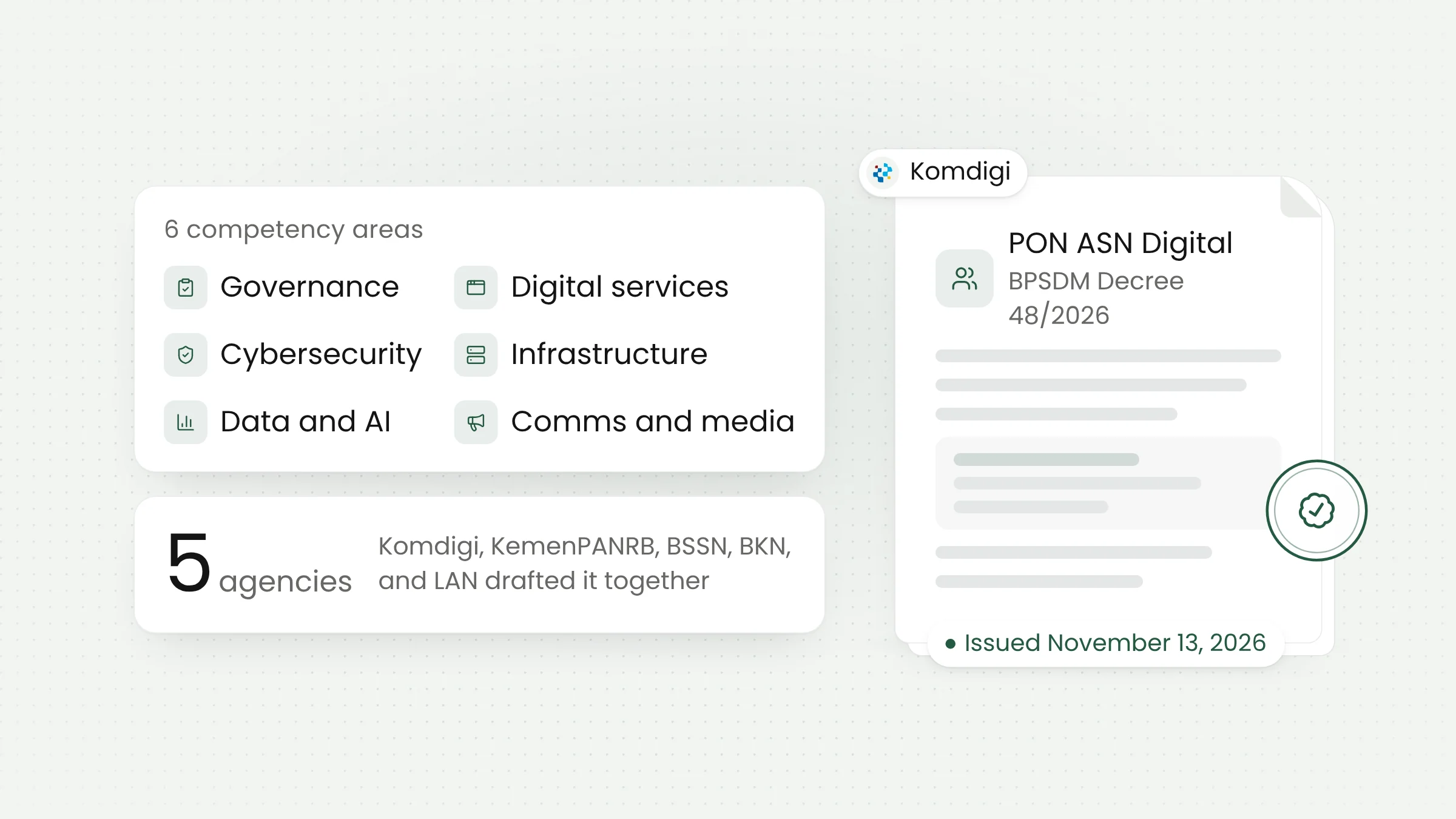
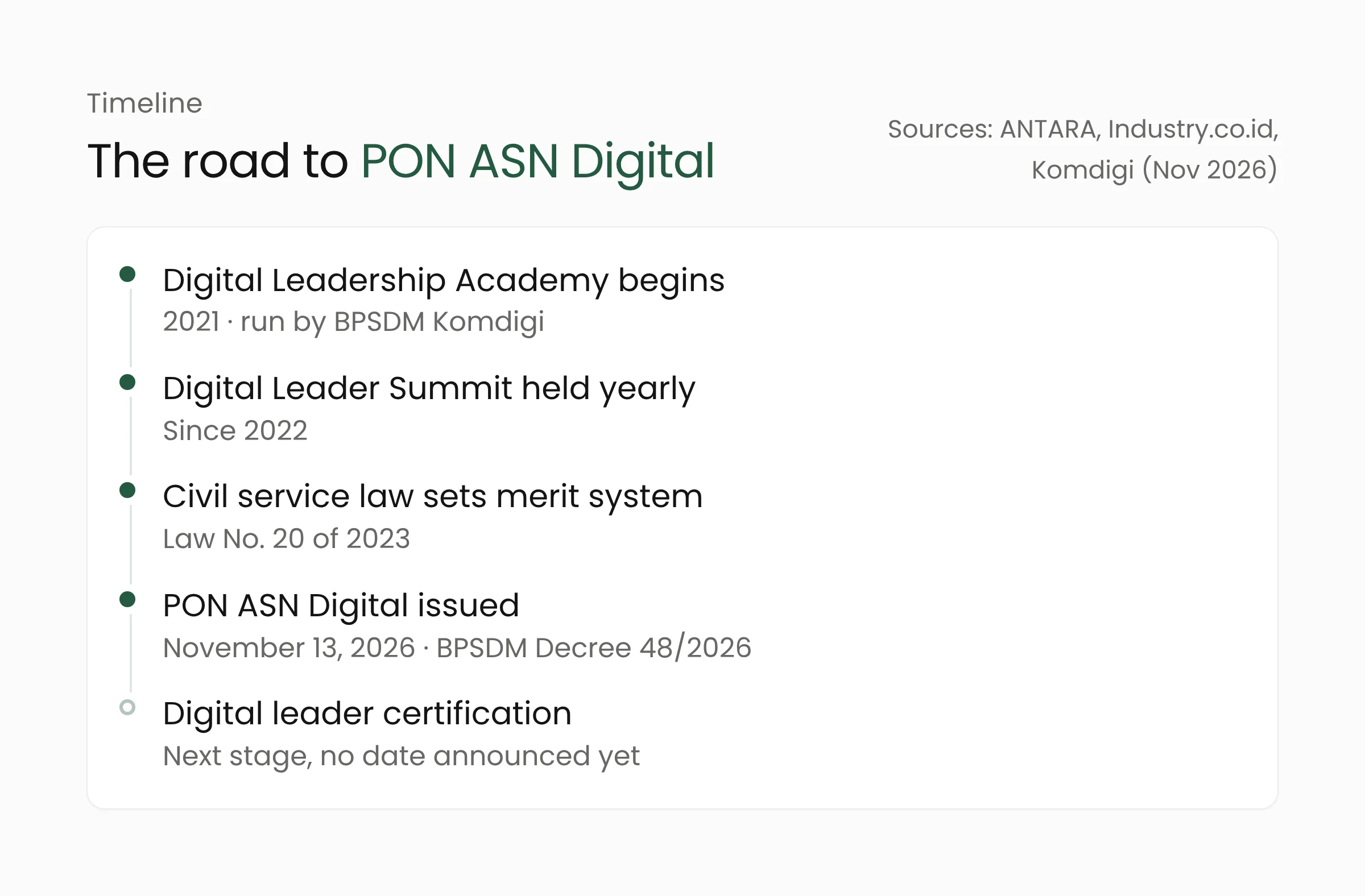
Indonesia launched a national digital competency map for civil servants, the Peta Okupasi Nasional (PON) ASN Bidang Digital, on November 13, 2026. PON ASN Digital sets out six digital skill areas and will guide education, training, certification, recruitment, and career development for civil servants in central and regional government.
What Komdigi launched
The map was presented by Bonifasius Wahyu Pudjianto, head of the Ministry of Communication and Digital Affairs’ human resources development agency (BPSDM Komdigi), at the Digital Leader Summit 2026 at Hotel Bidakara in Jakarta. Its legal basis is Keputusan Kepala BPSDM Komdigi Nomor 48 Tahun 2026 (Decree of the Head of BPSDM Komdigi No. 48 of 2026), ANTARA reported.
An occupational map lists types of jobs and the competencies needed to perform them. It gives agencies a shared vocabulary when they plan headcount, design training, or decide whether an employee is ready for a particular role. According to the ministry’s press release, republished by Headline.co.id, a more structured map also opens the way for talent management policies across the civil service.
Several institutions took part in drafting it. At the same event, Communication and Digital Affairs Minister Meutya Hafid said the digital occupational map was prepared jointly by five agencies: Komdigi, the Ministry of Administrative and Bureaucratic Reform (KemenPANRB), the National Cyber and Crypto Agency (BSSN), the National Civil Service Agency (BKN), and the National Institute of Public Administration (LAN), according to ANTARA.
On the technical side, the map builds on the Indonesian National Qualifications Framework (KKNI), aligned with the national work competency standards (SKKNI) and the existing national occupational map for digital and cybersecurity roles. On the policy side, it is tied to Undang-Undang Nomor 20 Tahun 2023 tentang Aparatur Sipil Negara (Law No. 20 of 2023 on the civil service), which emphasizes a merit system, meaning staff are managed on qualifications, competence, and performance. Komdigi also says the map supports the Digital Government Master Plan 2025–2045.
The six competency areas
PON ASN Digital groups civil servants’ digital skills into six areas. The detailed occupations within each area have not been widely published, so the job examples below describe typical government work, not the text of the decree.
- Digital technology governance. Planning and oversight of technology, such as designing an agency’s system architecture, managing risk, and writing procurement specifications.
- Digital product and service development. Designing and building public service applications, from online permit forms to queuing apps.
- Information and cybersecurity. Protecting agency systems and data, monitoring threats, and handling incidents.
- Digital infrastructure. Networks, servers, data centers, and the cloud services that keep applications running.
- Data science and artificial intelligence. Turning data into dashboards and analysis for decision-making, including responsible use of AI.
- Public communication and digital media. Running an agency’s information channels, such as its official website and social media accounts.
The split resembles how IT teams are organized in many companies. What the map adds is an official basis for calling someone an information security officer or a data analyst, with defined expectations for that role. In many regional communication and informatics offices, these jobs are still shared among one or two people.
A focus on digital leaders
The launch closed the 2026 cycle of the Digital Leadership Academy (DLA), a leadership training program BPSDM Komdigi has run since 2021. According to Industry.co.id, DLA reached 205 participants in the 2026 budget year: 50 from the Balikpapan city government, 50 from the Nusantara Capital City Authority, 60 from public broadcaster TVRI, and 45 civil servants, state and regional enterprise staff, academics, and private sector leaders in the November 12–13 session. The Digital Leader Summit, held every year since 2022, drew about 400 leaders in person and online.
Bonifasius said competency standards for digital leaders are needed so that the role rests on demonstrated ability as well as position or recognition. Those standards are expected to underpin a competency certification scheme at a later stage, Sinar Harapan reported. Event coordinator Hary Budiarto added that leaders need management skills, data governance, personal data protection, and cybersecurity knowledge.
Meutya focused on how leaders choose where to put their effort. “Salah satu tantangan para pemimpin saat ini adalah memilih prioritas,” she said, which translates as “one of the challenges for leaders today is choosing priorities,” Industry.co.id reported. She also cited the Microsoft Work Trend Index 2026: 72% of AI users in Indonesia feel able to produce work they could not do before, yet only 42% say their leaders have a clear, aligned direction and readiness for applying AI.
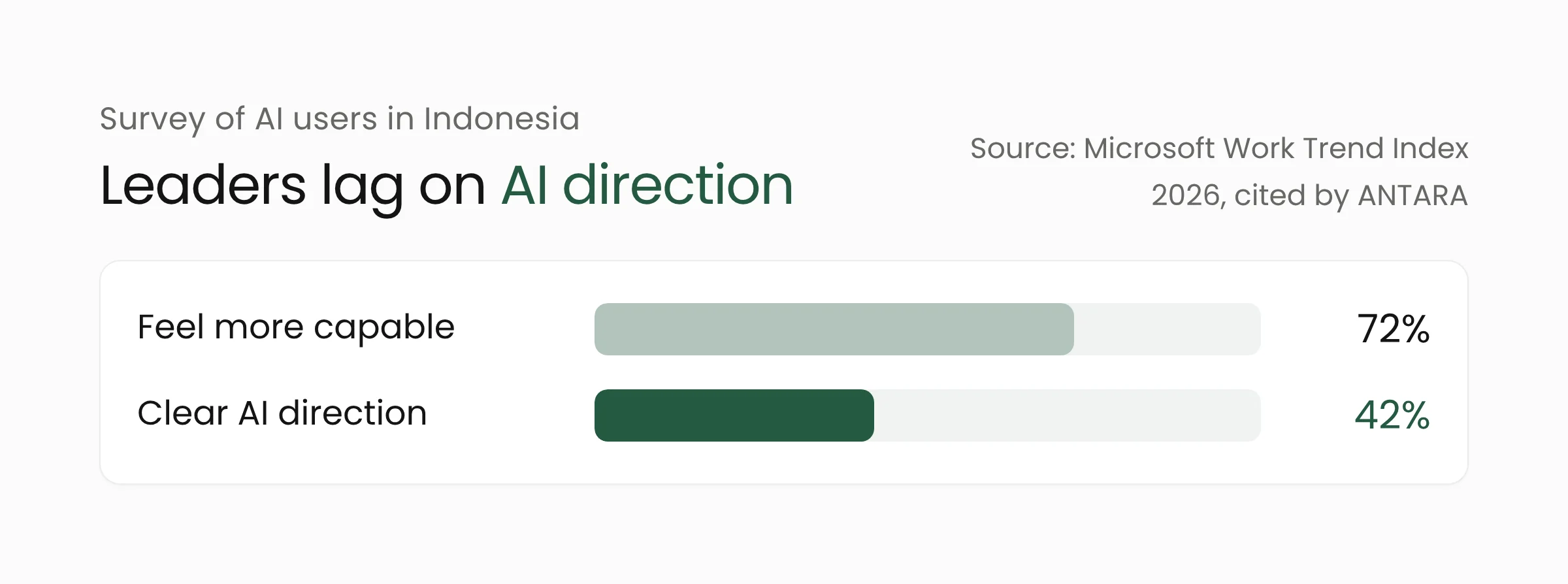
The distance between those two numbers helps explain why the government is targeting leaders. Staff can pick up new tools quickly, but decisions about which data may be processed, which applications come first, and who answers for security still sit with unit heads.
What this means for government agencies
For ministries, agencies, and regional governments, PON ASN Digital offers a framework for reorganizing digital staff. It also connects with other work underway, such as Komdigi’s effort to bring order to thousands of government apps through SPLP. Better-organized applications still need people who know how to run and secure them.
Agencies can start with a few steps while waiting for detailed guidance from BPSDM Komdigi:
- Map current staff and digital tasks. Record who manages networks, applications, data, security, and information channels today, then group them under the six PON ASN Digital areas. In many local offices, one person covers several areas.
- Match the map against the services you run. Compare the staffing picture with your list of applications and systems. An office may find a dozen active apps and nobody dedicated to information security or data backups.
- Plan training and certification. Start with the areas that carry the most risk, such as cybersecurity and data governance, and use the relevant SKKNI standards when choosing training programs.
- Clarify roles with technology partners. Vendors often build and maintain government apps. Agencies still need staff who understand governance and security to write specifications, review deliverables, and keep control of their data.
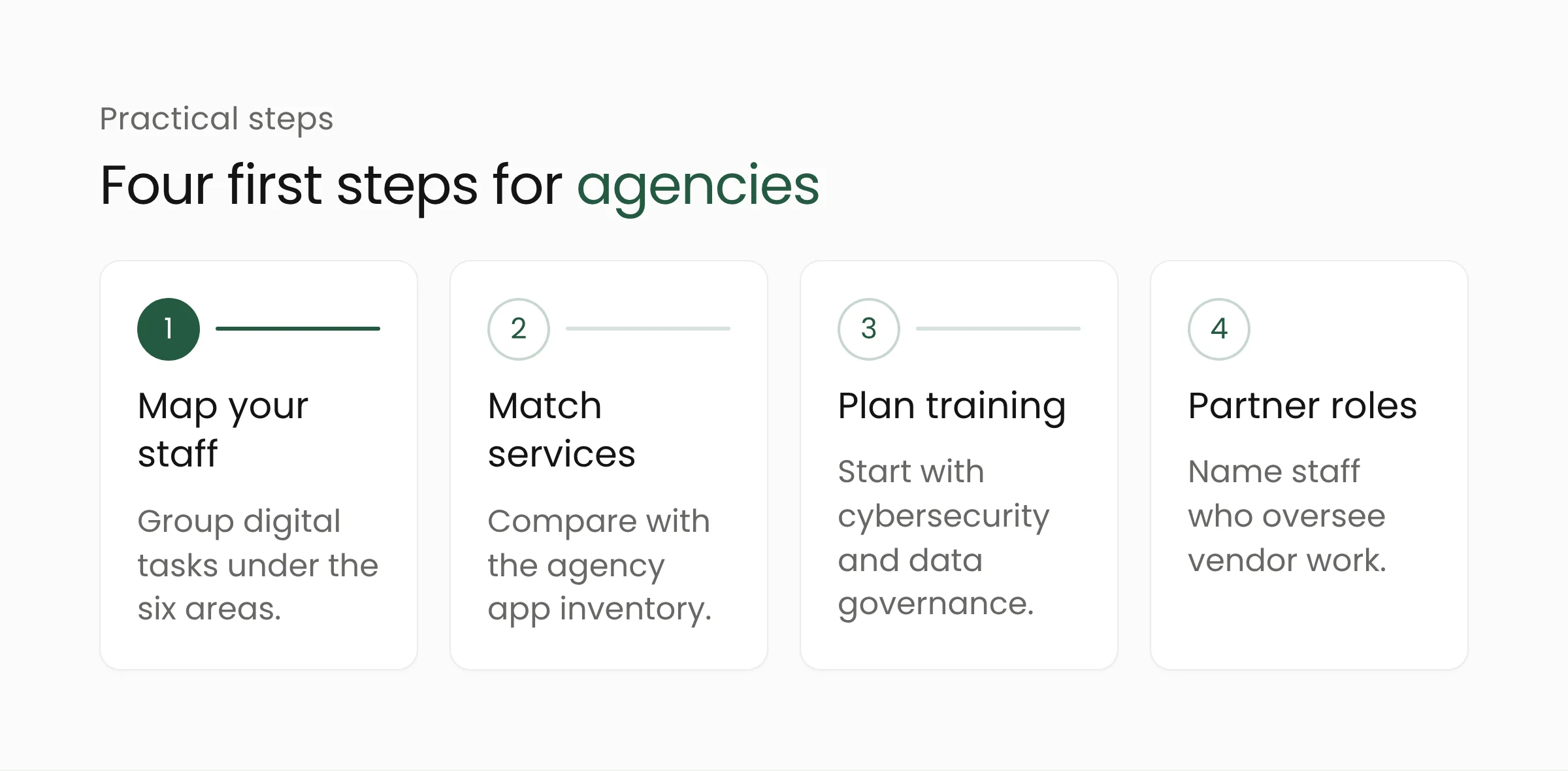
The fourth step matters most for regions that rely on outside contractors. A sound development contract states who holds the source code, who manages server access, and how handover works. Teams that build digital government solutions can help set up that division of work, while risk assessments and system testing can be strengthened with independent cybersecurity services.
Some details remain unknown. At the time of writing, we could not find the full text of BPSDM Komdigi Decree No. 48 of 2026 in the public channels we searched, and no timeline has been announced for the digital leader certification scheme. Agencies should watch official Komdigi and BPSDM channels for the role-by-role details.
Frequently asked questions
Is PON ASN Digital the same as BKN’s ASN Digital account?
No. PON ASN Digital is a competency map issued by BPSDM Komdigi. BKN’s ASN Digital is a staff services portal at asndigital.bkn.go.id that brings together 47 personnel services, including MyASN and SIASN, according to detikFinance.
Will every civil servant need a digital competency certificate?
The sources we reviewed do not mention mandatory certification for all civil servants. The map is described as a reference for certification programs, and the digital leader standards are expected to form the basis of a certification scheme later. Detailed rules have not been announced.
Who can use the occupational map?
Its main users are ministries, agencies, and regional governments. According to ANTARA, Bonifasius also invited universities, industry, and digital leader associations to use PON ASN Digital as a shared reference, for example when designing curricula and training programs.
Conclusion
PON ASN Digital gives central and regional government a single reference for naming, training, and assessing digital work across six areas. Its effect will show when agencies use it to map staff, plan training, and divide work with partners more clearly. The role-level details and certification scheme are still to come, but internal mapping can start now.
The Merakit Indonesia team regularly works with government agencies to build and hand over digital services. Get in touch if your office would like to discuss how to split responsibilities between in-house staff and technology partners.
Sources
- Pemerintah petakan enam bidang kompetensi digital ASN, ANTARA, November 13, 2026
- Menkomdigi: Kesiapan pemimpin kunci akselerasi adopsi AI, ANTARA, November 13, 2026
- [Siaran Pers] PON ASN Digital Petakan Enam Kompetensi ASN, Headline.co.id (Komdigi press release), November 2026
- Digital Leader Summit 2026 Perkuat Kapasitas Pemimpin Digital di Indonesia, Industry.co.id, November 13, 2026
- Digital Leader Summit 2026 Bentuk Pemimpin Digital Indonesia Adaptif, Sinar Harapan, November 13, 2026
- Apa Itu ASN Digital buat PNS?, detikFinance, January 2, 2026