Blog Online Scams
Indonesia's Scam Reporting Channels: 196,624 Account Reports
On this page· 7 sections
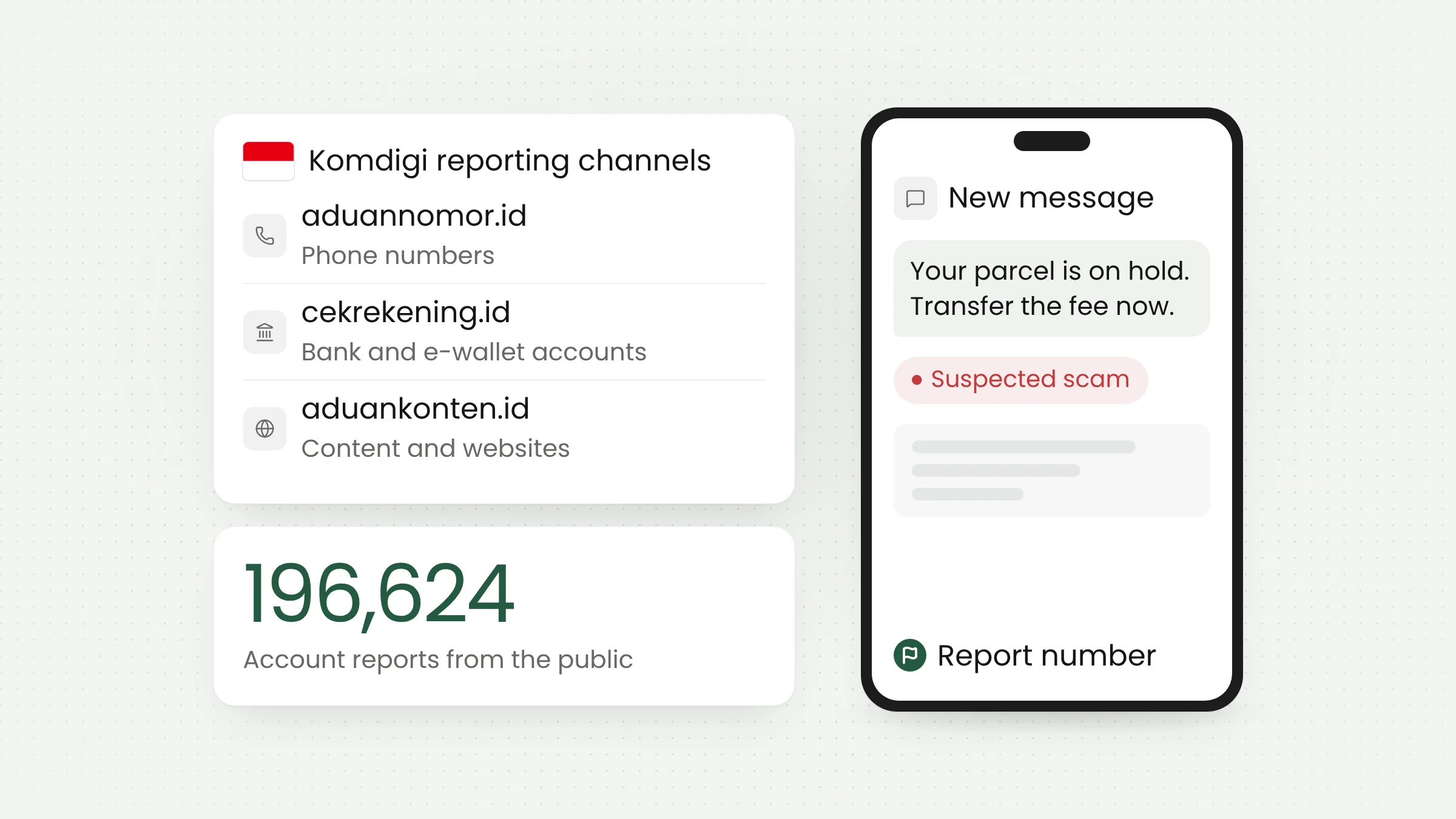
Indonesia’s scam reporting channels have taken in hundreds of thousands of public reports over the past two years. On November 24, 2026, Communication and Digital Affairs Minister Meutya Hafid cited 196,624 reports of suspect bank accounts, more than 103,000 reports of phone numbers, and 67,578 pieces of scam content handled by her ministry, known as Komdigi.
The numbers Komdigi announced
Meutya Hafid gave the figures on Tuesday, November 24, 2026, at a press conference where the National Police presented a cross-border online fraud case. According to ANTARA, the state news agency, Komdigi handled 67,578 pieces of online fraud content on social media and websites between October 2024 and November 4, 2026. A separate ANTARA report says that content came in through the aduankonten.id service.
The other two figures count public reports filed from October 20, 2024 to November 19, 2026. CNBC Indonesia reported the minister’s clarification that these totals cover reports from the public only. Cases the ministry handled directly, and reports from other government bodies, are excluded.
Phone number reports
The aduannomor.id service collects reports about mobile numbers suspected of being used for crime. Media outlets give slightly different totals. ANTARA puts the figure at 103,948 reports, while CNBC Indonesia has 103,940.
Three categories stand out in the breakdown. Extortion and threats over digital platforms account for 19,422 reports, and identity impersonation for 17,631. For the category labeled scamming, ANTARA reports 15,232 and CNBC Indonesia 15,292.
Bank account reports
The cekrekening.id service received 196,624 reports of accounts suspected of links to digital crime. Online buying and selling is the largest category, with more than 74,000 reports. Online gambling follows with more than 47,000, then extortion with more than 20,000, scamming with nearly 7,000, and social engineering fraud with 3,881.
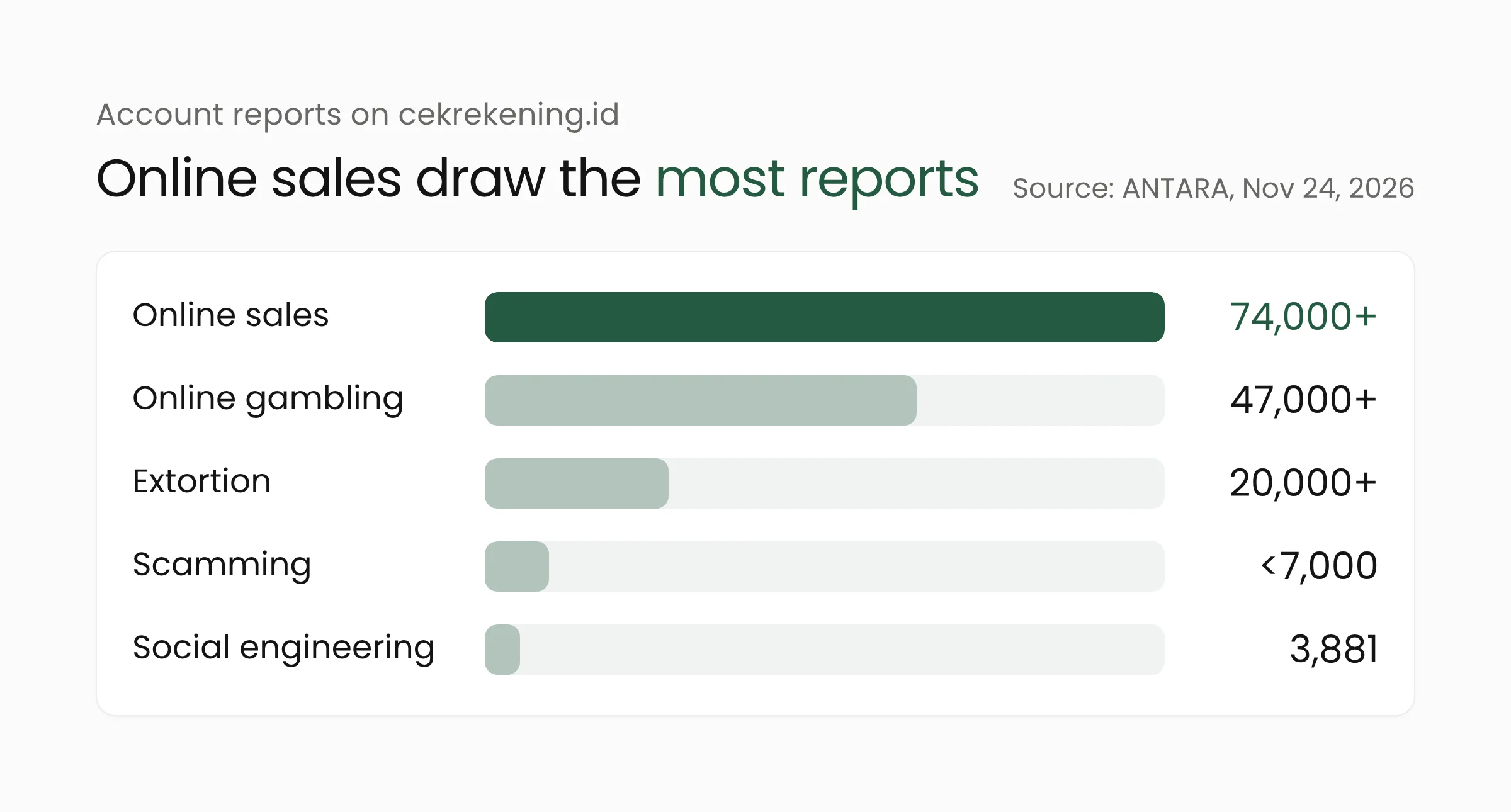
The weight of online sales reflects how many Indonesians shop. Purchases are often arranged in private chats and paid by direct bank transfer, without escrow or marketplace protection. The account number is then the only trace a victim has.
What the data leaves out
Report counts show how heavily the channels are used. They do not show outcomes. Coverage of the press conference does not say how many numbers were blocked, how many accounts banks acted on, or how long a report takes to process.
Reports are also different from victims. One account can be reported by many people, and one victim can file with more than one channel, so the three figures should not be added into a single case count.
For comparison, the Indonesia Anti-Scam Centre (IASC), coordinated by the Financial Services Authority (OJK), received 741,545 reports from November 2024 to October 2026, according to Kontan. Of the 1,481,176 accounts reported to IASC, 748,284 have been blocked.
How the three official channels work
Each Komdigi service deals with a different kind of trace: a phone number, an account, or a piece of content.
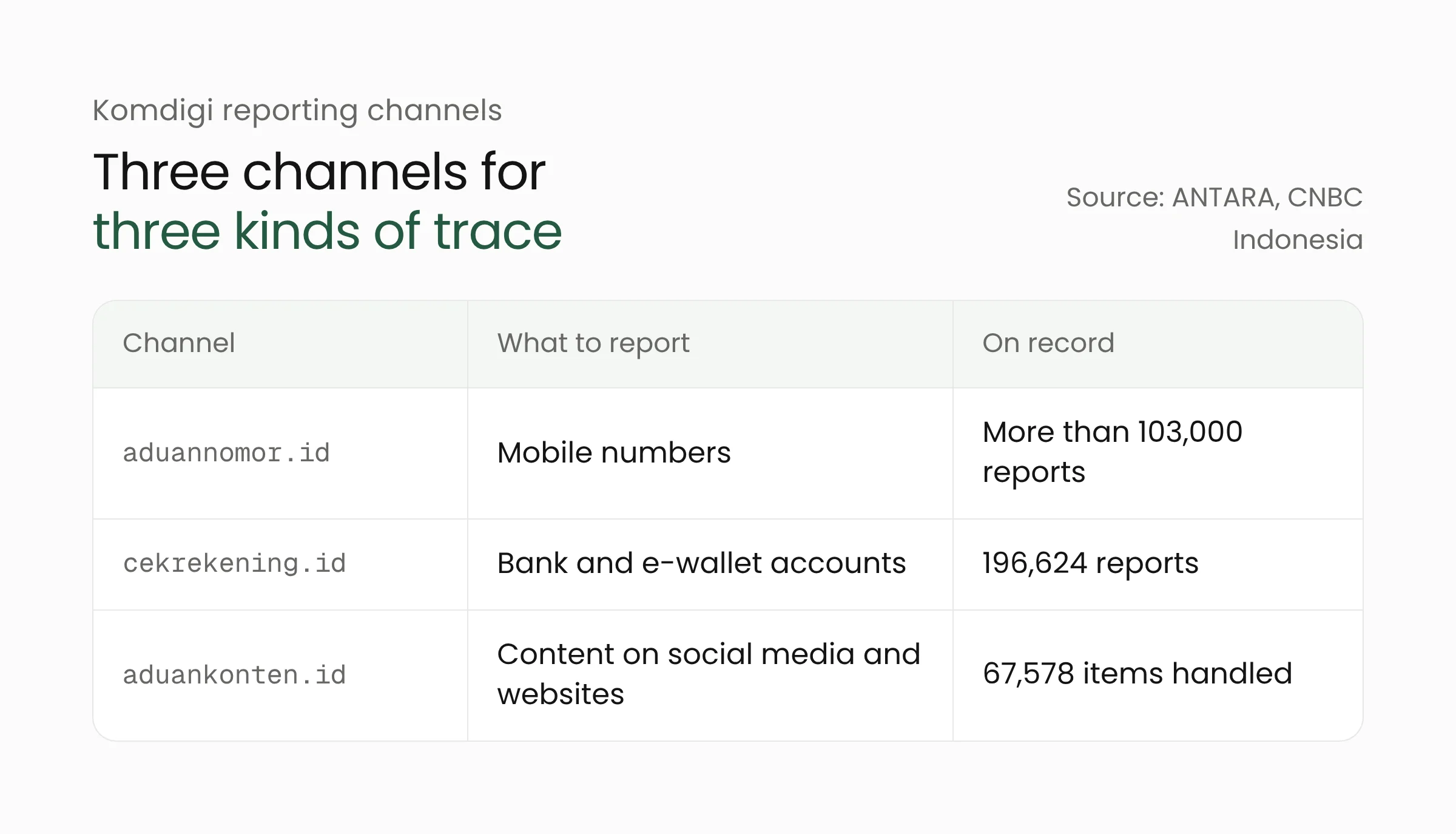
aduannomor.id is for reporting mobile numbers. A September 2026 CNBC Indonesia guide lays out the sequence. The reporter opens the menu for reporting a mobile number, enters the number and its operator, then picks a category such as fraud, identity impersonation, online investment, or online gambling. The reporter adds a name and contact, writes a dated chronology, and uploads evidence such as chat screenshots. If the report is substantiated, the number can be cut off from the mobile network. The service is free.
cekrekening.id does two things: it lets people check an account and report one. According to a detikInet walkthrough, the user selects the account type (bank or e-wallet), picks the bank, enters the account number, and presses the check button. If nothing is on file, the site states that the account has never been reported or registered.
An account with no reports is not proven safe. Fraudsters can use a new account, or a borrowed one that nobody has reported yet. A lookup filters out accounts already known to be a problem, and other precautions still apply.
aduankonten.id takes reports of digital content suspected of being used for fraud, on social media or on websites. The 67,578 items the minister cited were handled through this route.
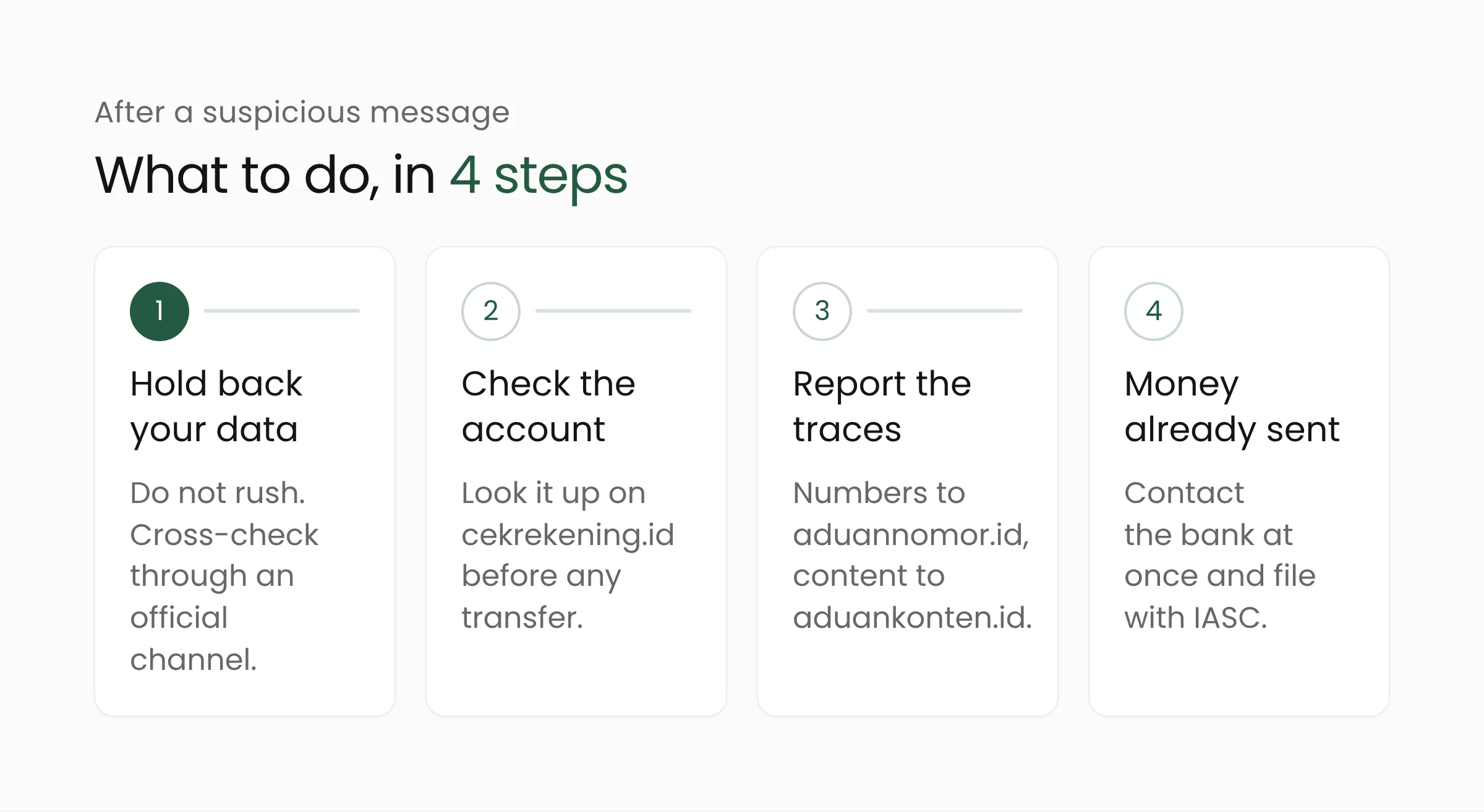
None of the three channels recovers money that has already moved. For that, victims need to contact their bank or e-wallet provider at once and file with IASC. Hudiyanto, secretary of the secretariat of the OJK-led illegal finance task force (Satgas PASTI), has said 80% of victims report only 12 hours after the incident, while stolen funds are usually moved very quickly. We covered that finding in our piece on Indonesia’s estimated scam losses.
A 24-hour blocking deadline and a proposed ASEAN protocol
Phone number reports now come with a deadline for follow-up. The minister pointed to Peraturan Menteri Komunikasi dan Digital Nomor 7 Tahun 2026 (the ministerial regulation on mobile subscriber registration). According to ANTARA, the rule obliges mobile operators to block a number within 24 hours of receiving a request from an officer designated by Komdigi.
The clock starts when the operator receives the request. The coverage does not say how long Komdigi takes to verify a report first.
The same regulation requires face verification when a new SIM card is registered. The aim is to close the gap that lets anonymous numbers be used for fraud and then discarded. We reviewed the rollout in our article on biometric SIM registration passing 41 million subscribers.
The minister also raised a regional proposal. Komdigi is pushing for an ASEAN Rapid Scam Disruption Protocol to be drawn up with ASEAN member states. ANTARA describes it as a way to speed up coordination between authorities over digital infrastructure misused for cross-border crime. It remains a proposal under discussion. No timetable or text has been announced.
She added that cutting off access has to go together with law enforcement, since blocking numbers and removing content only takes away the tools offenders use.
What this means for public agencies and businesses
The minister warned that fraudsters now misuse the identity and attributes of state institutions to win victims’ trust. She also said AI-based manipulation could make fraud harder to spot. For local agencies, public service bodies, state schools, regional hospitals, and companies whose names are easy to imitate, five steps are within reach of existing resources.
Publish every official channel on one page. List the agency’s WhatsApp number, email address, social media accounts, and bank account on a single page under the official domain. A page like this is basic groundwork in the digital government solutions we build.
State what the agency never does. For example, it never asks for one-time passcodes, never sends app files through private messages, and never collects payments into an account under an individual’s name.
Show the recipient’s name before payment. In services that collect fees, display the account holder’s name or the QRIS merchant name before the citizen confirms the payment.
Prepare an internal reporting flow. Front-line staff need to know what to do when a citizen reports a fake account. Save the screenshots, report the number to aduannomor.id, report the account to cekrekening.id, report the profile or site to aduankonten.id, then post a warning on official channels. Name one person responsible for the follow-up.
Watch for lookalike names and domains. Regular checks for similar domains and fake accounts can be run in-house or through cybersecurity services.
For citizens and employees, the order of action comes down to four steps.
Online shops and small businesses that take direct transfers have a similar interest. Use an account in the business name, list it on the official profile, and invite buyers to check it themselves.
Frequently asked questions
What is the difference between aduannomor.id, cekrekening.id, and aduankonten.id?
All three are run by Komdigi, each with its own target. aduannomor.id covers mobile numbers used to defraud or threaten people. cekrekening.id is for checking and reporting bank or e-wallet accounts. aduankonten.id covers content, on social media or websites, that is suspected of being used for fraud.
Is a reported number blocked immediately?
No. According to ANTARA, ministerial regulation No. 7 of 2026 requires operators to block a number within 24 hours of receiving a request from a Komdigi officer. How long the ministry takes to review a report before sending that request has not been stated.
Where should victims report if money has already been transferred?
Contact the bank or e-wallet provider as fast as possible, then file with the Indonesia Anti-Scam Centre (IASC), which OJK coordinates. After that, report the receiving account to cekrekening.id and the offender’s number to aduannomor.id so that others are warned.
Closing
Komdigi’s data shows that Indonesians are already using the reporting channels in large numbers, above all for the accounts of fake sellers. The next questions are how fast reports are acted on and what impersonated institutions do on their side. If your agency or business wants to tidy up its official channels page, payment flow, or monitoring for fake accounts, the Merakit team is open to a conversation.
Sources
- Komdigi perkuat koordinasi ASEAN cegah penipuan daring lintas negara, ANTARA, November 24, 2026
- Komdigi catat ratusan ribu aduan penipuan di ruang digital, ANTARA, November 24, 2026
- Masyarakat adukan ratusan ribu penipuan daring ke Komdigi, ANTARA Mataram, November 24, 2026
- Komdigi Ungkap 67 Ribu Konten Penipuan Online, Ini Modusnya, CNBC Indonesia, November 24, 2026
- IASC Terima 741.545 Laporan Scam, 80% Korban Lapor Setelah 12 Jam, Kontan, November 17, 2026
- Cara Cek Rekening Penipuan Online Sebelum Transfer, detikInet, July 20, 2025
- 8 Ciri Penipuan di WhatsApp dan Cara Melaporkannya, CNBC Indonesia, September 23, 2026