Blog Artificial Intelligence
Kimi K3.1 Pro Brings an Open Model Close to the Top Tier
On this page· 7 sections
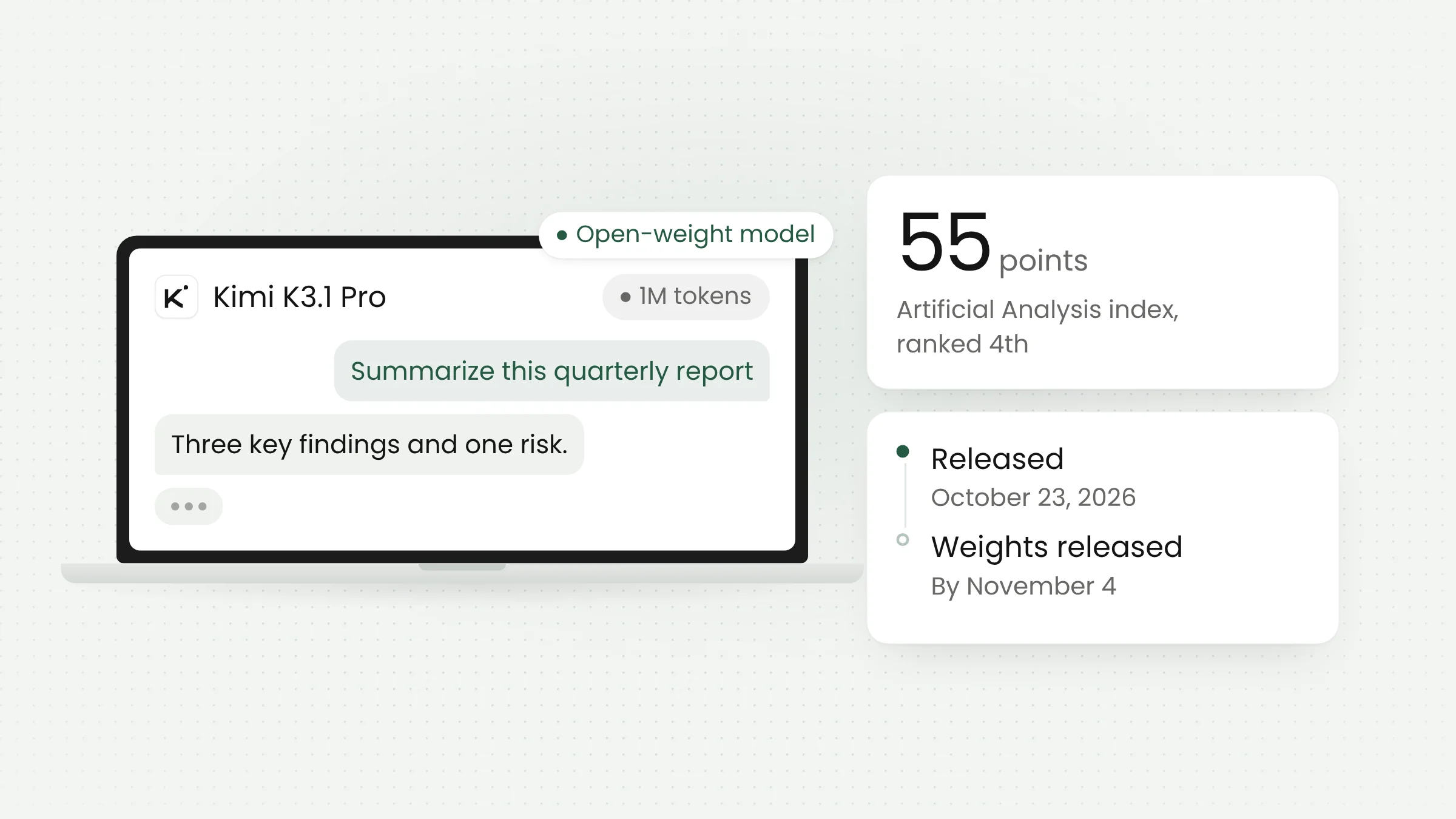
Chinese AI company Moonshot AI released Kimi K3.1 Pro on October 23, 2026. The model scores 55 on the Artificial Analysis Intelligence Index, three points behind the best closed model. Moonshot plans to publish the full weights by November 4, 2026, and says it first removed cyberattack-related material from the training data.
What Moonshot announced
Kimi K3.1 Pro builds on Kimi K3 with substantially more post-training compute, the refinement stage that follows base training. In its official announcement, Moonshot calls it its most capable 3-trillion-class open-weight model to date. According to Artificial Analysis, the model has 2.8 trillion total parameters with 104 billion active, accepts text and image input, and handles a context window of one million tokens.
Active parameters are the portion of the model that does the work for any single request. This design keeps a very large model cheaper to run per query, although all of its parameters still have to sit in server memory.
The model is live on Kimi.ai, the Kimi apps, the Kimi Work desktop app, the Kimi Code programming tool, and the Kimi API. Moonshot also released K3.1 Pro Highspeed, a variant it says runs two to three times faster. For Kimi Enterprise customers, access is switched off by default until an administrator turns it on.
Prices are lower than before. Artificial Analysis lists API rates of $2 per million input tokens and $10 per million output tokens, 33 percent below Kimi K3. Moonshot also offers Zero Data Retention to API customers, meaning request data is not stored.
Scores close to the closed leaders
In independent testing by Artificial Analysis, Kimi K3.1 Pro scored 55 points and ranked fourth. Ahead of it are Claude Opus 5.5 at 58 points, and Claude Sonnet 5.5 and Muse Wonder Full at 56 points each. Its predecessor, Kimi K3, scored 44.
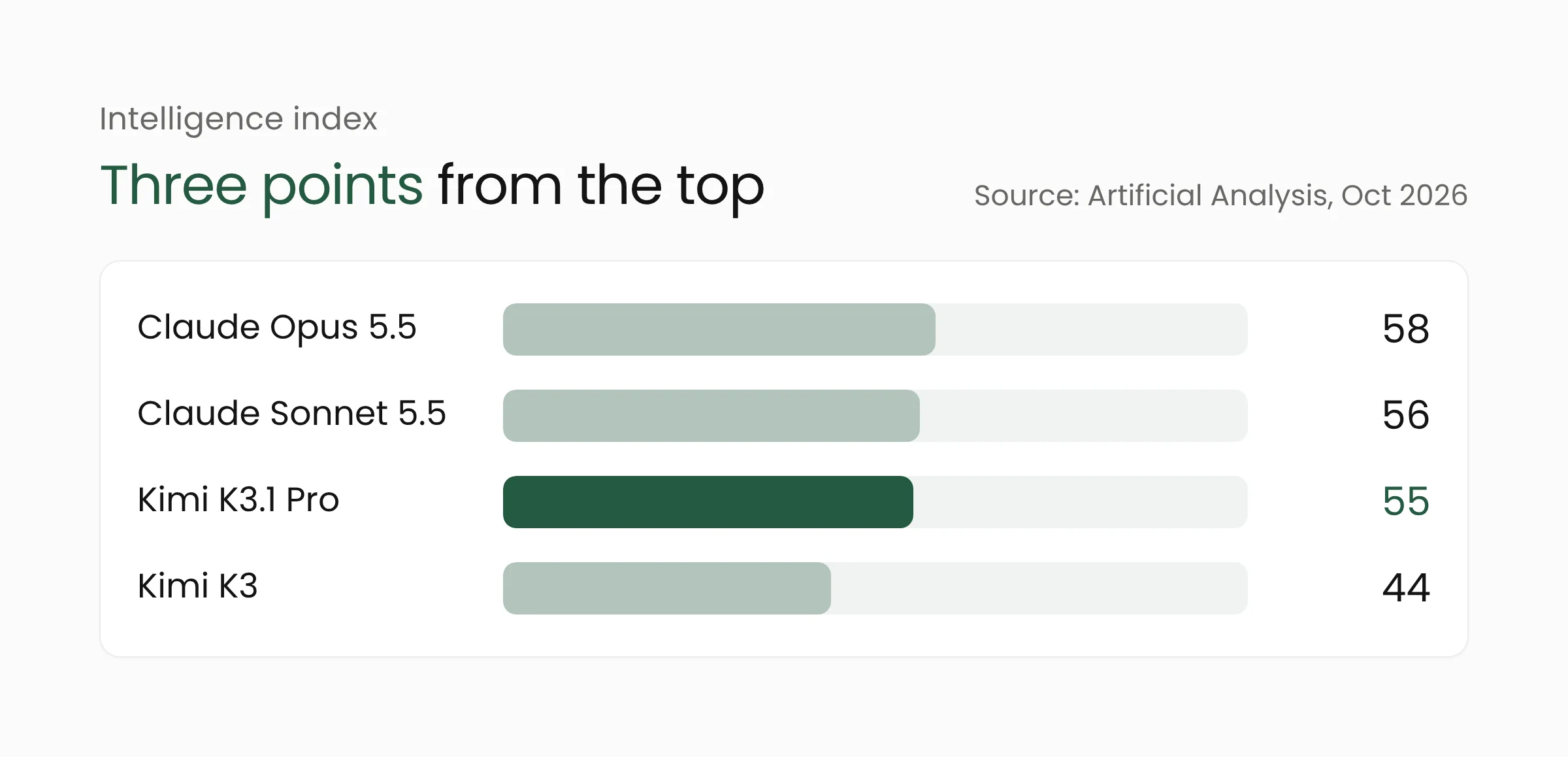
Artificial Analysis says the gap between the best open-weight model and the best closed model would narrow from 12 points to 3 once the K3.1 Pro weights are actually released. That condition matters, because the model only becomes the leading open model when anyone can download it.
On agentic coding work, Moonshot reports 65.7 percent on Terminal-Bench 4.0. That is slightly below Claude Opus 5.5 at 66.4 percent and above GPT-6 Astra at 58.2 percent. These figures come from Moonshot’s own testing and have not been independently verified.
The same benchmarking firm also points to limits. Gains outside agentic tasks were modest, with Humanity’s Last Exam rising only from 47 to 52 percent. The hallucination rate on AA-Omniscience fell from 53 to 44 percent, a figure Artificial Analysis still describes as high. Moonshot reports that the share of false claims on its internal stress test dropped from 23.4 percent to 8.3 percent, and notes that the test does not represent everyday error rates.
Cyberattack data removed before the weights go public
The most notable part of the release concerns security. Moonshot says it identified and removed cyber-related data from both training stages of the open-weight version, while keeping general coding tasks.
The effect shows up on its internal xdev-bench-hard test. A checkpoint without the risk-reduction measures solved 90.5 percent of problems, while the released K3.1 Pro solved 81.0 percent. For comparison, Kimi K3 solved 33.3 percent. Moonshot says K3.1 Pro’s cyber capability remains behind leading closed models.
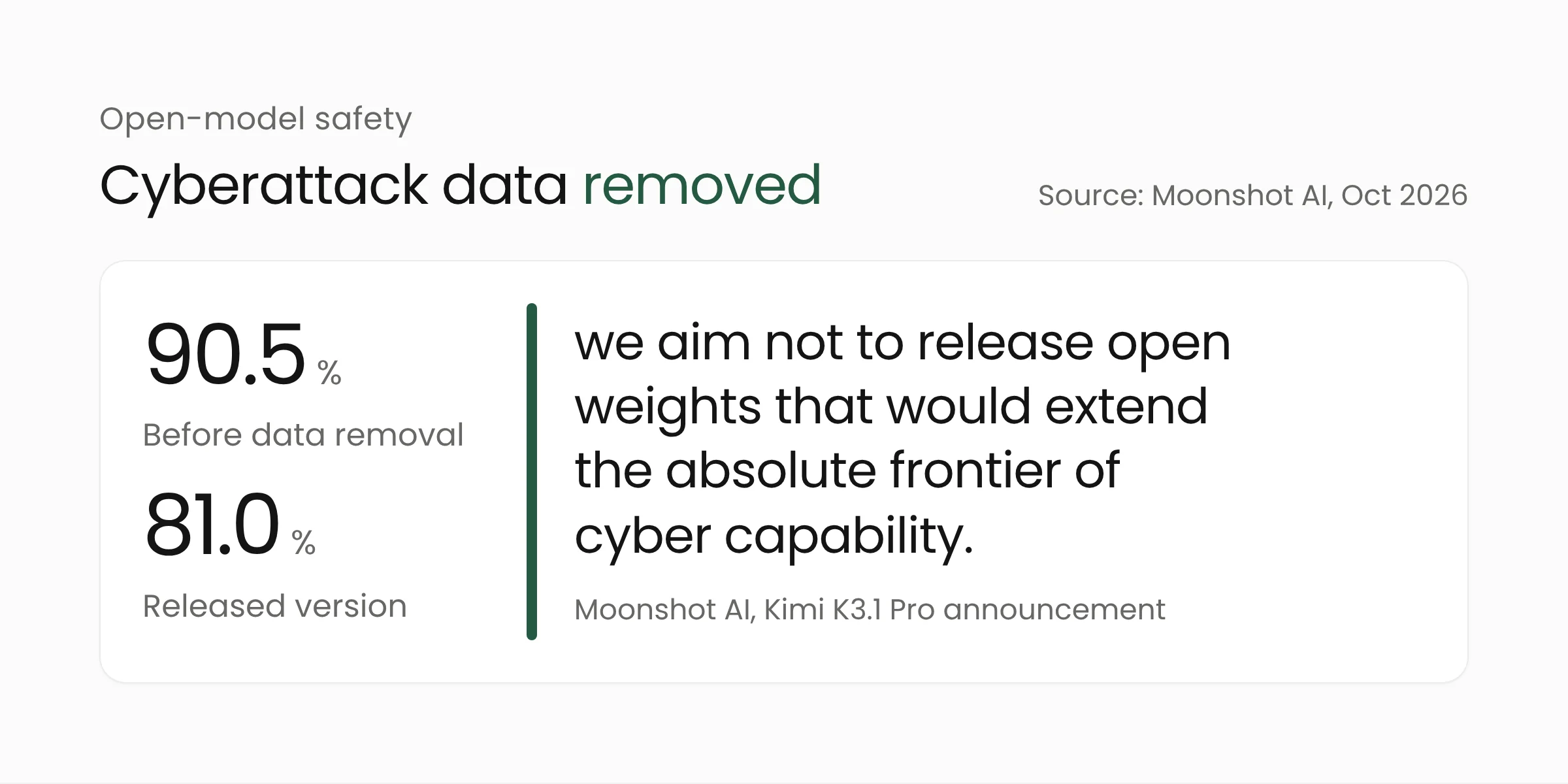
Moonshot states its principle plainly: “we aim not to release open weights that would extend the absolute frontier of cyber capability.” In practice, the company is trying to avoid publishing a model whose offensive skills exceed anything already available.
The move responds to a long-standing concern. TNW notes that open-weight models cannot be recalled once downloaded, and that safety researchers warn their safeguards lag behind closed models. The drop from 90.5 to 81.0 percent also shows the model’s cyber capability was reduced, though it is still substantial.
What this means for your organization
Open-weight models appeal to organizations that want to run AI on their own servers, such as banks, government agencies, or companies holding large volumes of customer data. With the weights in hand, data does not have to leave the internal network. The size of this model, however, carries costs that should be calculated from the start.
Open weights demand serious hardware
A 2.8-trillion-parameter model needs a GPU cluster with a very large memory pool. A single ordinary server will not do. For most organizations in Indonesia, running K3.1 Pro in-house means a significant investment in hardware or rented cloud GPUs. A more realistic choice is often a smaller open model for specific tasks, or an API with a clear data policy.
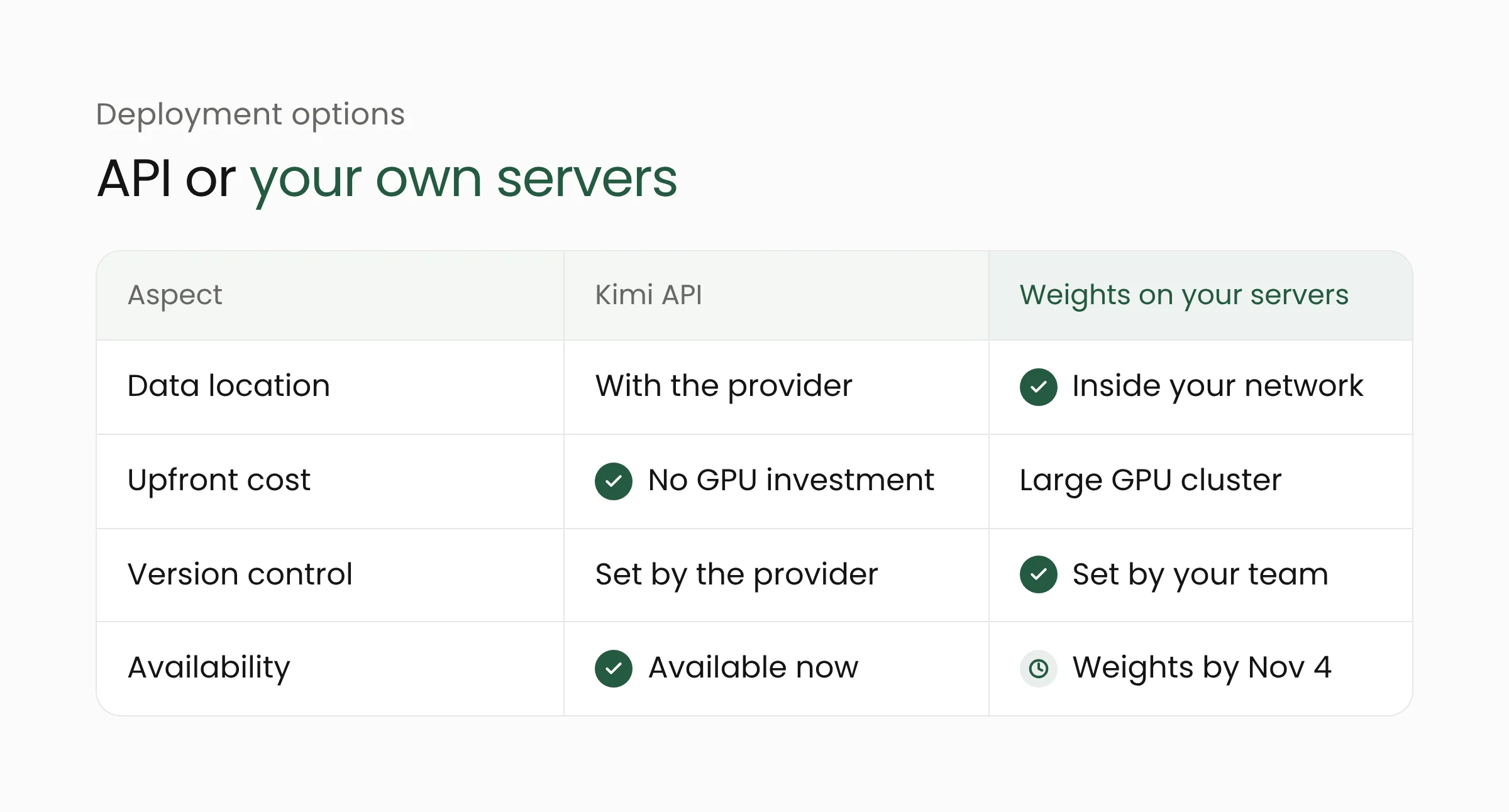
Steps worth taking now:
- Map the data you plan to process. Separate personal and confidential data from general data. Sensitive data is better handled on your own infrastructure, while general tasks can go through an API.
- Read the API provider’s data policy. Options such as Zero Data Retention need a close read, including where processing takes place, and should be checked against your organization’s personal data protection obligations.
- Test with your own tasks. Benchmark scores do not always reflect real work, such as summarizing Indonesian-language documents or reading financial reports. Prepare 20 to 50 sample tasks and compare several models.
- Calculate the total cost. Compare per-token rates with the cost of GPUs, power, and an operations team if you host the model yourself. Artificial Analysis notes that K3.1 Pro uses about 14 percent more output tokens than K3, so lower rates do not automatically mean a smaller bill.
These architecture decisions are usually made together with the infrastructure team. Merakit helps organizations design and test deployments like this through its artificial intelligence services, while GPU clusters and storage can be planned with our cloud computing services. If your organization already uses a public cloud, the model catalog on that platform can be a middle path, as we covered in our piece on OpenAI models in Google Cloud Model Garden.
Frequently asked questions
Is Kimi K3.1 Pro free?
The weights are promised for download by November 4, 2026, but Moonshot’s announcement does not detail the license terms. Use through the Kimi API is billed per token, at $2 per million input tokens and $10 per million output tokens according to Artificial Analysis.
What is the difference between open weights and open source?
An open-weight model shares the trained parameters so it can run on your own servers. The training data and full training process are not necessarily published, so the term does not mean fully open-source software.
Is K3.1 Pro better than Claude or GPT?
On the Artificial Analysis index, K3.1 Pro still trails Claude Opus 5.5 and Claude Sonnet 5.5. On Terminal-Bench 4.0, Moonshot reports a score above GPT-6 Astra and slightly below Claude Opus 5.5. The best model for your organization still has to be proven with tests on real tasks.
Conclusion
Kimi K3.1 Pro shows the gap between open and closed models continuing to narrow, and it opens a new debate about how to limit dangerous capabilities before weights are shared. For organizations in Indonesia, choosing a model now depends more on how well it fits their data, budget, and team. If you are weighing those options, the Merakit Indonesia team is ready to help design the trial.
Sources
- Kimi K3.1 Pro, Moonshot AI, October 23, 2026
- Kimi K3.1 Pro launch benchmarks, Artificial Analysis, October 23, 2026
- Chinese AI model Kimi K3.1 Pro is closing in on Anthropic’s Claude Opus 5.5, The Decoder, October 23, 2026
- Moonshot releases Kimi K3.1 Pro and says it cut its hacking skills, TNW, October 23, 2026