Blog AI Chips
Tenstorrent Raises $1.5 Billion for Open AI Chips
On this page· 7 sections
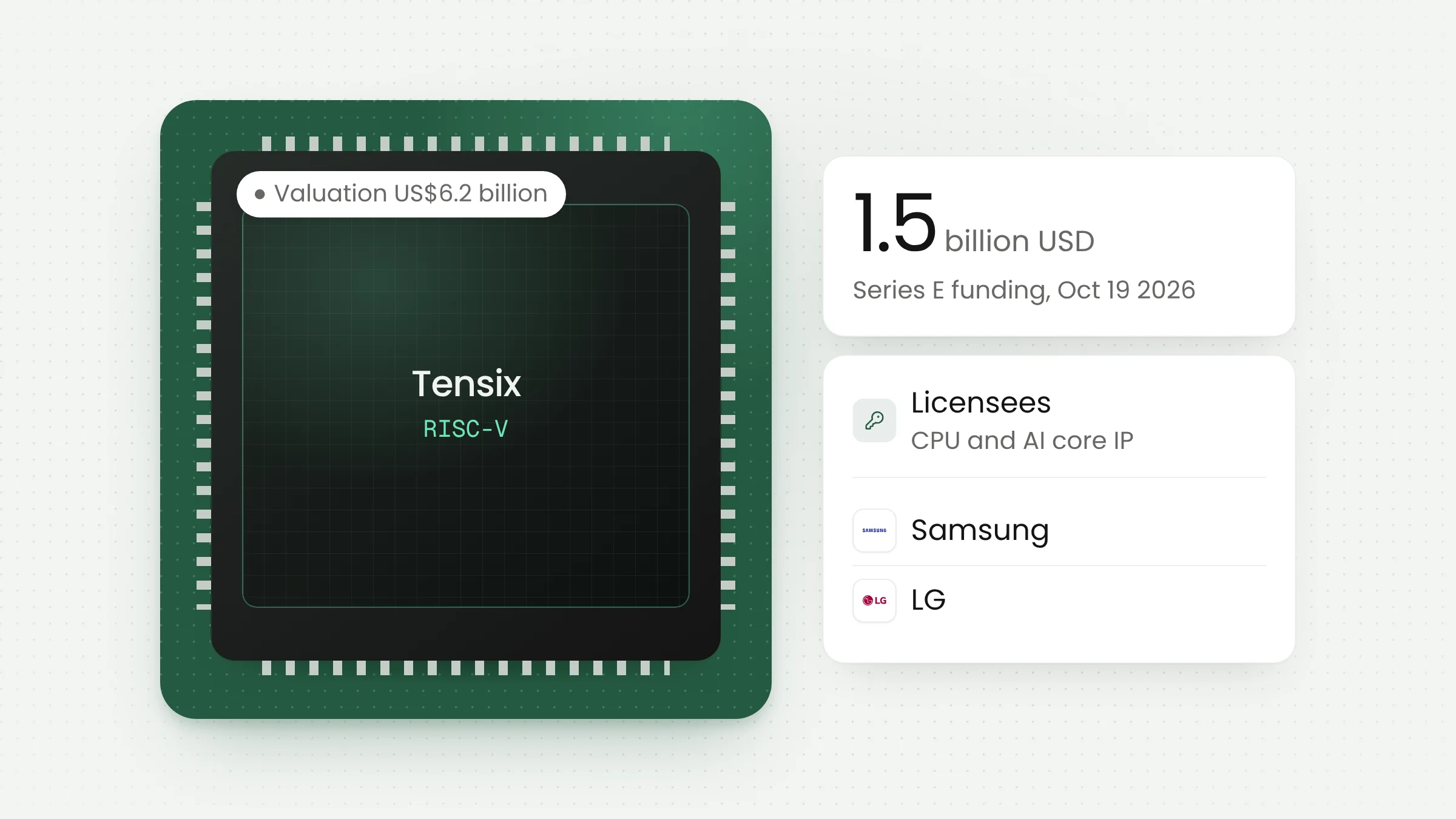
On October 19, 2026, Tenstorrent announced a $1.5 billion Series E at a $6.2 billion post-money valuation. The RISC-V AI chip company plans to use the money to manufacture its Galaxy servers in volume and expand its commercial business worldwide.
What Tenstorrent announced
According to Tenstorrent’s press release, the round was led by Trace Capital and Innovation X. Other participants include ARK Invest, Fidelity Management & Research Company, Morgan Stanley, Sandisk, T. Rowe Price, Tether Investments and XTX Markets. The company’s boilerplate lists existing backers such as Bezos Expeditions, Samsung, LG Electronics and Hyundai Motor Group.
The release’s subtitle says the funds are for volume manufacturing and global commercial expansion. In detail, the company will deploy Galaxy servers at scale, keep serving open-weight models (AI models whose parameters can be downloaded and run by anyone) for language and video generation, and advance the CPU and AI intellectual property it licenses to customers. Unite.ai and Seeking Alpha via TradingView report the same details.
CEO Jim Keller, whom the company credits as architect of the Apple A4 and A5, AMD Zen and Tesla’s Full Self-Driving chip, summed up the strategy in one line: “We built one architecture and sell it at every size.” The release gives no revenue, customer counts or benchmark results. Its description of the company’s latency and throughput as “industry-leading” is a company claim with no comparison data.
What Tenstorrent sells
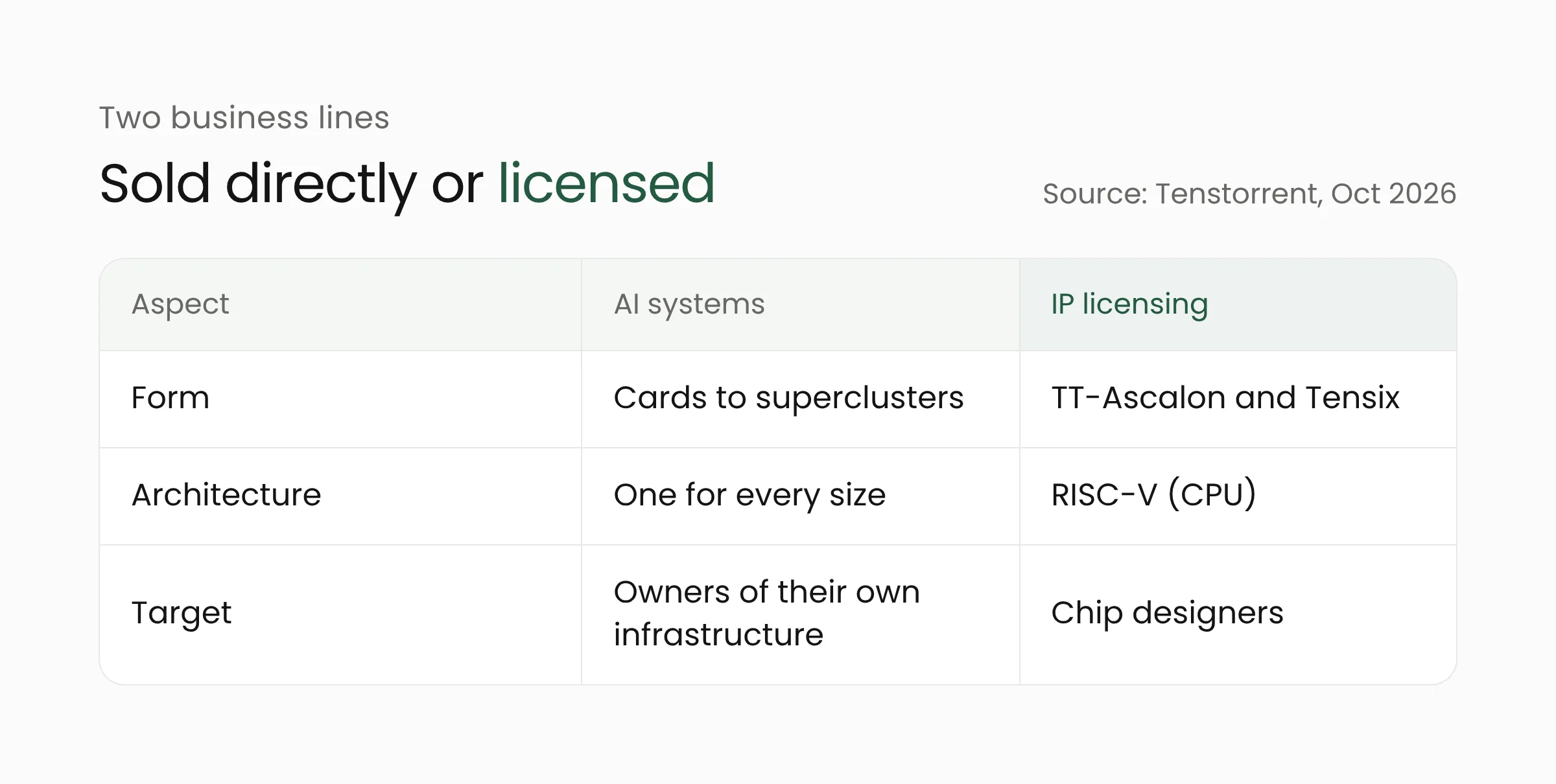
Tenstorrent sells AI compute at several scales: single cards, workstations, racks, superclusters and custom IP. The product highlighted in this announcement is the Galaxy server. Its specifications and price are not detailed in the sources we read, so both remain unannounced.
The second business is licensing. Tenstorrent licenses TT-Ascalon, a RISC-V CPU, and its Tensix AI cores to chip designers. RISC-V is an open standard for processor instruction sets, so chip designers can use it without depending on a closed architecture. Samsung and LG are named as licensees of the CPU and AI cores. Unite.ai writes that the company’s targets include chip designers, sovereign players and inference platforms.
The software stack is open source. According to Unite.ai, it lets developers run frontier models locally and lets enterprises deploy models on their own premises. For organizations with sensitive data, that on-premises option is what makes the news relevant.
In the same release, investor Protagonist says Tenstorrent’s video generation results beat industry benchmarks. The statement comes without figures and, as far as we could find, has not been tested independently.
Valuation and earlier takeover reports
In December 2024, Tenstorrent closed a Series D of more than $693 million at a $2 billion pre-money valuation, according to Unite.ai. That figure cannot be compared directly with the $6.2 billion post-money valuation announced now, because the two measure value at different points. Still, the company’s value rose sharply in under two years.
Through 2026, Tenstorrent also drew interest from would-be buyers. In May, Bloomberg reported, as cited by Proactive via Yahoo Finance, that Intel had shown early-stage interest in acquiring Tenstorrent and that the company had spoken with both Intel and Qualcomm. In such a deal, Tenstorrent could be valued above $5 billion. According to the same report, Tenstorrent had not committed to any transaction. Seeking Alpha notes that in June, Keller said the company was not in acquisition talks with Qualcomm.
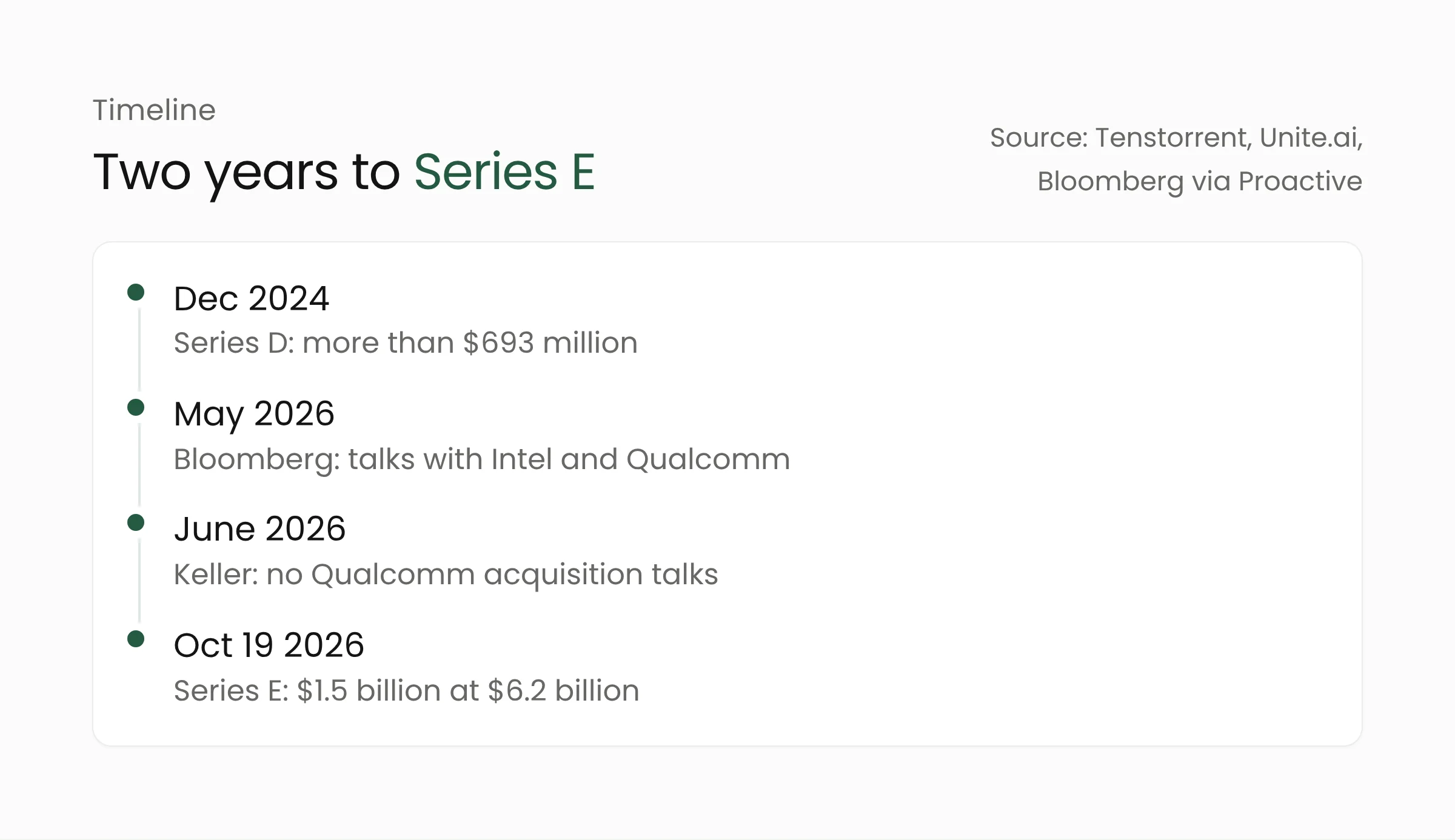
The Series E shows that the company, for now, is carrying on as an independent business. The announcement itself does not address acquisitions.
The 2024 Series D was led by Samsung Securities and AFW Partners, with Barclays as sole placement agent, according to Unite.ai. The Santa Clara-based company also has offices in Austin, Toronto, Belgrade, Tokyo and Bangalore, so its development and sales are spread across several continents.
What this means for your organization
Most organizations in Indonesia will not buy a Galaxy server soon. The sources we read do not mention availability, sales partners or pricing in Indonesia. Even so, the direction of the market deserves attention from government agencies, regional banks, hospitals and companies that hold sensitive data.
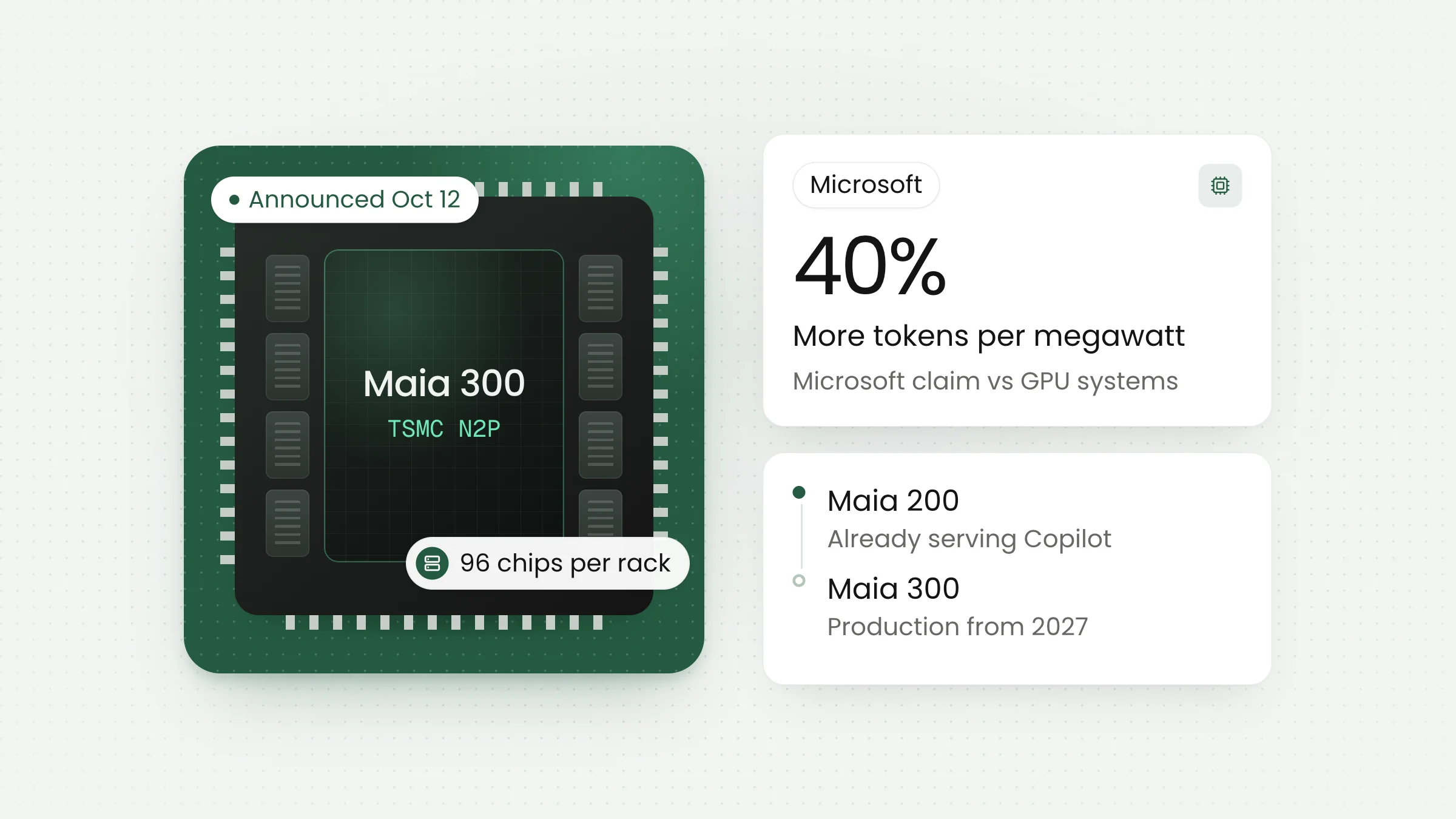
First, the choice of AI hardware is widening. As covered in our article on Microsoft’s Maia 300 chip, large cloud providers build their own chips to hold down costs. Tenstorrent offers another route: systems that can sit in an organization’s own data center, running open software. Competition like this tends to improve buyers’ bargaining position, although the effect on prices will take years to show.
Second, running AI models on your own premises is a credible option again. Agencies bound by personal data protection rules and data sovereignty policies often need to keep data inside their own environment. Processing on your own infrastructure addresses that, but it brings costs for power, cooling and skilled staff. Regional governments face similar trade-offs, as discussed in our piece on the Lamongan regional data center.
Third, do not decide on vendor claims. Until independent testing appears, latency and throughput figures from Tenstorrent, like those from any chip vendor, should be checked against your own workloads.
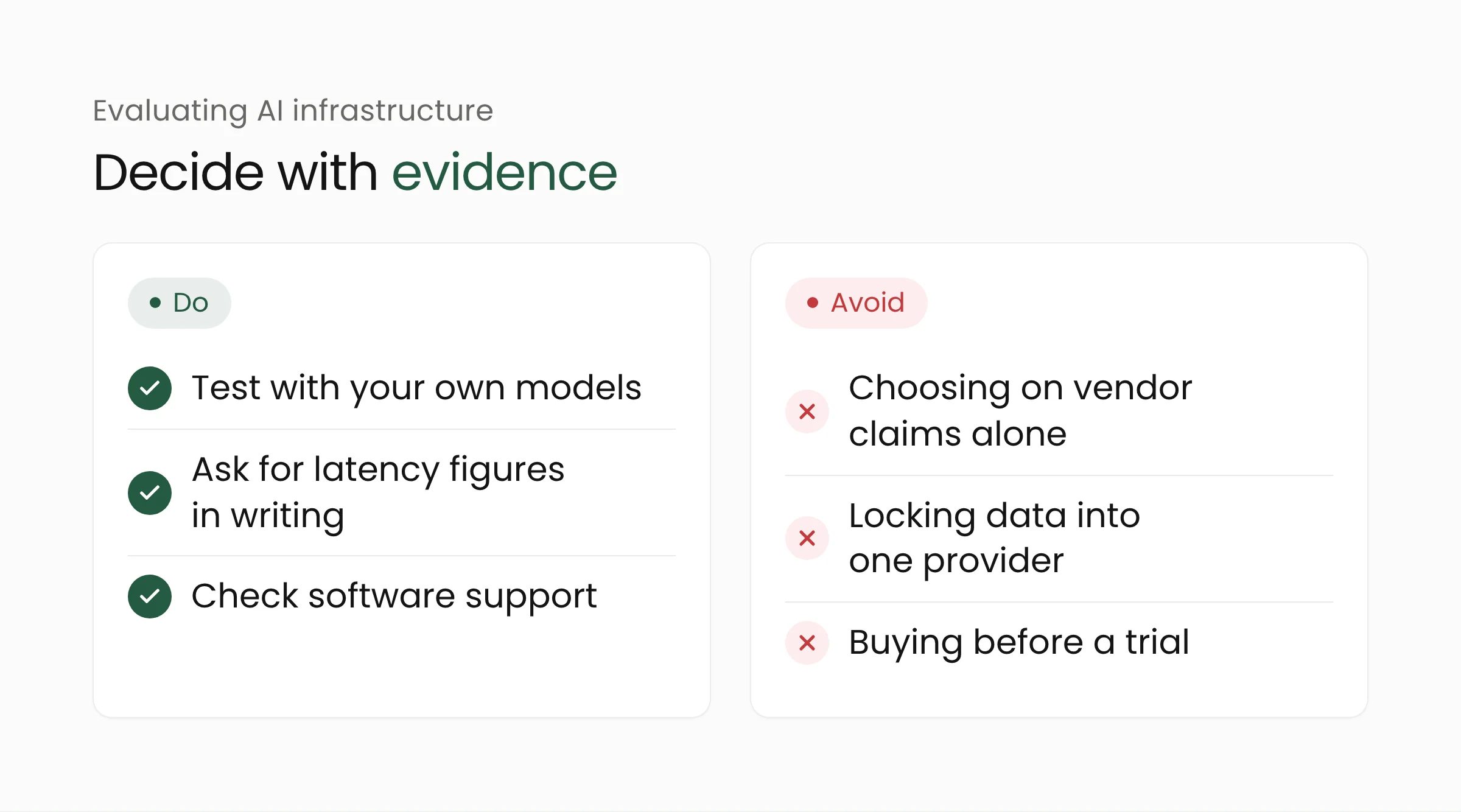
One more thing to check is the software. Fast hardware is of little use if the models and libraries you rely on are not supported. Ask which models already run on the system, how updates are managed, and who provides technical support in Indonesia.
The practical steps are simple. List the models and AI workloads you run today, calculate the cost per task in the cloud, then compare it with an estimate for on-premises deployment. Ask vendors to test your models, not sample ones, and make sure the software you adopt can move to another provider if needed. Merakit’s cloud computing and artificial intelligence teams can help build that cost comparison.
Frequently asked questions
What is Tenstorrent?
Tenstorrent is an AI chip company led by Jim Keller. It sells AI computing systems, from single cards to superclusters, and licenses RISC-V CPUs and AI cores to other chip designers.
Are Galaxy servers available in Indonesia?
The sources we read do not mention availability or pricing in Indonesia. The announcement focuses on volume manufacturing and global commercial expansion, without a list of countries.
Has Intel or Qualcomm bought Tenstorrent?
No. Bloomberg reported in May 2026 that Intel and Qualcomm had held talks with the company, but no transaction has been announced. On October 19, 2026, Tenstorrent instead announced its Series E.
Conclusion
Tenstorrent’s funding adds another player to the AI chip market, with an open approach that appeals to organizations wanting to run AI on their own infrastructure. Its performance claims still need independent testing. If your organization is weighing AI infrastructure options, feel free to contact us to talk it through.
Sources
- Tenstorrent, “Tenstorrent Announces a $1.5B Series E at a $6.2B Valuation” (October 19, 2026)
- Unite.ai, “Tenstorrent Raises $1.5B Series E at $6.2B Valuation to Scale AI Compute” (October 19, 2026)
- Seeking Alpha via TradingView, “Tenstorrent raises $1.5B Series E funding round at $6.2B valuation” (October 19, 2026)
- Proactive via Yahoo Finance, “Intel shares rise on reports of Tenstorrent acquisition talks” (May 20, 2026)