Blog Mailchimp
Mailchimp Sold to Bending Spoons: Steps for Online Sellers
On this page· 7 sections
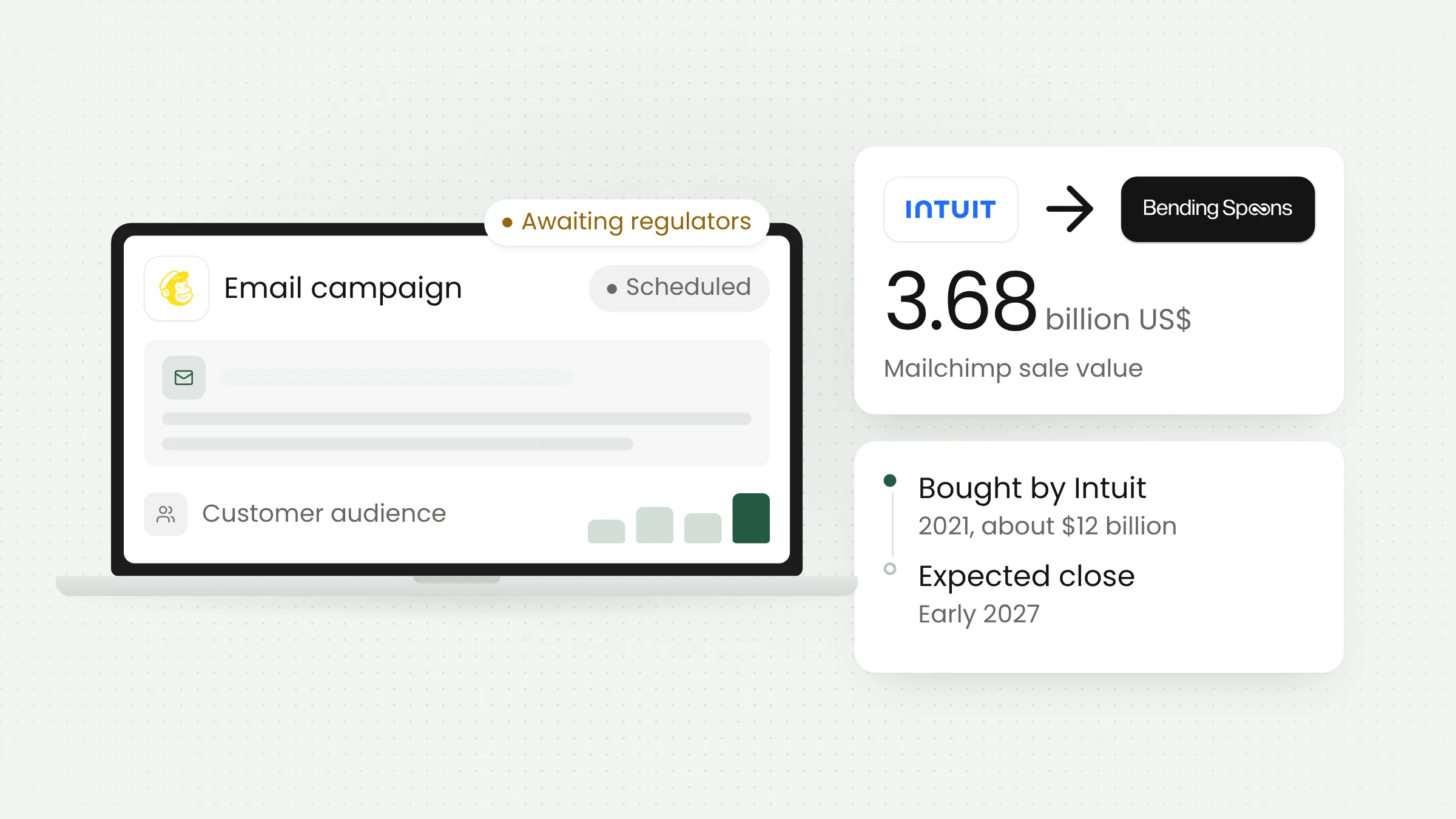
Intuit has agreed to sell Mailchimp, the email marketing service used by millions of businesses, to Italian technology group Bending Spoons at an enterprise value of $3.68 billion. The deal, announced on November 19, 2026, is expected to close in early 2027. Nothing changes for Mailchimp customers today, but online sellers have good reason to get their customer data in order now.
The terms of the Intuit and Bending Spoons deal
According to a Bending Spoons press release issued from Milan, the company has signed a definitive agreement to buy Mailchimp from Intuit. The purchase covers all of The Rocket Science Group, LLC, the entity behind Mailchimp, along with certain other assets and liabilities.
The payment has been described in two slightly different ways. Bending Spoons calls it an all-cash transaction, with Intuit reinvesting $368 million of the proceeds in newly issued Bending Spoons shares. Reuters and CNBC break it down as $3.31 billion in cash plus $368 million in stock. The total is the same.
Closing still depends on regulatory approvals and other customary conditions. Until then, Intuit continues to run Mailchimp. Jack Tam, a senior vice president at Intuit, said the company is focused on a smooth transition for Mailchimp’s customers, partners, and employees.
Mailchimp lost momentum under Intuit
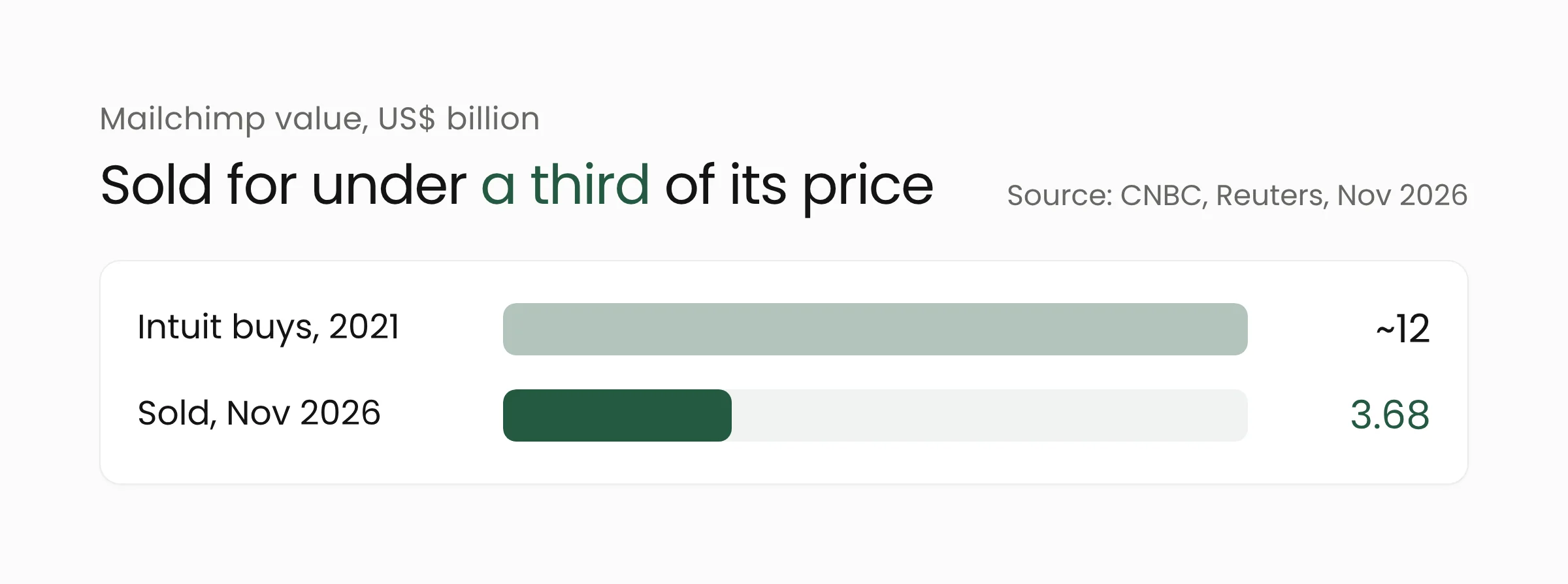
Intuit, the maker of TurboTax, bought Mailchimp in 2021 for about $12 billion. The sale price is less than a third of that. CNBC noted that Mailchimp, founded in 2001, had become a drag on Intuit’s overall revenue growth.
The latest numbers show the slowdown. In the quarter ended October 31, 2026, Mailchimp brought in $313 million in revenue, down 1% from a year earlier. For fiscal 2027, Intuit expects Mailchimp revenue of $1.256 billion to $1.266 billion, roughly flat to down 1%.
Intuit began reporting Mailchimp as a separate segment in August 2026. At the time, according to CNBC, chief financial officer Sandeep Aujla said Intuit expected higher effective prices to offset rising customer churn. Competition is also stiff, including from Klaviyo, which went public in 2023.
Reuters reported that Intuit plans to use the cash to buy back shares. The company said the sale will let it concentrate on AI-driven products for small businesses.
How Bending Spoons runs the products it buys
Bending Spoons was founded in Milan in 2013 and listed on Nasdaq in July 2026. According to Euronews, its revenue rose from $387 million in 2023 to $1.31 billion in 2025, mostly through acquisitions. Its portfolio now includes Airtable, AOL, Brightcove, Eventbrite, Evernote, Miro, Tractive, Vimeo, and WeTransfer.
The company is open about its playbook. Its press release says that after buying a business, it typically reorganizes teams, overhauls the technology, redesigns interfaces, speeds up product development, and improves marketing and monetization, with AI playing a central role. It also says it has never sold a material business it acquired.
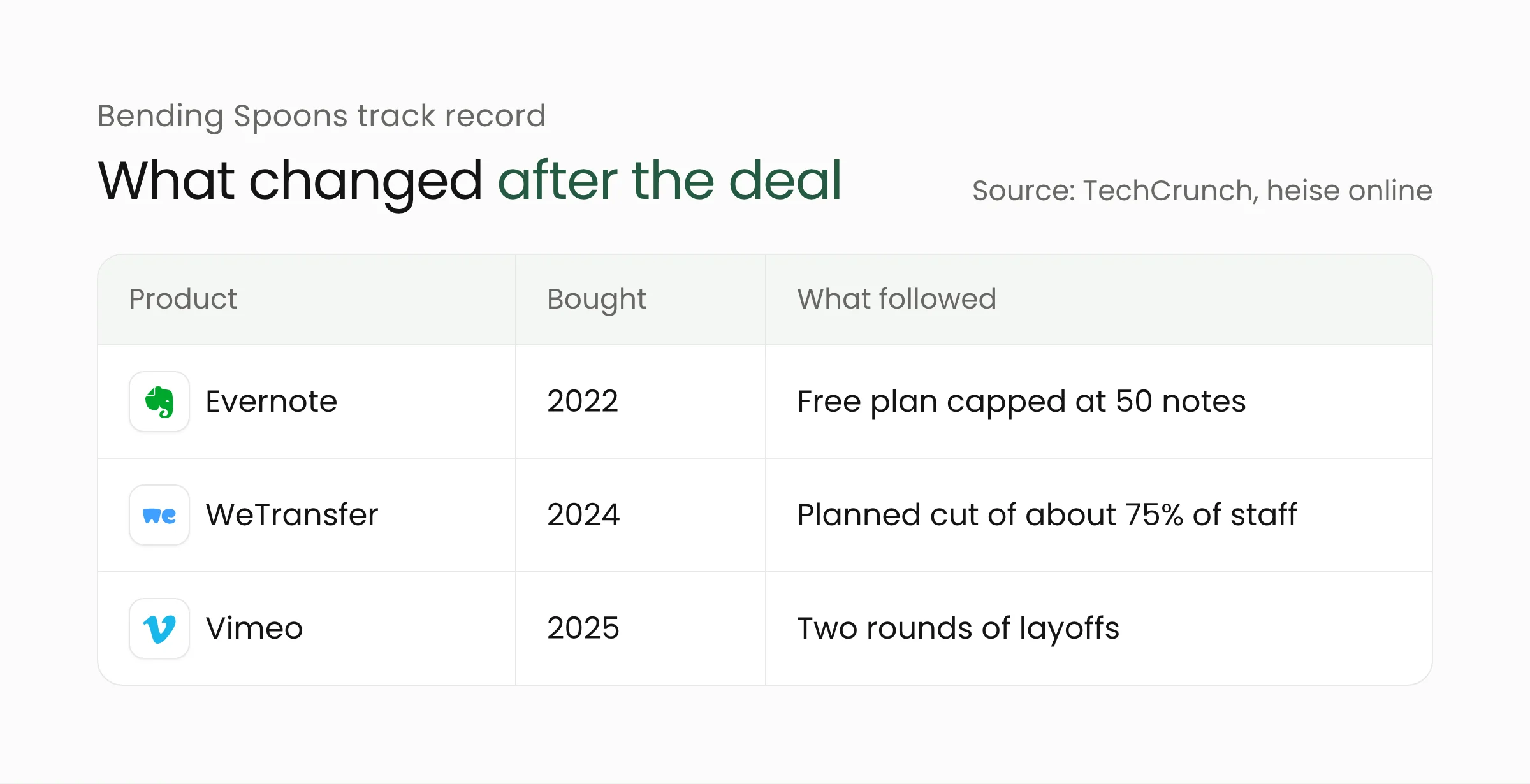
Users of its earlier acquisitions have seen concrete changes:
- Evernote, acquired in November 2022, cut 129 employees in February 2023. From December 4, 2023, its free plan was limited to 50 notes and one notebook, TechCrunch reported.
- WeTransfer, acquired in July 2024, was set to lose about 75% of its staff, a plan Bending Spoons confirmed to TechCrunch.
- Vimeo, bought for $1.38 billion in 2025, has gone through two rounds of layoffs. The first cut 10% of jobs, according to heise online.
For Mailchimp, Bending Spoons chief executive Luca Ferrari said “After closing, we’ll invest substantially in the business,” and added that the company would build on tools customers already rely on. The release says nothing about pricing, plans, or headcount, so any changes to Mailchimp’s plans have not been announced.
Speaking to Euronews, Dealroom analyst Yoram Wijngaarde cautioned that cost savings only go so far. Customers still need to feel the product is worth paying for, he said, and higher prices or reduced free access could push users away.
What this means for online sellers using Mailchimp
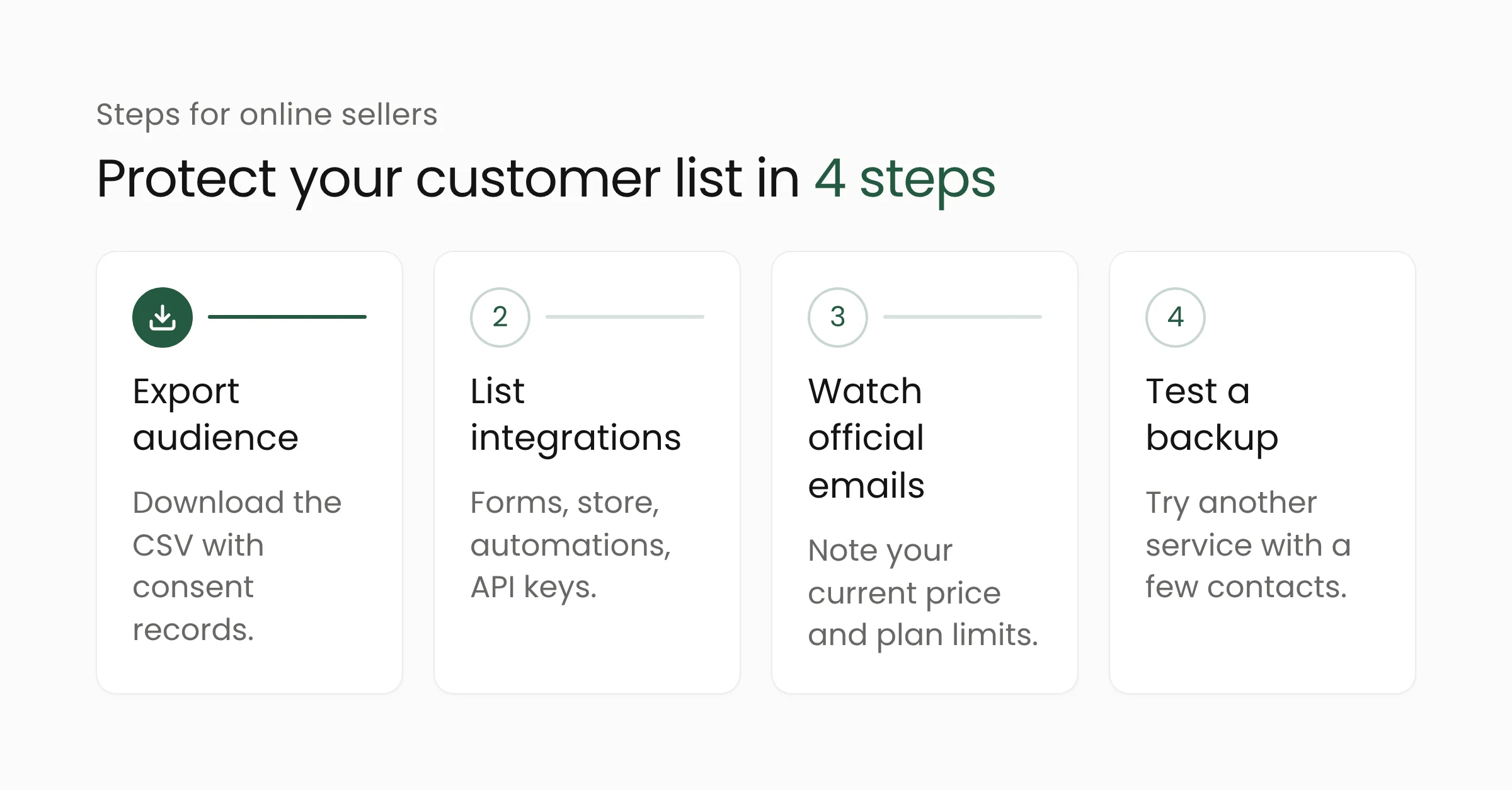
For an online store, the customer email list is a marketing asset built over years. A change of owner does not call for alarm. It is still a good reminder that this asset should be portable at any time. The four steps below can all be done before the deal closes.
1. Export your customer list regularly
According to Mailchimp’s help center, account owners and admins can export an audience from the Audience menu by choosing Export audience and then Export CSV. The result is a ZIP file with separate CSV files for subscribed, unsubscribed, non-subscribed, and cleaned contacts.
The export also includes tags, notes, and the time and IP address of each signup and confirmation. Keep these consent records, since they show that customers agreed to receive your emails. The export does not include opens, clicks, or purchase history, so campaign reports need to be exported separately. Export files can be downloaded for 30 days.
2. List every integration that depends on Mailchimp
Website signup forms, store platform connections, abandoned cart automations, and sales reports are often wired into Mailchimp. Keep a simple inventory of what is connected, who manages it, and which API keys are in use. That list will speed up any future move.
3. Watch official emails about plans and pricing
Plan changes are usually announced by email to the account owner and on the official pricing page. Make sure the owner’s email address is active and monitored. Write down your current price and contact limit as a baseline.
4. Prepare and test a backup service
There is no need to switch now. Still, trying an alternative service with a small slice of your contacts shows how long a migration would take. Keep core customer data in a system you own, such as your store database or point-of-sale system, so your marketing does not depend on a single vendor.
As Indonesian consumers shop online more often, as shown in the Digital 2027 report, customer data becomes more valuable for retailers. Merakit helps retailers bring customer and sales data together through its retail management solution and turn it into clear reports with its data analytics services.
Frequently asked questions
Will Mailchimp shut down?
There is no sign of that. Bending Spoons says it will invest substantially in Mailchimp after closing, and it says it has never sold a material business it acquired. Until the deal closes in early 2027, Intuit continues to run Mailchimp.
Will Mailchimp raise its prices?
That has not been announced. The press release does not mention pricing. Bending Spoons tightened Evernote’s free plan after buying it, but that does not mean the same will happen at Mailchimp.
What should Mailchimp users do now?
Export your audience along with its consent records, document the integrations that rely on Mailchimp, and watch for official announcements. These steps are useful regardless of who owns the service.
Conclusion
The Mailchimp sale shows that a tool used every day can change hands and change direction. Stores that keep their customer data organized and understand their integrations will be better placed to handle whatever comes next. If you want to structure your customer and sales data so it does not depend on a single vendor, the Merakit team is ready to help.
Sources
- Bending Spoons to acquire Mailchimp, Bending Spoons press release (Form 6-K exhibit, SEC), November 19, 2026
- Intuit to sell Mailchimp to Bending Spoons for $3.68 billion, CNBC, November 19, 2026
- Intuit to sell Mailchimp to Bending Spoons for $3.68 billion, Reuters via Investing.com, November 19, 2026
- From Vimeo to WeTransfer: How Italy’s Bending Spoons built a tech empire, Euronews, September 23, 2026
- Layoffs at Vimeo after acquisition by Bending Spoons, heise online, January 23, 2026
- Bending Spoons plans to lay off 75% of WeTransfer staff after acquisition, TechCrunch, September 8, 2024
- It’s official: Evernote will restrict free users to 50 notes, TechCrunch, November 29, 2023
- View or export contacts, Mailchimp Help Center