Blog Internet Users
Digital 2027: Indonesia's 231M Internet Users and Retail
On this page· 7 sections
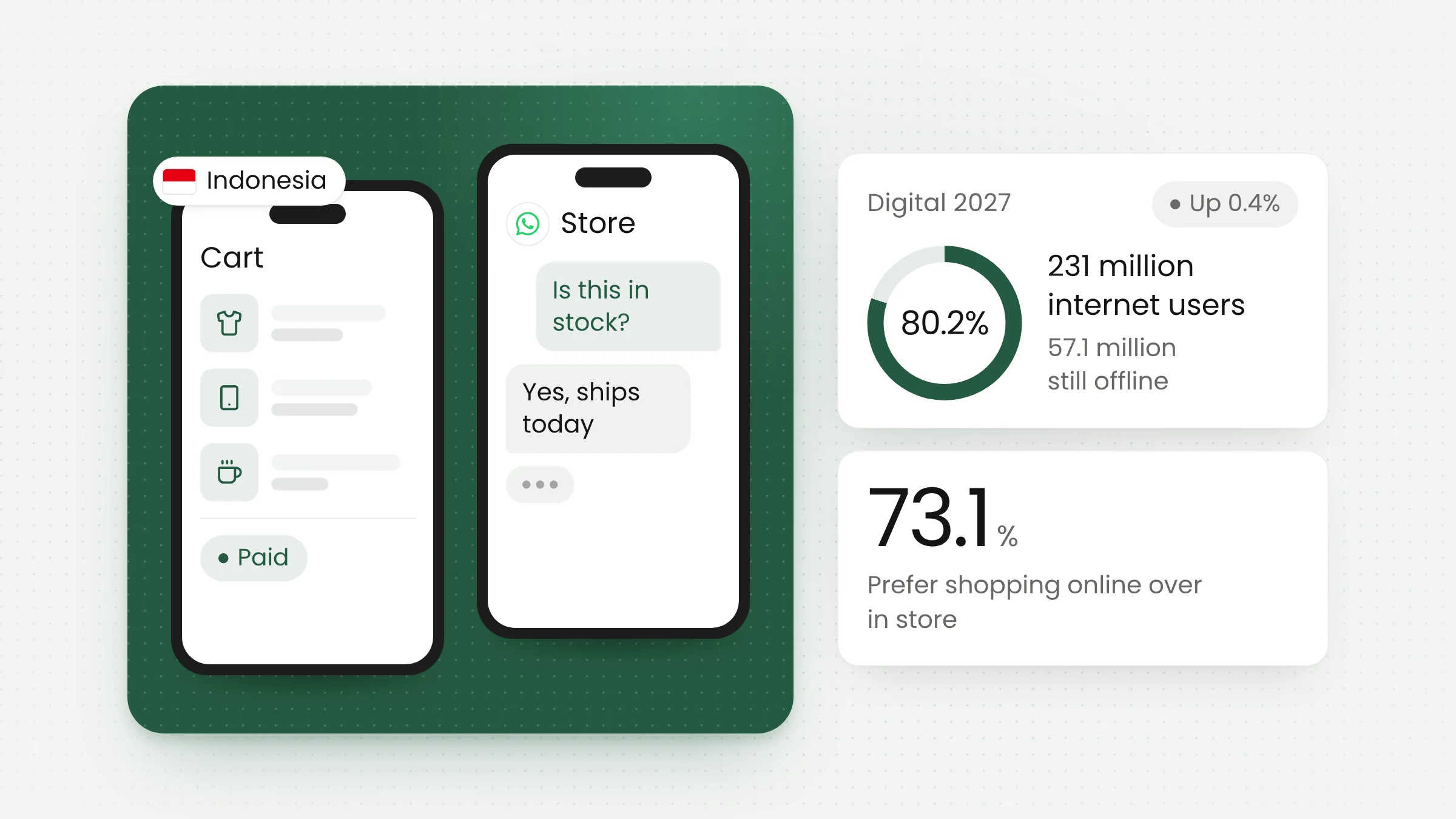
Indonesia had 231 million internet users in October 2026, or 80.2% of the population, according to the Digital 2027: Indonesia report. The total grew by only about 894,000 people in a year. The same report found that 73.1% of internet users prefer to shop online, while 57.1 million Indonesians still do not use the internet at all.
The headline numbers for Indonesia
Digital 2027 is the annual report by We Are Social and Meltwater on how people around the world use the internet, social media and connected devices. The Indonesia page on DataReportal is dated November 4, 2026, while Selular.ID reported that the report was released on November 5. Its key figures returned to the Indonesian news cycle this week.
The core figures for Indonesia:
- Population: about 288 million.
- Internet users: 231 million, or 80.2% of the population.
- Not using the internet: about 57.1 million people, or 19.8% of the population.
- Social media user identities: 240 million, equal to 83.2% of the population.
- Active cellular connections: 311 million, equal to 108% of the population.
Social media and mobile connection figures exceed the number of people because one person can hold several accounts or several SIM cards. DataReportal itself cautions that social media user identities may not represent unique individuals.
There is a small inconsistency in the reporting period. DataReportal describes the 231 million figure as October 2026 data but refers to the 80.2% penetration rate as the position at the end of 2026. detikInet used both framings in its November 16 report.
Internet user growth is flattening
Compared with October 2025, Indonesia added about 894,000 internet users, an increase of 0.4%. Over the same period the population grew by about 2.1 million, or 0.8%. Because the population grew faster than the user base, internet penetration actually fell by 29 basis points.
DataReportal adds an important caveat. Changes in user numbers can reflect revisions in source data, and this year’s figures are not directly comparable with earlier reports. Even so, a 0.4% increase shows that new users are now arriving slowly.
57.1 million people are still offline
Roughly one in five Indonesians does not use the internet. The report does not say who they are, whether older people, children or residents of areas with weak signal. The detikInet coverage does not include a regional breakdown either.
For businesses, this is a reminder that in-person service still has customers. Physical stores, cashiers, phone orders and cash payments remain necessary, especially outside the large cities.
Mobile internet is now faster than fixed broadband
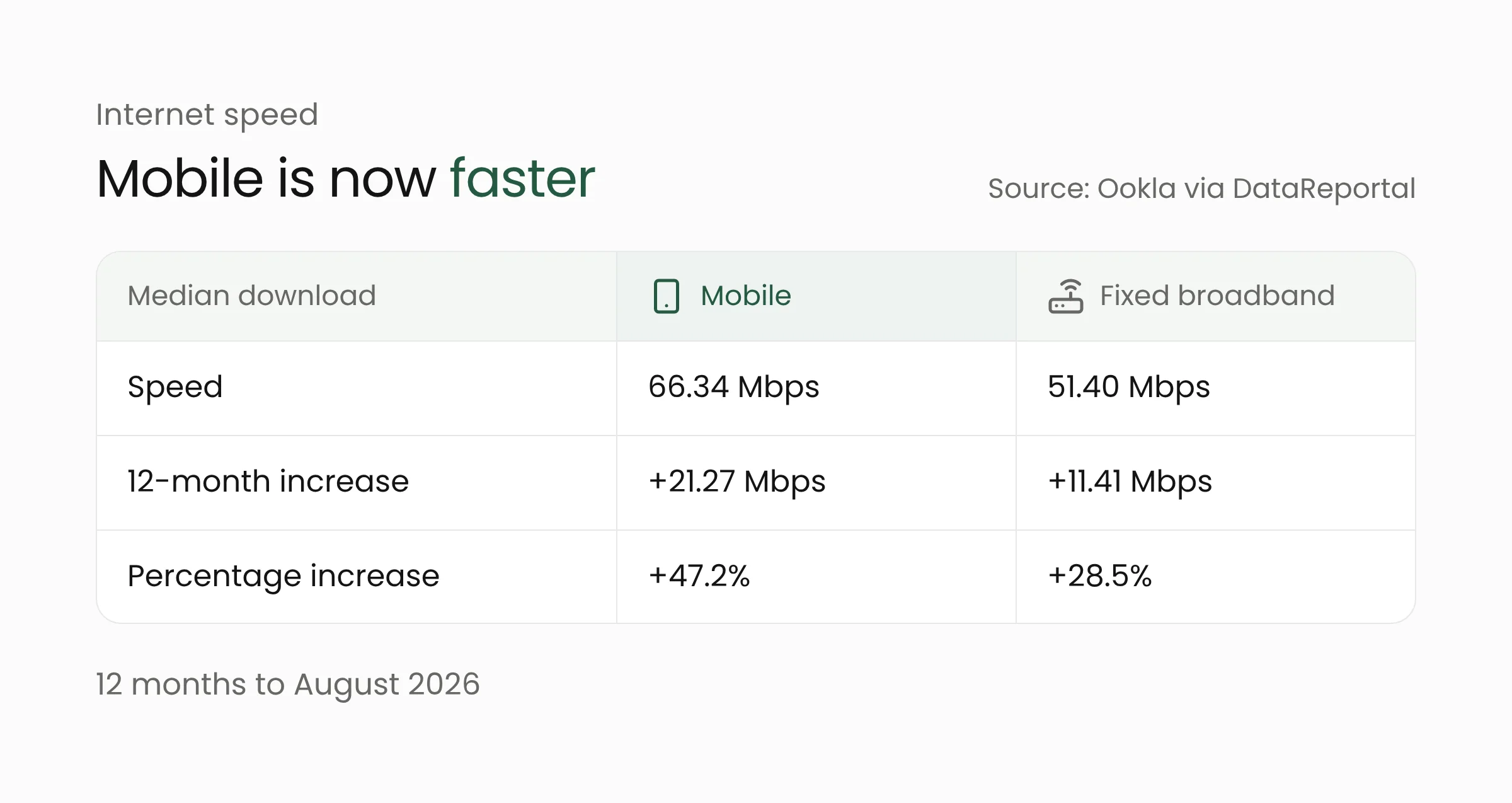
Ookla data cited in the report puts Indonesia’s median mobile download speed at 66.34 Mbps. That is higher than the median for fixed, or home, broadband at 51.40 Mbps. In the 12 months to August 2026, mobile speeds rose 47.2% while fixed speeds rose 28.5%.
A median is the middle value, so half of all measurements fall below it, and conditions vary widely between large cities and smaller towns. We looked at home broadband speeds in an earlier piece on Komdigi’s 100 Mbps home internet target.
How Indonesians shop and choose brands
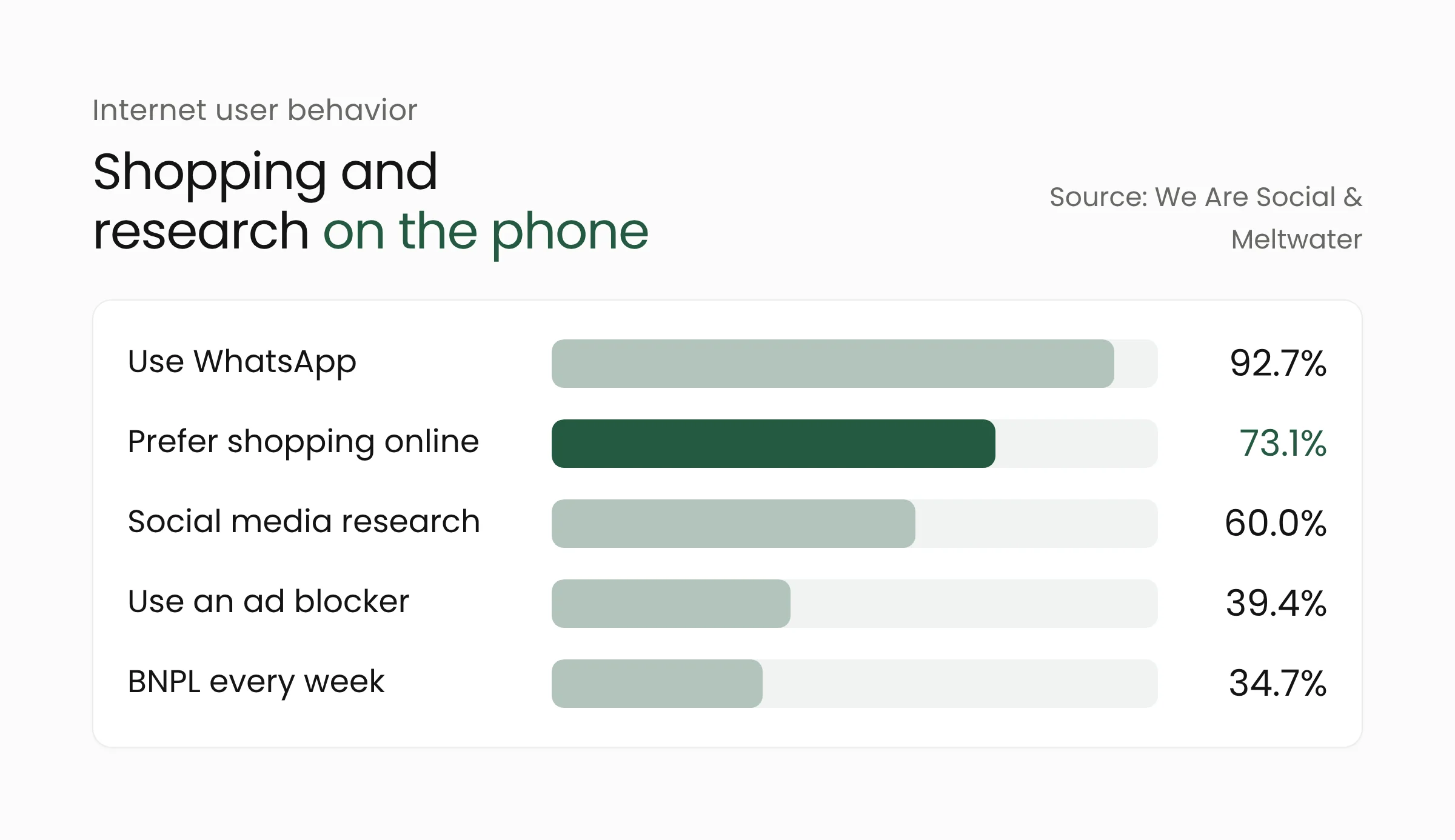
The behavioral section of the report matters most for retailers. According to the summary published by Industry.co.id, 73.1% of Indonesian internet users prefer shopping online to shopping in physical stores, the second-highest share among the countries covered.
Research comes before the purchase
More than two-thirds of Indonesian internet users research brands and products online before buying, the highest share in the report. Some 60.0% rely on social networks to look up brands, and 28.2% already treat AI as their main source for brand research.
AI use is widespread. In the past month, 94.9% of internet users aged 16 and over used an AI tool, yet only 28.3% say they feel comfortable using AI. The gap between adoption and comfort also appeared in another report we covered, e-Conomy SEA 2026 on Indonesia’s AI users.
WhatsApp is the everyday channel
WhatsApp is used by 92.7% of Indonesian internet users. Active users spend an average of 1 hour 55 minutes a day in the app, the longest of any country in the report. For many shops, WhatsApp already serves as a storefront, a place to ask about stock and a channel for order confirmations.
Ads are easy to tune out
Indonesia has the highest ad blocker usage in the report, at 39.4% of internet users, and only 13.2% feel represented by the ads they see. Meltwater’s APAC vice president of enterprise sales, Mimrah Mahmood, said brands have to earn the attention of Indonesian audiences, who are increasingly careful about how they search for information and filter the messages they receive.
Buy now, pay later is a weekly habit
About 34.7% of Indonesian internet users use buy now, pay later (BNPL) services every week, more than twice the global average. The rules are changing as well. Under OJK Regulation No. 32 of 2025 (POJK Nomor 32 Tahun 2025), in force since December 15, 2025, BNPL may only be offered by commercial banks and financing companies. According to InvestorTrust, other institutions have until December 31, 2027 at the latest to transfer their portfolios and stop offering the service.
What this means for retailers
The data describes shoppers who are almost entirely online through their phones, who compare before they buy, and who readily ignore ads. At the same time, the pool of new online shoppers is growing very slowly. For stores, minimarket chains and small businesses, several steps are worth considering.
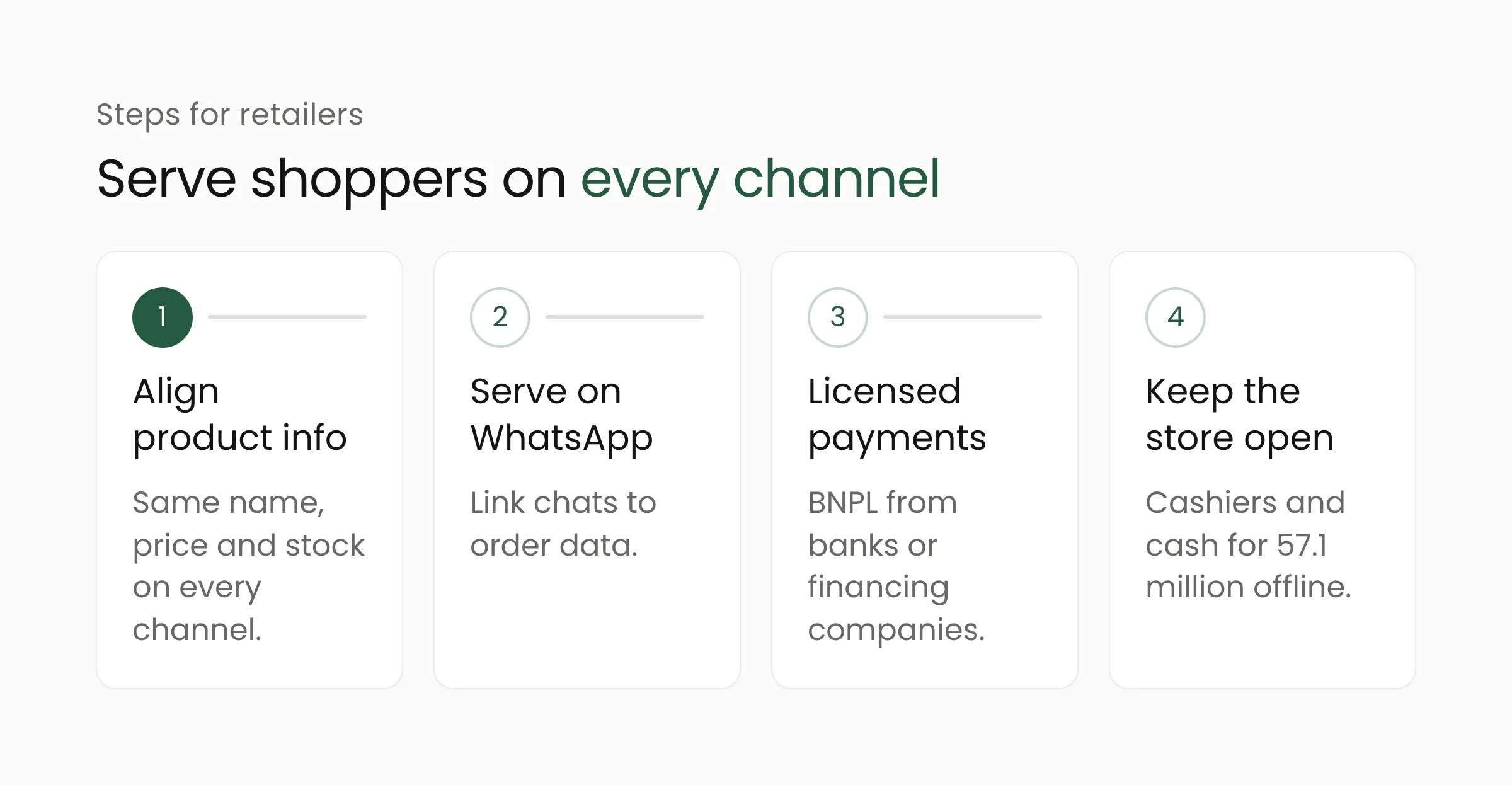
- Keep product information consistent across channels. Shoppers research on social media, marketplaces, search engines and now AI assistants. Consistent product names, prices, stock levels and specifications help every one of those sources show accurate information about your store.
- Design for the phone first. Faster mobile internet makes room for image-rich catalogs and product videos, but pages still need to stay light because half of all measurements fall below the median. In mobile app development for retail, the shortest path from search to selection to payment should be designed first.
- Treat WhatsApp as a structured service channel. With nearly two hours of daily use, WhatsApp suits order confirmations, delivery updates and stock questions. Connect those conversations to order data so staff do not copy information by hand.
- Rely less on intrusive advertising. With 39.4% of users running ad blockers, customer reviews, content that answers real questions and loyalty programs offer other ways to reach buyers.
- Check your BNPL partners. If your store offers card-free installments, make sure the provider is a commercial bank or an OJK-approved financing company, in line with POJK 32/2025.
- Keep serving shoppers in store. With 57.1 million Indonesians still offline, cashiers, cash payments and phone service remain important. Sales from physical stores and online channels should be recorded in one system.
Merakit helps retailers bring sales, inventory and customer data from stores and online channels together through its retail management solution.
Frequently asked questions
How many internet users does Indonesia have according to Digital 2027?
Digital 2027: Indonesia counts 231 million internet users as of October 2026, equal to 80.2% of a population of about 288 million. That is an increase of about 894,000 people, or 0.4%, from October 2025.
How many Indonesians do not use the internet?
According to DataReportal, about 57.1 million Indonesians, or 19.8% of the population, do not use the internet. The report does not break this group down by region or age.
Who publishes the Digital 2027 report?
Digital 2027 is published by We Are Social with Meltwater, and the country data is hosted on DataReportal. It combines several sources, including the UN, the ITU, GSMA Intelligence, government sources and the advertising tools of technology companies.
Conclusion
Digital 2027 shows a market that is already highly connected, where growth now depends on serving existing users well. Indonesian shoppers research first, buy on their phones and stick with channels they trust. If your business is reorganizing its sales channels and data, the Merakit team is ready to talk through the most suitable next steps.
Sources
- Digital 2027: Indonesia, DataReportal, November 4, 2026
- Digital 2027: 94,9% Pengguna Internet Indonesia Pakai AI, tapi Baru 28,3% yang Nyaman, Industry.co.id, November 5, 2026
- Digital 2027: Indonesia Catat 231 Juta Pengguna Internet, Selular.ID, November 9, 2026
- Pengguna Internet RI Tembus 231 Juta di 2026, 57 Juta Orang Masih Offline, detikInet, November 16, 2026
- OJK Issues Buy Now Pay Later Practices Regulation, Financial Services Authority (OJK), December 24, 2025
- OJK: Akhir 2027 Lembaga Non Bank dan Non Perusahaan Pembiayaan Harus Hentikan Layanan Paylater, InvestorTrust, June 17, 2026