Blog Industry 4.0
National Lighthouse 2026: Indonesia Names 24 Model Companies
On this page· 7 sections
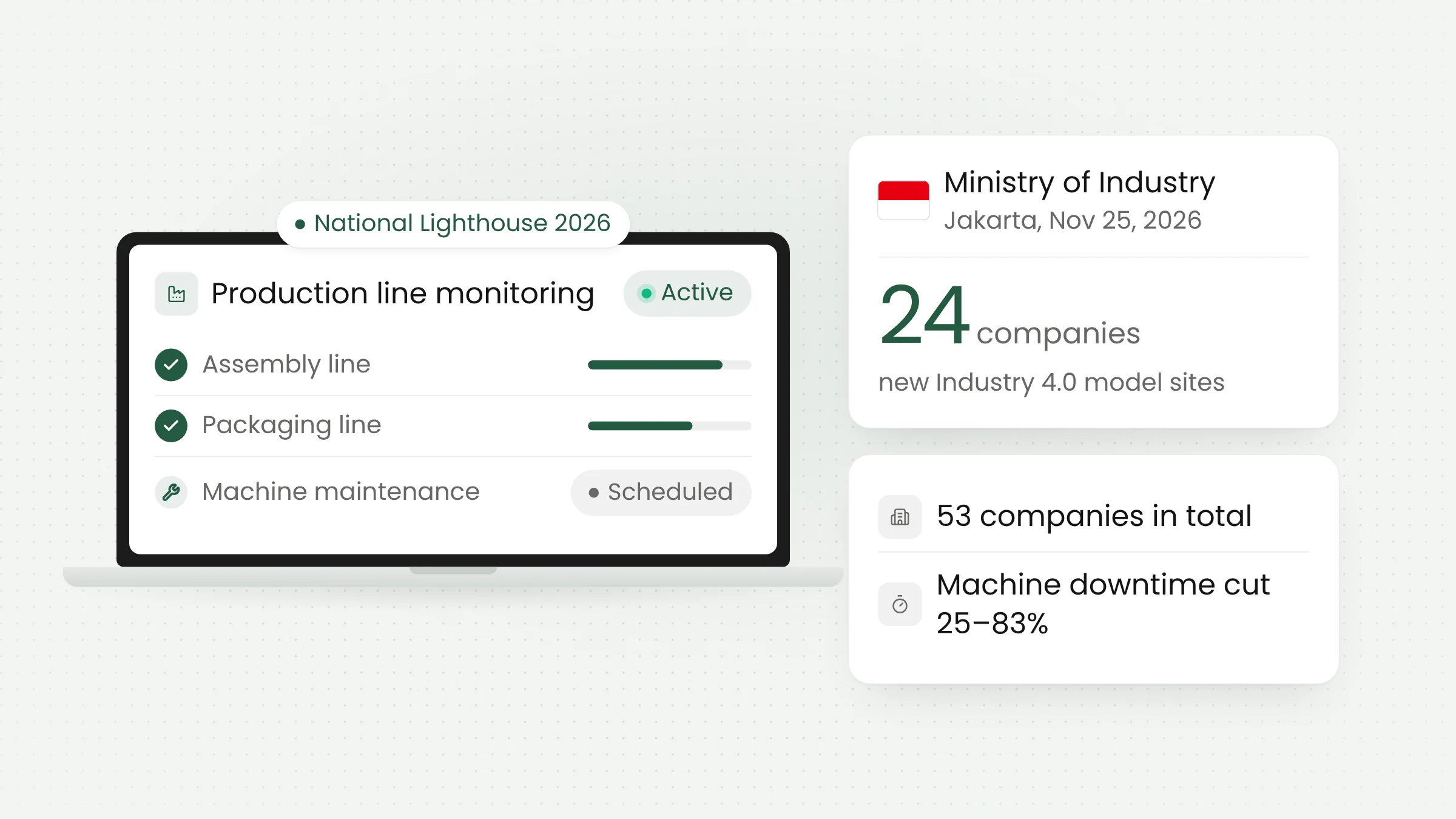
Indonesia’s Ministry of Industry named 24 companies as National Lighthouse Industry 4.0 sites for 2026 on Wednesday, November 25, 2026. The additions bring the number of designated model manufacturers to 53. The ministry also released performance figures reported by the new recipients.
What the 2026 National Lighthouse designation covers
The titles were handed out at an awards ceremony at the ministry’s office in Jakarta. According to Warta Ekonomi, about 450 participants and guests attended. Through 2025, 29 industrial companies held the National Lighthouse title, so the 24 new names take the total to 53.
National Lighthouse is a designation for companies judged to have put Industry 4.0 technology to work on the production floor. Industry 4.0 describes a plant where machines, sensors and planning systems are connected, so production decisions rest on data that is continuously updated. Emmy Suryandari, head of the ministry’s Agency for Standardization and Industrial Services Policy, said recipients are expected to act as strategic partners to the government, and the ministry is encouraging them to pursue Global Lighthouse recognition.
The Global Lighthouse Network is a World Economic Forum initiative launched in 2018 with McKinsey & Company. TVRI News reports that by 2026 it covered 238 facilities in more than 30 countries and 40 industry sectors. National Lighthouse is the domestic counterpart and part of Making Indonesia 4.0, the national roadmap set in 2018.
Four programs in one ceremony
National Lighthouse was presented alongside three other awards. The Indonesia Industry 4.0 Readiness Index (INDI 4.0) award went to 53 companies. The Rintisan Teknologi Industri (Rintek) award for home-grown industrial technology went to 13 companies, and TVRI News puts the number of innovations at 15. The Indonesia Industrial Services Awards (IdSAs) went to 14 industrial service firms, according to Warta Ekonomi.
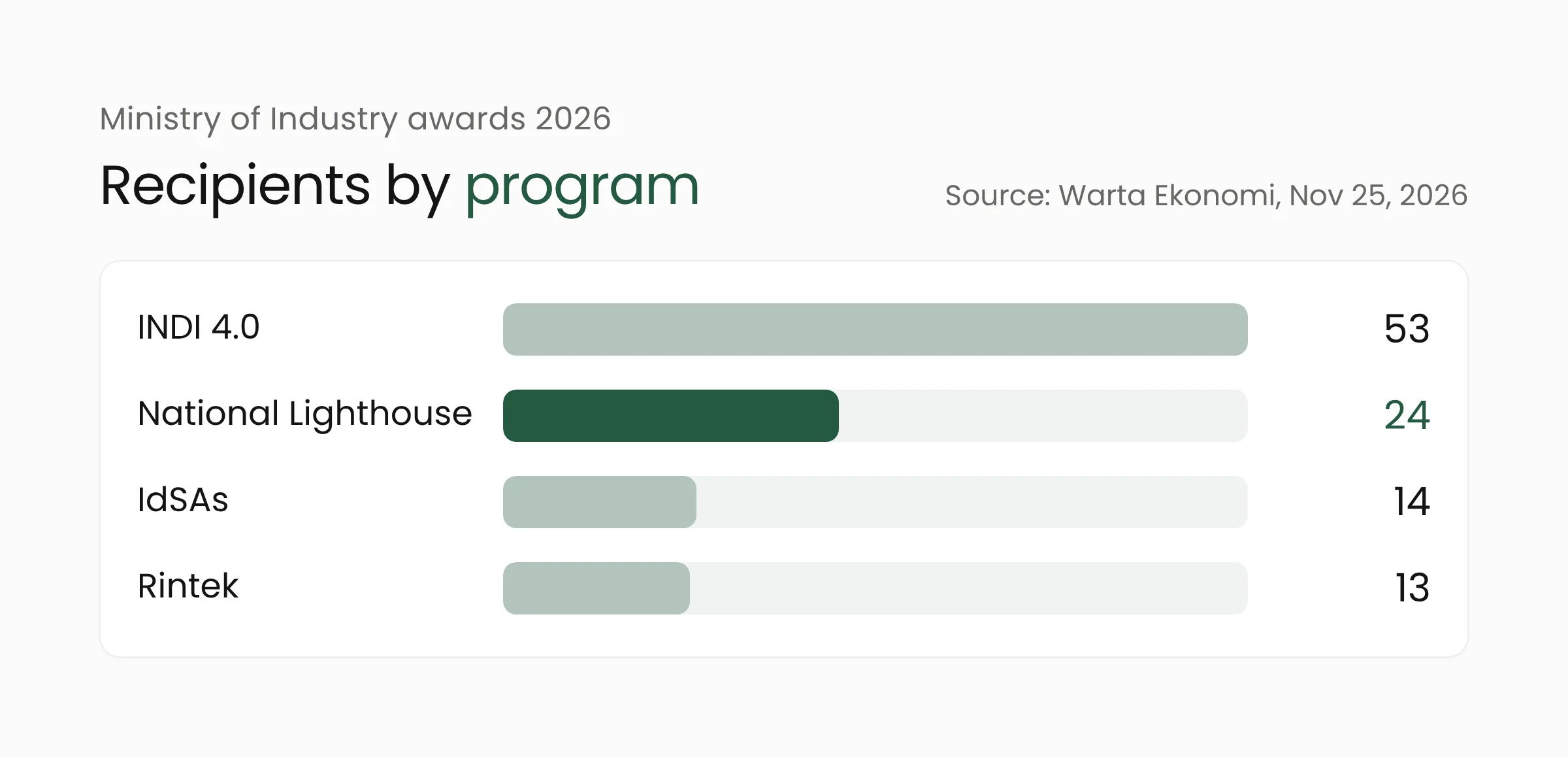
INDI 4.0 and National Lighthouse are linked. INDI 4.0 measures readiness, while National Lighthouse recognizes companies that are already operating this way. According to Jurnal Kalimantan, INDI 4.0 scores five pillars: management and organization, people and culture, products and services, technology, and factory operations. More than 100 companies received INDI 4.0 awards between 2019 and 2024.
The gains reported by the 24 companies
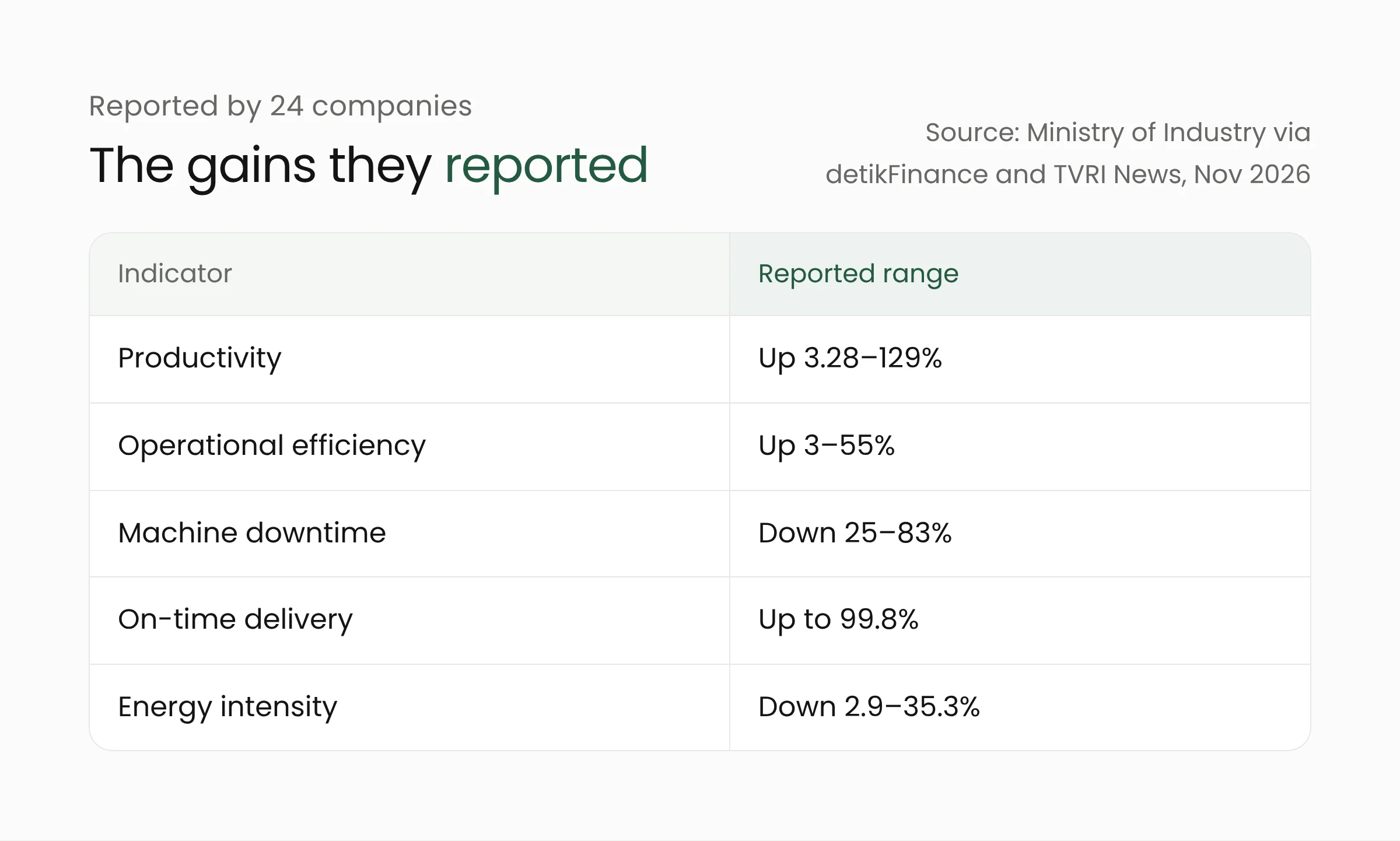
Industry Minister Muhammad Sarmuji cited several figures drawn from reports by the 24 recipients. detikFinance recorded productivity gains of 3.28% to 129%, operational efficiency gains of 3% to 55%, machine downtime reductions of 25% to 83%, and on-time product delivery of up to 99.8%.
Two further figures concern the environment. Energy intensity, the energy used per unit of output, fell by 2.9% to 35.3%. On greenhouse gas emissions the sources differ. Warta Ekonomi reports a reduction of 12% to 93%, while TVRI News reports 12% to 90%.
Sarmuji said he hopes National Lighthouse practices will keep being developed and replicated across domestic industry, detikFinance reported. He also addressed concern about jobs by pointing to the World Economic Forum’s Future of Jobs Report 2025, which projects 170 million new jobs and 92 million displaced worldwide by 2030.
How to read the figures
The numbers are worth noting, but three points matter before anyone uses them to justify a budget.
The ranges are wide. A productivity gain of 3.28% and one of 129% sit in the same sentence. The low end shows that some recipients saw modest improvement. The ministry did not say how many companies were near the top of the range, so 129% cannot be read as a typical result.
The figures are self-reported. The coverage we read says the numbers come from the recipients’ own reports. The baseline, the measurement period and the calculation method were not described, and there is no mention of independent verification.
The recipients are large companies. Names that appear in the coverage include Isuzu Astra Motor Indonesia, PT SMART Tbk and Indocement Tunggal Prakarsa. They have engineering teams, budgets and years of lead time. A mid-sized plant with fewer resources may not see the same results.
The technology behind the titles
Details from three companies show what the work involves.
According to Suara.com, PT Isuzu Astra Motor Indonesia began in 2015 with systems for production planning, inventory management, line production and maintenance. From 2023 it added a data warehouse, Power BI and an Integrated Command Center for live monitoring of operations. The eight-year gap between the two stages shows the order of work. Reliable record-keeping came first, and analysis was built on top of it later.
At PT SMART Tbk’s Marunda refinery unit, Jurnal Kalimantan lists four groups of applications. A production information system monitors the process live, and equipment maintenance is logged digitally. Field workers are connected through inspection apps. Storage and tank gauging are automated. Product traceability across the supply chain runs on SmartTrace, which is based on blockchain. The unit earned a Smart Factory category in 2024 through the INDI 4.0 assistance program, two years before receiving the National Lighthouse title.
PT Indocement Tunggal Prakarsa Tbk’s Citeureup plant uses an advanced control system, an energy management system, alternative fuels and solar panels, according to TVRI News. That example helps explain where the energy and emissions figures in the ministry’s summary come from.
The three share a pattern. Machine data is captured automatically, shown in one place, and then used to decide production and maintenance schedules. We covered a component-level version of the same approach in our article on ABB’s industrial motor with built-in sensing.
What this means for mid-sized manufacturers
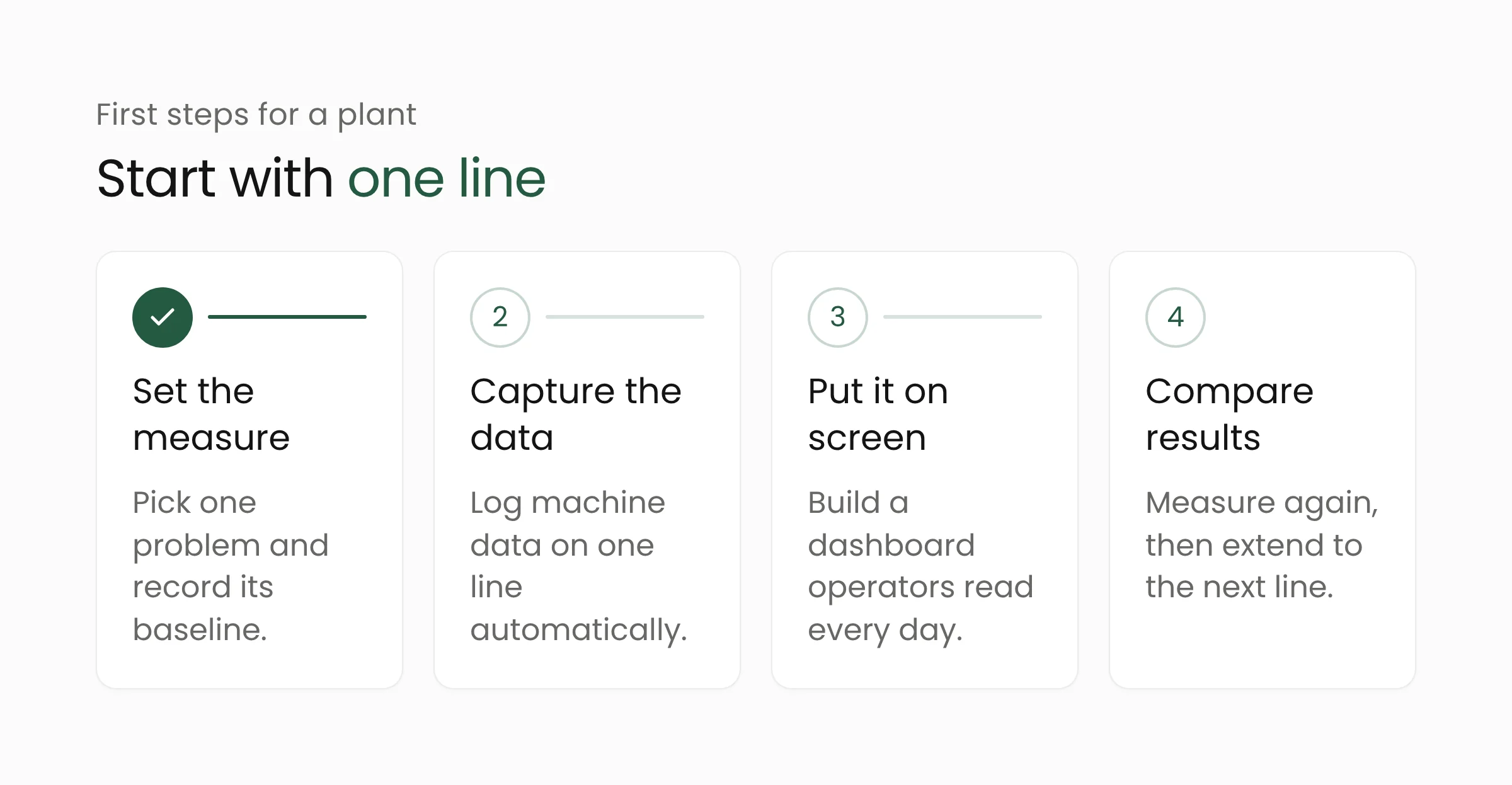
Many plants are not chasing a title. For them, the list of recipients is useful as a reference for the order in which to do things. The steps below can begin without waiting for a large budget.
Settle on one measure first. Choose the single most expensive problem, such as downtime on the packaging line or electricity used per ton of product. Record it the same way for several weeks, because without a baseline no result can be demonstrated.
Automate data capture on one line. Current sensors, vibration sensors or product counters on a few machines are enough to replace handwritten operator logs. This falls within IoT services, and older machines can usually be fitted with add-on sensors without replacing the unit.
Show the data to the people on the line. A dashboard that only a manager opens once a month rarely changes a decision. A screen near the line showing machine status and the shift target gets used sooner. This is where data analytics designed for daily decisions comes in.
Separate the machine network from the office network. Connected machines open new paths for disruption. Define who can reach machine controllers and from where, and make sure vendor remote access is logged.
Measure again, then extend. Compare the numbers after three to six months with the baseline. If the improvement is real, apply the setup to the next line. If it isn’t, find the cause before adding more devices.
A plant that wants to know where it stands can use the five INDI 4.0 pillars as a checklist. The first two concern organization and people. Operator training and a named owner for the data belong in the plan from the start, alongside the hardware purchase. This kind of design is part of our approach to industrial automation solutions.
Frequently asked questions
What is National Lighthouse Industry 4.0?
National Lighthouse is a designation from Indonesia’s Ministry of Industry for industrial companies judged to have applied Industry 4.0 technology successfully and expected to serve as models for others. There were 29 recipients through 2025, and 24 were added on November 25, 2026, for a total of 53.
How is it different from INDI 4.0?
INDI 4.0 is an index that measures a company’s readiness for Industry 4.0 across five pillars, from management to factory operations. National Lighthouse goes to companies whose implementation is already running and worth copying. In 2026, INDI 4.0 awards went to 53 companies.
Can every plant expect a 129% productivity gain?
No. That figure is the top of a 3.28% to 129% range reported by the 24 recipients. The measurement method was not detailed and the numbers come from company reports. Results elsewhere depend on the starting point, the type of process and how consistently the data is used.
Closing
The 2026 National Lighthouse list adds to the group of Indonesian plants that others can study up close, along with the figures they reported. The most transferable lesson from Isuzu, SMART and Indocement is the sequence: reliable records, data that operators can see, then gradual expansion. If your plant is weighing a first step, the Merakit team is ready to discuss which line makes a sensible starting point.
Sources
- Menperin Buka-bukaan Dampak AI ke Sektor Industri, detikFinance, November 25, 2026
- Dari 29 Jadi 53 Perusahaan, Kemenperin Perluas Percontohan Industri 4.0, Warta Ekonomi, November 25, 2026
- Menperin Harap 24 Perusahaan Jadi Rujukan Industri, TVRI News, November 25, 2026
- Isuzu Kantongi Predikat National Lighthouse Industri 4.0 Tahun 2026, Suara.com, November 26, 2026
- PT SMART Tbk Raih Dua Penghargaan Industri 4.0 dari Kemenperin, Jurnal Kalimantan, November 27, 2026