Blog Data Centers
NTT DATA Opens JKT2A Data Center, Links It to Bekasi via APN
On this page· 7 sections
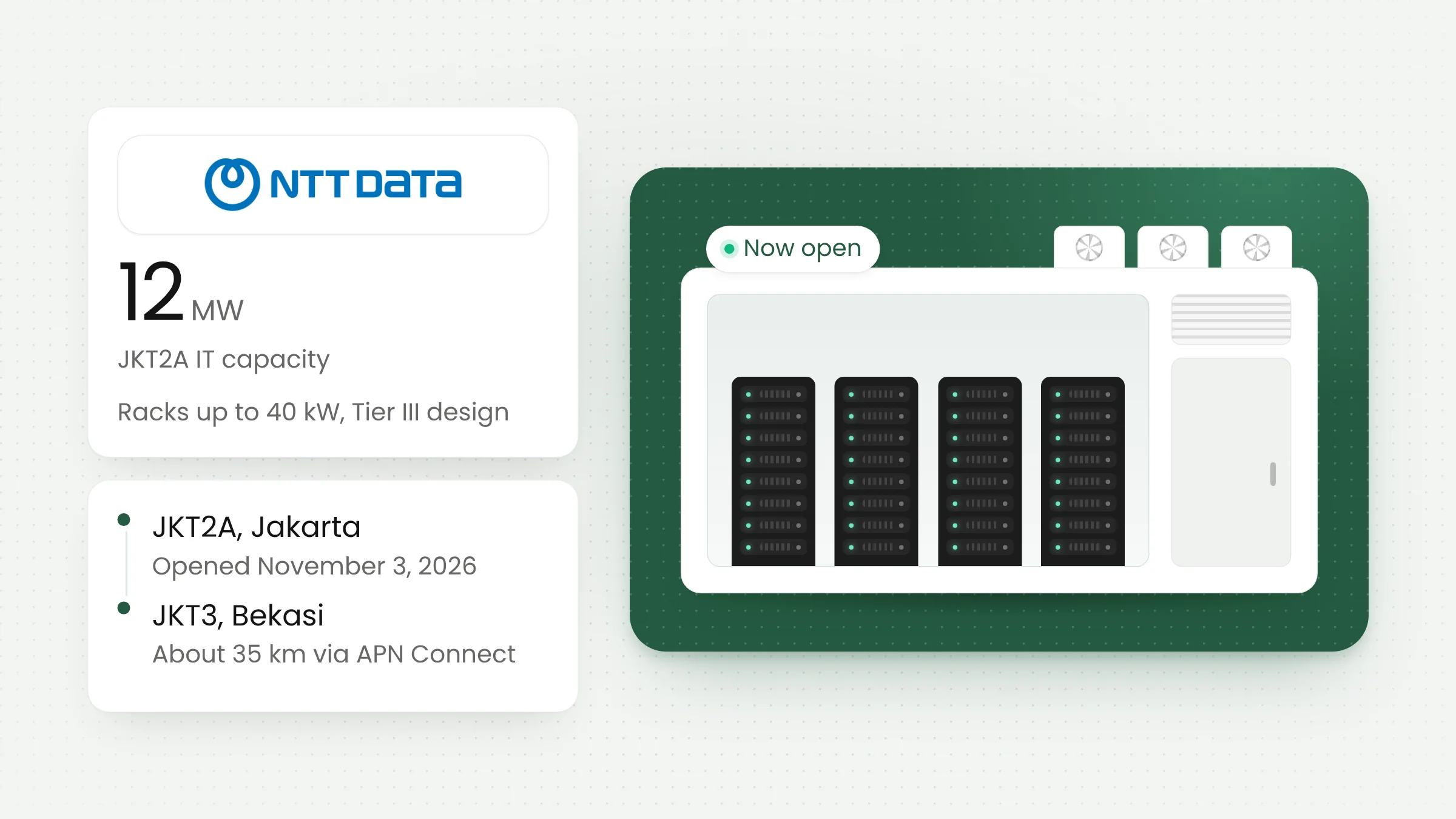
NTT DATA opened its JKT2A (Jakarta 2 Annex) data center in Jakarta on November 3, 2026, adding 12 MW of IT capacity. At the same time it launched APN Connect, an optical link between its JKT2 campus and the JKT3 facility in Bekasi, about 35 km away, built for data synchronization and recovery.
JKT2A specifications for dense workloads
According to NTT DATA’s announcement, JKT2A delivers 12 MW of IT capacity and is designed for AI computing and other high-density workloads. The building sits on NTT Global Data Centers’ Jakarta 2 campus, next to the existing JKT2 facility.
The design holds a Tier III certification. Power comes from two separate substations, backed by a 2N UPS architecture and N+1 backup generators. N+1 means one spare unit beyond what the load requires, while 2N means the entire system is duplicated. Cooling relies on N+1 air-cooled chillers and N+2 computer room air handlers (CRAH).
Racks up to 40 kW across seven floors
The Jakarta 2A Data Center profile page lists more than 5,800 square meters of IT space and support for high-density racks of up to 40 kW. For comparison, the same page lists power of up to 4.15 kVA per rack for wholesale customers and up to 5.68 kVA per rack for caged space. The 40 kW racks are aimed at GPU servers and other equipment that draws far more power.
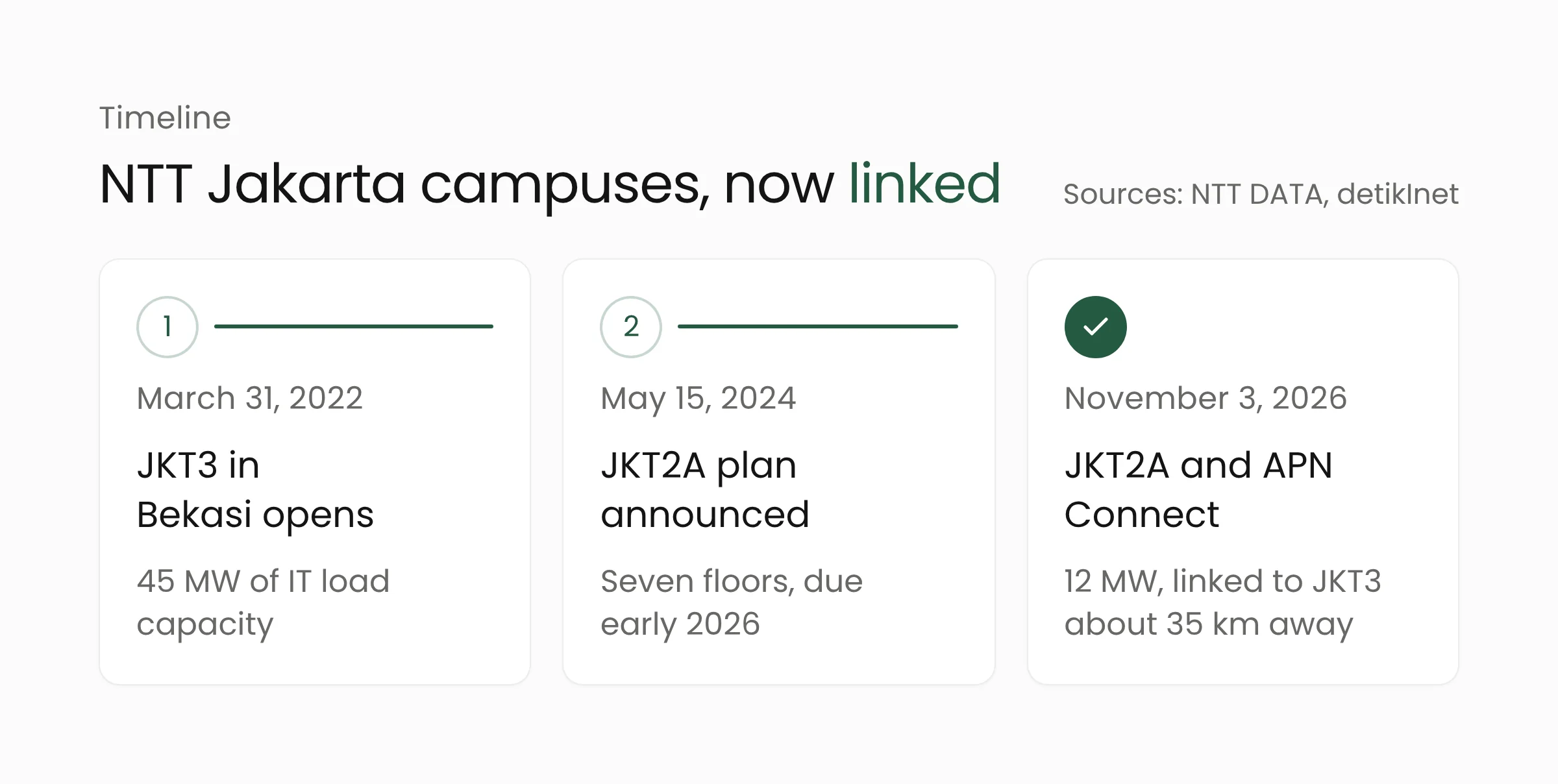
NTT first announced the building on May 15, 2024 as a seven-story facility in central Jakarta, about 20 km from Soekarno-Hatta International Airport, with completion targeted for early 2026. The November 2026 opening puts it several months behind that original schedule.
The JKT2 campus also works as a traffic exchange point. The 2026 announcement says it hosts more than 240 network service providers, the JKT-IX internet exchange, major cloud providers and subsea cable connections. The JKT2A profile page cites more than 150 telcos, ISPs and fiber carriers, likely a different update date or counting method.
Jakarta on Southeast Asia’s AI data center map
Katadata, citing Antara, reports that AI data center development in the region is shifting toward Indonesia, Malaysia and Thailand because land and power for new infrastructure in Singapore are limited. Yasuhiro Kajiki, Managing Director for Japan and APAC at NTT Global Data Centers, pointed to Indonesia’s user base. “The strength of data centers in Indonesia is the number of users,” he said, as quoted by W.Media.
For domestic users, more local capacity means more options to keep data in Indonesia with short network paths. That matters for sectors bound by data placement rules and for applications that depend on fast response times, such as digital payments and AI-powered customer service.
APN Connect links JKT2A and JKT3
The less familiar part of the launch is APN Connect. NTT DATA describes it as the first service in Indonesia to use All-Photonics Network (APN) technology. It provides high-capacity, low-latency Layer 1 connectivity between JKT2/JKT2A and JKT3, roughly 35 km apart.
JKT3 is NTT’s data center in Bekasi with 45 MW of IT load capacity, according to its Jakarta 3 profile page. The facility opened on March 31, 2022, as detikInet reported at the time. With APN Connect, the two campuses, which sit in different administrative regions, can operate as one system that backs itself up.
How an all-photonics network works
APN is part of IOWN (Innovative Optical and Wireless Network), the next-generation network program of Japan’s NTT group. On its official page, NTT describes APN as wavelength networks that provide end-to-end optical wavelength paths. Data travels on a dedicated light path instead of passing through many devices that reprocess packets along the way. NTT’s 2030 target for these photonics technologies includes end-to-end latency of 1/200 of today’s networks, a long-term goal rather than a specification of the Jakarta service.
According to an NTT research article, NTT EAST and NTT WEST launched the first APN IOWN1.0 service in March 2023. It uses the OTN (Optical Transport Network) protocol to provide end-to-end Layer 1 paths with latency close to the physical limit and no fluctuation. Capacity on each path is fully guaranteed and no Ethernet switch sits along the route, so signals pick up no significant extra delay.
For system operators, the key property of such a link is a stable, measurable travel time. NTT DATA has not published latency figures for APN Connect in Jakarta, so the “low-latency” claim still has to be confirmed in customer testing.
Synchronous replication and distance between sites
NTT DATA says APN Connect supports real-time data synchronization, disaster recovery, data replication and multi-data-center operations. They determine how much data can be lost when one site stops working.
With synchronous replication, a transaction counts as complete only after the data is written at both sites. If the primary data center goes down, the second site already holds the latest copy, so almost no data is lost. The trade-off is that every transaction waits for confirmation from the second site. Distance and network stability directly affect application speed.
With asynchronous replication, the transaction completes at the primary site first and the copy follows shortly after. Applications respond faster and the sites can be much farther apart, but the last few seconds or minutes of data can be lost in a disaster. Many organizations combine the two: synchronous replication between two nearby sites and asynchronous replication to a distant third site.
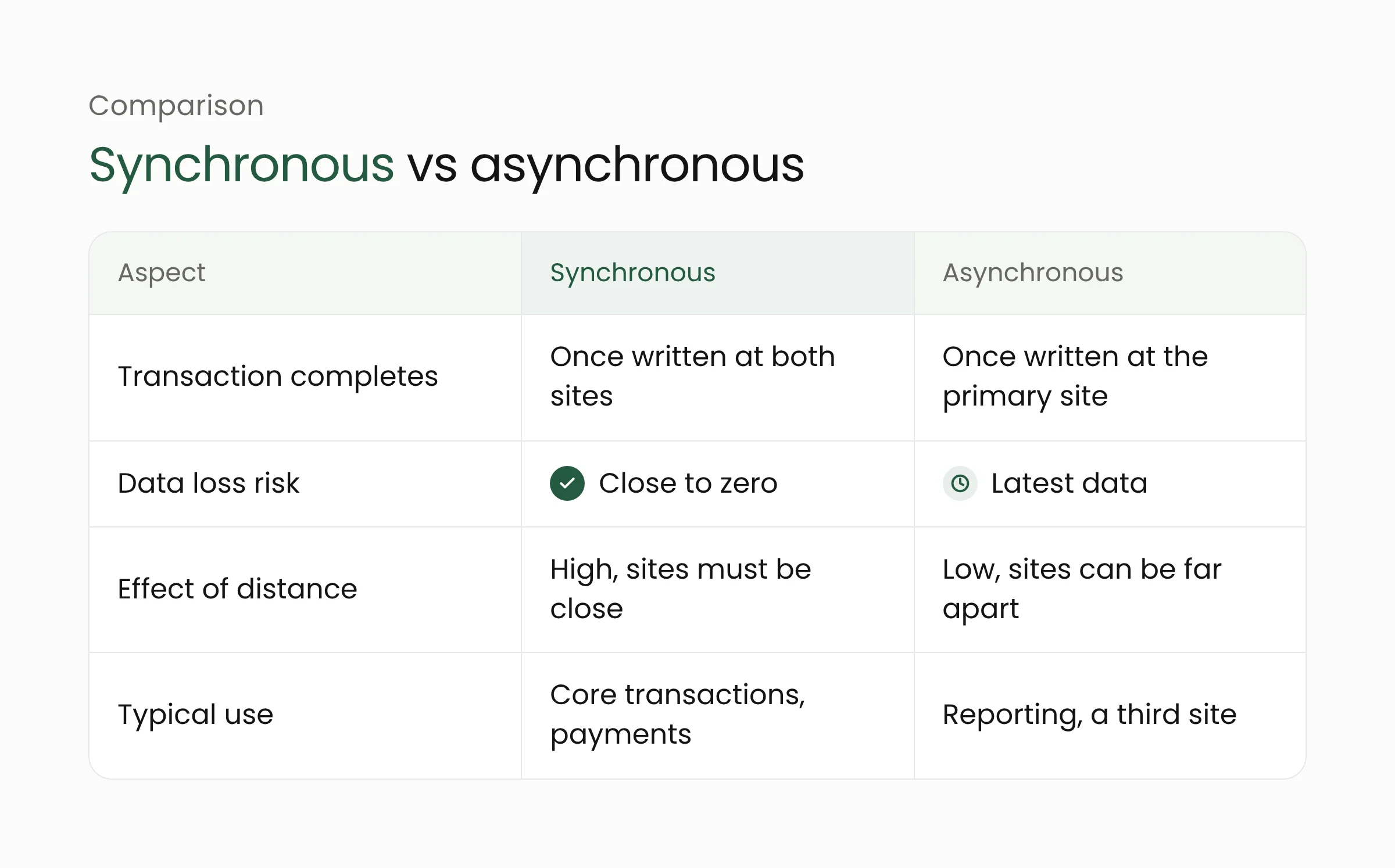
The 35 km between Jakarta and Bekasi is short enough for synchronous designs, yet far enough that the two sites do not share the same building or substation. Both still sit within one metropolitan area, however. Regional events such as major floods or a wide power outage still call for a third, more distant site.
What this means for your organization
The launch matters most to organizations running their own core systems, whether in colocation facilities or on cloud computing services. Banks, fintech firms, online retailers and public service providers share similar needs: transactions must not be lost, and services must recover quickly when one site fails.
For Indonesian banks, the obligation is already in writing. Article 18 of OJK Regulation No. 11/POJK.03/2022, Penyelenggaraan Teknologi Informasi oleh Bank Umum (on IT operations by commercial banks), requires banks to have a disaster recovery plan, to test it against all critical applications and infrastructure at least once a year, and to review it at least once a year. The Google Cloud outage in London showed that backups that look complete on paper can still fail under real conditions.
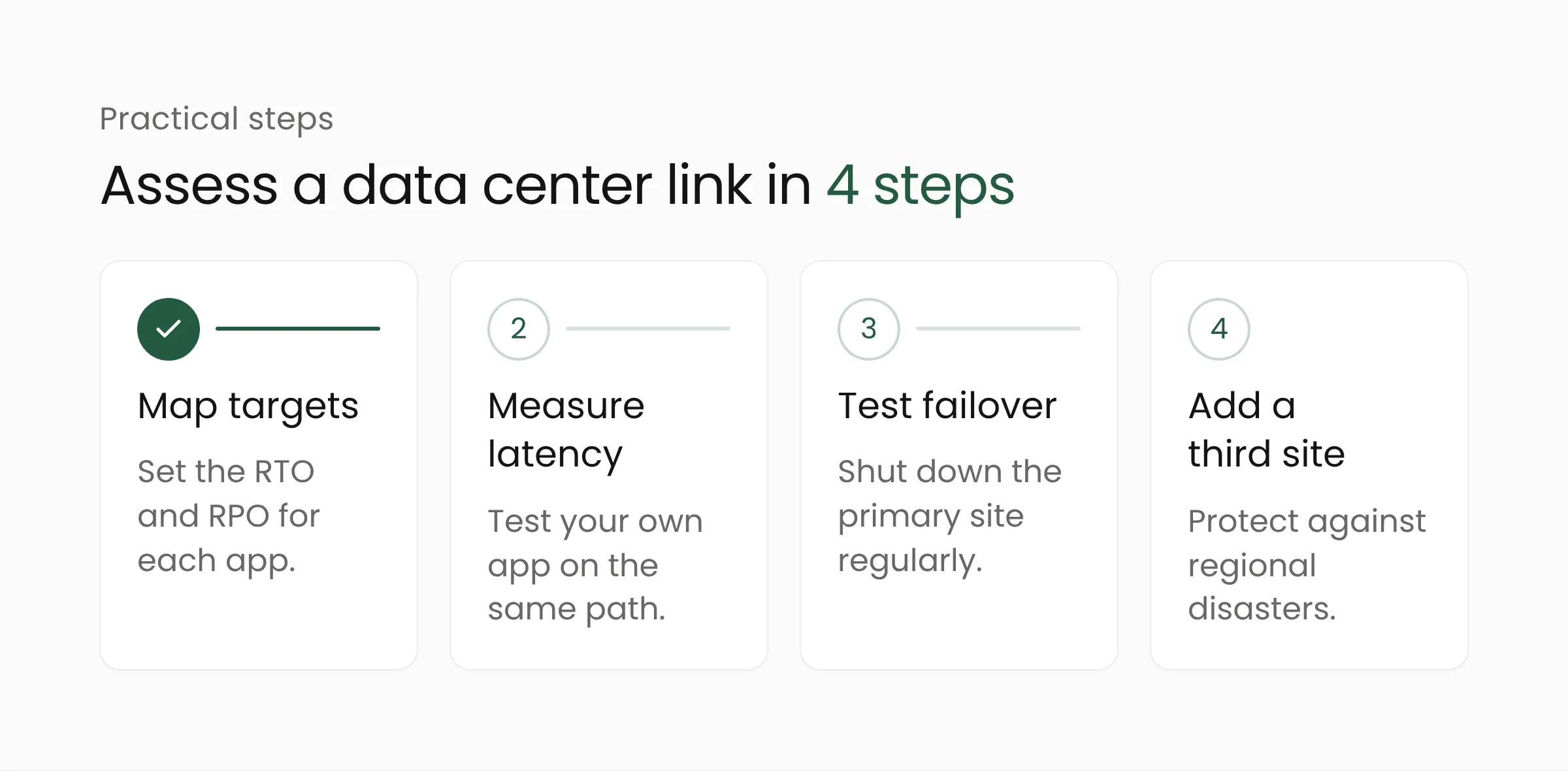
IT teams can take several concrete steps:
- Map recovery targets for each application. Decide how long a service may be down (RTO) and how much data it may lose (RPO). A core banking system or an online store’s checkout may need an RPO close to zero, while reporting systems can run asynchronously.
- Measure latency under real load. Before choosing synchronous replication, ask for latency data and test your own application on the same path. A stable travel time matters more than an average figure.
- Test failover regularly. Run drills that shut down the primary site, including while a component is under maintenance. Record recovery time and any data left behind.
- Prepare a third site for regional risk. Two nearby sites protect against a building failure, but not against a disaster that hits the whole area.
Teams that manage financial applications can align these steps with compliance needs through financial services solutions, so the technical design and recovery test reports are planned from the start.
Frequently asked questions
What is NTT DATA’s APN Connect?
APN Connect is a Layer 1 optical connectivity service linking the JKT2/JKT2A campus in Jakarta with JKT3 in Bekasi, about 35 km apart. It uses All-Photonics Network technology from NTT’s IOWN program and is intended for data synchronization, replication and disaster recovery.
How much capacity does the JKT2A data center have?
JKT2A offers 12 MW of IT capacity, more than 5,800 square meters of IT space and racks of up to 40 kW. Its Tier III-certified design includes two substations, a 2N UPS and N+1 backup generators.
Is synchronous replication always the better choice?
Not always. Synchronous replication reduces the risk of data loss, but every transaction waits for the second site to confirm, so performance depends on distance and network stability. For less critical data or distant sites, asynchronous replication is often more practical.
Conclusion
JKT2A adds AI-ready capacity in Jakarta, but the APN Connect link that came with it raises a more pressing question for many organizations: how ready are your systems to recover when one site goes down? The answer depends on recovery targets, latency measurements and routine failover tests. If your team is reworking its cloud architecture or disaster recovery plan, Merakit can help you design it.
Sources
- NTT DATA: NTT DATA Opens Jakarta Data Center (November 3, 2026)
- Antara: NTT DATA perluas kapasitas pusat data AI melalui JKT2A di Jakarta (November 3, 2026)
- Katadata: NTT DATA Bangun Data Center AI di Jakarta, Bidik Pasar Asia Tenggara (November 4, 2026)
- W.Media: NTT Data opens 12MW new Jakarta 2 Annex data center (November 4, 2026)
- Developing Telecoms: NTT Data launches new AI-ready data centre in Jakarta with added APN (November 4, 2026)
- NTT DATA: Jakarta 2A Data Center (profile page, accessed November 4, 2026)
- NTT DATA: Jakarta 3 Data Center (profile page, accessed November 4, 2026)
- NTT DATA: NTT expands network data center for generative AI platform in Indonesia (May 15, 2024)
- NTT: All-Photonics Network (IOWN)
- NTT R&D: Delay Managed Network for APN IOWN1.0 (2023)
- detikInet: Data Center Terbesar di Indonesia Dibuka, Kapasitas 45 MW (March 31, 2022)
- Article 18 of OJK Regulation No. 11/POJK.03/2022