Blog Data Centers
Marvell to Buy Lumentum as AI Data Centers Race for Lasers
On this page· 7 sections
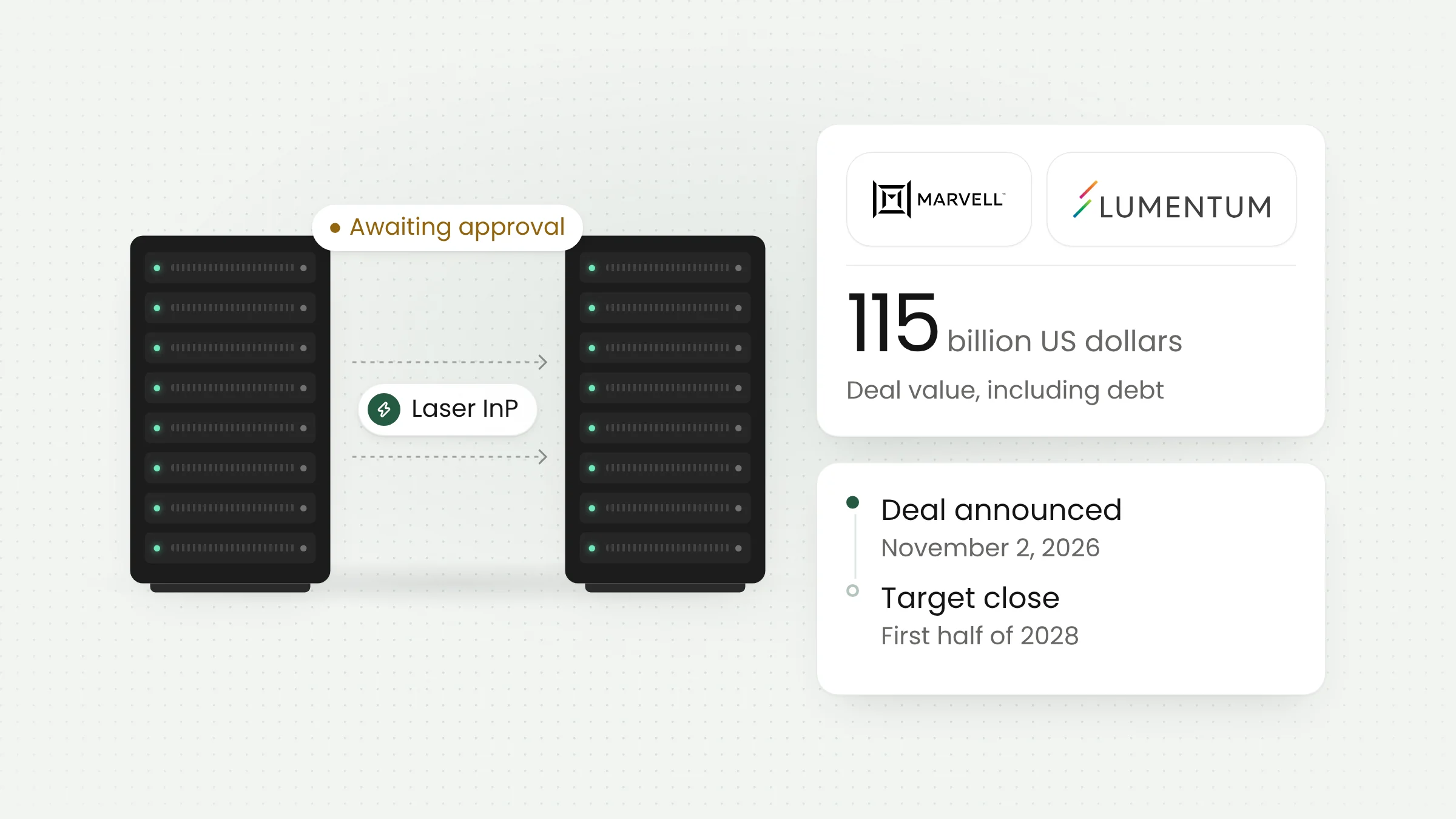
Marvell Technology agreed on November 2, 2026, to acquire Lumentum in an all-stock deal with an implied enterprise value of about $115 billion. Lumentum makes the lasers and optical modules that move data between servers in AI data centers. The deal shows how light-based components have become one of the tightest constraints in building AI infrastructure.
The terms of the Marvell and Lumentum deal
Under Marvell’s announcement, each Lumentum share will be exchanged for 4.5 Marvell shares, or roughly $1,132 per share. That is a premium of about 23.9% over Lumentum’s closing price on October 28, 2026, the last trading day before speculation about a deal began.
The $115 billion figure includes debt. Reuters put the equity value at $102.54 billion and called the transaction one of the biggest deals of 2026. Once it closes, Marvell shareholders will own about 67% of the combined company and Lumentum shareholders about 33%.
Both boards approved the agreement unanimously. Matt Murphy will remain chairman and CEO, and three Lumentum directors, including CEO Michael Hurlston, will join Marvell’s board. “AI infrastructure is undergoing a fundamental architectural shift toward optical connectivity, creating an opportunity that comes along once in a generation,” Murphy said in the release.
The process will take time. The companies expect the deal to close in the first half of 2028, subject to shareholder and regulatory approvals. They project more than $1 billion in annual run-rate cost savings and a combined addressable market of $550 billion. Both figures are company projections that cannot yet be tested.
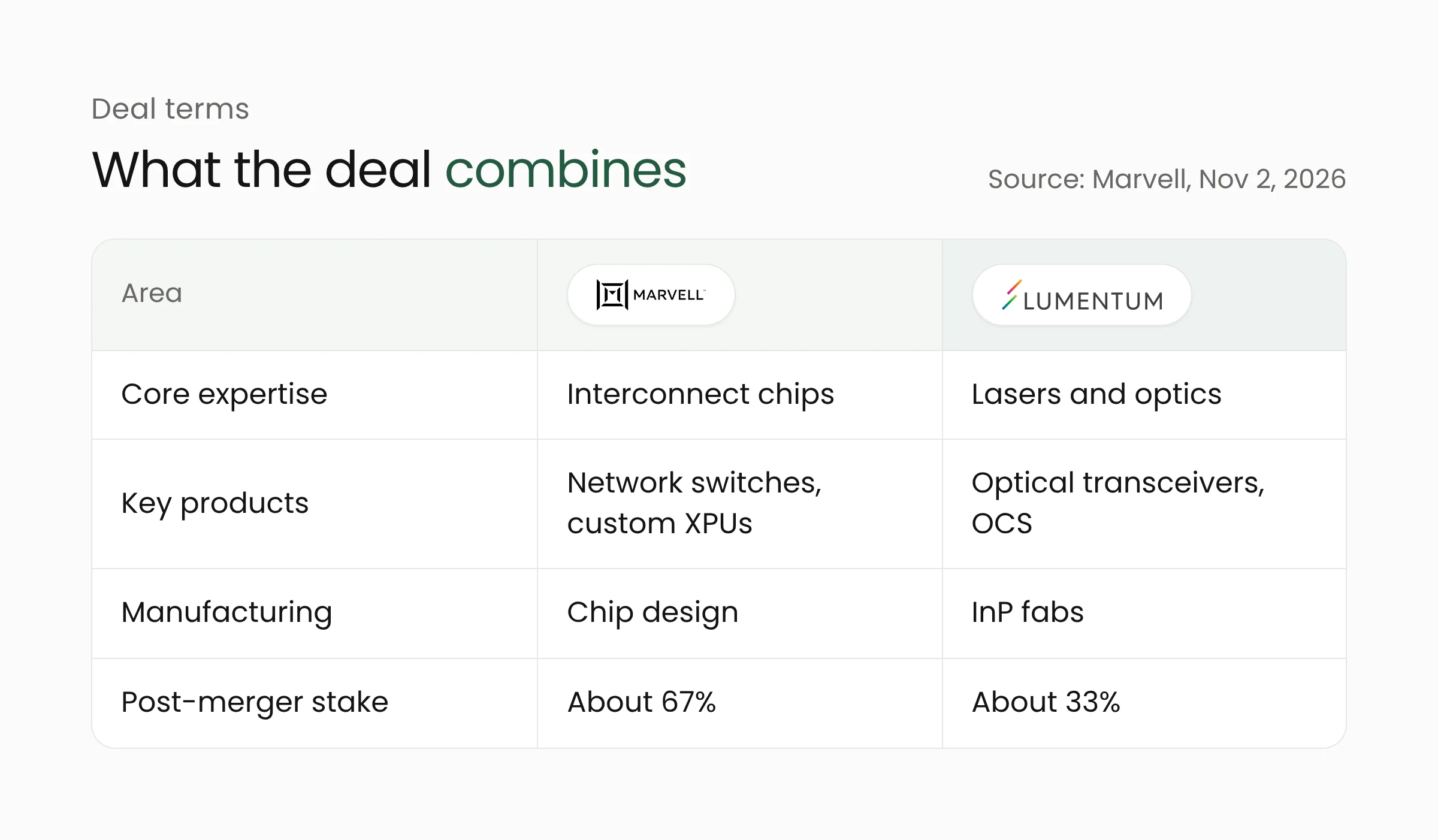
The division of roles is clear. Marvell contributes electrical and optical interconnect chips, network switching, and custom accelerator chips (XPUs). Lumentum adds high-speed and high-power lasers, optical transceivers, optical circuit switching (OCS), and compound semiconductor manufacturing, including indium phosphide. Reuters framed the combination as Marvell’s bid to challenge Broadcom, which sells a broader range of AI hardware.
How lasers move data inside AI data centers
Large AI models are trained and served on thousands of accelerators, such as GPUs, that constantly exchange data. Within a single rack, that data can still travel over copper cables. As distances grow, for example between racks or between buildings, electrical signals fade quickly and consume more power, so the data is converted into light.
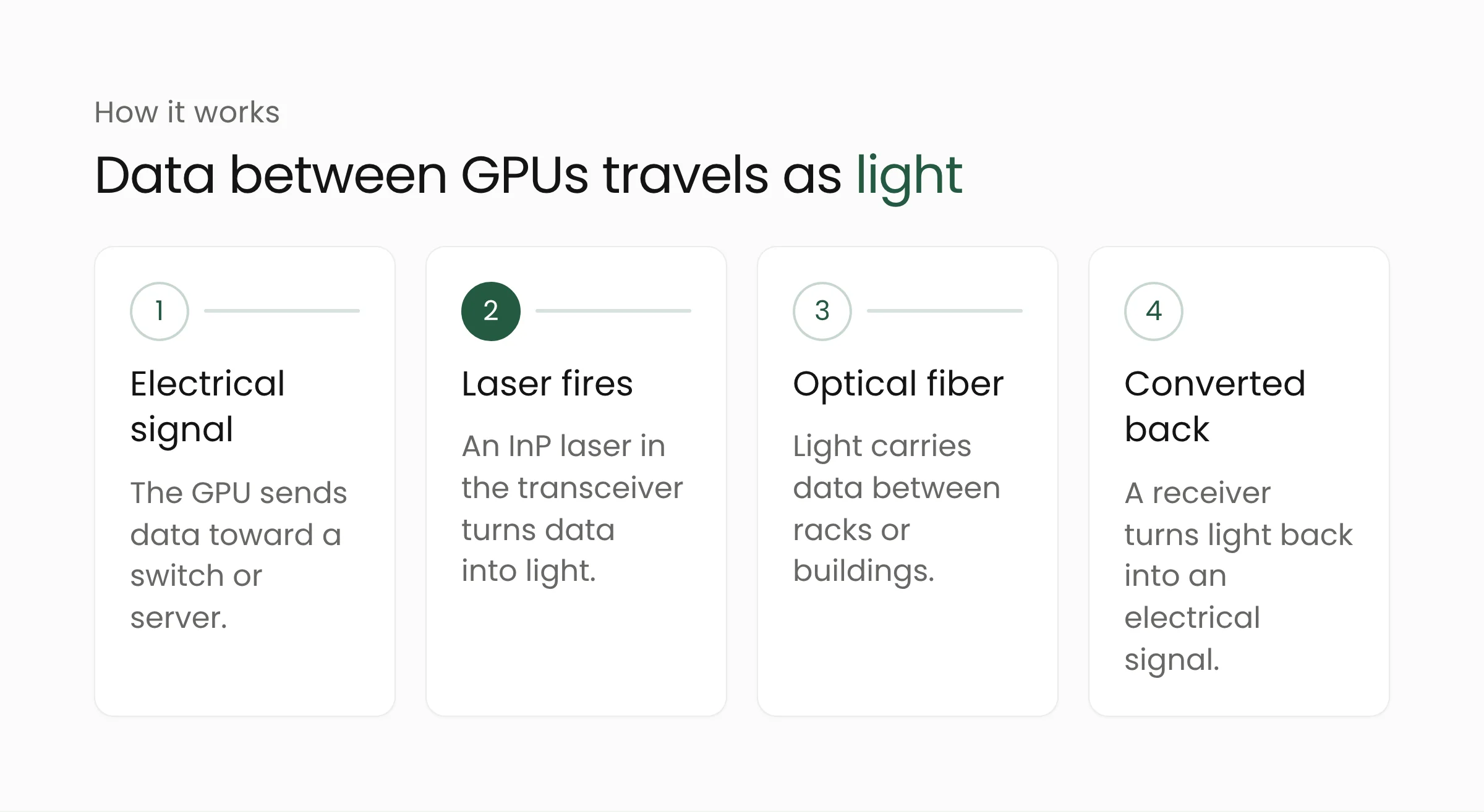
That conversion happens in an optical transceiver, a small module plugged into a switch or server. Inside it, a laser emits light that carries the data through optical fiber, and a receiver at the other end turns it back into an electrical signal. Lasers for high-speed modules are typically made from indium phosphide (InP), a semiconductor that emits light at the wavelengths optical fiber is designed to carry.
According to Marvell’s release, rising bandwidth requirements and the physical limits of copper-based connectivity are accelerating the move to optical technology. Hurlston said the combined company will serve scale-across links between data centers and scale-out links between racks today, then scale-up and scale-in connections inside systems and chip packages next. In other words, light is starting to take over distances that copper still covers.
The technology is also shifting. Co-packaged optics (CPO) place optical components directly next to the switch chip or accelerator. According to Counterpoint Research analyst Gareth Owen, that shift could reduce demand for the DSP chips that have long anchored Marvell’s optical module business, while lasers remain necessary in every design. Owen sees Lumentum as Marvell’s hedge against that transition.
Why InP laser supply is hard to expand
Counterpoint estimates that about two-thirds of Lumentum’s revenue comes from lasers and laser chips, and describes the laser as the scarcest part of an optical link. Global InP laser capacity is concentrated among a few players, mainly Lumentum and Coherent. Lumentum runs five InP fabs in Japan, San Jose, North Carolina, and the United Kingdom, all of which are expanding. Building a new InP fab takes years.
Supply pressure was visible by mid-year. In an August 2026 report by TrendForce, Hurlston said the supply-demand gap for indium phosphide had surpassed that of DRAM and NAND. Indium is mostly recovered as a by-product of zinc refining, which makes output hard to raise quickly. TrendForce also noted that China produces roughly 70% of the world’s refined indium and has tightened export controls on indium and InP since 2025.
The move to 800G and 1.6T optical modules adds to demand. TrendForce reported that customers are ordering further ahead and paying substantial deposits, while inventories across the supply chain are tightening and prices are rising.
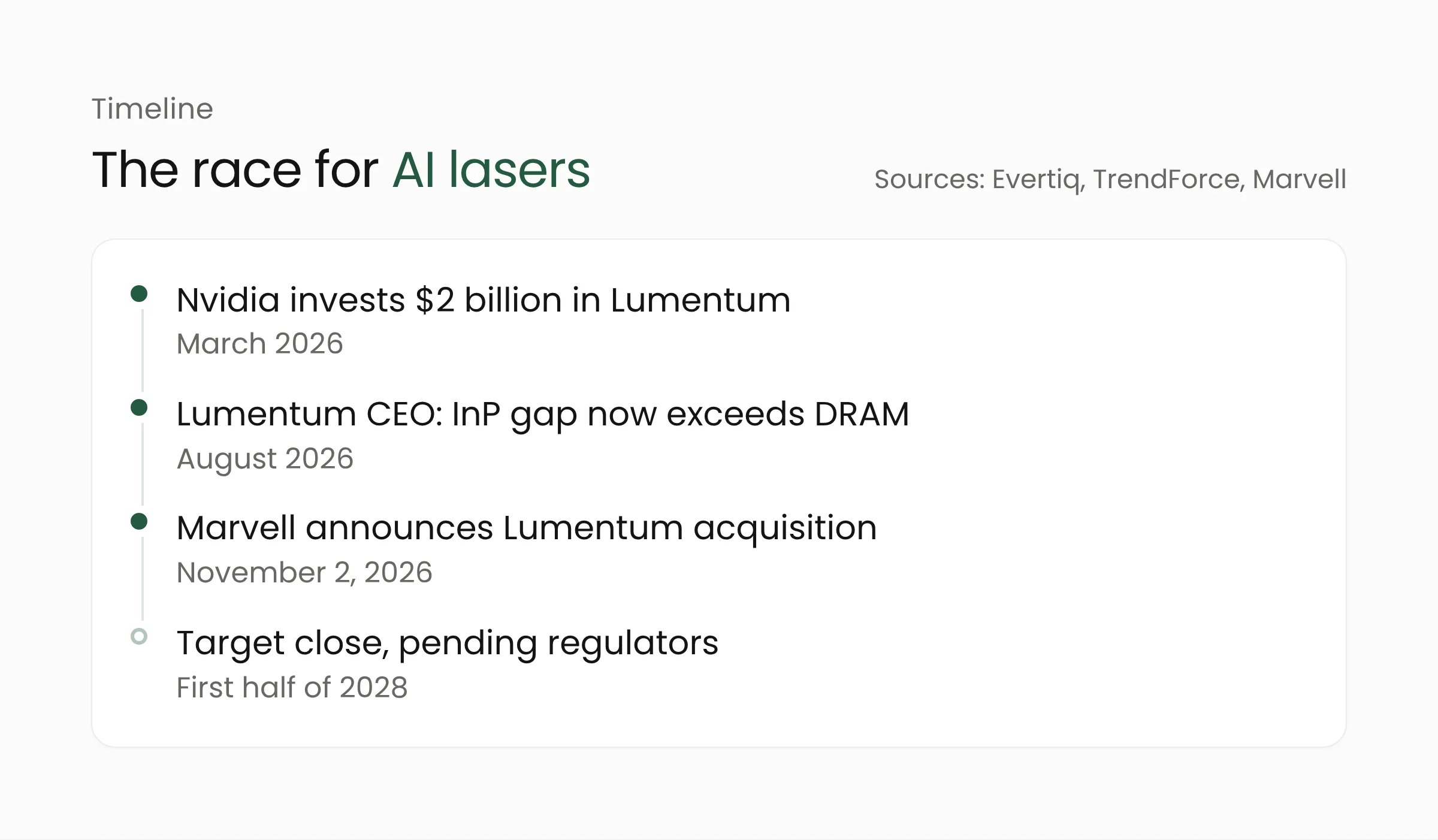
Nvidia moved first to secure supply. In March 2026, it announced a $2 billion investment in Lumentum as part of a multiyear, nonexclusive partnership that includes a multibillion-dollar purchase commitment and future capacity access rights for advanced laser components, as reported by Evertiq. The funds support research and a new Lumentum fab in the United States. Nvidia announced a similar $2 billion partnership with Coherent.
Lumentum’s results reflect the demand. According to Investing.com, Lumentum posted revenue of $1.26 billion for its fiscal first quarter of 2027, with an adjusted gross margin of 53.2%, up from 39.4% a year earlier. For the following quarter, it guided to revenue of $1.575 billion to $1.625 billion.
Counterpoint expects the size of the deal and Lumentum’s place in a strategic supply chain to draw close regulatory scrutiny. Marvell’s release refers only to regulatory approvals, without naming the jurisdictions or agencies involved.
What this means for cloud and AI users
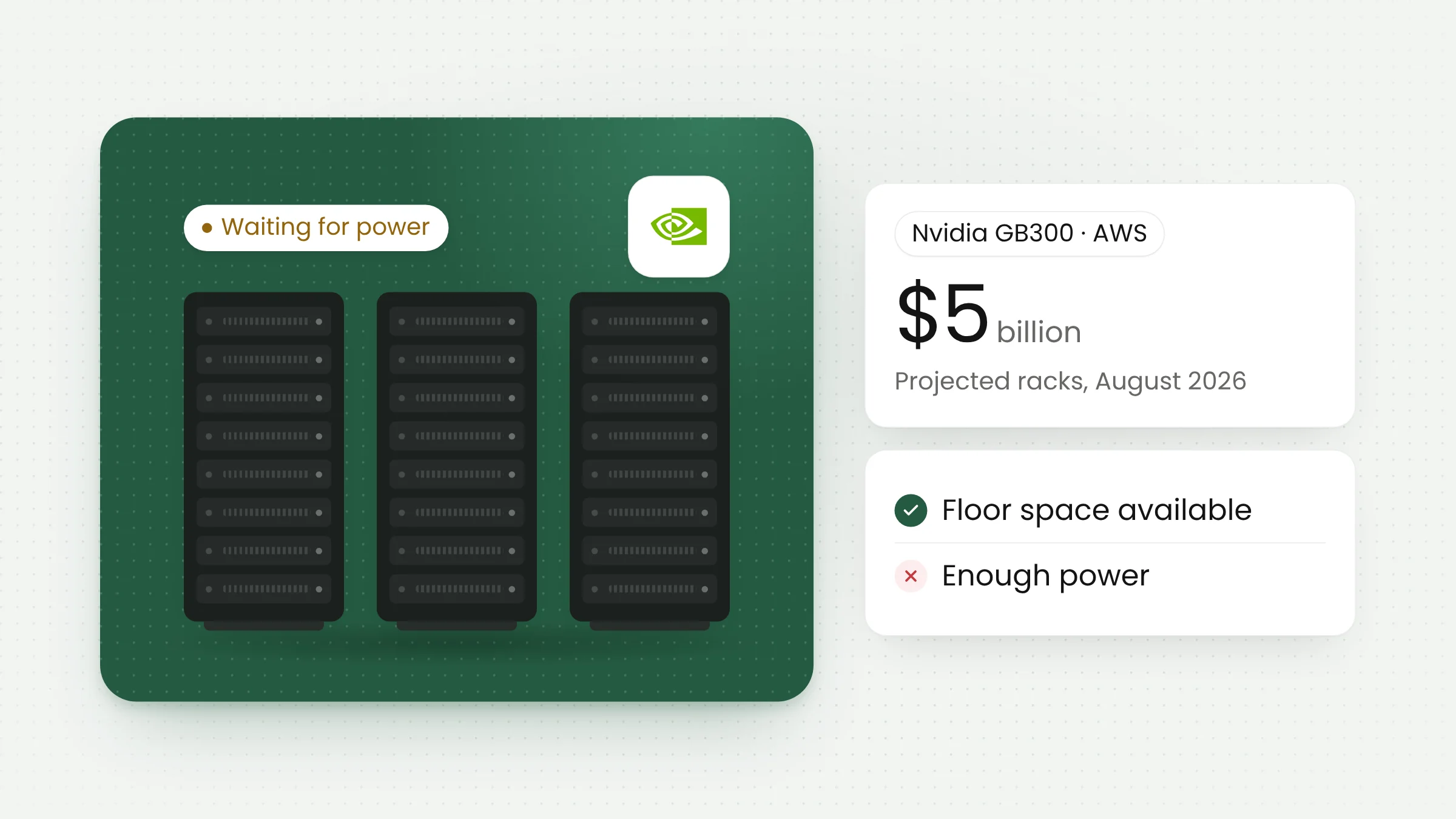
Most organizations in Indonesia will never buy an InP laser directly. The effects arrive through cloud providers, colocation data centers, and network equipment vendors. The GPU capacity that a hospital, bank, or government agency rents depends on a supply chain that reaches well beyond the chips. Power is one constraint, as the case of Amazon’s dark GPUs showed, and optical components are now another.
Steps IT teams and AI project planners can consider:
- Plan capacity early. For large training or inference projects next year, discuss GPU capacity reservations with your cloud provider during planning, including which regions have availability.
- Right-size workloads. Many tasks, such as document classification, report summaries, or internal search, can run on smaller models. Smaller models need fewer accelerators and less network traffic.
- Add network gear to procurement from the start. If you are building your own GPU cluster in a server room or colocation facility, order optical modules and high-speed switches together with servers and GPUs, because supply is tight.
- Prepare a fallback path. An architecture that can shift between regions or providers lowers the risk of delays when one location runs short of capacity.
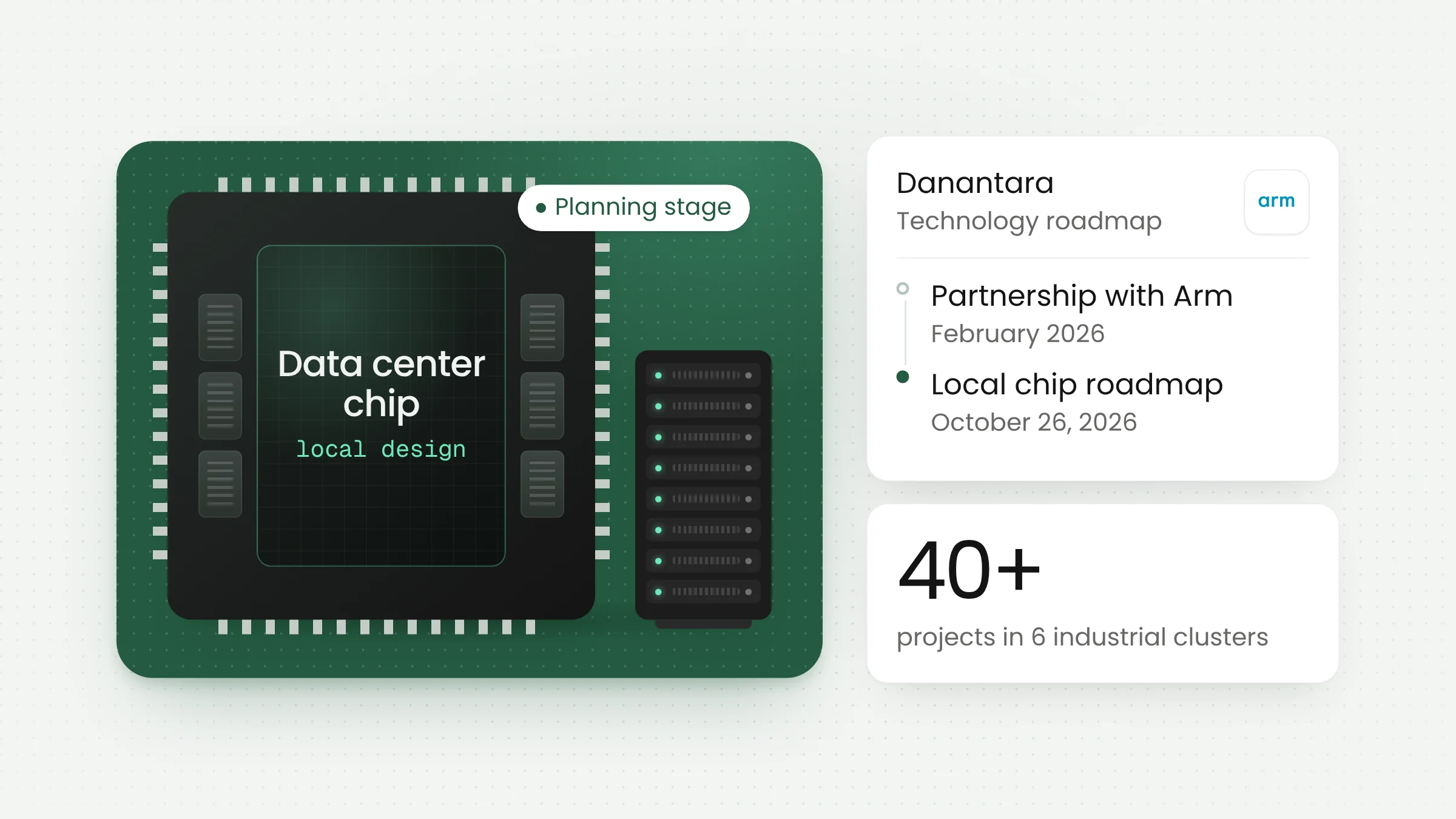
Teams working on this kind of capacity strategy can start with an architecture review alongside Merakit’s cloud computing services team. In Indonesia, demand for data center equipment is also being addressed on the industrial side, for example through Danantara’s plans for locally made data center chips and equipment.
Frequently asked questions
Is Marvell’s acquisition of Lumentum final?
No. The definitive agreement has been signed and approved by both boards, but the transaction still requires shareholder and regulatory approvals. The target is to close in the first half of 2028.
What is an optical transceiver?
An optical transceiver is a module that converts electrical signals from a server or switch into light for transmission over optical fiber, then converts the light back at the receiving end. Its light source is a laser, which in high-speed modules is typically made from indium phosphide.
Will cloud prices in Indonesia rise because of this deal?
We have found no cloud provider linking price changes to this acquisition. Tight optical component supply is one cost factor in building AI data centers, but rental prices also depend on power, chips, exchange rates, and competition among providers.
Closing thoughts
The Lumentum deal shows that competition in AI infrastructure now extends to components most people never see: the lasers and optical modules between server racks. For organizations using AI, the practical lesson is that plans need to account for capacity and lead times as well as model choice. If your team is mapping its cloud and AI needs for next year, Merakit is ready to talk it through.
Sources
- Marvell: Marvell and Lumentum to Combine, Creating a Category Leader in AI Connectivity (November 2, 2026)
- Reuters via 93.3 The Drive: Marvell to Buy Lumentum in $115 Billion Deal in AI Data-Center Bet (November 2, 2026)
- Investing.com: Marvell Agrees $115 Billion All-Stock Deal to Buy Lumentum (November 2, 2026)
- Counterpoint Research: Marvell Rumoured to Be Acquiring Lumentum? (October 29, 2026)
- TrendForce: InP Shortage Emerges as AI Optical Interconnect Bottleneck (August 6, 2026)
- Evertiq: Nvidia to Invest $2 Billion in Lumentum under New Optics Partnership (March 4, 2026)