Blog Data Centers
Yandex Data Center Strikes: Cloud Resilience Lessons
On this page· 7 sections
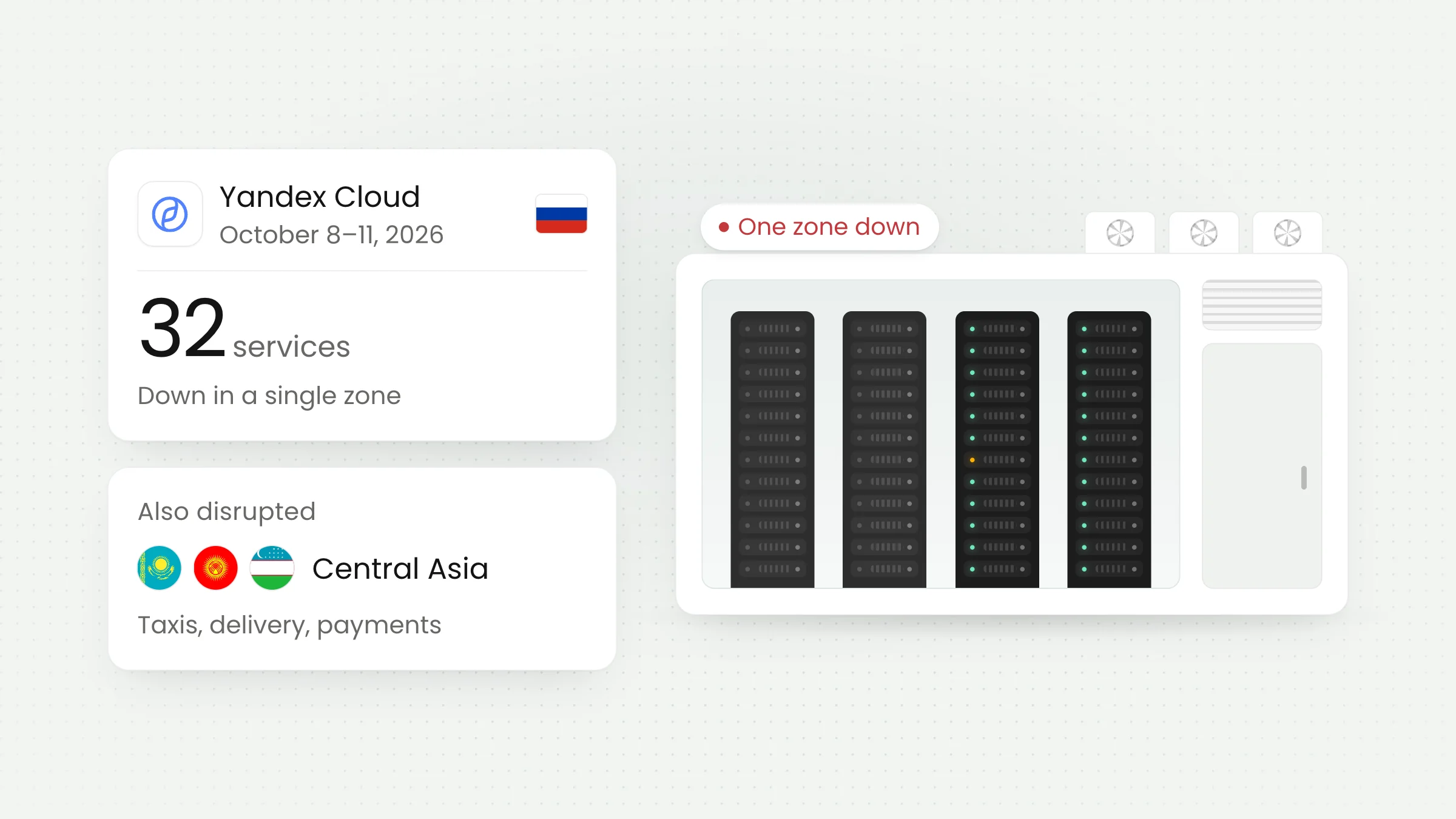
Between October 8 and 11, 2026, drone strikes hit three data centers belonging to Yandex, the Russian technology company. One Yandex Cloud zone went dark, and the effects spread to taxi and payment apps across Central Asia. For any organization that depends on servers, the data center resilience lessons here are very practical.
What happened between October 8 and 11, 2026
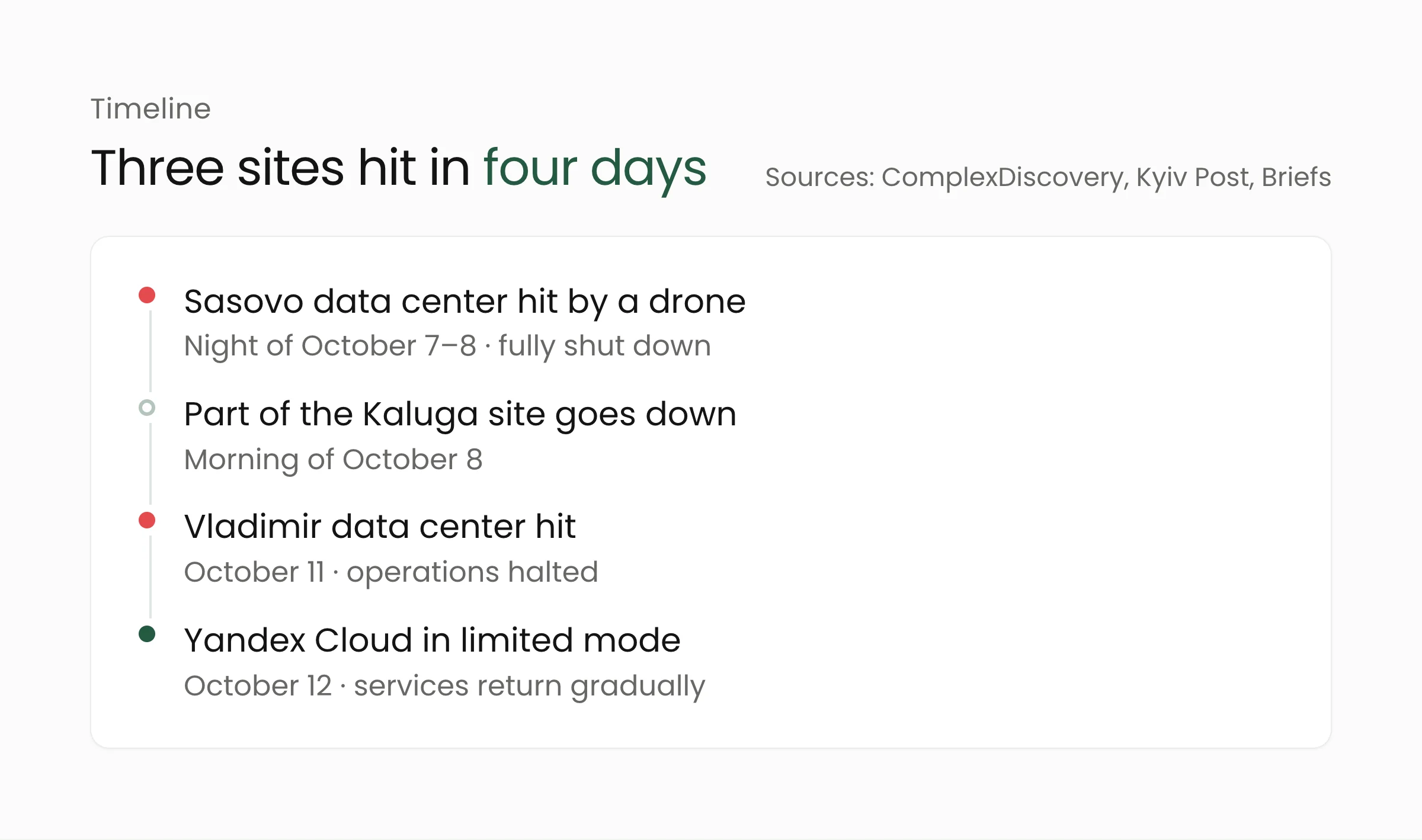
According to a ComplexDiscovery summary dated October 10, 2026, Yandex’s data center in Sasovo, in the Ryazan region, was hit by a drone on the night of October 7–8. Yandex said the site was seriously damaged and completely shut down. The next morning, part of the infrastructure in Kaluga went out of service as well. Yandex said no employees were injured.
Another strike followed on Sunday, October 11. Kyiv Post reported that the Vladimir data center was hit and its operations halted, disrupting more than 80 digital platforms, AI tools, and cloud services. That report relies on Telegram channels and Russian official claims, so the damage figures have not been independently verified.
This article does not take a side in the conflict. What matters for us is what happens to customers and users when a physical location suddenly disappears.
The impact: one zone down, many services dragged along
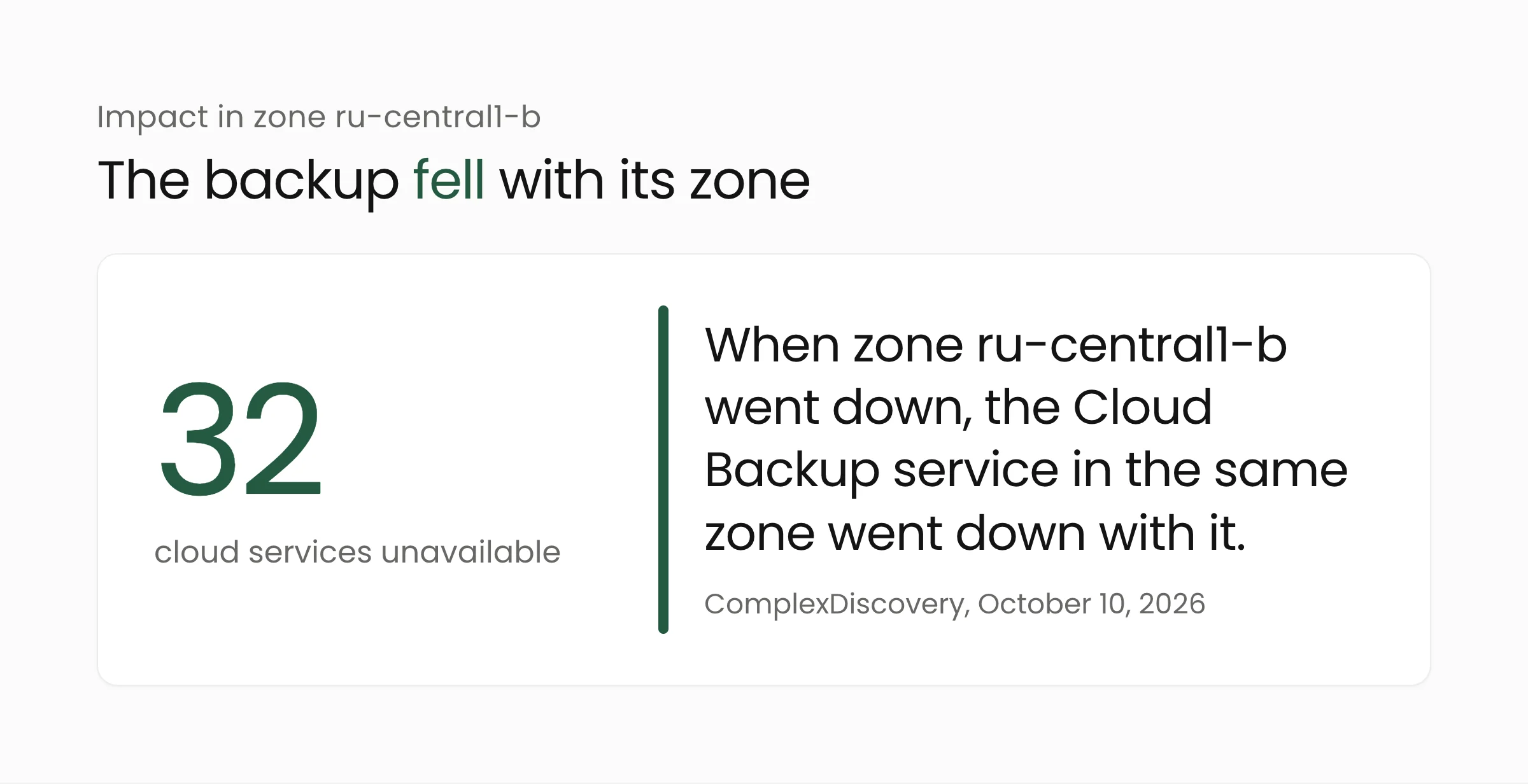
Yandex Cloud, like other large providers, splits its infrastructure into zones. ComplexDiscovery reports that zone ru-central1-b was knocked out by the fire linked to the Sasovo incident and was still unavailable as of October 10. The incident notice listed 32 cloud services as unavailable in that zone, including Cloud Backup. Other zones were reported as running normally, and Yandex shifted some load to them.
The Cloud Backup detail deserves attention. A backup service that sits in the same zone as the system it protects goes down along with it. A backup you cannot reach at the moment you need it is worth much less than it looks on paper.
On October 12, Briefs reported that Yandex Cloud was still running in a limited mode, while search and the Alisa AI assistant were coming back gradually. The Russian daily Kommersant, citing industry sources, estimated that replacing damaged hardware could take up to six months. That is an estimate, not a commitment from Yandex.
The cross-border ripple
Times of Central Asia wrote that on October 11, Yandex Go (taxis), Yandex Eats, and Yandex Lavka were disrupted in Kazakhstan. Kyrgyzstan and Uzbekistan also saw errors with taxi booking and food delivery. Yandex Pay users were briefly unable to check balances or send money.
Yandex Qazaqstan said Kazakh users’ personal data remained stored in Kazakhstan. But the article pointed out something that is easy to miss: keeping data in-country does not automatically mean all the computing happens there. An app can still stall while its database is perfectly intact, because the processing depends on servers elsewhere.
Why this matters in Indonesia
Indonesia is not in the same situation, and you do not need to imagine a war scenario to learn from this. A data center can go offline because of fire, flood, a power cut, an earthquake, ransomware, or a bad configuration change. The causes vary, but the shape of the problem is the same: one location disappears, and everything that depends on it stops.
Picture a district education office running online exams and daily attendance on a single server. Or a hospital keeping its queue system and patient records in one rack. When that location is unreachable, the question is no longer “is our system secure?” but “how long can we work without it?”
The Yandex case also shows that no provider is immune, however large. Choosing the cloud does not automatically buy resilience. Resilience has to be designed, and much of that design sits on the customer’s side.
What this means for your organization
There is no single recipe for every organization, but the following order of thinking usually helps.
Map the services that must not go down. Not every system is equally important. A live online exam, payments, or attendance may need to recover within hours, while an old archive can wait a few days. Write down two numbers per system: how long it can be down, and how much recent data it can afford to lose. Those two numbers decide how expensive your design will be.
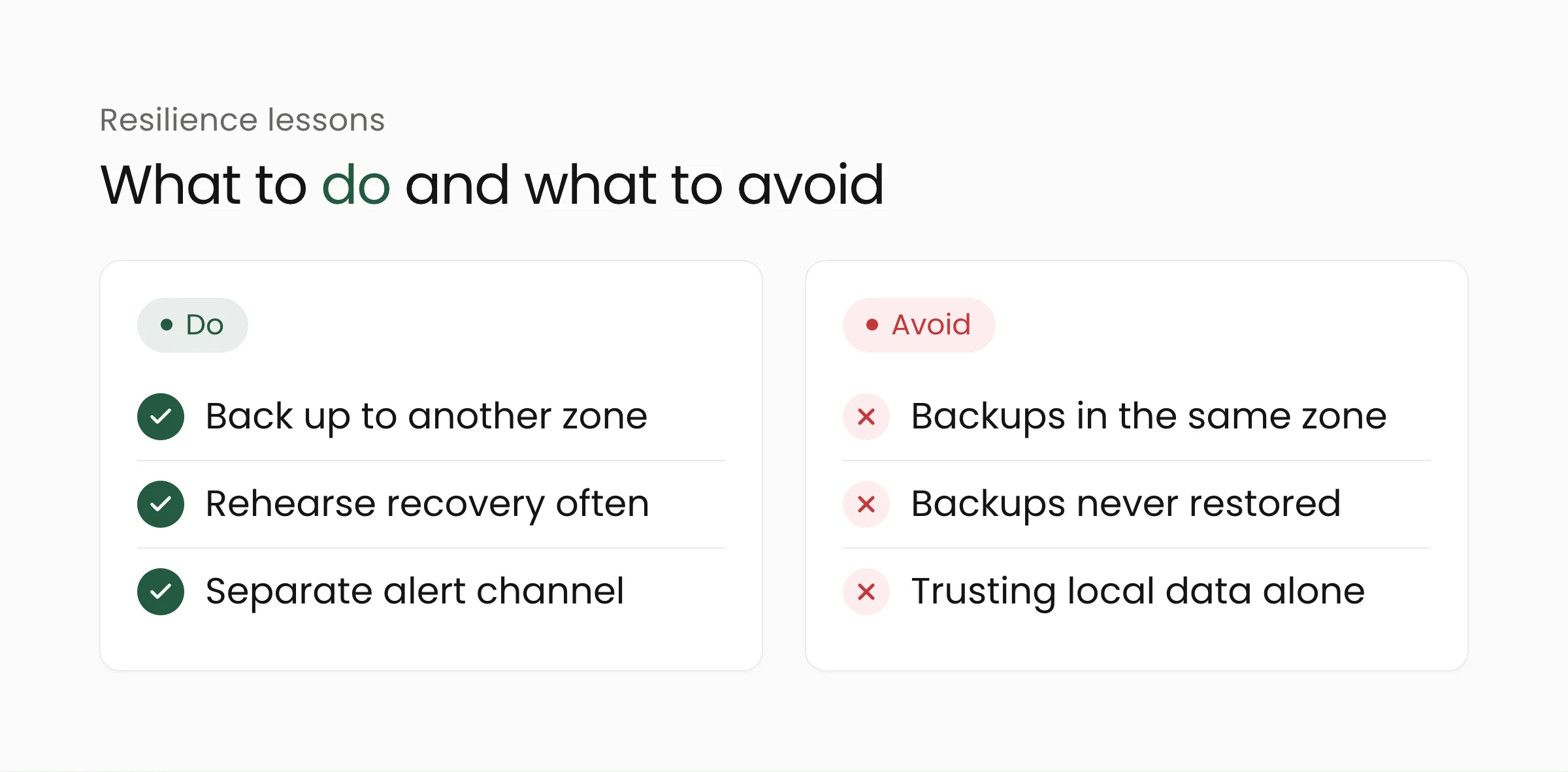
Separate your backup locations. Backup copies should live in a different zone or region from the main system, and ideally with a different provider. Also check whether your backup service goes down when your main zone goes down, as Cloud Backup did here. If you keep only one backup location, treat it as the first layer, not the only one.
Check for hidden dependencies. Applications often lean on services you cannot see: a database in one place, a message queue in another, a login service in a third. The Kazakhstan case shows that local data does not guarantee a working app. Draw the dependency map, then ask where each part actually runs.
Practice recovery, not just backup. A backup that has never been restored is an assumption. Schedule a simple drill twice a year: pick one system, restore it to a different environment, and time it. Write down who does what. During the Yandex incident, the company offered customers extra resource allowance to restore from backups and move workloads, and arranged priority help from several other providers. Help like that only works for teams who know what to restore first.
Plan how to communicate when systems are down. Decide who informs teachers, parents, staff, or customers, through which channel, and in what words. That channel must not depend on the system that is down.
If you want to review your current cloud and backup design, our team offers cloud computing services. For recovery after security incidents, see our cybersecurity services. We also compared cloud location choices for small businesses in Local vs Global Cloud.
Frequently asked questions
What is the difference between an availability zone and a cloud region?
An availability zone is one or more separate data centers inside an area, each with its own power and networking. A region is a group of zones in one geographic area. Spreading across zones protects you from a single building failing. Spreading across regions protects against wider disruption, though it costs more.
Does a small organization need a disaster recovery plan?
Yes, but it can be simple. For a school or a small business, start with automatic backups to a separate location, one copy that is not connected to the main network, and one recovery drill per semester. You do not need to build two data centers on day one.
Is keeping data inside the country enough?
In-country storage helps with compliance and data sovereignty, but it is not a resilience guarantee. As the Yandex case in Kazakhstan shows, an app can still fail if its computing depends on another location. Check both: where the data is stored, and where the processing runs.
Closing thoughts
News about attacks on infrastructure is heavy to read. Yet the lesson is calm and workable: know what matters, do not put everything in one place, and rehearse recovery before you truly need it. If you would like to talk through the state of your systems, feel free to get in touch for a relaxed conversation.
Sources
- ComplexDiscovery, “Drones hit two Yandex data centers, and a Kremlin decree sets terms for state management” (October 10, 2026)
- Kyiv Post, “Drone Strike Hits Yandex Data Center, in Vladimir, Russia, Triggering Major Outages” (October 11, 2026)
- Times of Central Asia, “Drone Strikes on Russian Data Centers Disrupt Yandex Services Across Central Asia” (October 12, 2026)
- Briefs, “Yandex Services Disrupted After Data Center Strikes” (October 12, 2026)