Blog Asset Tokenization
OKXICE Opens Tokenized Stock Trading as 67 Issuers Object
On this page· 7 sections
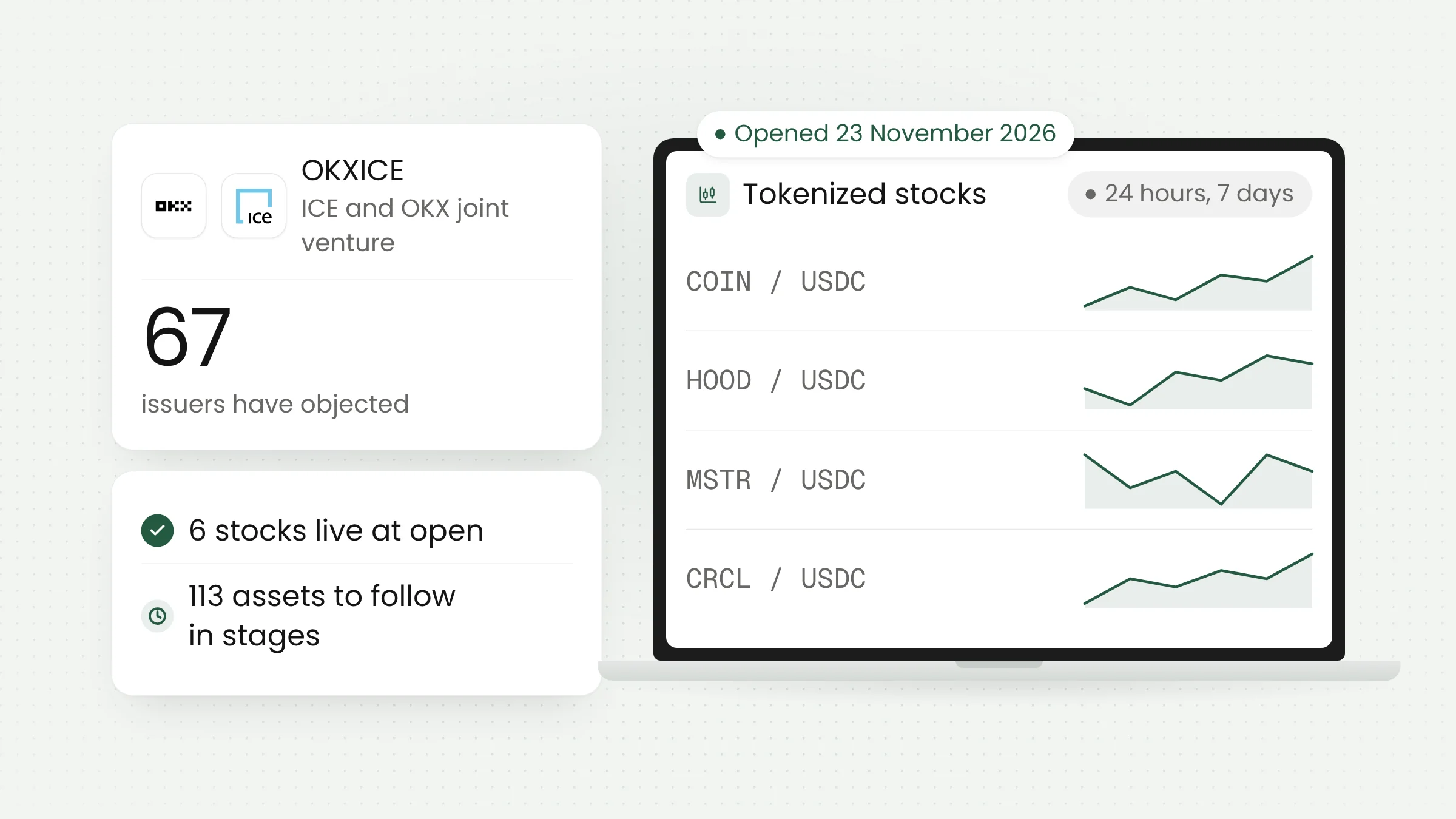
OKXICE, a joint venture between New York Stock Exchange owner ICE and crypto exchange OKX, opened tokenized stock trading on 23 November 2026. Six US stocks were live on the first day. By then 67 other issuers, among them Apple, Microsoft and Nvidia, had objected to having their shares turned into tokens.
A tokenized stock is a blockchain token that represents a real share, and holders can trade it at any hour. The OKXICE launch brings that idea to the US equity market, and it has already exposed a gap between the venue and the companies whose shares it wants to list.
Six stocks live out of 113 planned assets
Trading began at 12 p.m. Eastern time on 23 November, according to Unchained. The venue has lined up 113 stocks, ETFs and exchange-traded products to be added in stages.
Far fewer were available at the open. The OKXICE public notice dated 20 November 2026 lists six stocks, each paired with the USDC stablecoin: Coinbase (COIN), Securitize (SECZ), Strategy (MSTR), BitGo (BTGO), Robinhood (HOOD) and Circle (CRCL).
Some outlets reported a different figure. CoinPaprika wrote that the platform launched with 113 stocks and ETFs, including 59 Direxion ETFs. The official notice records only six stocks at launch, so 113 is better read as the plan.
The same document sets out the ownership. OKXICE LLC is a Texas limited liability company owned 50% by Intercontinental Exchange Holdings (ICE) and 50% by OKC USA Holding, the US parent of OKX. An OKX announcement on 11 November said the service is open only to eligible US-based OKX customers who pass identity verification.
How tokenized stocks work on OKXICE
OKXICE does not issue the tokens itself. That job belongs to a third party called the tokenizer, in this case Securitize Markets.
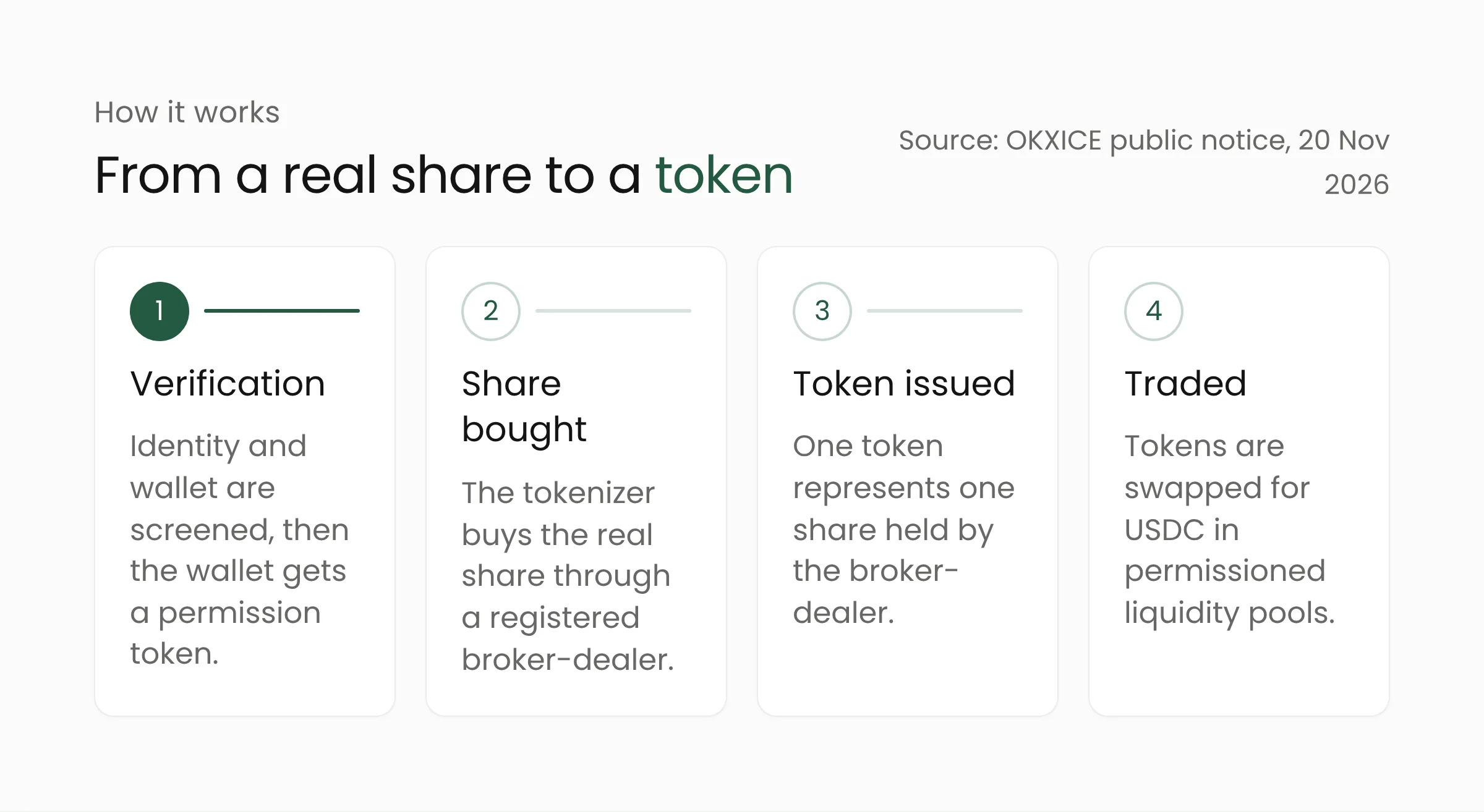
When a user requests new tokens, the tokenizer buys the underlying shares through a broker-dealer registered with the US Securities and Exchange Commission (SEC) and a member of FINRA. Tokens are issued once custody of the shares is confirmed. Each token represents an entitlement to one share, on a one-for-one basis.
OKXICE also states that token holders receive the same rights as ordinary shareholders of the same class, including dividends and voting rights. The tokenizer handles dividend payments, proxy materials and stock splits.
Liquidity pools set the price
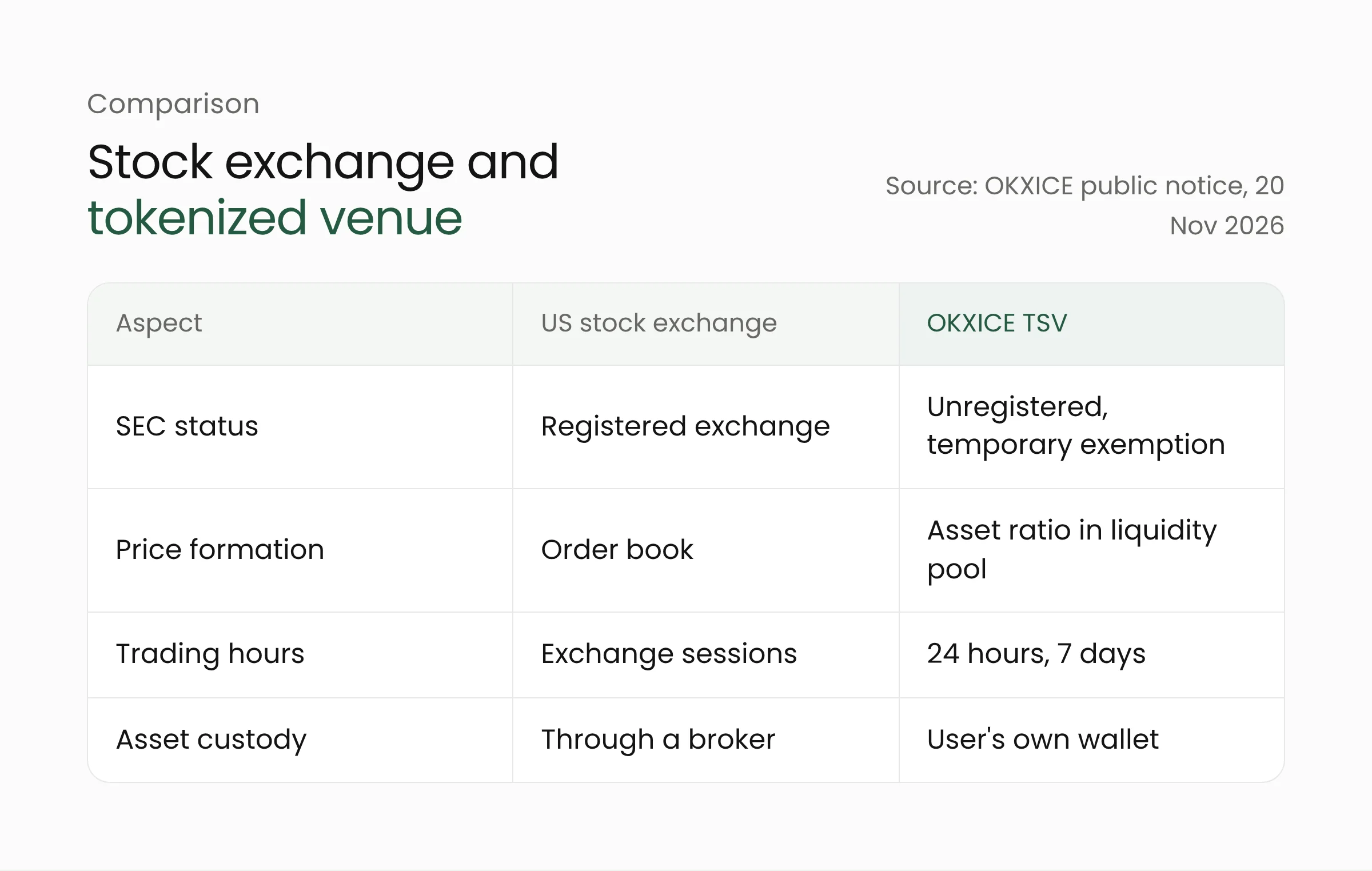
The largest difference from a conventional exchange is how prices form. OKXICE has no order book matching bids and offers. Trading takes place in liquidity pools holding tokenized shares and stablecoins deposited by liquidity providers, built on Uniswap v4 and deployed on X Layer, OKX’s blockchain network.
A price is derived from the ratio of the two assets in the pool, and the smart contracts take no price data from outside. A token’s price can therefore differ from the share’s price on its exchange, especially when that exchange is closed.
Access is restricted with a permission token
Applicants go through identity verification, anti-money-laundering checks and sanctions screening. Once approved, their wallet receives a soulbound token, a permission token that cannot be transferred to another wallet.
Assets stay in a wallet whose keys the user controls. OKXICE says it does not hold users’ assets or extend credit. The venue operates 24 hours a day, seven days a week.
Limits and risks OKXICE acknowledges
No SEC registration. The notice says OKXICE TSV is not registered with the SEC in any capacity for these activities. OKX’s own announcement adds that the venue “is not a registered exchange or broker-dealer and is not approved by the SEC.” It runs under a temporary SEC exemption.
Volume caps. For stocks in the first tier of the US plan that curbs extreme price swings, the exemption allows at most 75 symbols, with trading volume no higher than 0.25% of the prior month’s average daily volume. For the second tier the limits are 250 symbols and 2.5%. If a token breaches its volume limit a second time, trading in it is paused for three months.
The operator controls the smart contracts. OKXICE can upgrade the contracts, pause trading, change the permission list and withdraw a provider’s liquidity. Changes take effect without a waiting period, and the notice concedes that a compromised administrator key could be used to alter the contracts or withdraw liquidity.
Protection if the broker-dealer fails is unclear. Decrypt, citing the October edition of the notice, reported that it is uncertain whether tokenized shares in a self-custodied wallet would count as customer property or be covered by SIPC, the US investor protection scheme, if the broker-dealer holding the shares failed.
Crypto Briefing added a market observation. With many large companies objecting, the OKXICE lineup leans toward crypto firms and thematic or return-amplifying ETFs.
67 objections and the 30-day rule
The temporary exemption OKXICE relies on was issued by the SEC in September 2026. CoinDesk reported that it runs for five years.
The rule gives issuers one important right. According to Unchained, when a stock is tokenized by a third party unaffiliated with the issuer, the venue must notify the company in writing and wait at least 30 calendar days. An objection within that window keeps the stock off the venue. OKXICE says it also accepts objections that arrive after the 30 days have passed.
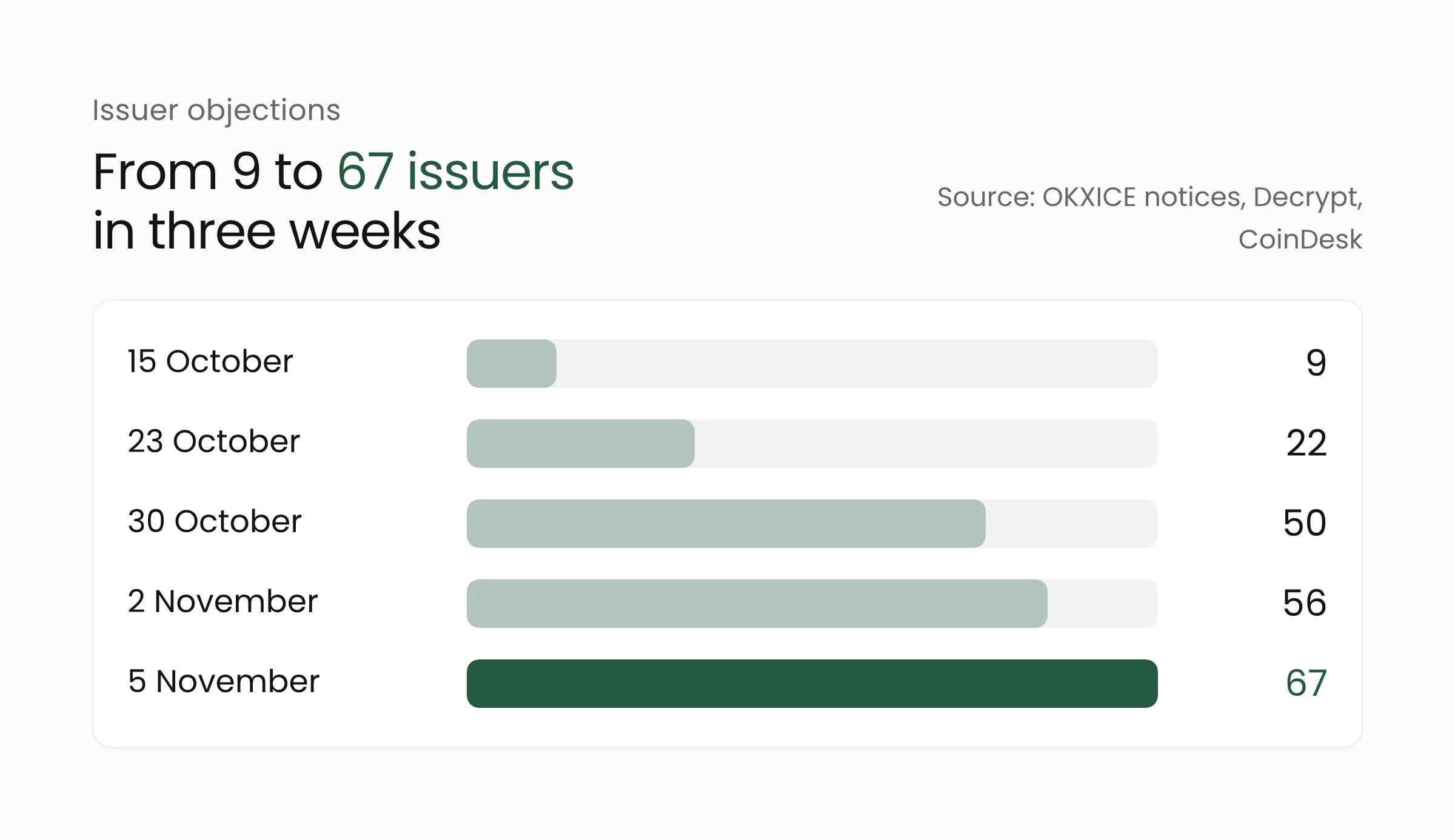
The number of objecting issuers rose quickly. Decrypt counted nine on 15 October and 22 on 23 October. CoinDesk counted 50 on 30 October and 56 on 2 November. The OKXICE notice dated 20 November names 67.
The list includes Apple, Microsoft, Nvidia, Alphabet, Amazon, Meta and Tesla in technology, JPMorgan Chase and Goldman Sachs in banking, and Walmart, Coca-Cola and McDonald’s in consumer goods.
Outlets differ on the original roster. Crypto Briefing wrote that 56 of the 62 issuers first selected had objected. CoinDesk broke down the figure of 56 on 2 November as 49 issuers from the original list of 62, plus seven from outside it.
The reasons have not been made public. Decrypt noted that the OKXICE notices do not state why issuers objected. CoinDesk reported that issuers are still weighing whether the new markets would attract additional investors and how such trading would affect their shares.
What this means for financial services firms in Indonesia
OKXICE is not available to investors in Indonesia. The debate still matters because Indonesia’s Financial Services Authority (OJK) is preparing rules in the same area. According to Infobanknews, OJK official Ludy Arlianto said on 23 November 2026 that tokenization would proceed in stages, starting with financial instruments or securities already registered in the capital market.
His example was INDON34, a US dollar-denominated Indonesian government bond maturing in 2034. A unit was worth US$200,000 before tokenization, and the proposed token value is US$100. OJK also requires tokenized assets to have clear legal status, be free of disputes and not be pledged as collateral.
For banks, securities firms and developers of investment apps, the OKXICE case offers five points to weigh.
- Issuer rights. The SEC gave issuers a right to refuse, and most used it. Tokenization products for Indonesia should plan for issuer consent from the outset.
- Proof of reserves. A claim of one token per asset has to be verifiable. OKXICE requires a reserve attestation issued or verified by an independent accounting firm.
- Price gaps outside exchange hours. Apps that display tokenized assets should show users the reference price and how far the pool price has drifted from it.
- Smart contract governance. Administrator keys and upgrade procedures need to be audited like core systems, which is part of the blockchain development work we take on.
- Identity on chain. Tying verified identity to a wallet is a pattern digital financial services can study before using a public blockchain.
The approach differs from the one taken by DTCC, the US clearing and depository institution, which we covered in our article on DTCC’s tokenization service.
Frequently asked questions
Can investors in Indonesia buy tokenized stocks on OKXICE?
No. According to OKX, the service is limited to eligible US-based OKX customers who have activated a wallet and passed identity verification.
Do token holders receive dividends and voting rights?
The OKXICE public notice says holders receive the same rights as holders of shares of the equivalent class, including dividends and voting rights. OKXICE says it will stop trading any token that no longer provides those rights.
Why are Apple and Nvidia shares unavailable?
Both are among the 67 objecting issuers. According to Unchained, an objection made within the 30-day window keeps a stock off the venue.
Closing
OKXICE shows that the technology to trade shares on a blockchain is ready, while issuer consent, investor protection and governance are still being worked out. If your institution is exploring asset tokenization or adding blockchain to financial services, the Merakit team is glad to talk.
Sources
- Public Notice of OKXICE TSV, OKXICE, 20 November 2026
- Digital Securities are Coming to OKXICE TSV, with 70+ Assets to be Listed, OKX, 11 November 2026
- OKX and NYSE Parent ICE Launch Tokenized Stock Venue With 113 Assets Lined Up, Unchained, 23 November 2026
- Amazon, Tesla and SpaceX join OKX–ICE tokenized stock objections as deadline looms, CoinDesk, 3 November 2026
- OKXICE plans tokenized stock launch despite objections from 56 of 62 issuers, Crypto Briefing, 23 November 2026
- Intel, Oracle, IBM Join Objections to OKX-ICE Tokenized Stock Venue, Bringing Total to 26, Decrypt via Yahoo Finance, 27 October 2026
- 67 Companies Objected, But OKXICE Launched 113 Tokenized Stocks Anyway, CoinPaprika, 24 November 2026
- OJK Matangkan Tokenisasi Aset dan Stablecoin Rupiah, Ini Perkembangannya, Infobanknews, 23 November 2026