Blog Asset Tokenization
DTCC Tokenization Service: 25 Securities on Canton, Besu
On this page· 7 sections
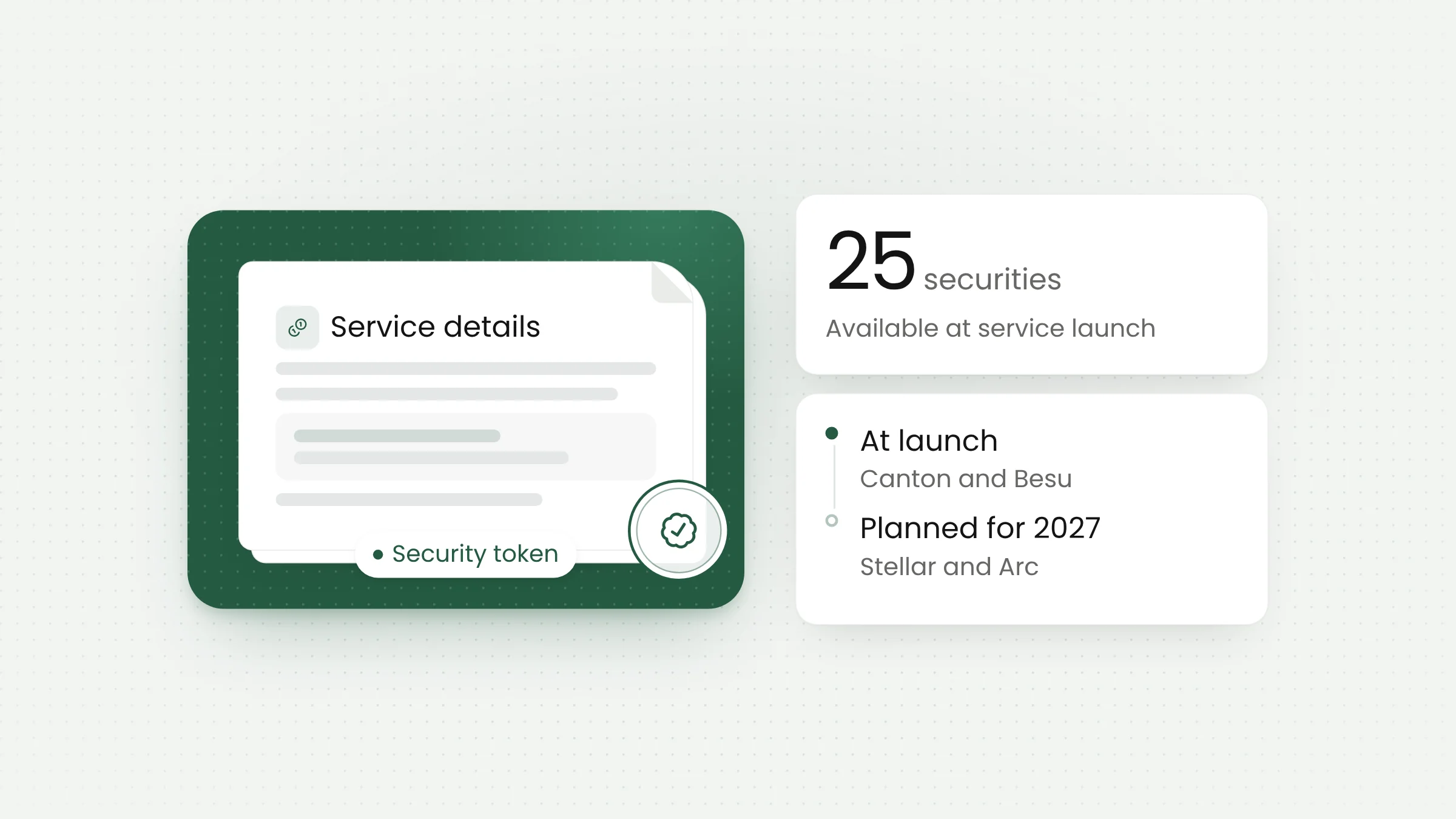
DTCC, the US financial market infrastructure group, published details of its tokenization service on October 16, 2026. The first phase covers 25 securities that can be converted into tokens on the Canton and Besu blockchain networks. DTCC has said the service is scheduled to launch in October 2026.
What DTCC announced
Tokenization means recording ownership of an asset as a digital token on a blockchain. In DTCC’s service, the assets are real securities already held by The Depository Trust Company (DTC), the DTCC subsidiary that acts as the central securities depository. DTC holds assets valued at more than $114 trillion from more than 150 countries and territories. Each token is backed one to one by a security that DTC holds.
DTCC’s overview document puts the pool of assets eligible for tokenization at roughly $30 trillion. That figure is a ceiling on eligibility, and the first phase is far smaller: 25 securities. The eligible asset classes are constituents of the Russell 1000 index, exchange-traded funds (ETFs), and US Treasury bills, notes and bonds. DTCC says the service starts with a select set of names and expands over time.
The legal basis is a no-action letter from the US Securities and Exchange Commission (SEC) issued in December 2025. It allows DTC to offer the service for three years to DTC participants and their clients. DTCC states that the service’s scope, priorities and timing are subject to that letter and may change.
Earlier, on May 4, 2026, DTCC said its industry working group had more than 50 member firms, and it set a schedule of limited production trades in July followed by a launch in October. The first step has been completed. On July 15, 2026, more than 30 firms processed live trades with tokenized DTC assets, including collateral pledges, securities lending, Treasury repo and equity delivery versus payment. DTCC named participants such as BlackRock, Citadel Securities, Goldman Sachs, J.P. Morgan, Nasdaq and Vanguard. Brian Steele, president of DTCC’s Clearing and Securities Services, said the trials showed that tokenization can let collateral move in real time between parties. Nadine Chakar, DTCC’s global head of digital assets, said in the same release: “the safest, most direct path to decentralization runs through trusted financial market infrastructures”.
How a security becomes a token
A DTC participant submits a conversion order through a web interface or an API. Orders are accepted from 2 a.m. to 6 p.m. Eastern Time on business days, with a target of 15 minutes or less. Once the token is issued, its holder can move it at any hour between registered digital wallets, as long as both sit on the same network.
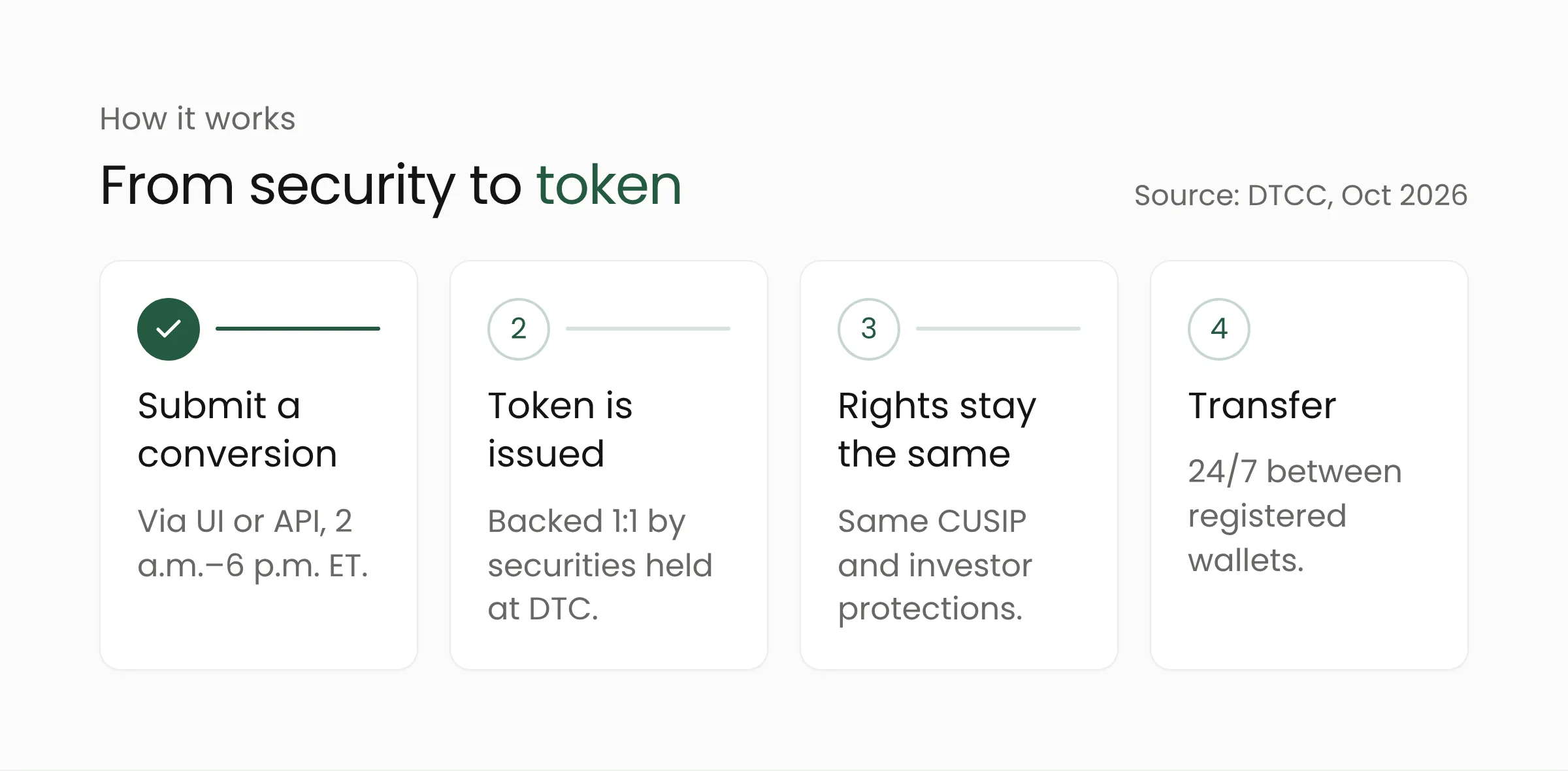
The token carries the same CUSIP number as the underlying security. A CUSIP is the identifier that links an asset to reference data and settlement systems. DTCC states that holders keep the same rights and investor protections as with book-entry securities, and DTC remains the keeper of the official books and records.
Two technical details are worth noting. Tokens are designed to be compliance-ready, with transfer restrictions that can be applied. Wallet registration runs through the service interface and, at the start, covers a selection of third-party wallets. For Treasuries, distributions and maturity payments are made in fiat currency to participants’ traditional accounts.
Networks, limits and the roadmap
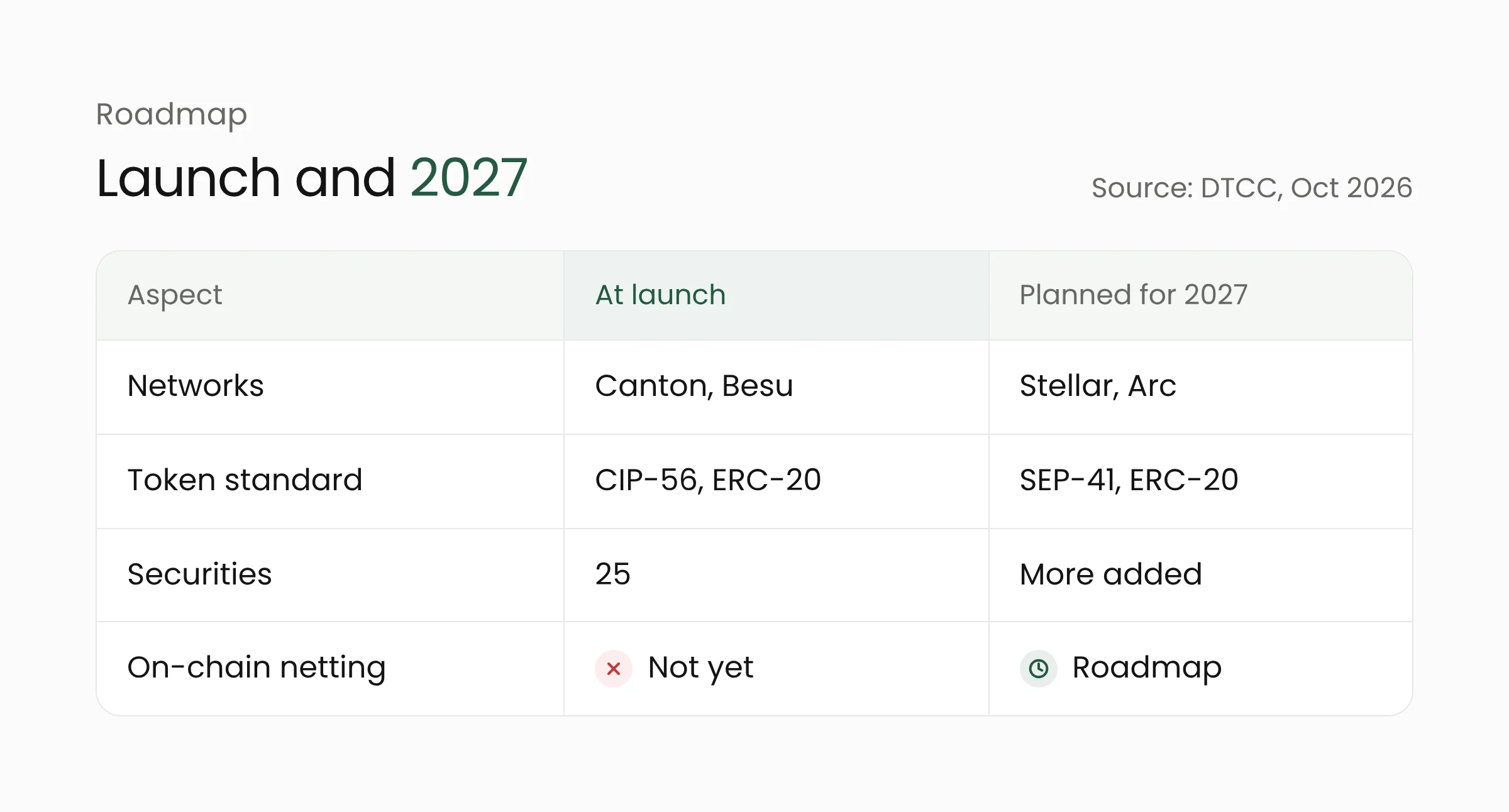
At launch the service runs on two networks. Canton is a public network developed by Digital Asset, using the CIP-56 token standard. Besu is DTCC’s private network built on Hyperledger Besu, using ERC-20. According to DTCC, Stellar with the SEP-41 standard and Circle’s Arc with ERC-20 are anticipated in 2027.
The difference between a public and a private network matters to market participants. On a public network such as Canton, many parties can connect to the same network. On a private network such as DTCC’s Besu, DTCC manages access itself. By offering both, DTCC gives participants a choice that fits their own risk policies.
The first phase has clear limits. Transfers happen within a single network, so movement across networks is outside the initial scope, according to Genfinity’s summary of DTCC’s document. The roadmap for 2027 and beyond adds more networks and securities, extra controls such as single sign-on and maker-checker approval, broader corporate action servicing for equities and ETFs, a consolidated stock record covering book-entry and on-chain positions, and settlement and collateral on-chain, including netting and digital cash. DTCC calls the roadmap indicative and says priorities will be set through 2027 with input from participants.
What this means for financial institutions
DTCC’s service sits in the US market, but its design is relevant to banks, brokerages, asset managers and fintech operators in Indonesia that are weighing digital assets. Three practical considerations stand out.
First, look at how roles are divided. DTCC is not replacing its existing systems. The official record stays with the depository, while the blockchain becomes an additional channel for transfers and, later, settlement. An organization considering a similar project should first map which system remains the source of truth.
Second, plan controls before technology. The choice of public or private network, wallet registration, transfer restrictions and a split of authority between the people who create and approve transactions determine whether a system can be audited. Wallet registration and transfer restrictions are available at DTCC’s launch, while controls such as maker-checker are on the roadmap. That sequence shows controls are built in layers and need scheduling from the start of a project.
Third, test interoperability. DTCC picked two networks with different token standards and plans two more. Institutions that connect applications to blockchains need an integration layer that is not locked to one network, because standards and rules can change.
All three can be acted on before any product exists: inventory the processes that depend on ownership records, decide who may approve transactions, and define the data auditors will need. Building applications like this overlaps with blockchain development and with financial services needs that call for a tidy audit trail. For domestic fintech rules, see also OJK’s planned four tiers for P2P lenders.
Frequently asked questions
Is DTCC tokenization the same as crypto?
No. The tokens in this service represent real securities held at DTC, carry the same CUSIP and give the same rights as ordinary securities. Each token is backed one to one by a security at DTC. Tokens can also move only between registered wallets.
Can retail investors buy these tokens?
DTCC has not said so. The service is offered to DTC participants and their clients, and DTCC says eligible participants will be onboarded gradually. Which parties may offer it to end customers is not explained in the documents released.
Is the service already running?
A production trial with more than 30 firms took place on July 15, 2026. DTCC’s press releases schedule the launch for October 2026. The October 16 document says 25 securities and two networks are available “at launch”, without a specific date.
Closing
DTCC’s tokenization service shows how an infrastructure institution brings blockchain in step by step, with the same securities, the same rights and a new transfer channel. For financial institutions in Indonesia, the main lesson is to design governance and controls from the outset. If your organization is weighing blockchain, the Merakit team can help map the needs and the constraints.
Sources
- DTCC, Tokenization Service At-a-Glance, October 16, 2026
- DTCC, DTC-Tokenized Assets Power Successful U.S. Trades, July 15, 2026
- DTCC, Advancing DTC Tokenization Service Adoption, May 4, 2026
- Genfinity, DTCC Tokenization Service Opens $30 Trillion in Assets, Launching 25 Securities on Canton and Besu, October 16, 2026