Blog Blockchain
Lisk Chain Shuts Down: Lessons for Blockchain App Builders
On this page· 7 sections
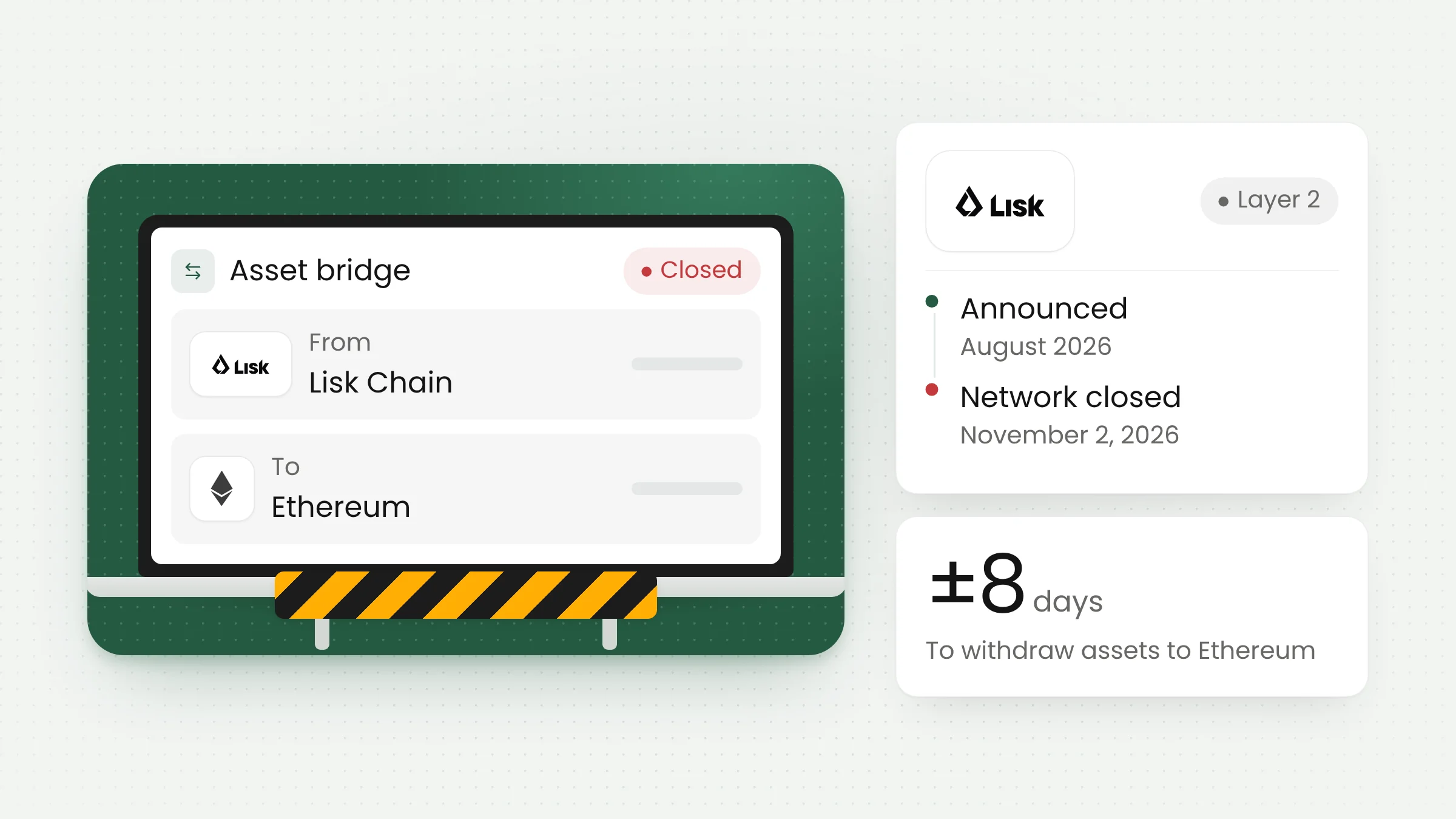
Lisk Chain, the Ethereum layer 2 network operated by the company Lisk, shut down on November 2, 2026. The portal and bridge used to move assets off the network are already offline, and Lisk says it cannot guarantee that assets still sitting on the chain will be recovered.
The closure stands out because Lisk is one of the older blockchain projects, with roughly ten years of history. For organizations weighing blockchain-based applications, it shows that a network itself can stop operating, and that an exit plan belongs in the design from day one.
What happened to Lisk Chain
Lisk has been around since 2016. It began as its own layer 1 blockchain and later moved onto Ethereum as a layer 2. According to L2BEAT, which tracks layer 2 networks, Lisk Chain is an OP Stack rollup that migrated from the layer 1 blockchain of the same name.
A layer 2 processes transactions off Ethereum to make them faster and cheaper, then posts a summary back to Ethereum. Final security still rests on Ethereum, while day-to-day operations depend on whoever runs the layer 2.
The plan to close the network was announced in August 2026 in a post by Lisk founder Max Kordek titled Introducing the New Lisk. Lisk’s official FAQ originally gave October 31, 2026 as the shutdown date. In its closure announcement, Lisk says the chain stopped on November 2, 2026, starting with the user-facing services, the Lisk Portal and Lisk Bridge. The remaining network components were switched off afterward.
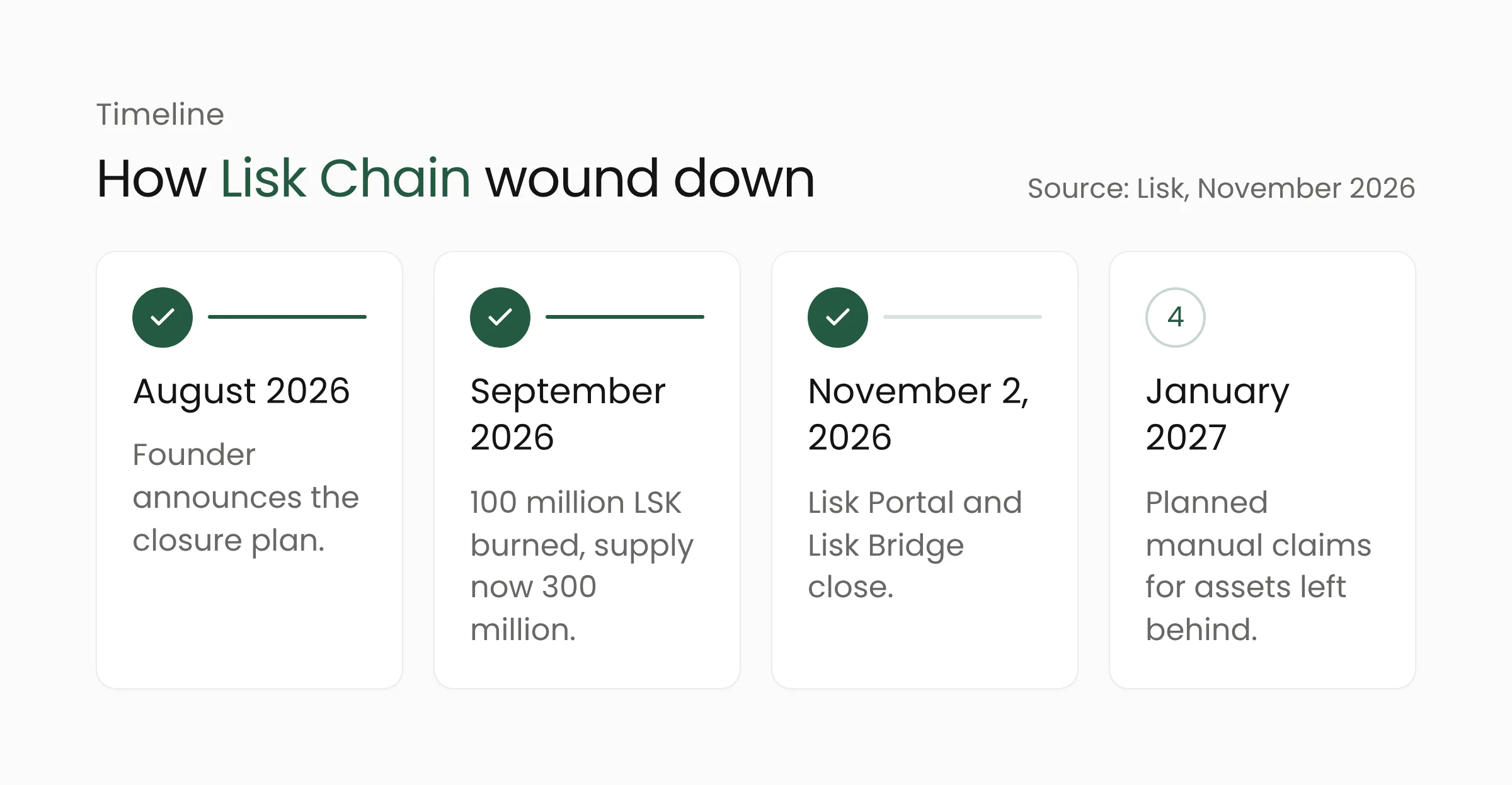
For anyone who waited too long, the message is blunt. “We cannot guarantee the recovery of any assets left on the Lisk Chain,” the company wrote. Lisk plans to introduce a manual claims process in January 2027 and will share details then.
What happens to the LSK token
LSK continues as Lisk’s loyalty token, now on Ethereum. Under an approved proposal from the DAO (the token-holder voting body that governed the network), 100 million LSK was burned in September, cutting total supply from 400 million to 300 million, with no inflation. After the chain is fully off, about 5.2 million LSK left in the staking rewards contract will also be burned. LSK that users staked is not burned.
Holders with LSK on Ethereum or on an exchange do not need to act. The people affected are those who still held LSK, ETH, stablecoins, or DeFi positions on Lisk Chain when the bridge closed.
Why Lisk closed its network
Lisk is not going out of business. The company is putting all of its effort into a finance platform for businesses, and it describes the chain closure as part of that decision.
In his post, Kordek describes problems he says Lisk and companies around it kept running into: bank accounts opened and then closed, transfers to partners blocked without explanation, and fiat and stablecoin balances spread across separate places. The new Lisk combines accounts, payments, and approvals in one workspace. Lisk says payments cover bank transfers (ACH, wire, and SEPA) and stablecoins to more than 100 countries. The service is in Early Access for qualifying businesses.
There was also an economic reason. Blockwisely, citing the DAO proposal, reports that Lisk Chain struggled to generate enough revenue to create meaningful value for the LSK token, while ecosystem incentives paid in LSK added to selling pressure. Crypto Briefing notes that the same proposal wound down the Lisk DAO and made staking withdrawable without penalty after a three-day wait.
A funding channel for emerging markets closes
The shutdown also ends one source of funding for Web3 startups in emerging markets. Blockwisely reports that the Lisk DAO Fund launched in October 2025 with a budget of 4 million LSK to invest in startups across Africa, Latin America, and Southeast Asia. It engaged with more than 40 founders and made three investments before closing ahead of its planned two-year run.
For projects built on Lisk Chain, Lisk arranged an optional migration path to Celo, another Ethereum-based network. The FAQ stresses that each project is free to redeploy wherever it chooses and that projects should not assume any funding or incentives from that path.
Leaving the network takes about eight days
For technical teams, the most useful detail is how long it takes to get out. On optimistic rollups such as those built with the OP Stack, withdrawals to Ethereum pass through a challenge period, a window during which a transaction can be disputed if it looks invalid.
The Lisk FAQ spells out the steps. A user starts a withdrawal on the Lisk Bridge and, about an hour later, submits a “prove” transaction on Ethereum. The seven-day challenge period only begins at that point. After it ends, the user submits a claim transaction. The whole process takes around eight days, and the user needs a small amount of ETH on Ethereum to pay fees.
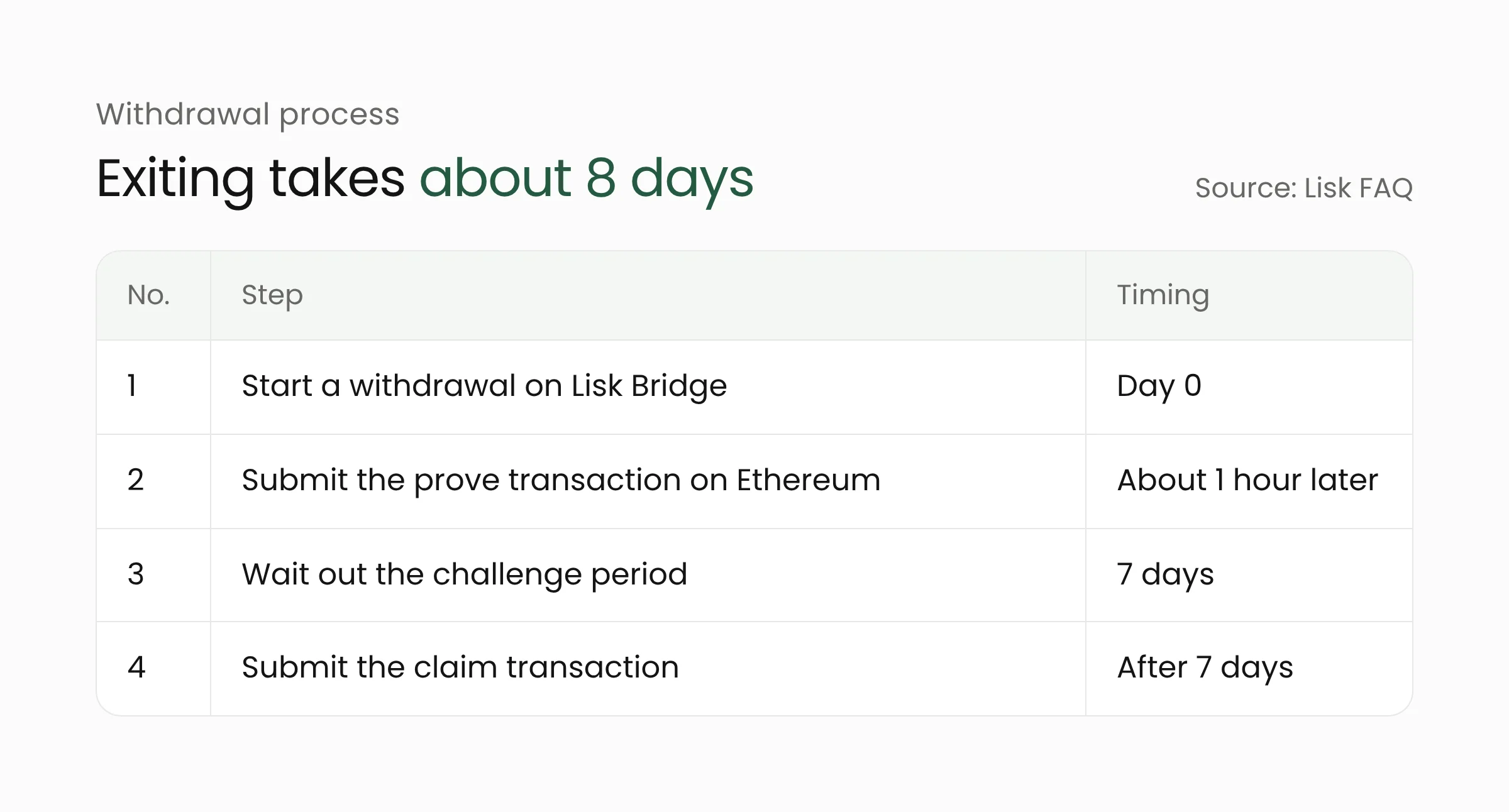
Stakers needed even longer. They first had to release their staked position, wait three days before unstaking, and only then bridge. Lisk advised allowing at least 11 days in total. Anyone who started in the final week was effectively out of time.
What this means for organizations building on blockchains
In Indonesia, blockchain is being used or piloted for tasks ranging from digital asset records at fintech firms to retail loyalty programs and supply chain tracking. The Lisk case does not make every blockchain project risky. It is a reminder that choosing a network means choosing a service provider, including the risk that the provider walks away.
Practical steps for organizations:
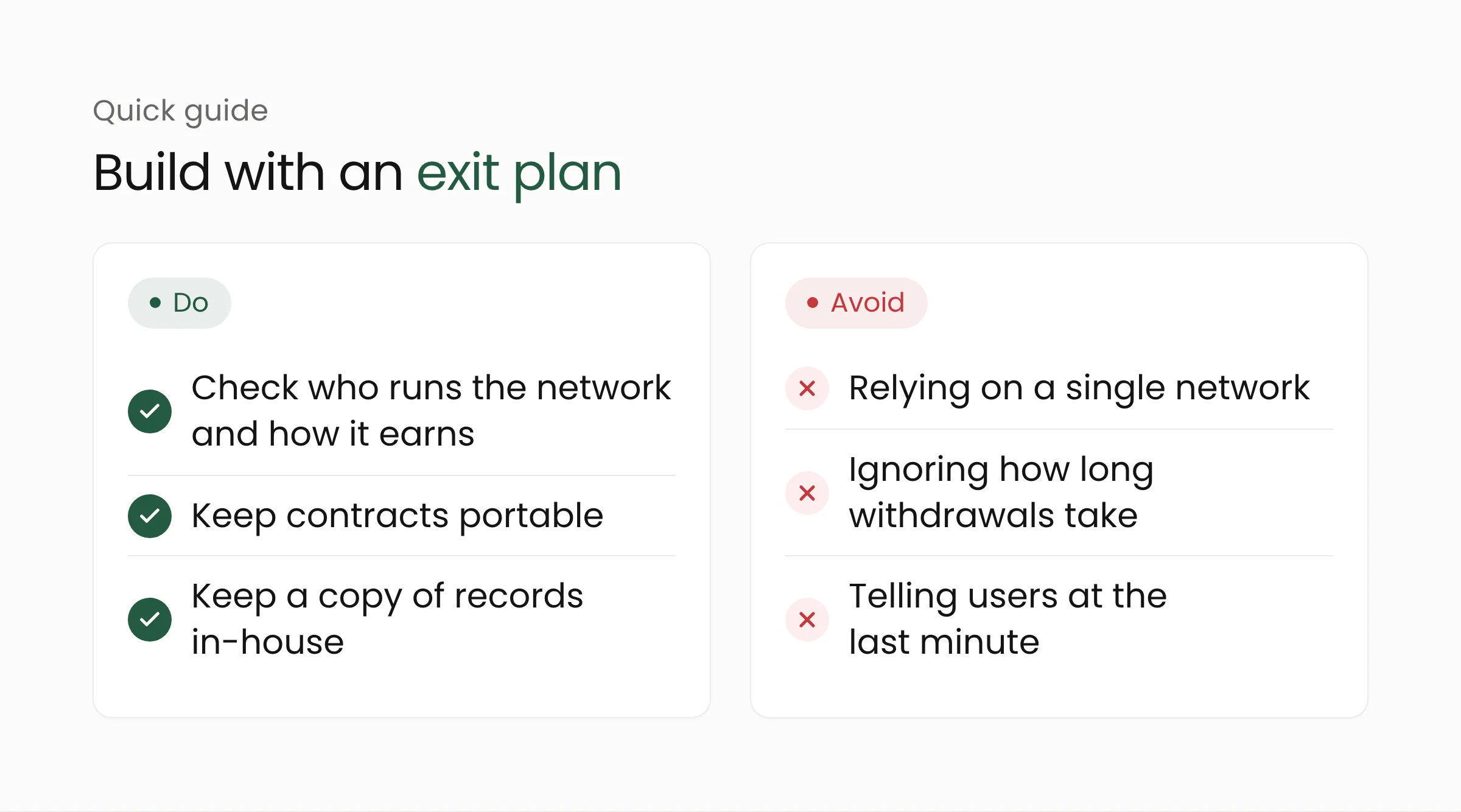
- Assess a network’s staying power before you commit. Look at who runs it, where its revenue comes from, and how much it depends on token incentives. Trackers such as L2BEAT help gauge the technical maturity of a layer 2.
- Design an exit plan from the start. Make sure smart contracts and application data can move to another network. Compatibility with the Ethereum Virtual Machine (EVM) makes migration easier, as the Lisk path to Celo shows.
- Build exit time into business continuity plans. If a withdrawal takes eight days or more, the notice you give users must be much longer than that.
- Keep critical records outside a single network. Transaction data needed for audits or compliance should also live in the organization’s own systems.
- Tell users early. Non-technical users need clear step-by-step guidance with firm deadlines.
These questions matter for teams designing blockchain development services and for financial institutions starting to use stablecoins or tokenized assets. In finance, an exit plan also protects customer funds, so it belongs in the risk assessment from the outset, in line with what reliable financial services solutions require.
State-run blockchain networks raise similar questions, even with a different kind of operator. We looked at that in our piece on China’s national blockchain network.
Frequently asked questions
Is Lisk the company shutting down too?
No. Only Lisk Chain, the Ethereum layer 2 network Lisk operated, has closed. The company continues as a finance platform for businesses, and LSK remains a token on Ethereum.
What happens to assets still on Lisk Chain?
The Lisk Portal and Lisk Bridge are closed, and Lisk does not guarantee that assets left behind can be recovered. It plans a manual claims process in January 2027. Owners should follow Lisk’s official channels and be wary of recovery offers from unofficial parties.
Can other layer 2 networks shut down as well?
Yes. A layer 2 is run by a specific team or company, so a business decision can end it. Users and developers should know how to withdraw assets to Ethereum and how long that takes on the networks they rely on.
Closing thoughts
The Lisk Chain closure came with more than two months of notice, detailed withdrawal guides, and a migration route for projects. Even so, assets that were not moved in time are no longer guaranteed to come back. For organizations, the practical lesson is to treat a blockchain network like any other third-party service: check that it can last, plan the exit, and test that plan before you need it.
If your organization is considering a blockchain-based application, the Merakit team can help map the risks from the design stage.
Sources
- The Lisk Chain has closed. The new Lisk is just getting started. (Lisk, November 2026)
- Introducing the New Lisk (Max Kordek, Lisk, August 2026, updated November 2026)
- Lisk Chain closure FAQ (Lisk Support)
- Lisk (L2BEAT, accessed November 3, 2026)
- Lisk to Shut Down Blockchain and DAO (Blockwisely, August 26, 2026)
- Lisk Chain to shut down on October 31 as project pivots to business finance (Crypto Briefing, August 27, 2026)