Blog Digital Health
OpenSAFELY Comes to SATUSEHAT, Indonesia's Health Data Hub
On this page· 7 sections
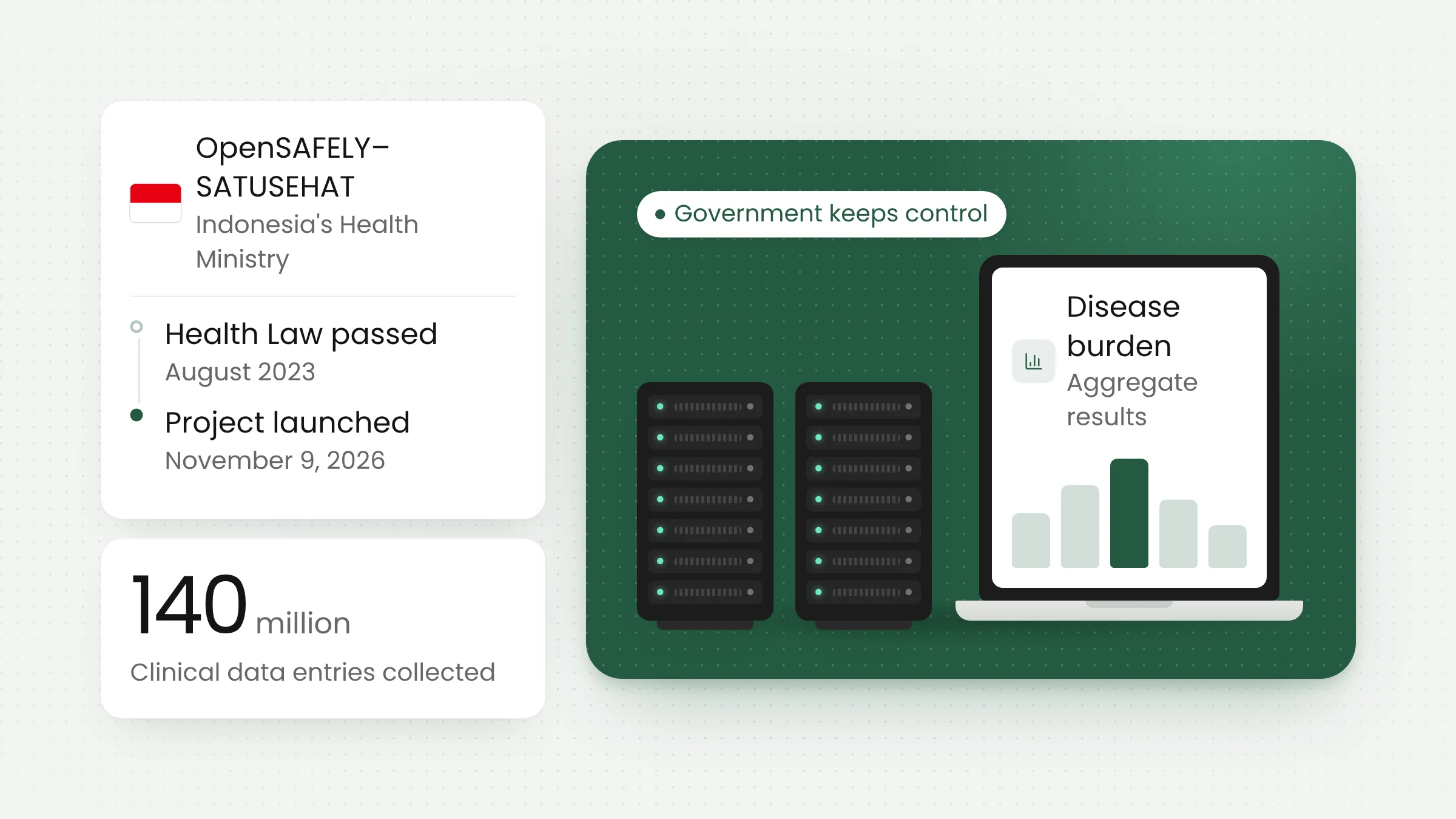
Indonesia’s Ministry of Health launched the OpenSAFELY SATUSEHAT project on November 9, 2026. It is meant to give researchers a way to analyze national health data for disease burden estimates while the data stays under government control. Technical details of the Indonesian deployment have yet to be published.
The project launched on November 9
Its full name is the Implementation Project of the OpenSAFELY–SATUSEHAT Ecosystem for Disease Burden Analytics and Policy. According to a release from the ministry’s Health Development Policy Agency (BKPK), the launch took place in Jakarta on Monday, November 9, 2026, at a working dinner with the Global Burden of Disease Independent Advisory Committee (GBD IAC) and the Institute for Health Metrics and Evaluation (IHME).
Health Minister Budi Gunadi Sadikin launched it with BKPK head Prof. Asnawi Abdullah, GBD IAC chair Prof. Peter Piot, and representatives of IHME, the Gates Foundation, and the National University of Singapore (NUS). Disease burden, the project’s target, measures how much a disease, injury, or risk factor reduces a population’s health, and governments use it to set program and budget priorities.
BKPK describes the goal in two parts. National health data in SATUSEHAT will be used for disease burden analysis and evidence-based policy. Throughout, the data remains under government control, and researchers access and analyze it through a mechanism the agency calls secure and open.
On the same day, the ministry and NUS signed a memorandum of understanding on evidence-based health policy. A second BKPK release lists two workstreams. Project A is the OpenSAFELY–SATUSEHAT ecosystem itself. Project B covers disease burden estimation, modeling, and cost projection, along with capacity building in health metrics and data science.
In his remarks, Piot addressed data sovereignty. As reported by BKPK, he said data sovereignty should not be read as isolationism and described it as a principle of sharing data together with ownership of that data.
How OpenSAFELY works
OpenSAFELY is open source software for analyzing electronic health records inside a trusted research environment. According to its official site, the platform is led by the Bennett Institute for Applied Data Science at the University of Oxford, working with the London School of Hygiene and Tropical Medicine. In England it is deployed in the data centres of the two largest electronic health record providers in the National Health Service, and NHS England is the data controller.
In this design, analysis code is sent to where the data sits, and the data is never copied to a researcher’s computer. Researchers write their code against dummy data that has the same structure as the real records. Finished code is packaged in a Docker container and run against the real data inside the secure environment. The site states that researchers never need to see real patient data.
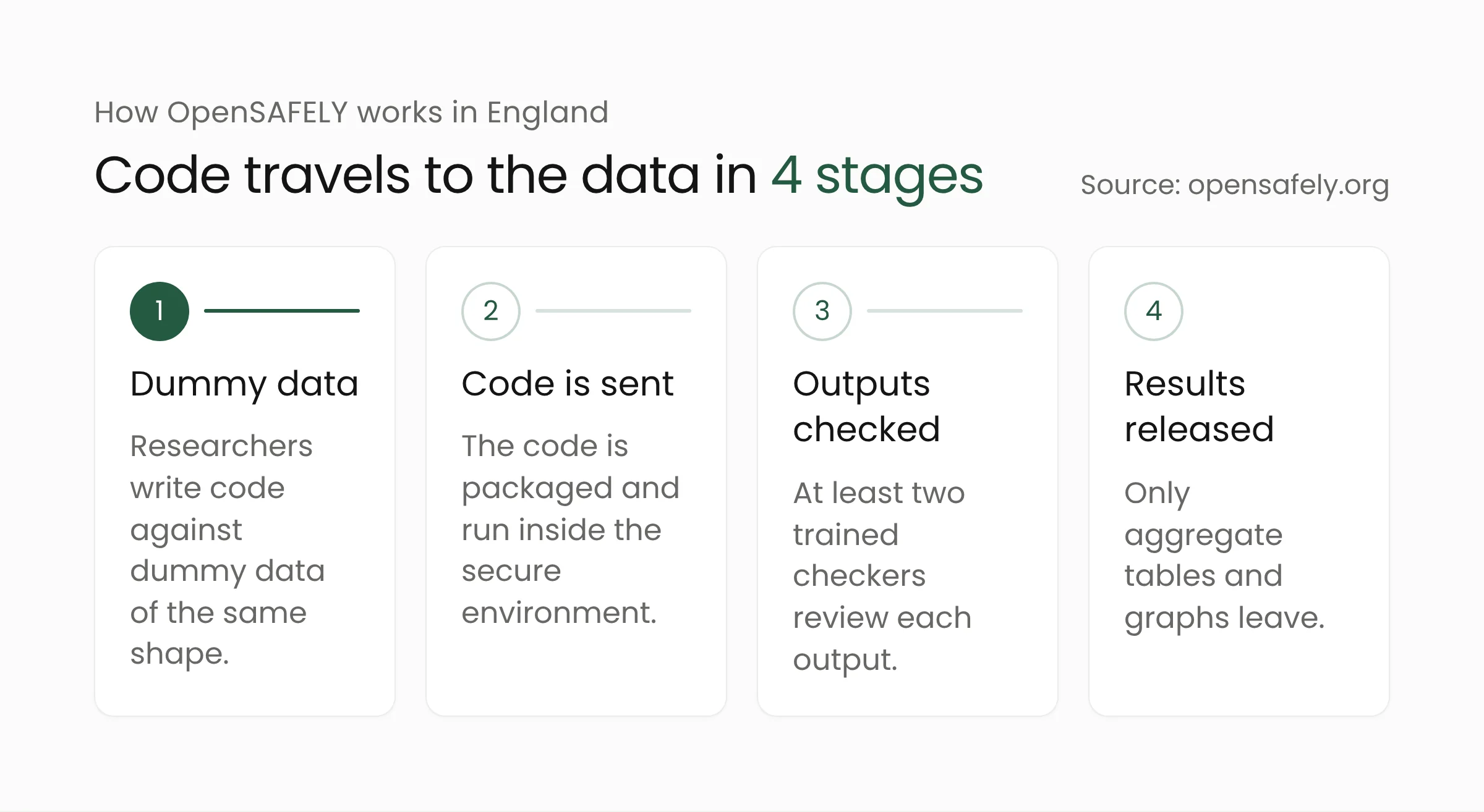
What comes out is restricted too. Researchers see outputs such as tables and graphs, and every release request is checked manually by at least two trained people. Most requests are checked in under seven days. All activity on the platform is recorded in a public log, including the code that was run.
OpenSAFELY does not rely on pseudonymisation alone, the practice of replacing patient identities with codes. Its site says that step is insufficient as a safeguard by itself. The documentation divides data into four levels. Raw and patient-level data can be reached only by data processor staff and a small number of platform developers. Researchers get access at level four, which holds aggregate outputs that still have to pass checking before release.
The platform became known through a study in Nature in July 2020 on factors associated with COVID-19-related death.
Three population databases and reporting duties
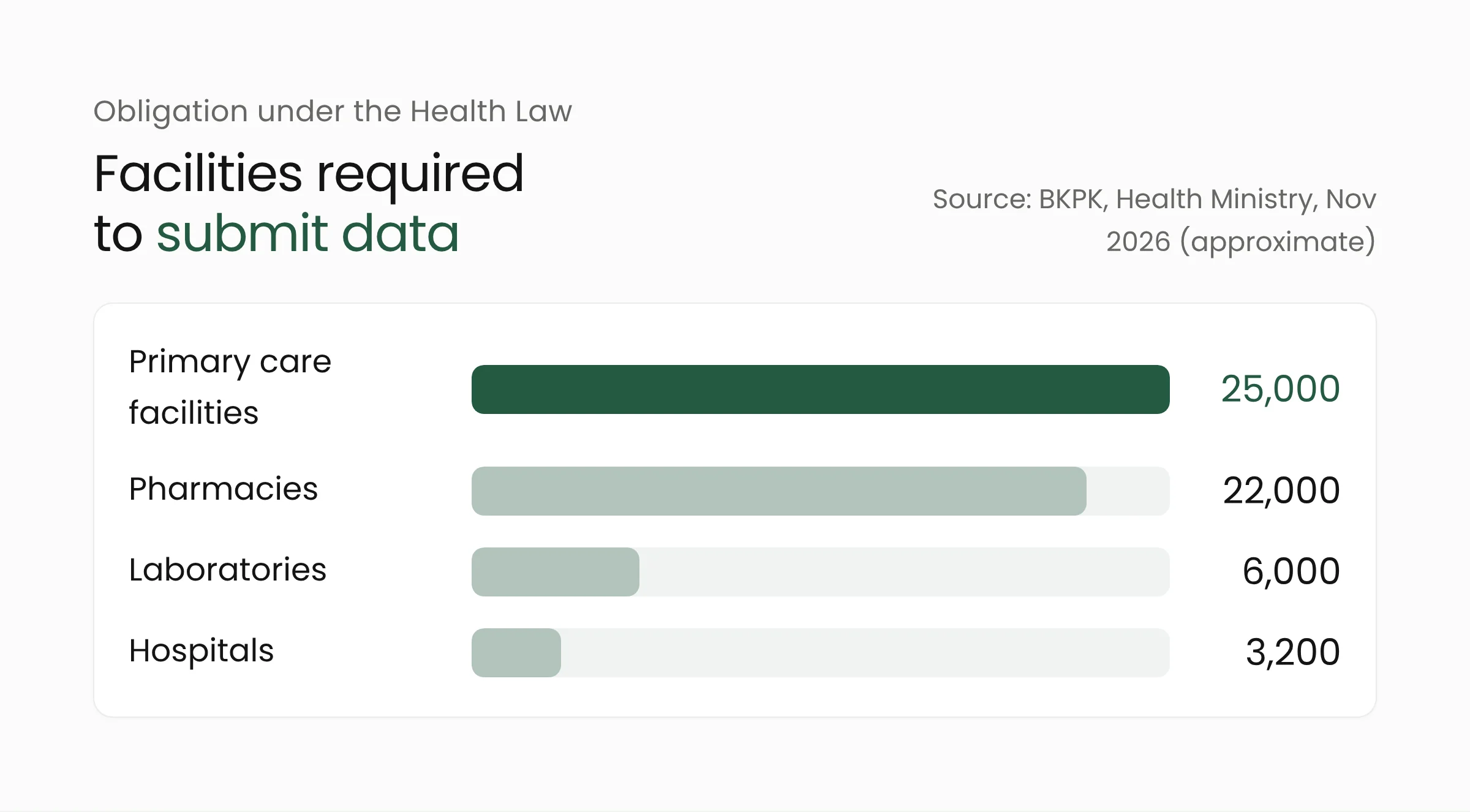
Budi explained where the data comes from. Per BKPK, the Undang-Undang Kesehatan (Health Law) passed in August 2023 requires every health service facility to submit service data to national databases under an opt-out mechanism. The obligation covers about 3,200 hospitals, 25,000 primary care facilities, 6,000 laboratories, and 22,000 pharmacies.
The second population database holds clinical data such as blood pressure, blood glucose, CT scan results, and MRI results. One of its sources is the government’s free health screening program. Budi said clinical data was targeted to reach 130 million this year and has already reached 140 million. A third database, for genomic data, will follow. Indonesia would then have three national population databases: demographic, clinical, and genomic.
He gave two examples of why genomic data matters. Variation in the CYP2C19 gene makes the drug clopidogrel work differently in the Indonesian population than in others. In eastern Indonesia, the HLA-B*13:01 mutation can trigger hypersensitivity syndrome in some people who take dapsone, a leprosy drug.
On ownership, Budi used a bank account analogy. Health data belongs to the public and not to health facilities, he said, in the same way that money held by a bank still belongs to the account holder. He said OpenSAFELY was chosen as one of the mechanisms because data can be analyzed without the government losing control over it. He said he hoped the private sector would help develop the project.
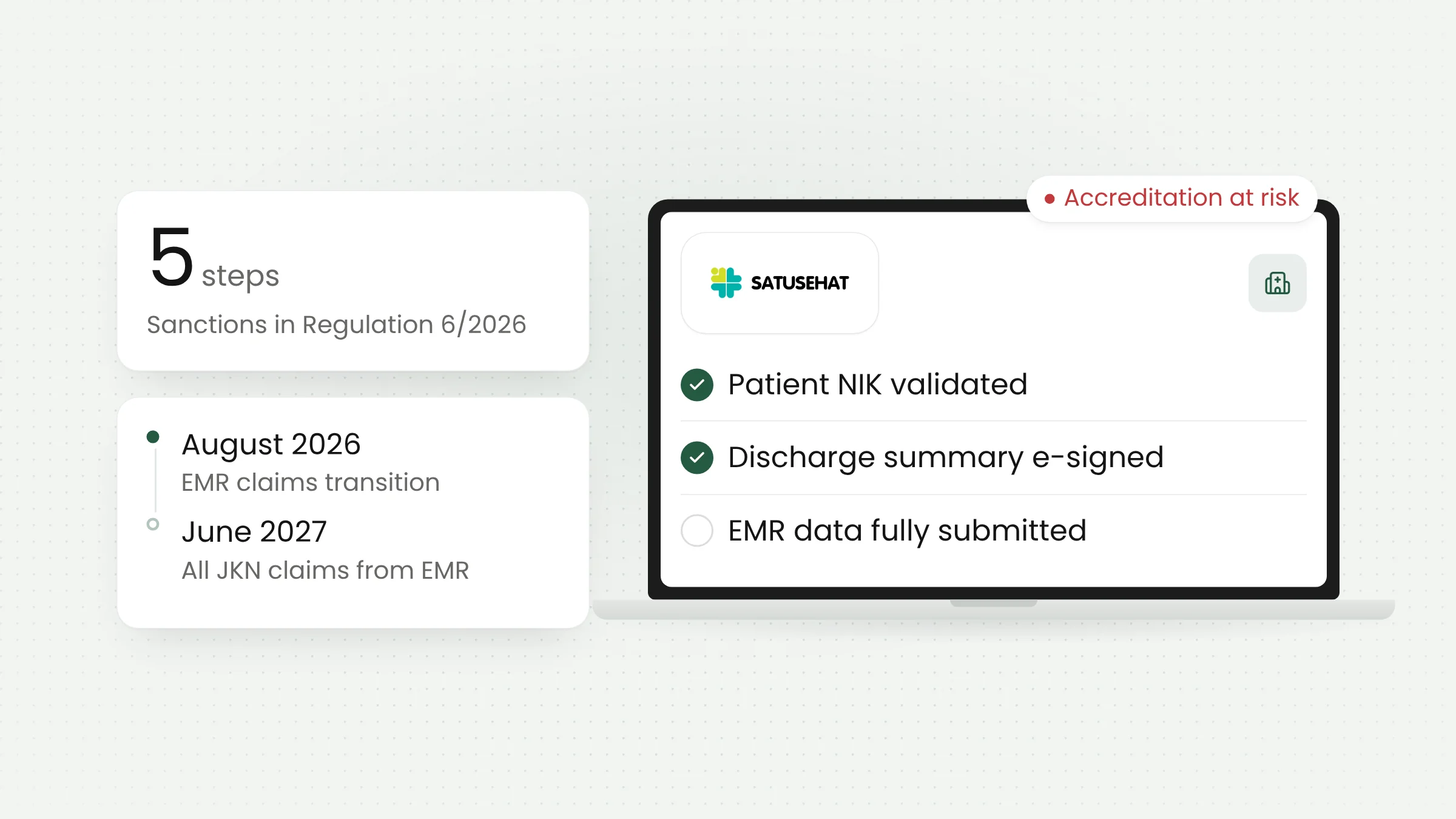
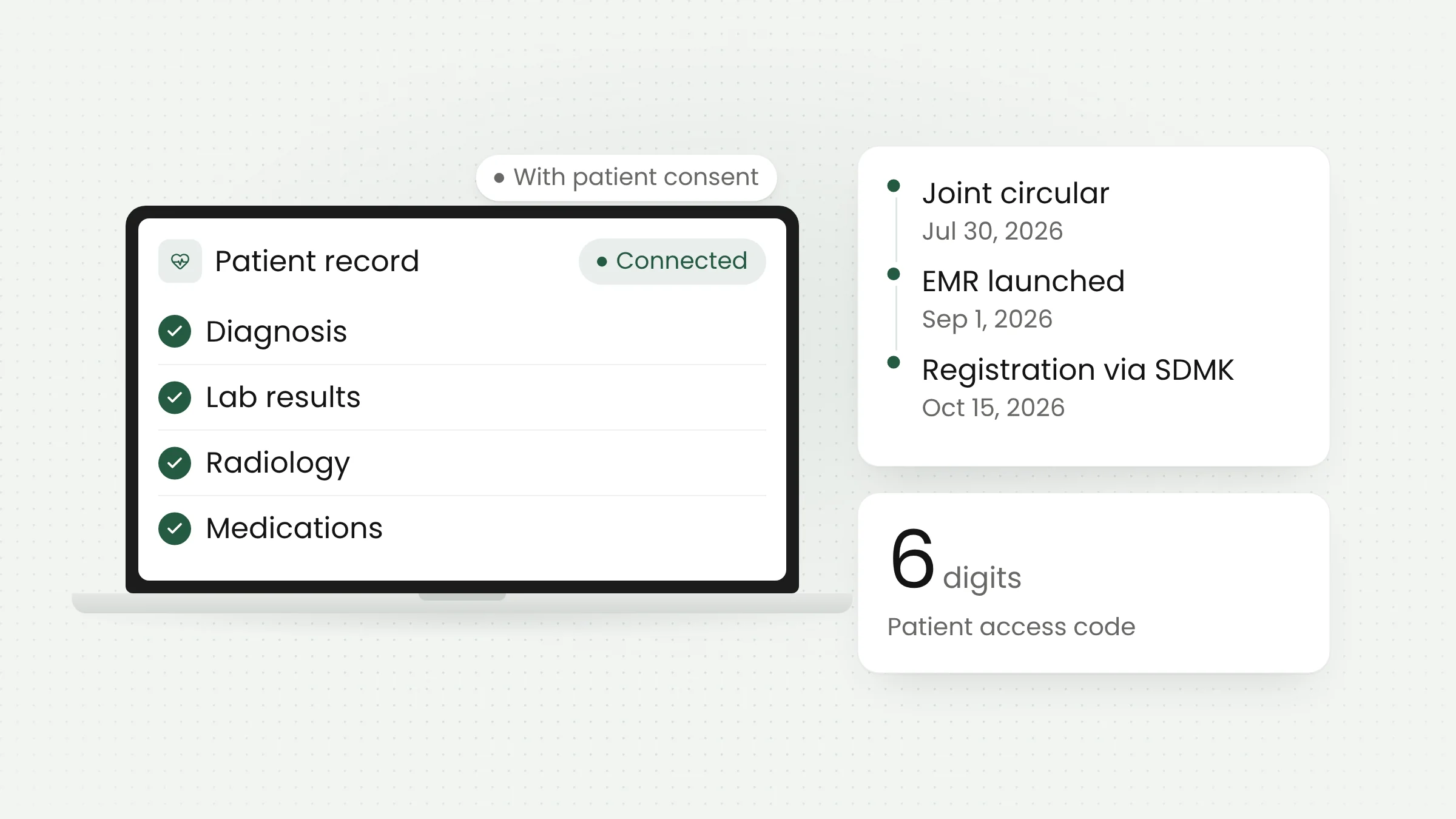
The project builds on integration work already under way. When he launched the SATUSEHAT electronic medical record viewer on September 1, 2026, as reported by detikHealth, Budi asked about 98,000 health facilities to send complete data, from diagnoses and laboratory results to medication and radiology. The electronic medical record mandate already carries penalties, which we covered in our article on SATUSEHAT EMR sanctions.
Open questions
The ministry’s releases leave several technical and governance questions open.
- Whether the safeguards match the English version. There is no statement on whether dummy data, two-person output checking, and public logs apply in the same way in Indonesia.
- Who operates the analysis environment and where. The operator and the data centre have not been named.
- Who may submit an analysis. Requirements and approval steps for university researchers, research institutes, or private companies have not been presented.
- How opt-out works for patients. The release does not say how a person registers an objection or what that means for research use of their data.
- Timing. No date has been given for the first analysis or its publication.
England’s experience comes from fairly uniform primary care data. SATUSEHAT data comes from tens of thousands of facilities running varied systems, so data quality and completeness will shape the quality of any analysis.
What this means for hospitals and data teams
Researchers and policymakers now join the users of the data that facilities submit.
- Treat data completeness as a quality issue. Data sent to SATUSEHAT may now feed disease burden calculations. A miscoded diagnosis or a laboratory result that never arrives shifts the figures for a district or province. Regular audits of coding accuracy and completeness belong on the medical records committee’s agenda.
- Check integration down to the content. The minister’s September request stressed complete data over a connected status. Hospital IT teams can compare visit counts in their internal system with the number of records SATUSEHAT accepted, by data type.
- Apply the same pattern to internal analytics. Hospitals, health offices, and insurers are often asked to open data to researchers or partners. The OpenSAFELY pattern can be copied at small scale: provide dummy data for writing code, run the code on your own server, and assign two reviewers before results leave. Designing data warehouses and workflows of this kind is part of data analytics services.
- Prepare an explanation for patients. Registration and communications staff should understand that service data is sent to national databases and may be used for research in aggregate form. Until written guidance exists, questions about opt-out are best referred to the ministry’s official channels.
Orderly electronic medical records, complete data submission, and use of the data all fall within the healthcare solutions we build with hospitals and clinics.
Frequently asked questions
Can researchers see my medical record?
In OpenSAFELY’s design in England, researchers do not see patient data. They submit code and receive aggregate tables and graphs that have been checked. Indonesia’s ministry says the data stays under government control, but it has not specified whether every safeguard is applied in the same way.
How does this relate to the SATUSEHAT mobile app?
Both draw on the same data for different purposes. The SATUSEHAT app and viewer show a person’s health history to that person and to facilities they authorize. The OpenSAFELY–SATUSEHAT project is intended for population-level analysis, such as estimating disease burden by region.
When will the results be public?
That has not been announced. The BKPK releases mention a publication in The Lancet Global Health on Indonesia’s disease burden based on the Global Burden of Disease Study 2023, but give no schedule for the first analysis run through OpenSAFELY–SATUSEHAT.
Closing
Indonesia’s Health Ministry has chosen a model that brings code to the data as its way of opening national health data to research. The project’s value will show in two things that are not yet available: written access rules and a first analysis published together with its code.
Merakit helps hospitals, clinics, and public agencies organize service data so it is ready to be submitted, analyzed, and audited. If your organization is preparing for that, our data analytics services can be a starting point for the conversation.
Sources
- BKPK, Indonesian Ministry of Health: Menkes Luncurkan Ekosistem Big Data Analitik OpenSAFELY–SATUSEHAT untuk Kebijakan berbasis Bukti (November 10, 2026)
- BKPK, Indonesian Ministry of Health: Kemenkes Perkuat Kebijakan Kesehatan Berbasis Bukti melalui Kerja Sama dengan NUS (November 10, 2026)
- OpenSAFELY: About OpenSAFELY (accessed November 23, 2026)
- OpenSAFELY Documentation: Security levels (accessed November 23, 2026)
- Nature: Factors associated with COVID-19-related death using OpenSAFELY (July 8, 2020)
- detikHealth: Warga +62 Bakal Punya Akun Riwayat Kesehatan Pribadi, Menkes: Mirip M-Banking (September 1, 2026)