Blog Health Sandbox
Indonesia's Health Sandbox: How AI Medical Tools Get Tested
On this page· 7 sections
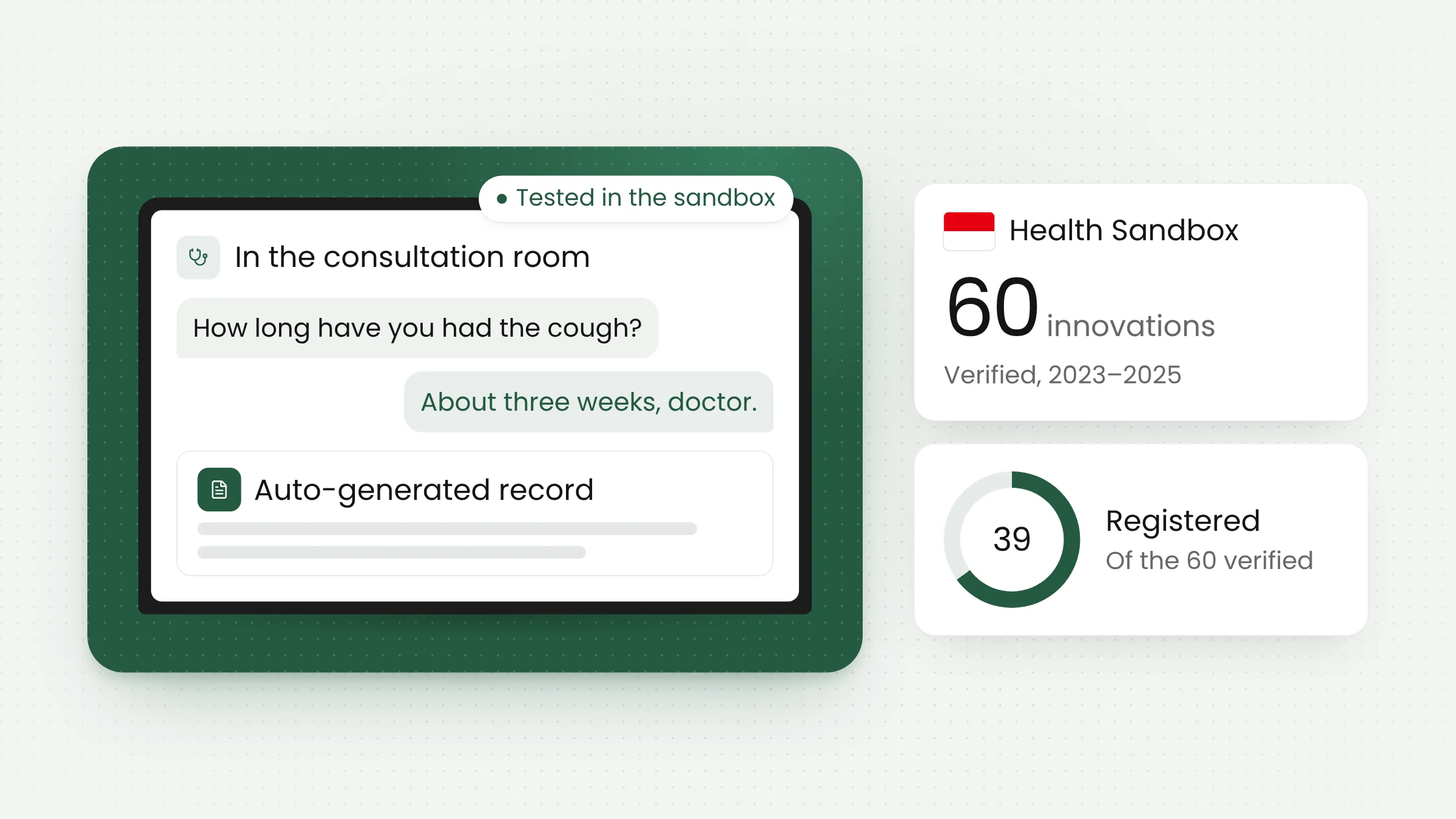
Indonesia’s Ministry of Health is expanding its Health Sandbox (Sandbox Kesehatan), a controlled testing program for health apps and devices before they reach wide use. Between 2023 and 2025, 60 innovations passed verification and 39 received official registration. Artificial intelligence was the most prominent trend, and the next registration round is scheduled to open in late 2026.
What was announced at Health Innovation Showcase 2026
The figures were presented at the Health Innovation Showcase 2026 in Jakarta on Tuesday, October 27, 2026. According to a Ministry of Health press release, eleven selected innovators presented their solutions at the event. They were assessed on three criteria: readiness for implementation, public acceptance, and potential integration with SATUSEHAT, the ministry’s national health data platform.
Deputy Health Minister Dante Saksono Harbuwono opened the event. He urged innovators to keep quality, safety, and patient data protection at the top of their priorities. In his view, digitalization should be judged by the quality of care patients actually receive, and an impressive-looking device does not meet that test on its own.
Deputy Minister of Communication and Digital Affairs Nezar Patria pointed to three areas that need joint work: data governance, startup mentoring, and access to investment. Cynthia Krisanti, director of Pijar Foundation, the program’s implementing partner, said its collaboration with the ministry targets three health challenges: tuberculosis, diabetes, and an aging population.
The context matters. According to ANTARA, SATUSEHAT is now connected to more than 43,000 health facilities, including nearly all hospitals and more than 90% of puskesmas (community health centers). Through SATUSEHAT’s electronic medical records (EMR), a patient’s health history can be accessed across facilities, subject to regulations and patient consent. Any innovation that wants a place in Indonesian healthcare will eventually need to work on top of this data network.
How the Health Sandbox works
A sandbox is a controlled testing environment. Innovators develop and test their solutions with guidance from government officials and experts before releasing them to the public. The ministry, in turn, uses the test results to shape rules that fit new technology, so regulation keeps pace with products already on the market.
The program is open to individuals, groups, government agencies, and private institutions. For the 2025 round, a ministry announcement said the sandbox accepted innovations at three levels of maturity: ideas, prototypes, and solutions ready for deployment. Registration for that round ran from November 5 to 30, 2025, through sandbox.kemkes.go.id. Successful participants receive a Health Technology Innovation registration mark and, where they qualify, a “Recommended” status from the ministry.
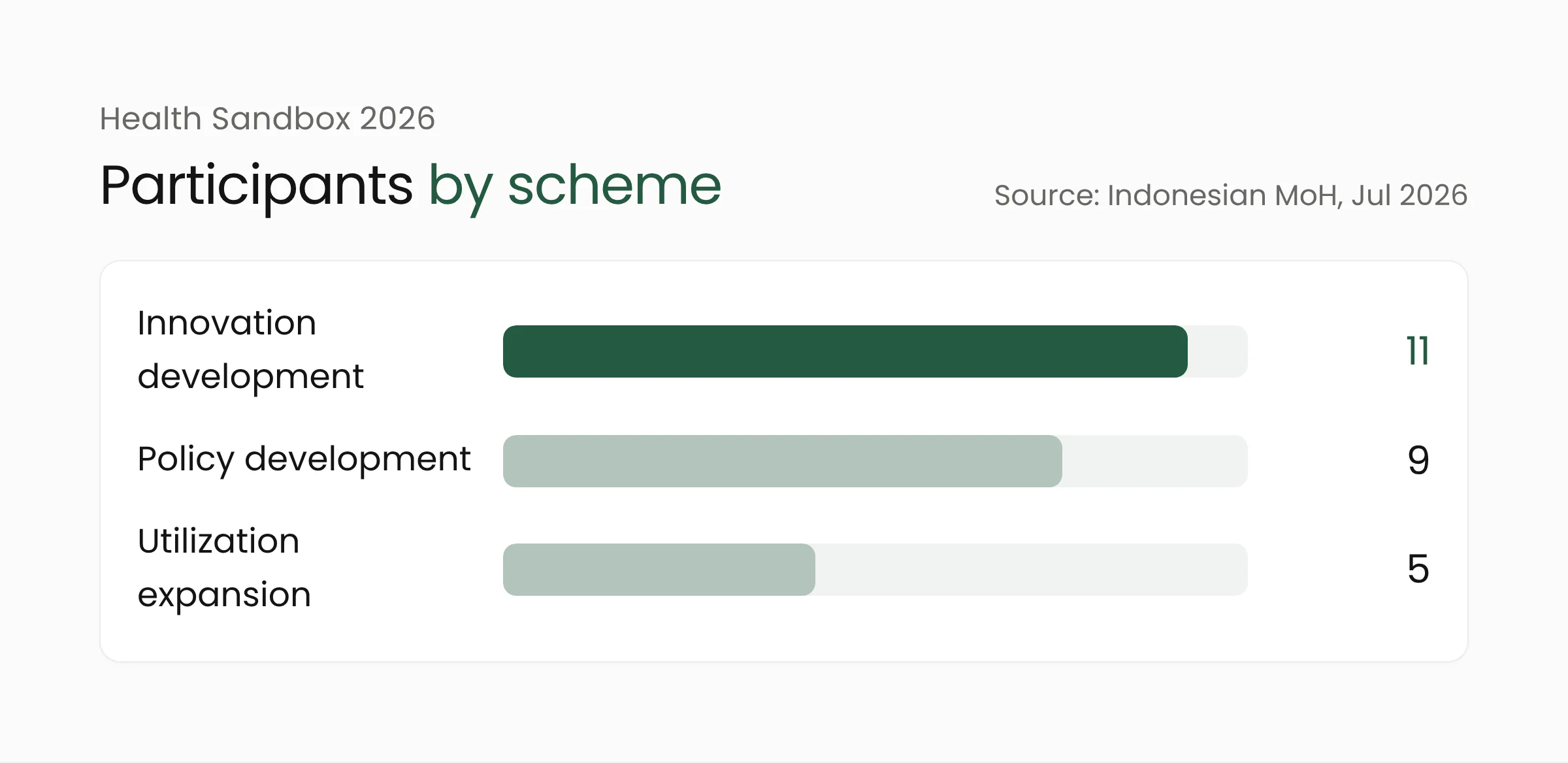
The 2026 cycle is divided into several schemes. A July 2026 report from the ministry’s Secretariat General said 11 teams with prototype-stage products took part in the final evaluation of the innovation development scheme. The innovation-based policy development scheme had 9 participants, and the innovation utilization expansion scheme had 5. The full 2026 cycle was scheduled to conclude in September 2026.
The assessment has several layers. In the innovation development scheme, participants were evaluated by the ministry’s technical unit, which checked fit with field needs, by a panel of technology and AI experts, and by Pijar Foundation on business development. The method combined interviews with quantitative scoring. Innovations that pass receive “Recommended” status and are listed in the directory on the Health Sandbox website.
Not every outcome is positive. In the 2024 regulatory sandbox, 48 digital innovations registered and 15 passed verification, then went through business model reviews, scenario tests, and live testing. Participants were then given statuses such as “Guided” or “Supervised.” Those under supervision had six months to fix service and governance issues, or the status could be revoked.
AI leads the pipeline, within clear limits
Among the innovations on show, AI was the most prominent trend. The ministry cited two examples: technology that supports genetic testing, and a tool that automatically turns clinical conversations into medical record summaries. The July 2026 evaluation report added detail: the genetic test provides AI-based lifestyle recommendations, while the second tool converts doctor-patient conversations from speech into text for the EMR.
Tools of the second kind are often called clinical documentation assistants. They listen to a consultation, transcribe it, and draft a medical note for the doctor to review. For a busy community health center with long queues, time saved on note-taking can go back to patients. These tools also process voice recordings and health data, the most sensitive kinds of personal information. Patient consent, data storage location, and transcription accuracy in Indonesian and regional languages all need testing before wide adoption.
The ministry has drawn a clear line on AI’s role. “Kecerdasan artifisial harus menjadi mitra yang mendukung tenaga kesehatan, bukan menggantikan pertimbangan klinis,” Dante said, meaning AI should be a partner that supports health workers and does not replace clinical judgment. That position matches what research on diagnostic AI has shown elsewhere, including Microsoft’s MAI-DxO study: results in a test setting may differ from results in a real clinic, so the final decision stays with the doctor.
This is where the sandbox earns its place. Innovations are tested on data and workflows close to real conditions, under supervision, before thousands of patients depend on them. The results can also inform future rules, including open questions such as who is responsible when an automated summary is wrong.
What this means for health technology developers
For startups, university research teams, and hospital IT units building health applications, the sandbox is an official route to show that a product is safe and useful. The next registration round is expected to open in late 2026, so preparation can begin now. Here is what to focus on.
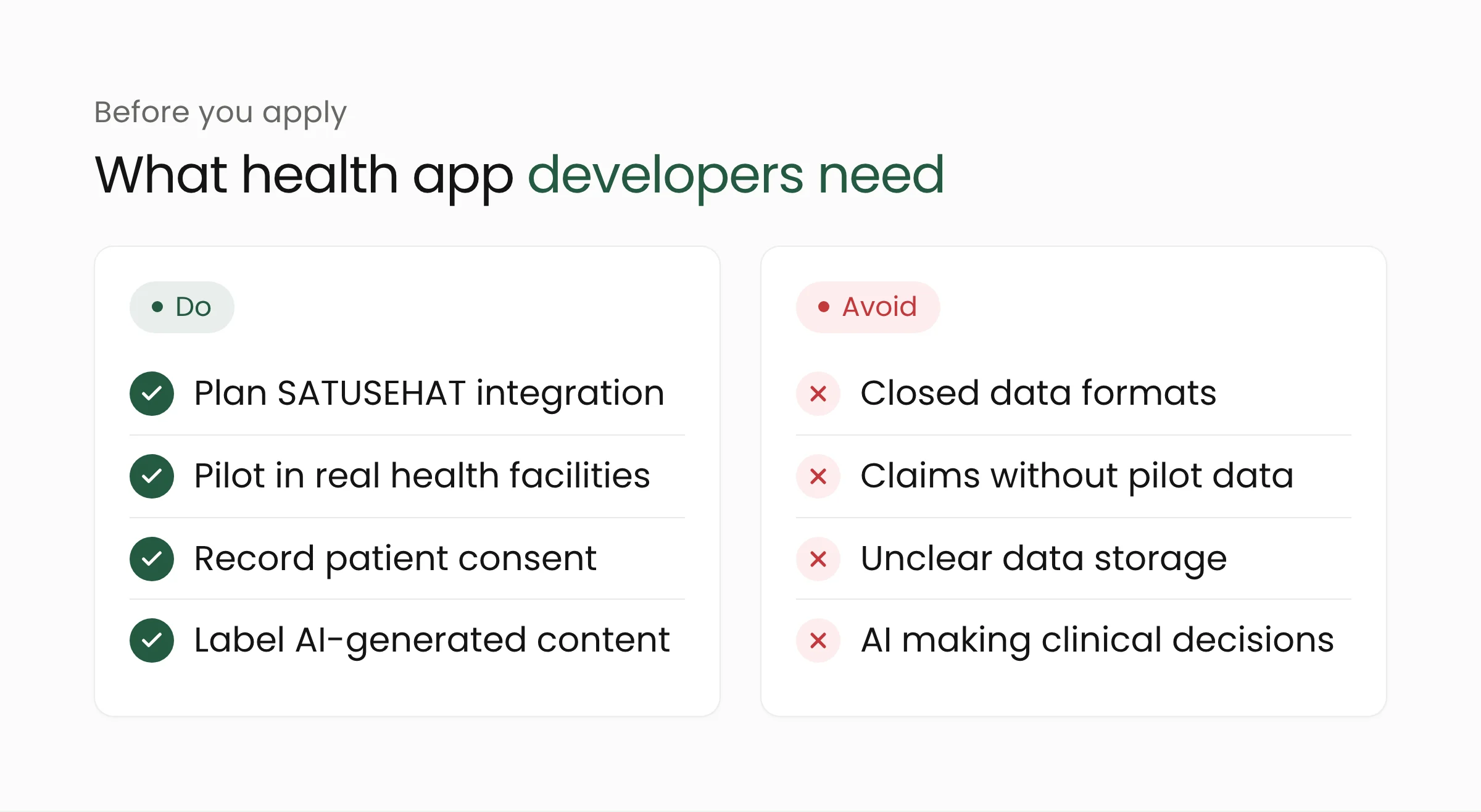
- Design for SATUSEHAT integration from the start. Potential integration with SATUSEHAT is one of the assessment criteria. Make sure the data your application produces can be exchanged using the formats and flows SATUSEHAT uses. Our look at hospital readiness for SATUSEHAT EMR is a useful starting point.
- Gather evidence of real-world need. The ministry’s technical reviewers check how well a solution fits field data and needs. Collect pilot data from real health facilities, including feedback from the health workers who used it.
- Document patient data protection. Explain what data is collected, where it is stored, who can access it, and how patient consent is recorded. For AI features, state the accuracy limits and how doctors review the output.
- Define the AI’s role clearly. Systems that draft, flag risks, or summarize data are easier to accept when health workers keep the final decision. Show clearly which parts were generated by AI.
- Plan for operational readiness. The utilization expansion scheme assesses resilience, scalability, and sustainability. Make sure infrastructure, user support, and the business model can serve more facilities.
For hospitals and clinics buying health software, sandbox results can be one factor in the decision. Ask vendors whether their product has been tested in the Health Sandbox, what status it received, and how it integrates with SATUSEHAT. Teams building their own systems can use the same criteria as an internal checklist. For projects like these, Merakit builds digital healthcare solutions designed around the data flows and regulations of Indonesian healthcare.
Frequently asked questions
What is Indonesia’s Health Sandbox?
The Health Sandbox is a Ministry of Health program that tests health technology innovations in a controlled environment before wide use. It offers testing schemes, mentoring, and recommendations, and it gives the ministry input for drafting regulations.
Who can apply, and when is the next round?
According to the 2025 announcement, applicants can be individuals, groups, government agencies, or private institutions, with innovations at the idea, prototype, or deployment-ready stage. The ministry says the next registration round opens in late 2026, but exact dates have not been announced.
Does passing the sandbox mean a product can be used in every health facility?
The ministry says 39 of the 60 verified innovations have received official Health Technology Innovation registration, and innovations with “Recommended” status are listed in the sandbox directory. That status reflects test results. The decision to adopt a product still rests with each health facility, which must also comply with data protection rules and patient consent requirements.
Preparing for the next round
The Health Sandbox gives health innovations a clear route to be tested, assessed, and formally recognized. As more AI enters the consultation room, that route helps ensure new technology genuinely supports health workers and stays safe for patients. If your team is building an AI-based health application or a SATUSEHAT integration, Merakit’s artificial intelligence services team is ready to talk it through.
Sources
- Kemenkes Dorong Inovasi Teknologi Kesehatan yang Tingkatkan Akses dan Mutu Layanan, Ministry of Health, October 27, 2026
- Kemenkes kuatkan Sandbox Kesehatan, 60 inovasi lolos verifikasi, ANTARA, October 28, 2026
- MoH Indonesia Held Final Evaluation for the Innovation Development Scheme of Sandbox Kesehatan, Ministry of Health Secretariat General, July 29, 2026
- Sandbox Kesehatan 2025 Resmi Dibuka, Ministry of Health, November 12, 2025
- Kemenkes Umumkan Hasil Regulatory Sandbox 2024 untuk Inovasi Digital Kesehatan, Ministry of Health, February 4, 2025