Blog Digital Health
SATUSEHAT EMR Sanctions for Indonesian Hospitals Explained
On this page· 7 sections
Indonesia’s Ministry of Health has warned that hospitals failing to connect their electronic medical records (EMR) to SATUSEHAT could lose accreditation status or have their license suspended. The legal basis for these SATUSEHAT EMR sanctions is Peraturan Menteri Kesehatan Nomor 6 Tahun 2026 tentang Rumah Sakit (Health Ministry Regulation No. 6 of 2026 on Hospitals).
The warning was delivered to regional public hospitals (RSUD) in East Java, but the regulation applies to every hospital in the country. For hospital directors, records managers, and IT teams, three things matter now: the order of the sanctions, the national health insurance (JKN) claims deadline, and the data used to judge compliance.
The ministry’s warning in Surabaya
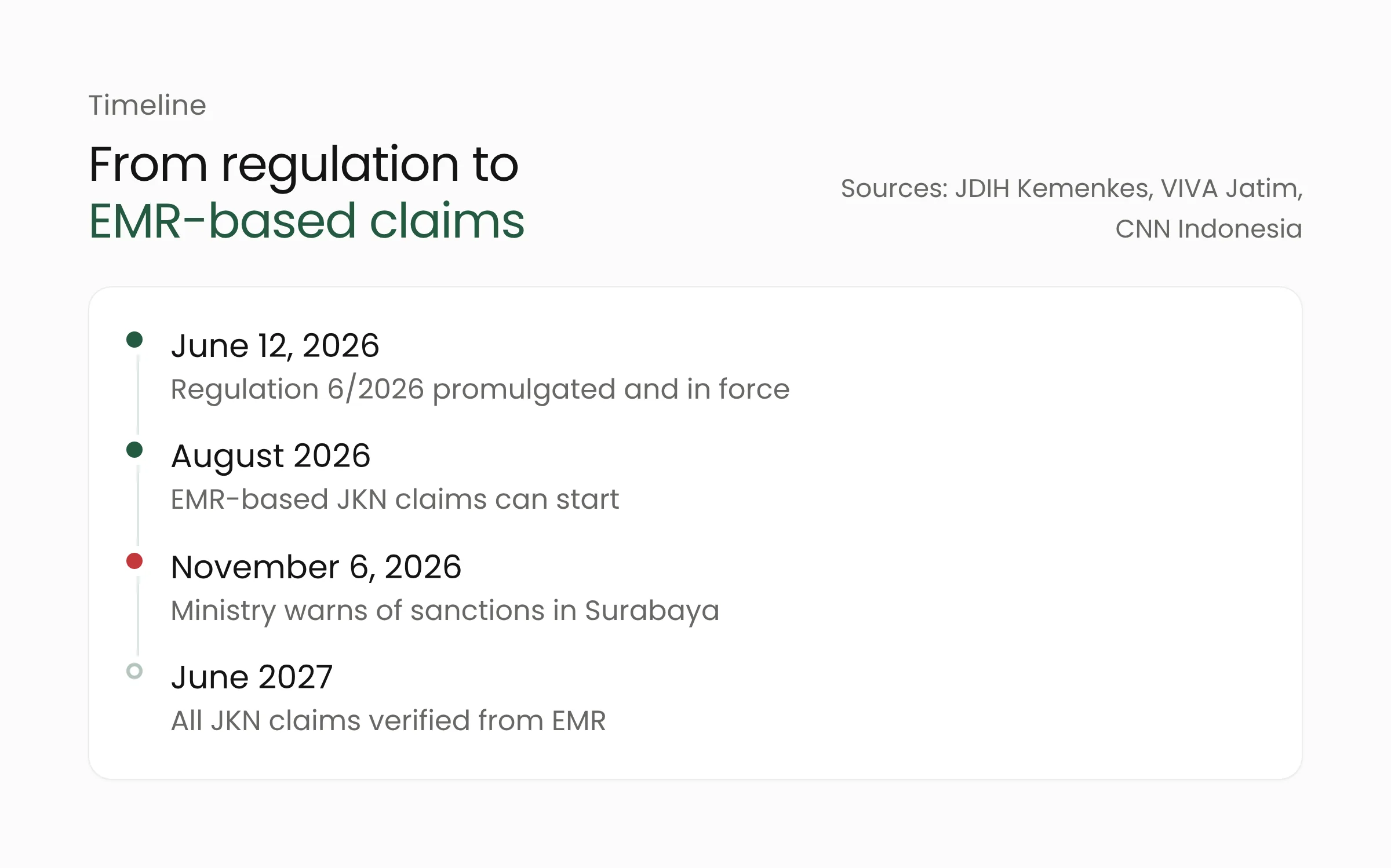
According to CNN Indonesia, the warning came from Dr. Azhar Jaya, the ministry’s Director General of Advanced Health Services, at the Digital Sovereignty Forum 2026 RSUD NEXTGEN in Surabaya on Friday, November 6, 2026. The forum was organized by the ministry-run RSUP Surabaya hospital and ARSADA East Java, an association of regional hospitals.
Azhar said every health facility is required to run EMR integrated with SATUSEHAT, the ministry’s national health data platform. VIVA Jatim reported that the obligation covers four things: protecting the security and confidentiality of patient data, validating patient identity against the national ID number (NIK) held by the civil registry, using certified electronic signatures, and submitting medical record data completely, accurately, and on time.
VIVA reported that the administrative penalties being prepared are a recommendation to lower a hospital’s accreditation status by one level or a recommendation to suspend its business license.
We covered the technical preparation side of this in our October article on SATUSEHAT EMR and JKN claims. What has changed is enforcement: the ministry is now naming sanctions openly and pointing to a regulation that is already in force.
What Regulation 6/2026 says about records and penalties
Health Ministry Regulation No. 6 of 2026 was signed on June 4, 2026 and promulgated on June 12, 2026, taking effect on that date. The full text is on the ministry’s legal documentation portal (JDIH).
Two articles matter most for EMR. Article 36(1) lists hospital obligations, one of which is to maintain medical records. Article 74(1) requires every hospital to record and report all of its activities in a health information system integrated with the National Health Information System. The following paragraphs say those records must be kept confidential and that hospitals must update their data in the system whenever something changes.
The regulation does not mention SATUSEHAT by name; the ministry’s explanation in Surabaya treats EMR integration with SATUSEHAT as part of these obligations.
Five steps of administrative sanctions
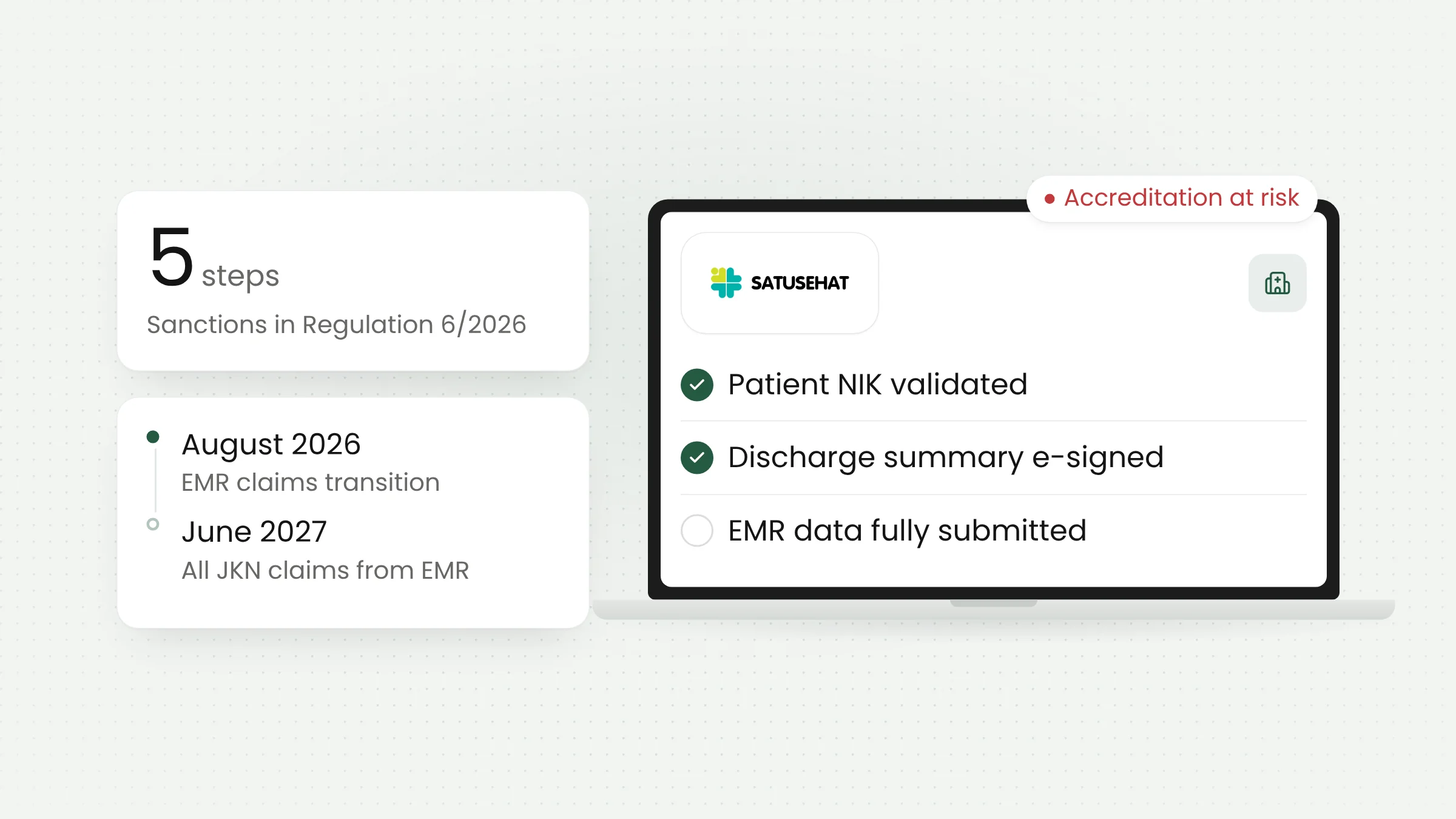
Penalties for breaching Article 36(1) and Article 74(1) are set out in Article 79. They are imposed by the minister, the governor, or the regent or mayor, depending on jurisdiction, in this order.
- Verbal warning for a first violation, issued at most once, with an order and a deadline to fix the problem.
- Written warning for repeat violations or when the verbal order is ignored, issued at most twice. The order may require a change in hospital leadership.
- Administrative fine when the written warning is ignored. The minister sets the amount, and the money goes to the state or the regional budget.
- Adjustment or revocation of accreditation status after a fine has been imposed or left unpaid.
- Revocation of the business license if violations continue after the accreditation sanction.
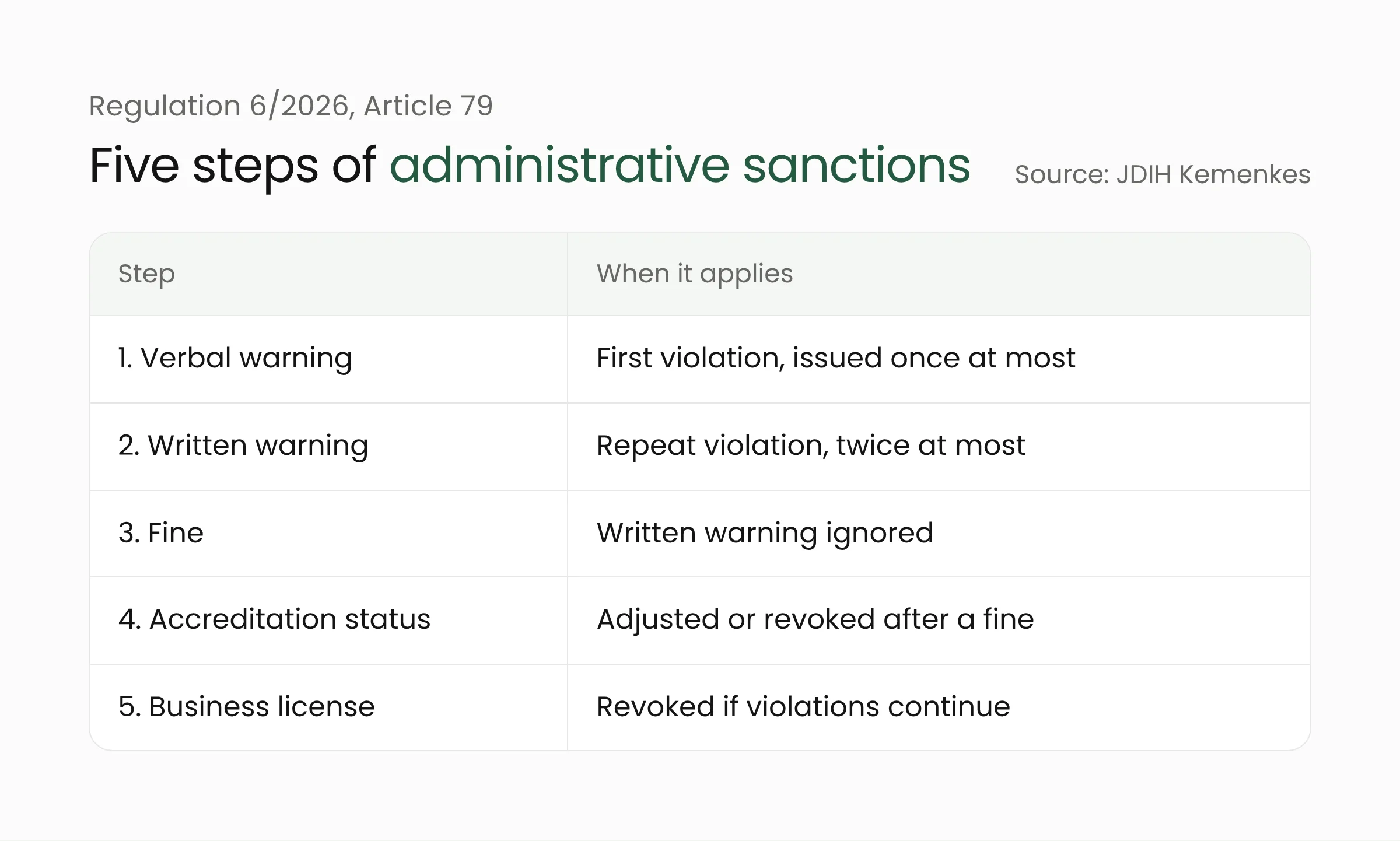
Two details stand out. Under Article 79(12), a hospital that is not yet accredited and reaches the accreditation step goes straight to license revocation. The wording also differs: the official in Surabaya spoke of a recommendation to suspend licenses, while the regulation uses the term revocation. Technical guidance or formal letters should confirm which form applies.
When steps are skipped, and how violations surface
Article 80 sets out an exception. If a breach of these obligations is proven to have caused serious harm, including a patient’s death, permanent disability, widespread disruption to health services, or financial irregularities, sanctions can be imposed without following the steps.
Article 81 lists how violations come to light: written complaints, media reports, and the results of monitoring and evaluation. For digital record-keeping duties, data already received by the ministry’s systems can feed that monitoring.
The JKN claims deadline and the East Java picture
The sanctions arrive alongside a change in how JKN claims are processed. A joint circular signed on July 30, 2026 by several agencies, including the Health Ministry, BPJS Kesehatan (the national health insurer), and the national cyber agency BSSN, sets out JKN claims based on EMR integrated with SATUSEHAT. According to VIVA Jatim, hospitals could start using EMR-based claim documents for services delivered from August 2026, and from the June 2027 service month all JKN claims will be verified on that basis.
Earlier reporting by Investortrust said the policy known as “No RME, No Claim” was targeted to take full effect in 2027, provided a national evaluation found hospitals ready. The same report said about 2,400 hospitals had sent data for six EMR services to SATUSEHAT by May 2026.
How ready regional hospitals are
The ministry presented a mapping of 90 hospitals owned by the provincial, regency, and city governments in East Java, based on RS Online data as of September 21, 2026. Most of their services were still at the basic and intermediate tiers, and only 21 services had reached the top tier, known as paripurna.
Those tiers come from a new classification in the same regulation. Article 12 classifies hospitals by service group into four levels: paripurna, utama, madya, and dasar, roughly comprehensive, main, intermediate, and basic. According to VIVA Jatim, there are 24 service groups, and assessments consider staff competence, facilities and infrastructure, and medical equipment.
The ministry also pointed to other JKN changes: the referral system, the standard inpatient class known as KRIS, and a shift in tariffs from INA-CBG to iDRG. CNN Indonesia reported that iDRG tariffs are designed to group 57,000 disease cases that previously had no standard tariff and to reduce the risk of claims fraud. On KRIS, data as of November 1, 2026 showed 66.5 percent of East Java hospitals met all 12 criteria, while 2.8 percent had not met the requirements.
All of these changes rely on the same data: diagnoses, procedures, and patient identities recorded correctly from the moment a patient registers.
What this means for hospitals
Hospitals that have not finished integrating still have room to act, because the first sanction is a warning that comes with an order and a deadline. That window is best used to fix the data, since the later steps hit finances and accreditation directly.
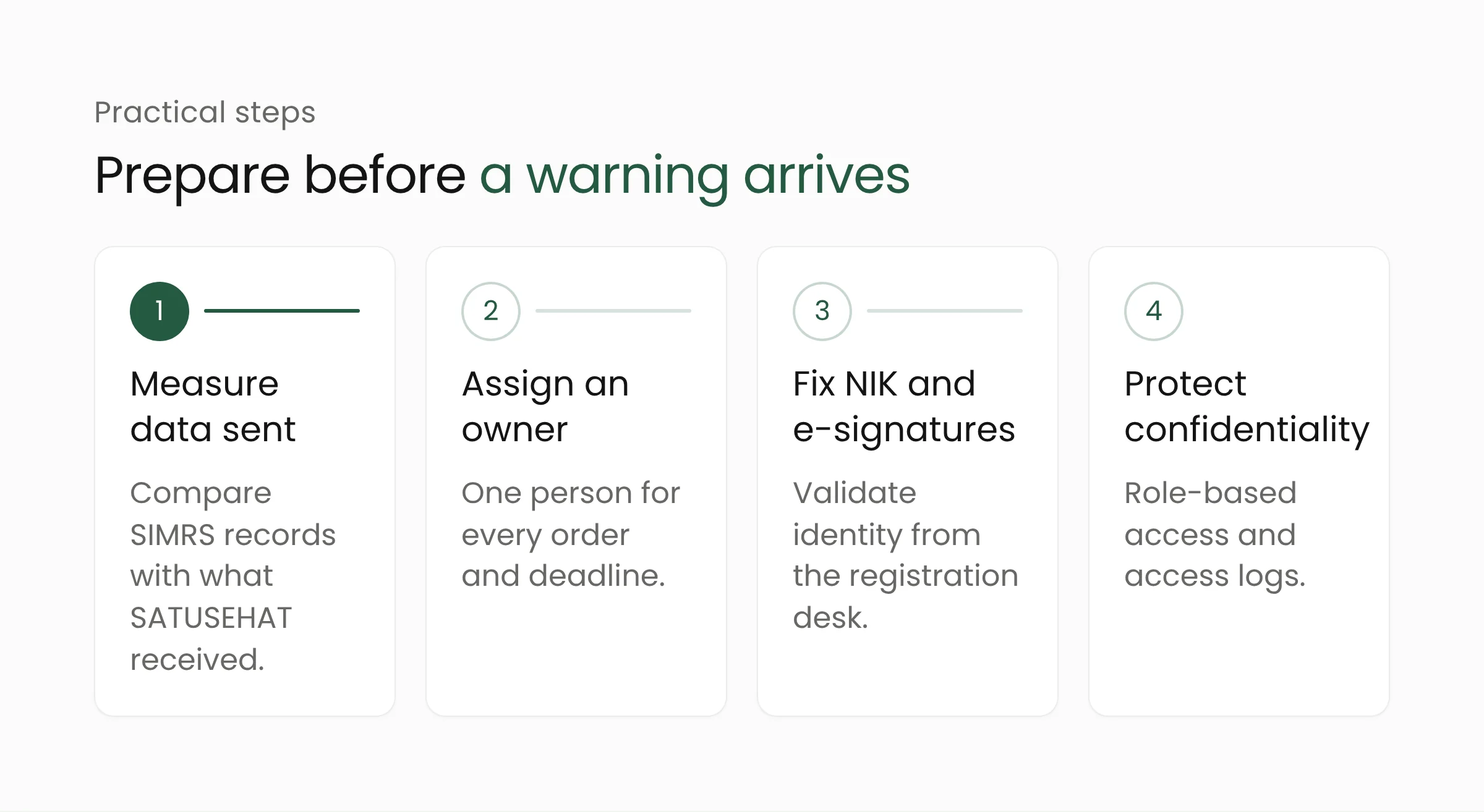
Measure compliance with your own numbers. Compare visits and procedures recorded in the hospital information system (SIMRS) with the records SATUSEHAT actually received, by service and by day. The gap shows which units are behind. An internal dashboard like this can be built from data the hospital already has, the kind of operational monitoring covered by data analytics services.
Assign an owner to every warning order. Warnings under the regulation always carry a deadline. Decide who receives the letter, drafts the corrective plan, and reports progress to the board. Ignoring a warning order moves the hospital to the next step.
Fix identity and signatures at registration. NIK validation through the civil registry and certified electronic signatures are requirements the ministry named directly.
Keep the hospital profile current. Article 74(3) requires changes to hospital data to be recorded in the system. Outdated details, such as bed counts or service types, leave the national system with an inaccurate picture of the hospital.
Protect the data you send. The integration duty is always paired with patient data security. Set role-based access and keep access logs on every system connected to SATUSEHAT.
For local governments, the ministry said regional hospitals that do not yet meet requirements need support from provincial and district health offices. Teams drawing up a roadmap for hospital systems can start the conversation through Merakit’s healthcare solutions.
Frequently asked questions
Has the ministry imposed new sanctions since the Surabaya forum?
Reports on November 7, 2026 described the ministry as threatening sanctions, and the forum did not announce new penalties against specific hospitals. Regulation 6/2026 has been in force since June 12, 2026, so the legal basis already exists.
Do private hospitals fall under these rules?
Articles 74 and 79 of Regulation 6/2026 refer to “setiap Rumah Sakit” (every hospital) without distinguishing ownership. The Surabaya warning was aimed at regional public hospitals, but the record-keeping duty and the sanction steps apply generally.
When must JKN claims be fully EMR-based?
According to the ministry, as reported by VIVA Jatim, from the June 2027 service month. Investortrust reported in July 2026 that full implementation was targeted for 2027 after a national readiness review, so hospitals should keep watching for official announcements from BPJS Kesehatan and the Health Ministry.
Closing thoughts
The ministry’s warning in Surabaya turns EMR integration from a program target into an obligation with consequences for accreditation and licensing. The step-by-step sanctions give hospitals time to correct course, and that time is best spent making sure the data they send is complete, accurate, and something they can monitor themselves. If your team wants a partner to work through that data flow, Merakit is ready to help.
Sources
- CNN Indonesia: Kemenkes Ancam Sanksi RSUD yang Lalai Tak Integrasi SATUSEHAT (November 7, 2026)
- VIVA Jatim: Kemenkes Wajibkan Rekam Medis Elektronik Terintegrasi SATUSEHAT, RS Bisa Kena Sanksi (November 7, 2026)
- JDIH Kemenkes: Peraturan Menteri Kesehatan Nomor 6 Tahun 2026 tentang Rumah Sakit (promulgated June 12, 2026)
- Investortrust: Cegah Fraud, Mulai Agustus 2026 RS Didorong Terapkan Klaim Elektronik (July 31, 2026)