Blog Digital Health
Oura to Acquire Counsel Health in $625M AI Primary Care Deal
On this page· 7 sections
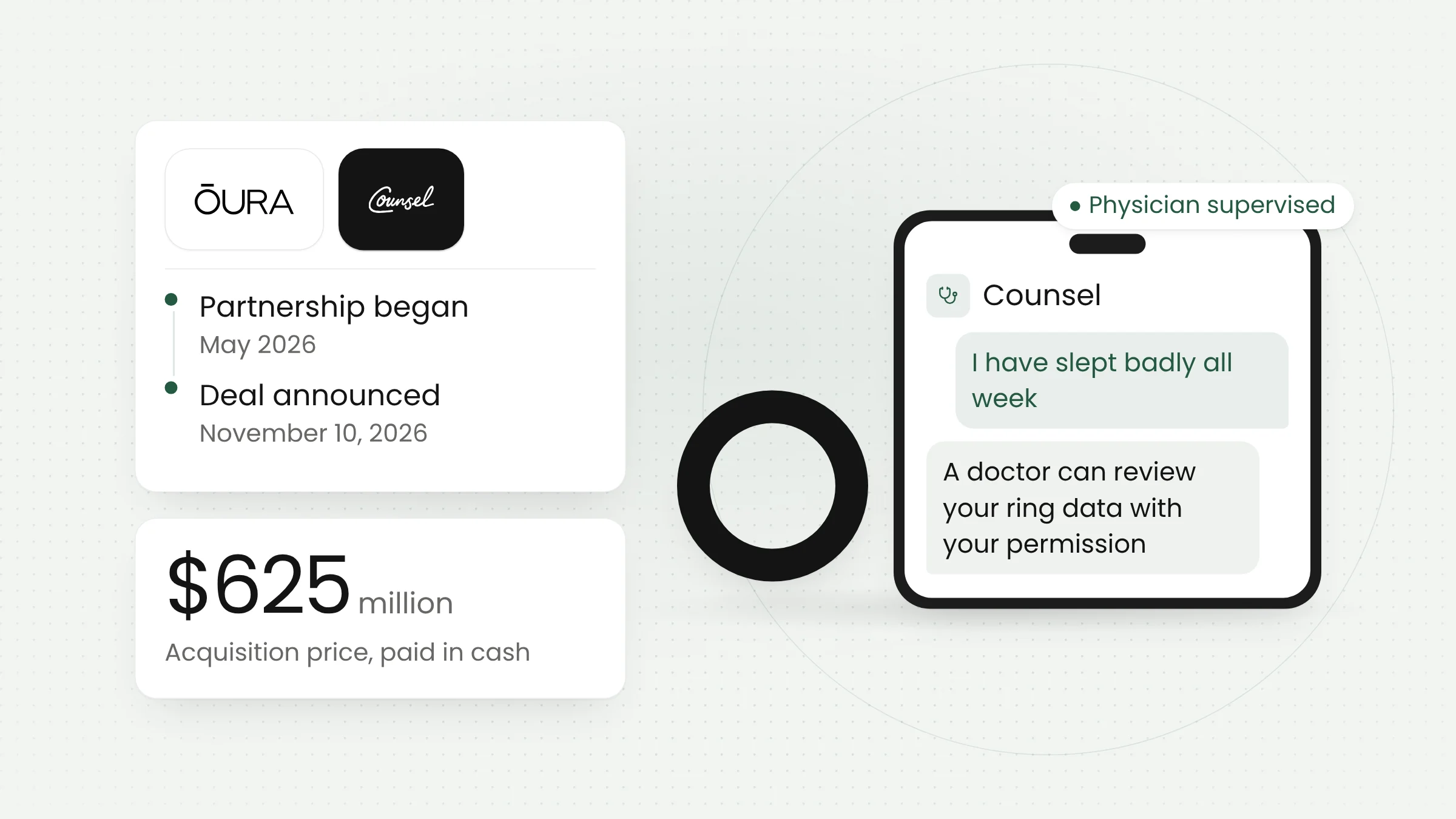
Oura, the maker of the health-tracking smart ring, announced on November 10, 2026 that it has agreed to acquire Counsel Health for $625 million. Counsel runs an AI-native primary care service supervised by physicians. The Oura Counsel Health deal means data from the ring can now inform medical advice and treatment from a doctor.
The deal joins two things that have usually lived apart: a wearable that records the body day and night, and a doctor who typically sees a patient for a few minutes per visit. For hospitals and clinics in Indonesia, it offers an early look at where digital health services are heading.
The terms of the Oura and Counsel Health deal
According to Oura’s announcement, the two companies have signed a definitive agreement. They have worked together since May 2026, and Oura members have been able to try Counsel through Oura Labs, the app’s channel for experimental features.
HIT Consultant reports that the $625 million will be paid in cash, subject to customary adjustments. Sources differ on timing. Oura expects the deal to close near the end of 2026, while TechCrunch wrote that it is expected to close before the end of 2027.
Counsel founder and CEO Dr. Muthu Alagappan will join Oura as chief clinical AI officer. TechCrunch, citing Bloomberg, said Counsel’s roughly 70 employees will move over as well. Counsel will keep serving its existing partners, including health plans, health systems, and employers, and will reach people who do not wear an Oura Ring.
Finances and competition
Oura is buying from a position of strength. TechCrunch reported revenue of $533 million for the quarter ended September 30, up 153% year over year, and fiscal 2026 revenue of about $1.75 billion. The company was valued at $11 billion after a funding round in October 2025. At the same time, Oura has postponed its planned initial public offering indefinitely, citing uncertainty in the IPO market.
Counsel is much smaller. It raised a $25 million Series A led by Andreessen Horowitz and GV, and PitchBook estimates its total funding at about $36 million. Oura faces rivals such as RingConn and Ultrahuman in smart rings, so a physician service could become a hard-to-copy advantage.
How Counsel works inside the Oura app
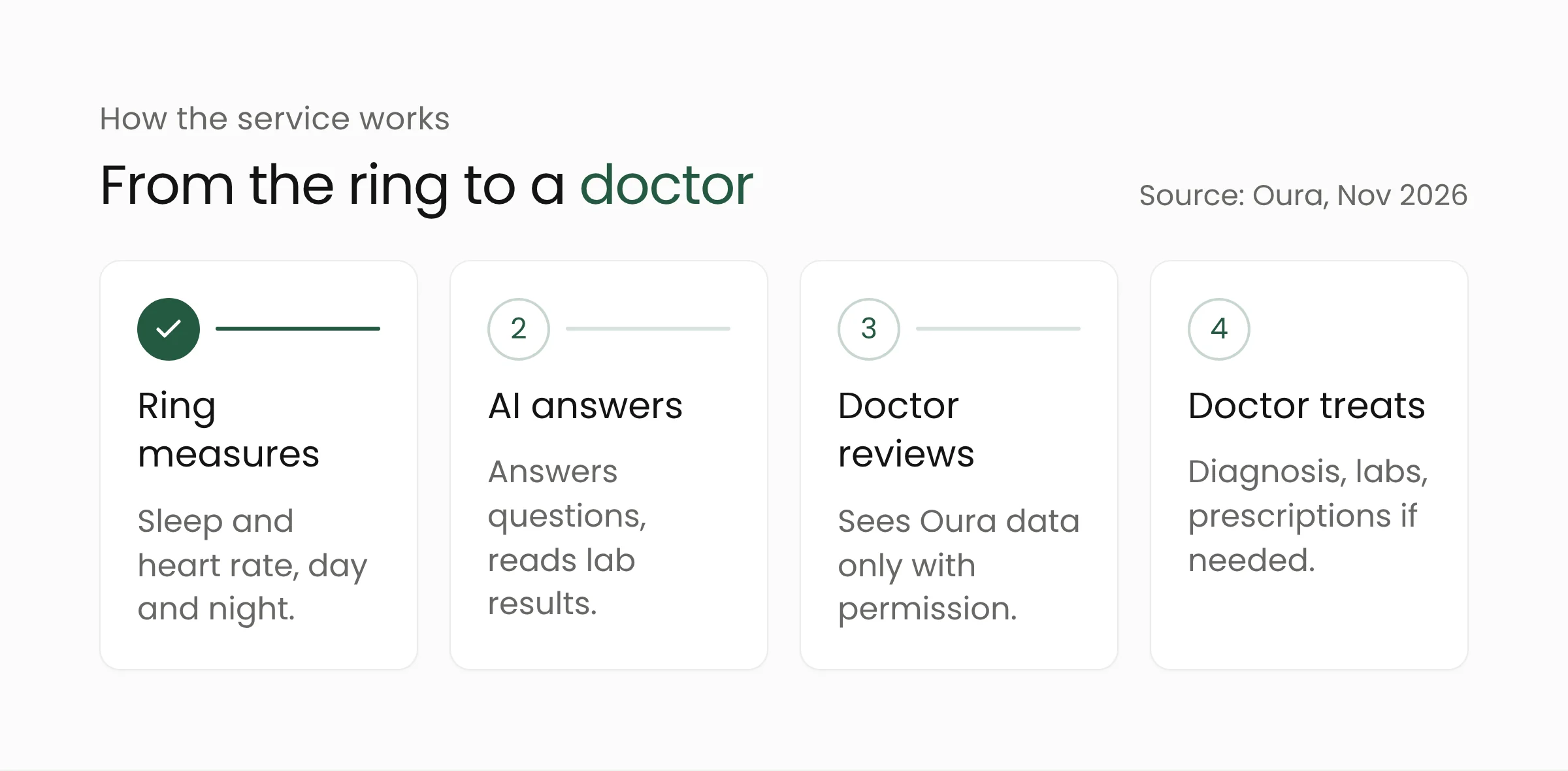
Oura describes the service in three layers. The Oura Ring measures body signals around the clock, such as sleep patterns and heart rate. The Oura App turns those signals into insights through features such as Health Radar, Health Panels, and Symptom Radar. Counsel is the third layer, where care happens.
Counsel’s medical AI, supervised by board-certified physicians, answers health questions, helps interpret lab results, and recommends next steps. When a case needs more, Counsel physicians can diagnose, treat, order labs, and prescribe when appropriate. HIT Consultant adds that members can escalate to a physician within minutes, and that doctors use an interface called the Clinician Cockpit, which summarizes medical records and biometric baselines.
Oura shared two member stories. A 68-year-old member who had food poisoning was advised by a physician to delay a scheduled GLP-1 injection by one day after the doctor reviewed the member’s history and Oura data. Another member living with multiple sclerosis got help interpreting symptoms during recovery from surgery, based on Oura data collected over time.
Oura also states that Counsel is not for emergencies. In an emergency, members are told to call their local emergency number.
The companies plan to expand into three areas: preventive care, acute care, and specialty and chronic care such as cardiometabolic and hormonal health. The announcement is focused on the United States. Oura has not said whether Counsel will be offered in other countries, including Indonesia.
Wearable data, consent, and the limits of the claims
The real value of the deal lies in the data. Oura says Counsel physicians can see Oura data and past conversations only with the member’s permission. Since the partnership began, more than half of Counsel users in Oura Labs have chosen to share their Oura data with their physicians, which spares them from repeating their history at every visit.
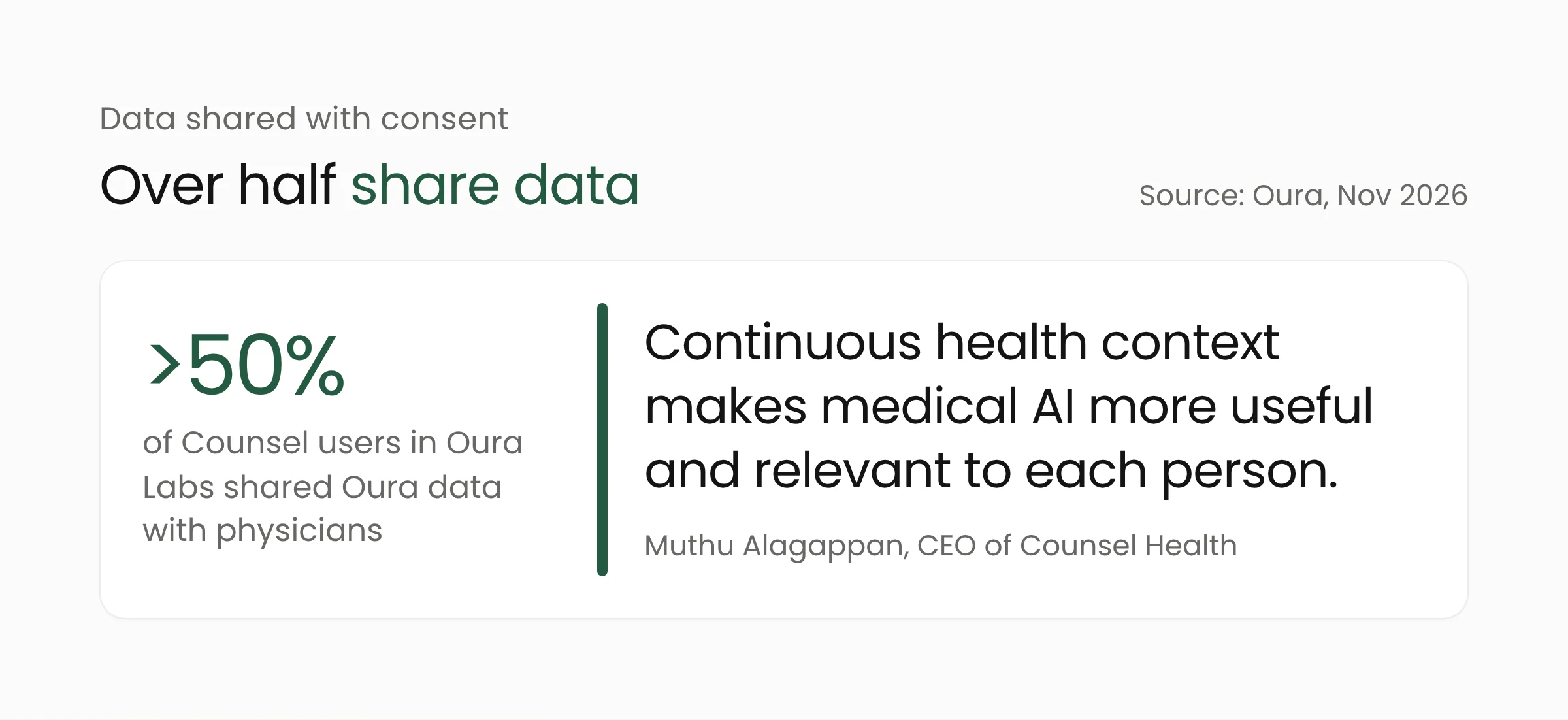
Alagappan explained the thinking behind the combination: “Continuous health context makes medical AI more useful and relevant to each person.” In practice, the AI and the doctor see weeks of body data instead of relying only on what a patient remembers during a consultation.
Some of the success figures deserve caution. HIT Consultant cited internal evaluations in which more than 90% of members said continuous biometric context led to better clinical encounters, with an average satisfaction score of 4.6 out of 5. Those numbers come from the companies and have not been independently verified. The same outlet noted consumer concerns about health data privacy and the risk of AI giving wrong answers.
Oura points to U.S. figures to describe the problem it wants to address. A typical primary care visit lasts about 18 minutes, and the country could be short as many as 86,000 physicians by 2036. Short consultations are exactly why daily wearable data appeals to doctors, as long as it arrives summarized and relevant.
What this means for hospitals and clinics
Counsel is not available in Indonesia, but the model is already relevant for health providers building digital services. Many patients wear smartwatches or smart rings, and questions about that data will come up more often in consultations. Providers can prepare in several ways:
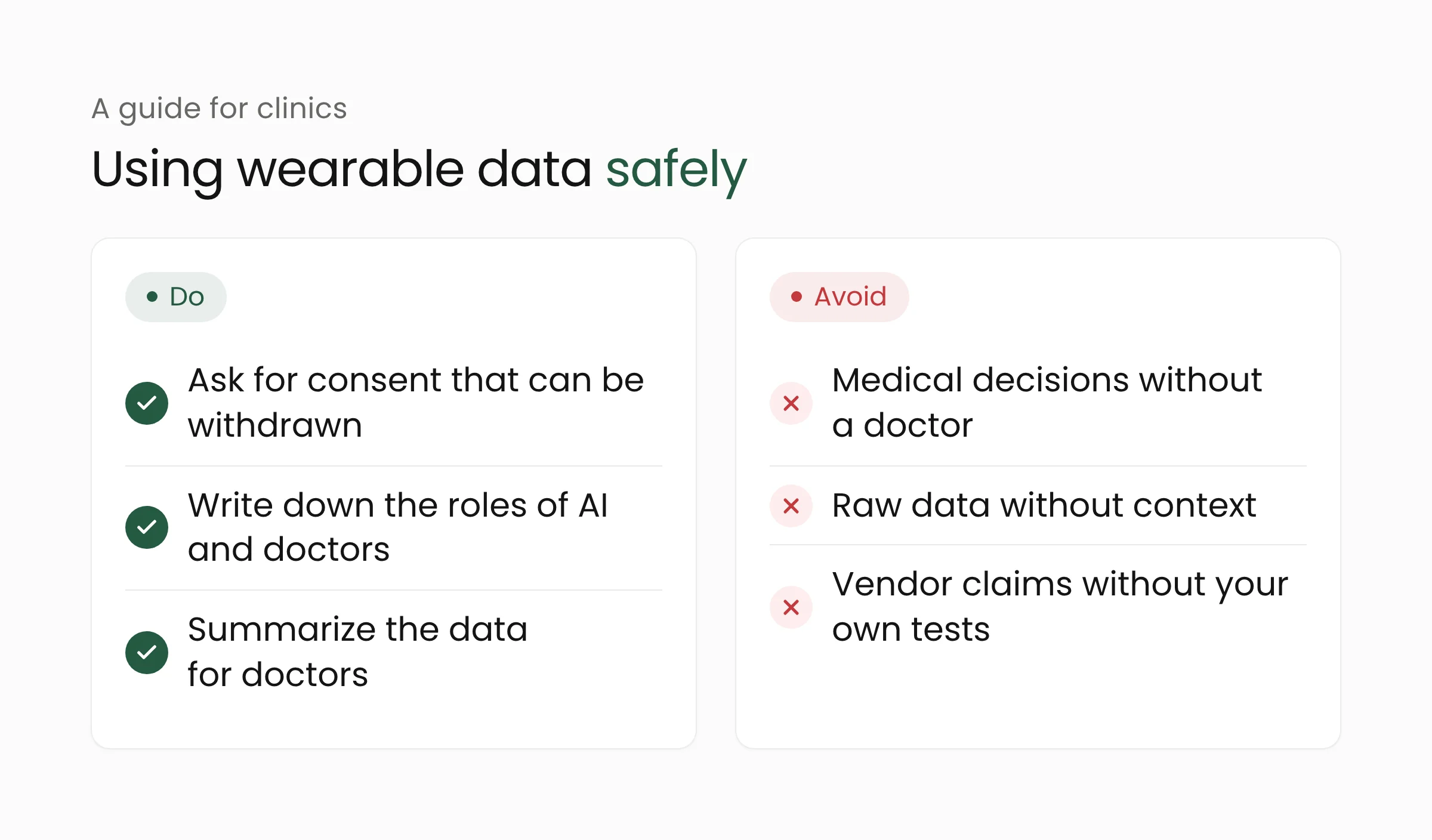
- Start with patient consent. Indonesia’s Undang-Undang Nomor 27 Tahun 2022 tentang Pelindungan Data Pribadi (the Personal Data Protection Law) classifies health information and biometric data as specific personal data. Any flow that shares app data with a doctor should ask for clear permission that can be withdrawn and is recorded.
- Define the roles of AI and doctors. Counsel limits AI to answering questions and triage, while diagnosis and prescriptions stay with physicians. Rules for when a conversation must go to a clinician should be written from day one, along with a clear notice that the service is not for emergencies.
- Connect to existing medical records. Wearable data is more useful next to a patient’s history. According to ANTARA, SATUSEHAT now connects more than 43,000 health facilities, so summaries from patient apps should be designed to sit alongside electronic medical records.
- Summarize the data for doctors. Physicians do not have time to read weeks of sleep charts. A view like the Clinician Cockpit shows that clinicians need a short summary of meaningful changes rather than raw data.
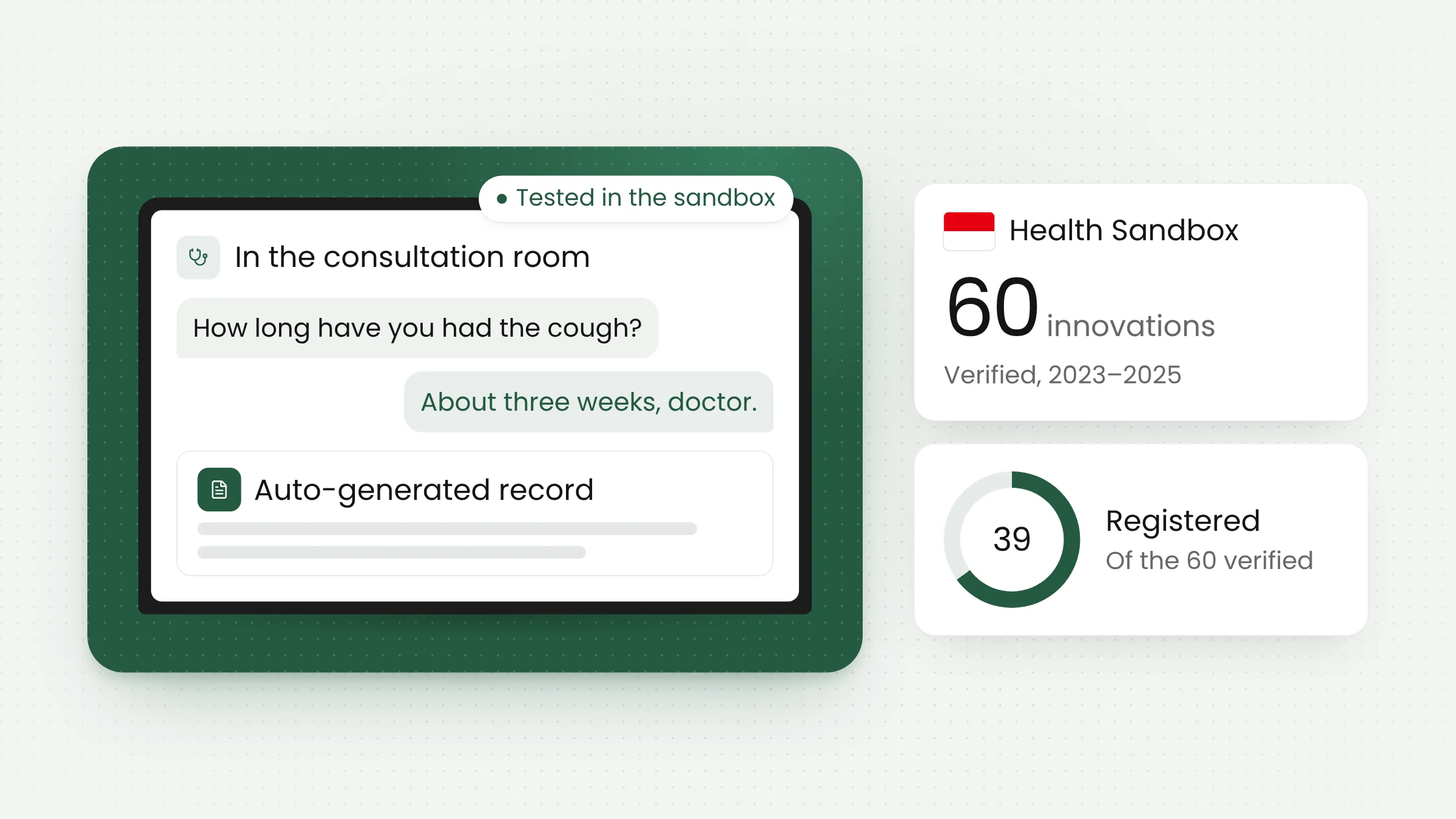
- Test before scaling. Vendor satisfaction claims should be checked against your own trials. Innovators in Indonesia can also use the Ministry of Health’s Sandbox Kesehatan to test medical AI services in a controlled setting.
For hospitals that want to build something similar, the technical work covers a patient app, device data integration, and an AI assistant with clear boundaries. Teams designing digital healthcare solutions should plan data security from the first draft, and language models for triage are best developed with clinical staff through a measured artificial intelligence development process.
Frequently asked questions
Can people in Indonesia use Counsel Health?
There has been no announcement about that. Oura’s announcement focuses on the U.S. market, where the service is delivered by licensed physicians. Oura has not mentioned plans to expand to other countries.
Does Counsel’s AI make the diagnosis?
According to Oura, Counsel’s AI works under the supervision of board-certified physicians. It answers questions, helps interpret lab results, and recommends next steps. Diagnosis, treatment, lab orders, and prescriptions are handled by Counsel physicians.
Do doctors automatically see Oura ring data?
No. Oura says Counsel physicians see Oura data and past conversations only with a member’s permission. Since the partnership began, more than half of Counsel users in Oura Labs have chosen to share their data.
Conclusion
The Counsel Health acquisition points to a new role for wearables: daily body data is entering the doctor’s workflow, with AI as the bridge and patient consent as the condition. For hospitals and clinics in Indonesia, the main lesson is in service design that is secure, clearly bounded, and connected to medical records.
Merakit Indonesia helps healthcare providers design patient apps, data integration, and AI assistants that fit their services. Talk to our team if you are planning your next digital health service.
Sources
- Oura Announces Agreement to Acquire Counsel Health, the AI-Native, Physician-Supervised Care Platform, Oura, November 10, 2026
- Oura to acquire AI-native primary care startup Counsel Health for $625M, TechCrunch, November 10, 2026
- Oura Acquires Counsel Health for $625M: Scaling Continuous Biometrics into On-Demand Medical Care, HIT Consultant, November 10, 2026
- Kemenkes kuatkan Sandbox Kesehatan, 60 inovasi lolos verifikasi, ANTARA, October 28, 2026
- UU Nomor 27 Tahun 2022 tentang Pelindungan Data Pribadi, Pasal.id