Blog Qwen4-Max
Qwen4-Max Is Out: How Manufacturers Can Test Its Cost Claims
On this page· 7 sections
Alibaba released Qwen4-Max, its newest flagship AI model, on November 16, 2026. The model is available through an API and comes with a claim that average cost per task is about 60% lower than its predecessor. Manufacturers that have started using AI for engineering work should test that claim against their own tasks before building a budget around it.
What Alibaba released
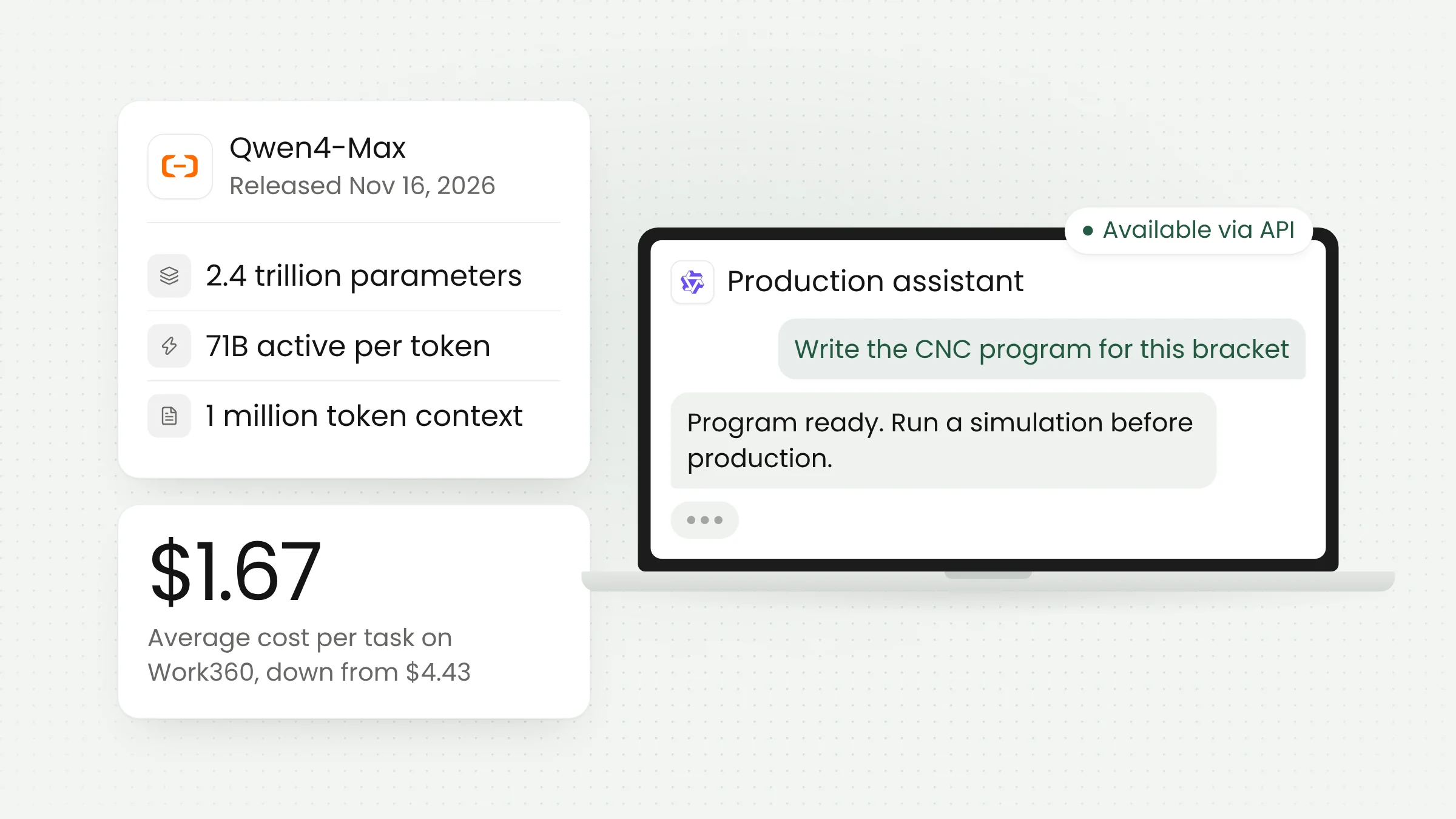
According to Alibaba Cloud’s press release, issued from Hangzhou, Qwen4-Max is the most capable model in the Qwen family to date. It has 2.4 trillion parameters, native vision capabilities, and a context window of one million tokens. Tokens are the small chunks of words or characters that language models process and bill by.
Qwen4-Max is a sparse Mixture-of-Experts (MoE) model. In this design the network is split into many “experts,” and only some of them fire for each token. Alibaba says Qwen4-Max activates 71 billion parameters per token, 25% fewer than Qwen3.8-Max at the same total size. Computerworld puts the predecessor’s figure at about 95 billion. Fewer active parameters mean less compute for every answer.
SiliconANGLE described several of the architectural changes. They include 328 billion additional parameters that act as a cache for frequently repeated calculations, plus two attention techniques, Gated DeltaNet and QSA, that reduce the hardware needed to process long prompts.
The launch follows a limited preview. Alibaba Cloud Model Studio documentation shows that qwen4-max-preview opened on November 11, 2026 through the Token Plan only, and the same page now points users to the production Qwen4-Max. The production model is available on QwenCloud through the Token Plan and the API, and in Alibaba apps such as QwenWork and QwenStudio.
Qwen4-Max can only be used through Alibaba’s services because its weights have not been released. Alibaba says smaller open-weight Qwen4 models will be released to developers soon, without giving a date. The press release also says Qwen4-Max ranks sixth on Code Arena, a leaderboard that scores models on real-world programming tasks.
Cost per task and the new prices
Cost is the headline of this release. Alibaba measures it with Work360, an in-house benchmark of difficult industry tasks drawn from 721 specialized fields. On that benchmark, Qwen4-Max reportedly uses 35% fewer tokens in High effort reasoning mode and lowers average cost per task by about 60%.
The figures in circulation differ slightly. Computerworld and Digital Trends cite the Qwen team’s announcement, which puts average task cost at $1.67 for Qwen4-Max against $4.43 for Qwen3.8-Max. That gap works out to about 62%. Alibaba’s official press release uses “about 60%.”
The savings come from two places: fewer tokens and lower prices. According to Computerworld, the Qwen4-Max API costs $1.50 per million input tokens and $4.50 per million output tokens, down from $2 and $6 for Qwen3.8-Max.
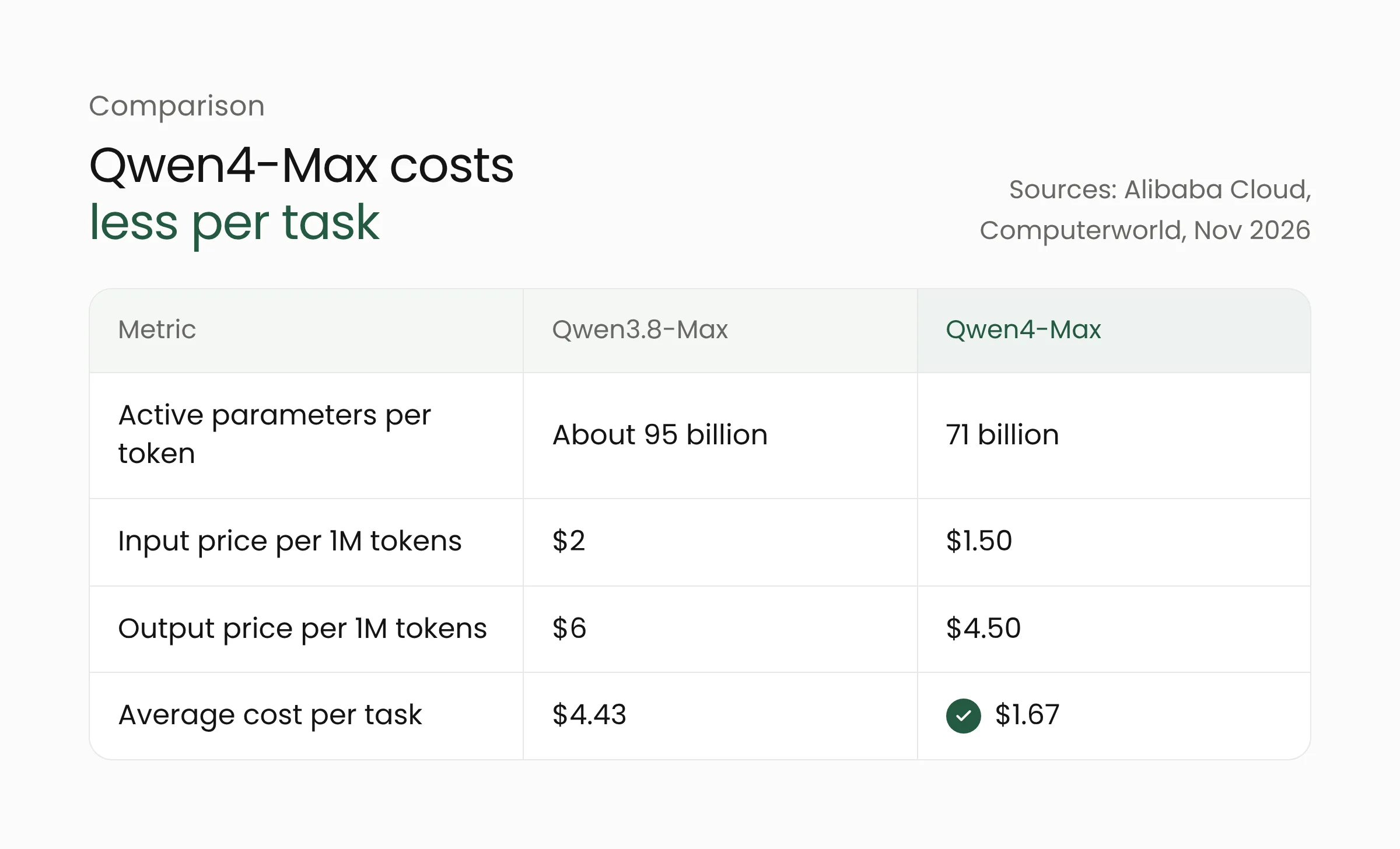
Two caveats apply. The 60% or 62% figure compares Qwen4-Max with Alibaba’s own previous model, and says nothing about rival models. Work360 is also an internal Alibaba benchmark whose results have not been independently verified.
Examples from a car plant and cloud scheduling
Alibaba included several deployment examples. In one automotive manufacturing showcase, manual workpiece programming time fell 95%, from roughly 475 minutes to 24 minutes. Workpiece programming means writing the instructions a machine, such as a CNC mill, follows to cut or shape a part.
Another example came from Alibaba’s own cloud resource scheduling. In that test, model call costs for data annotation fell about 9%, and offline CPU rescheduling ran more than 14 times faster. On the research side, Alibaba says Qwen4-Max ran an agent continuously for 48 hours and found a chip-cooling coolant molecule that was later validated experimentally.
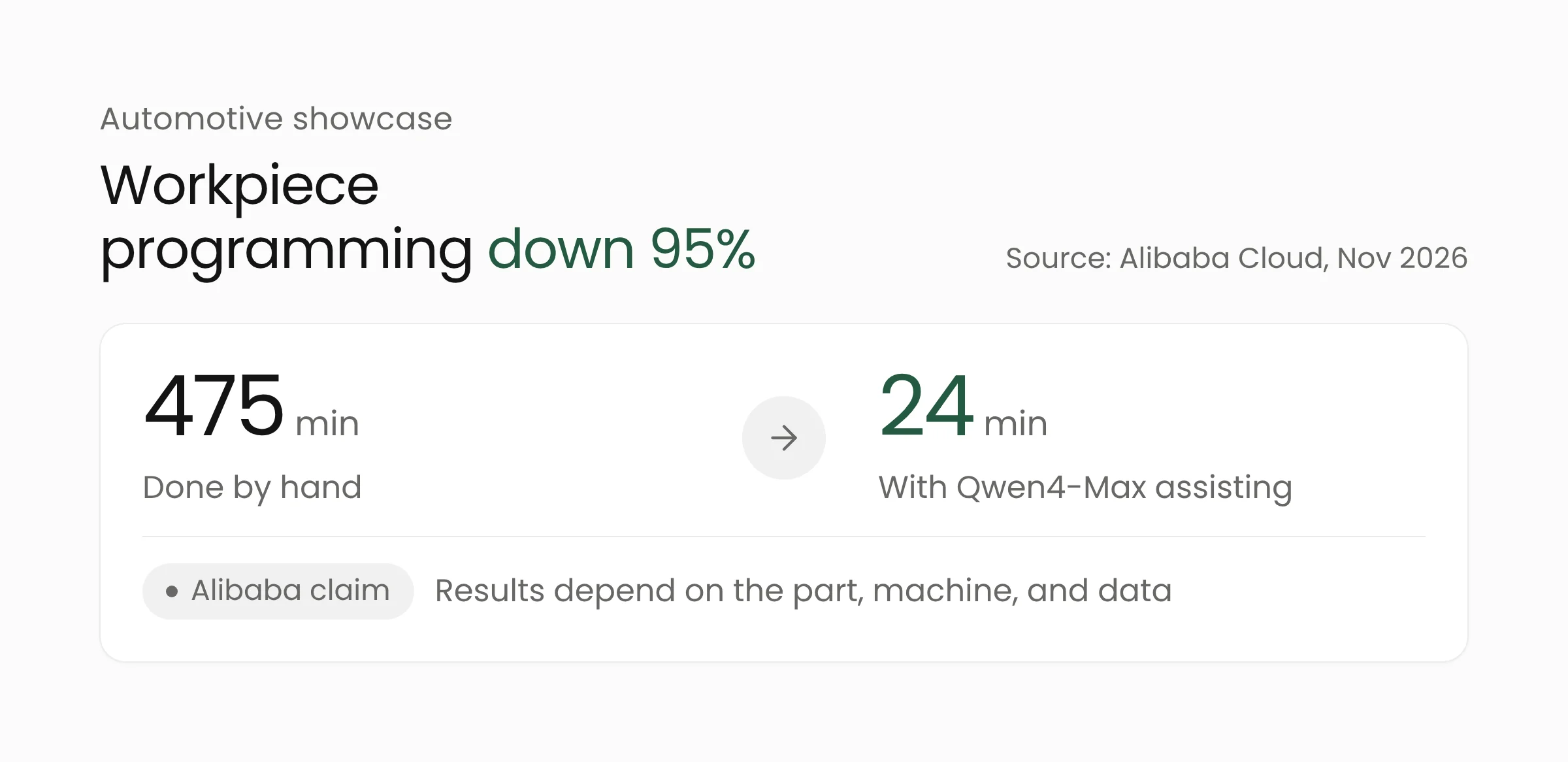
All of these numbers come from Alibaba’s own demonstrations. Results depend on the part, the machine, and the data involved, so they cannot be assumed to hold on every factory floor.
Cybersecurity safeguards and analyst caution
Alibaba also highlighted changes on the safety side. During software engineering training, generated code was checked for security as well as functionality, to reduce flaws such as injection and broken access control. Computerworld reports that this lifted the pass rate on Last Secure Code Bench, which requires code to pass both functional and security tests, from 22% to 31.8%.
Cybersecurity training data was also filtered by intent. Defensive material, such as vulnerability detection and remediation, was kept, while offensive attack content was removed. Alibaba says it added dedicated safety data and post-training to reduce chemical, biological, radiological, and nuclear risks. Digital Trends notes that these safety claims come from Alibaba’s own reviews and that no external red team has tested the model yet.
Analysts urge buyers to treat the numbers with care. “Alibaba has published the mileage it got on its own road, and a buyer’s bill depends on the road the buyer drives,” said Sanchit Vir Gogia, chief analyst at Greyhound Research. He advises companies to measure the cost of accepted results, including retries and the time people spend reviewing output.
Yash Kadakia, founder of Security Brigade, recommends benchmarking the cost of completing 1,000 real business tasks successfully rather than comparing token prices. He also doubts that offensive and defensive knowledge can be fully separated, since much of it overlaps.
On data handling, Gogia pointed to prompt retention of up to 30 days, with longer retention for flagged content. He said enterprises outside China should review the geographic scope of Alibaba’s global service, its retention policies, and the jurisdiction governing stored data before using the model for sensitive workloads.
What this means for manufacturers
Lower prices give mid-sized plants a reason to try AI on engineering work such as drafting machine programs, summarizing quality reports, or translating work instructions. The decision should still rest on tests run against the plant’s own work.
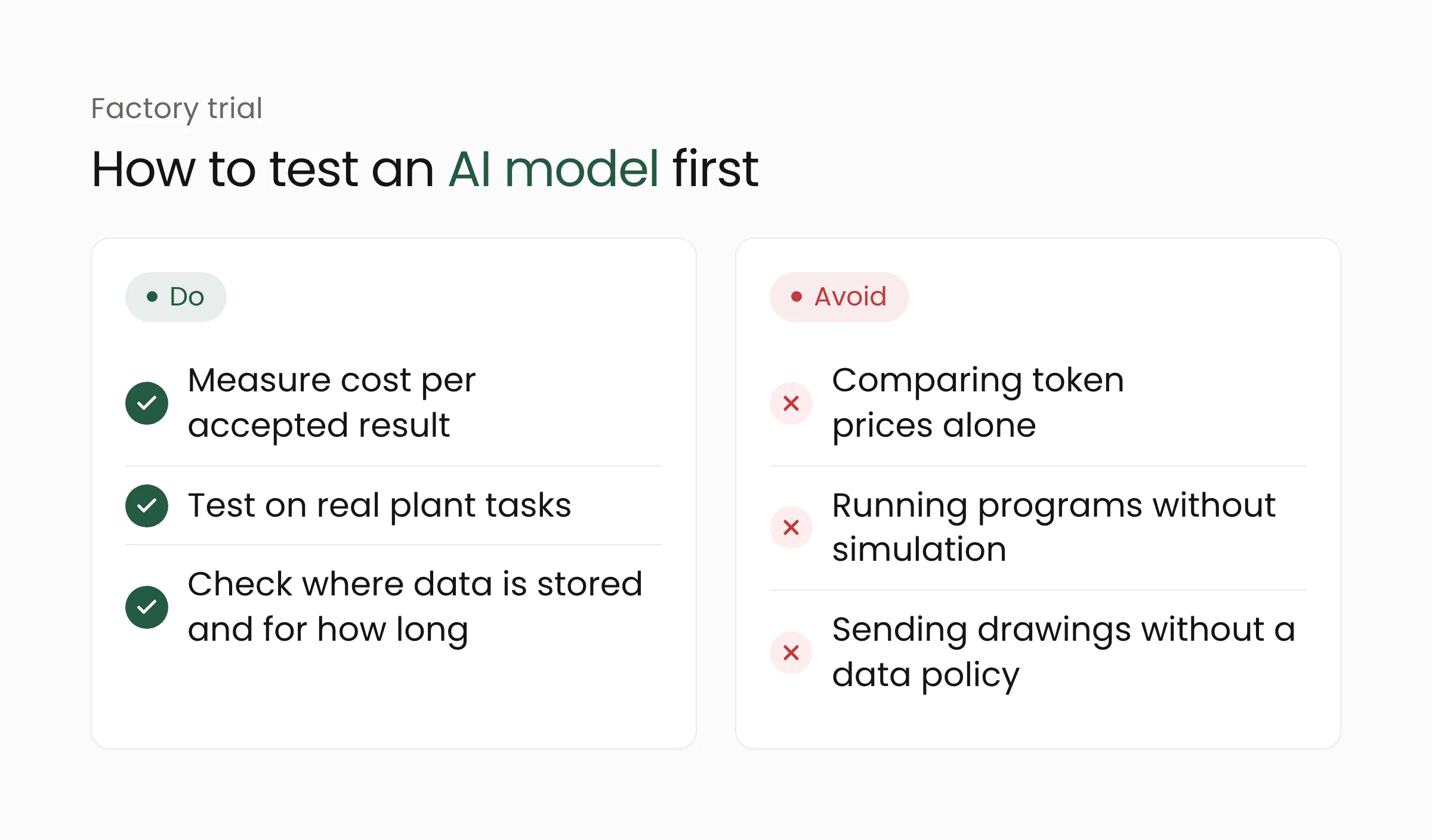
Practical steps to consider:
- Pick one repetitive task. Examples include CNC programming for one family of parts or a summary of daily inspection reports. Record the current time and cost as a baseline.
- Calculate cost per accepted result. Include token spend, the number of retries, and the engineering hours needed to check the output. That figure is more honest than a price per million tokens.
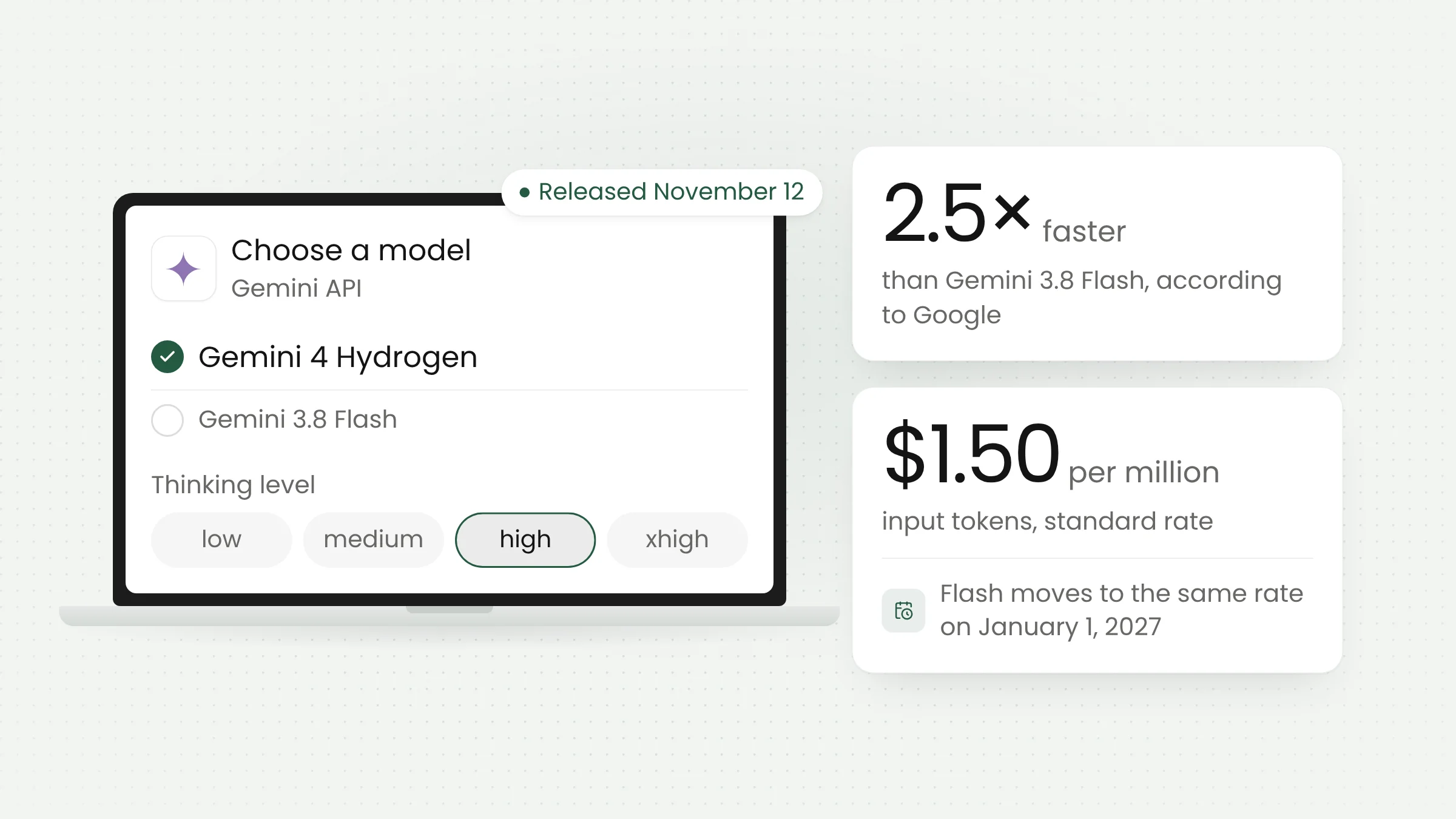
- Test several models on the same task set. Compare Qwen4-Max with models already in use on identical tasks. Teams that previously weighed cost per task on Gemini 4 Hydrogen can reuse the same test framework.
- Map the data you send. Technical drawings, process recipes, and supplier data are trade secrets. Personal data about employees or customers is also covered by Indonesia’s Undang-Undang Pelindungan Data Pribadi (Personal Data Protection Law). Confirm that processing location and retention match company policy.
- Keep a human check on risky decisions. Machine programs generated by AI should still be simulated and reviewed by an operator before they run on a production line.
If the tests show real savings, the next step is connecting AI to existing systems such as manufacturing execution and machine monitoring. Merakit supports this work through its artificial intelligence development services, from model trials to integration, and its industrial automation solutions for linking AI to shop-floor data.
Frequently asked questions
Can Qwen4-Max be deployed on our own servers?
Not yet. Qwen4-Max is only available through Alibaba services such as QwenCloud and its API. Alibaba says smaller open-weight Qwen4 models will follow, but no release date has been announced.
Did AI costs really fall by 60% or 62%?
Both figures come from Alibaba and compare Qwen4-Max with Qwen3.8-Max on the internal Work360 benchmark. The official press release says about 60%, while the breakdown of $4.43 to $1.67 works out to about 62%. Savings in your organization depend on the type of work and need to be measured directly.
How much does the Qwen4-Max API cost?
According to Computerworld and Digital Trends, it costs $1.50 per million input tokens and $4.50 per million output tokens. Token Plan packages may be priced differently, so check the official QwenCloud pricing page before setting a budget.
Conclusion
Qwen4-Max shows where competition among AI models is heading: lower cost per piece of work and longer-running agents. Its savings claims are compelling, but they still come from Alibaba’s own testing. If your plant wants to measure the value of a model like this in a controlled way, the Merakit team can help design the trial.
Sources
- Alibaba Unveils Qwen4-Max: New AI Teammate for Work, Creativity, and Discovery, Alibaba Cloud press release, November 16, 2026
- Qwen4-Max-Preview, Alibaba Cloud Model Studio documentation, updated November 16, 2026
- Alibaba touts 62% lower task costs with Qwen4-Max, adds cyber safeguards, Computerworld, November 16, 2026
- Qwen4-Max is China’s newest flagship AI model, Digital Trends, November 16, 2026
- Alibaba launches Qwen4-Max with training, attention optimizations, SiliconANGLE, November 16, 2026