Blog TKA 2026
TKA Score 200–800: How IRT Scoring Works and How to Read It
On this page· 8 sections
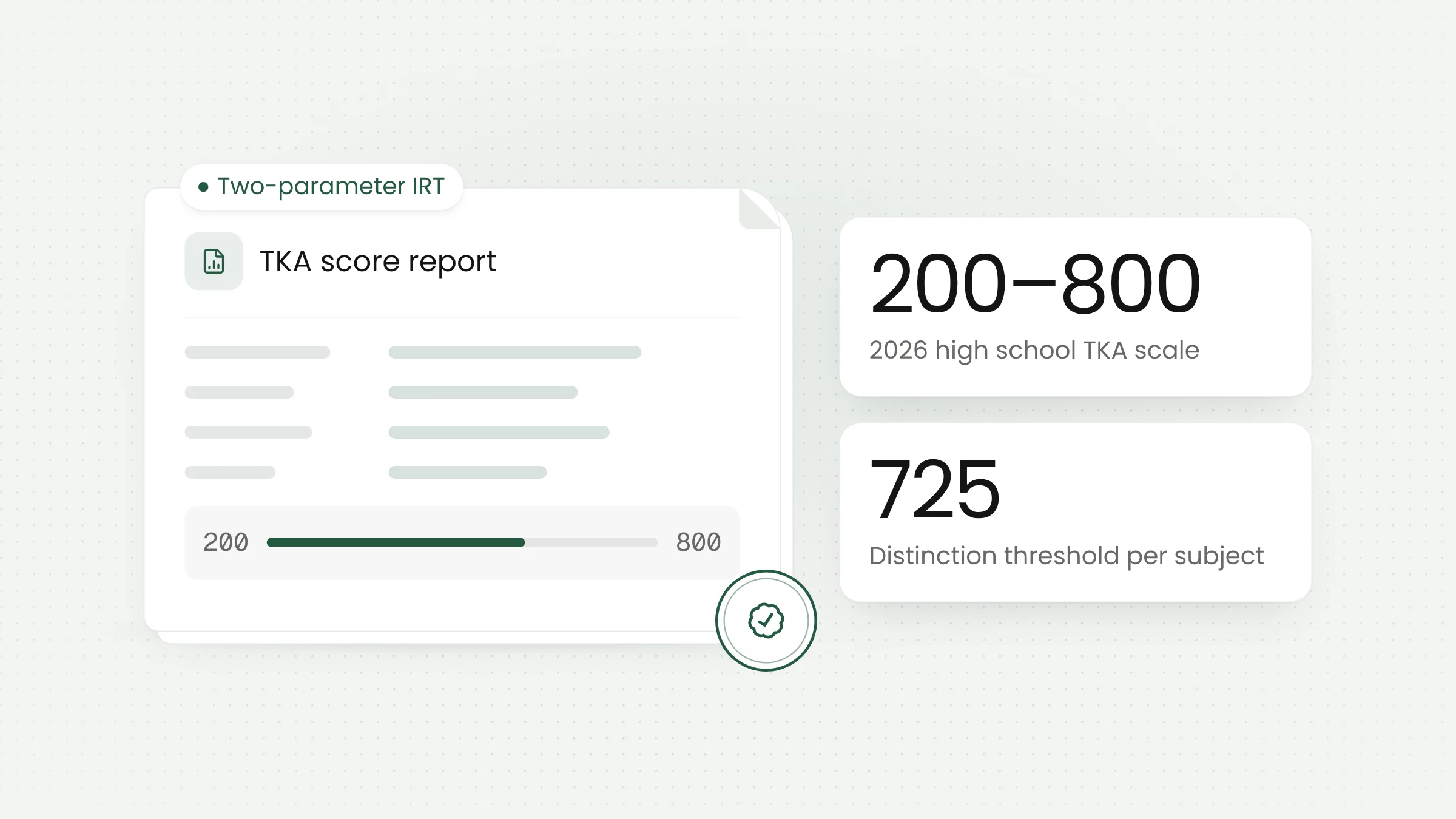
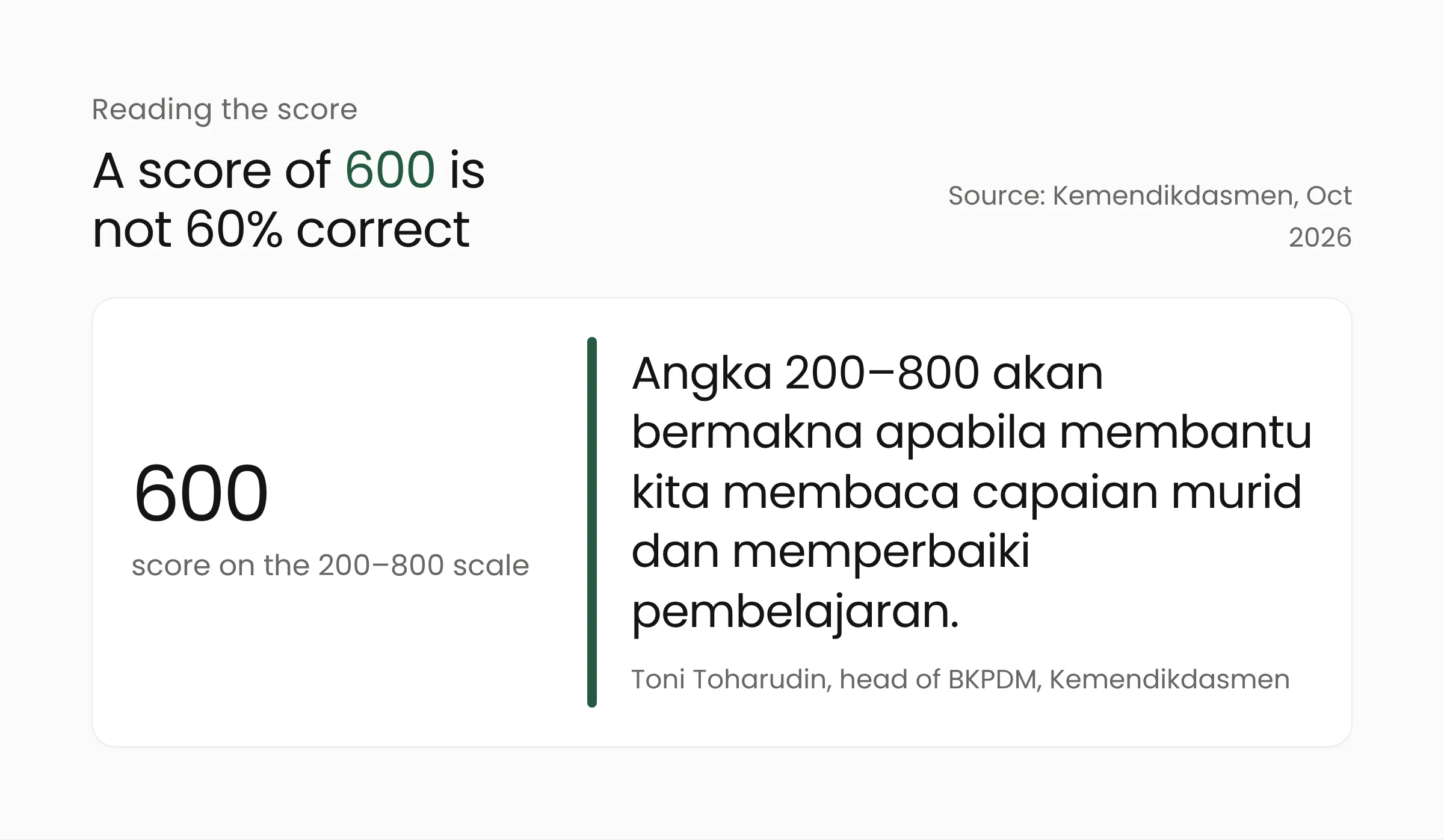
Indonesia’s Academic Ability Test (TKA) for senior high schools now reports scores on a 200–800 scale, replacing last year’s 0–100 range. The Ministry of Primary and Secondary Education (Kemendikdasmen) says the score is not a percentage of correct answers. A TKA score of 600 does not mean a student answered 60% of questions correctly. It comes from two-parameter item response theory (IRT).
A new scale for the 2026 TKA
The ministry set out the change in press release No. 899/sipers/A6/X/2026, dated October 24, 2026, two days before the TKA for senior high, vocational, and Islamic high schools began. Toni Toharudin, head of the ministry’s Agency for Primary and Secondary Education Policy (BKPDM), said the new scale is meant to present students’ academic ability in a more informative way.
According to the East Java Education Quality Assurance Center (BBPMP Jawa Timur), the change is set out in Keputusan Menteri Pendidikan Dasar dan Menengah Nomor 56 Tahun 2026 (Ministerial Decree No. 56 of 2026). Results are grouped into three achievement categories: Good (Baik), Adequate (Memadai), and Low (Kurang). Senior high and vocational students who score 725.00 or higher on every subject receive the Distinction (Istimewa) designation.
Neither the press release nor the reports we reviewed give the score boundaries for the three categories. Schools should check the decree itself before explaining categories to students.
The new scale arrives in a year when the test itself runs longer. We covered the technical preparation, including the school dress rehearsal, in our earlier piece on TKA 2026 digital exam readiness.
How item response theory works
Item response theory is a statistical method that estimates a test taker’s ability from their pattern of answers while accounting for the properties of each question. It is widely used in large-scale testing where students sit different versions of a test.
Why counting correct answers falls short
Toharudin offered a simple example. On a ten-question test where every question carries equal weight, eight correct answers produce a score of 80. That works when everyone answers the same questions.
The TKA is different. Students may receive test packages with different levels of difficulty. According to the ministry, two students with the same number of correct answers do not necessarily have comparable ability if their packages differ in difficulty.
Two parameters for every question
A two-parameter IRT model describes each question with two properties. The first is difficulty: the ability level at which a student has an even chance of answering correctly. The second is discrimination: how sharply the question separates stronger students from weaker ones.
In IRT practice, both parameters are usually estimated from answers given by large numbers of test takers. When a score is calculated, a correct answer on a highly discriminating question tells the model more about a student’s ability. The result is an ability estimate, which is then reported on the 200–800 range.
Measurement method versus reporting scale
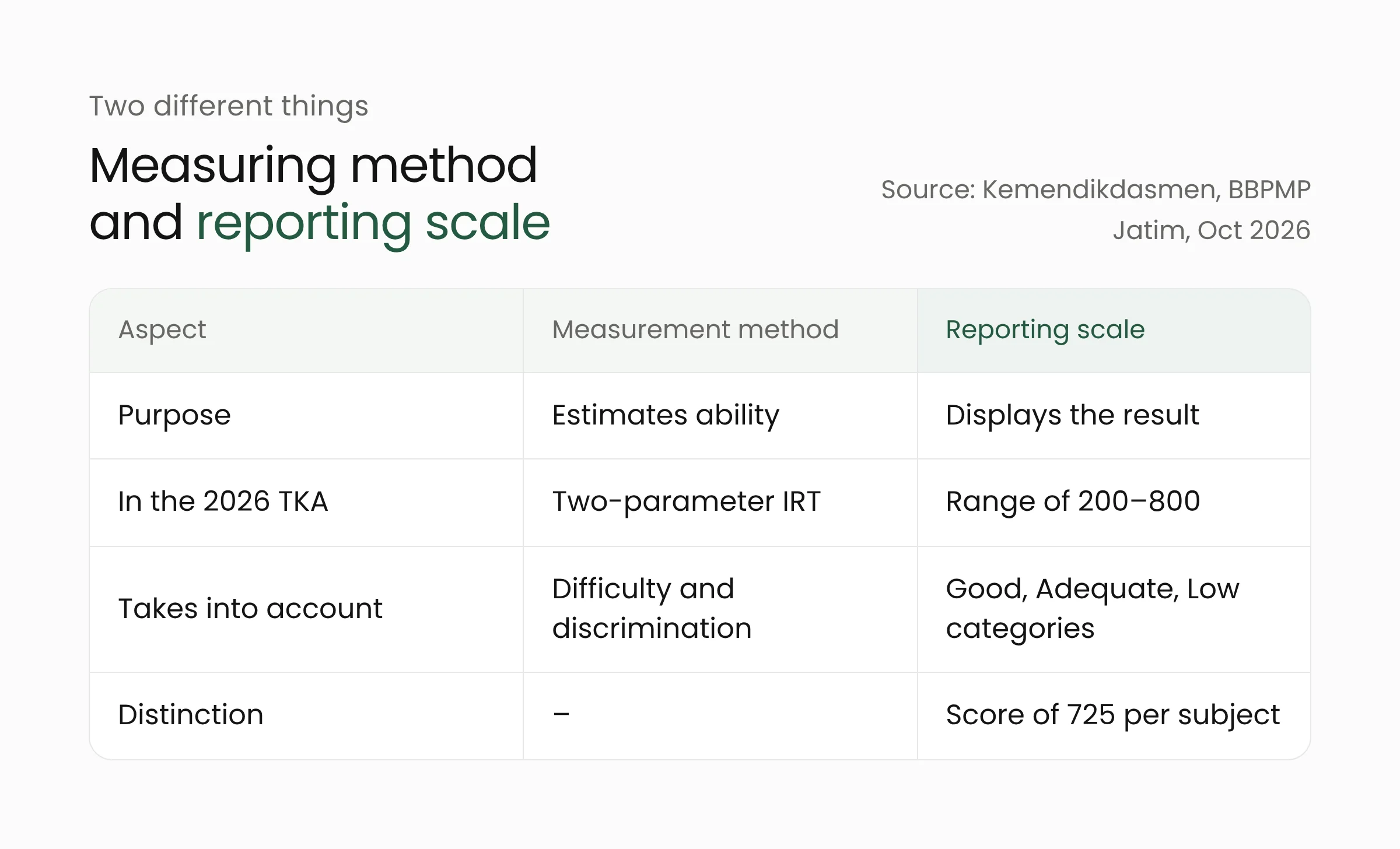
The ministry separates two ideas that are easily confused. The measurement method is how ability is estimated, which here means two-parameter IRT. The reporting scale is how that estimate is displayed, which here means 200–800.
That is why the ministry says the new scale does not make the questions harder or mean students have improved. New scores also cannot be converted to the old scale through simple division or multiplication. Dividing 600 by eight, for instance, does not produce a result equivalent to the 0–100 scale.
How to read a 200–800 score
Three points matter when reading a TKA score.
First, the score is an estimate of ability in each subject. It does not show how many questions a student got right, so the question “what percentage was correct?” cannot be answered from the score.
Second, small differences need care. Every statistical estimate carries measurement error, a band of uncertainty around the reported number. The ministry says small score differences should be interpreted with that error in mind. Two students whose scores are only a few points apart may not differ meaningfully in ability.
Third, scores can be compared across years. The ministry says year-to-year equating is done by estimating ability with two-parameter IRT. This lets schools compare one cohort’s results with the next.
The ministry also explained how results should be used. Schools can combine TKA results with classroom assessment and student work to decide who needs extra learning support. Parents can use them to understand where their children struggle. For universities, the TKA provides standardized achievement data that can complement report-card grades in merit-based admissions, in line with applicable rules.
Toharudin was clear about the end goal. “Angka 200–800 akan bermakna apabila membantu kita membaca capaian murid dan memperbaiki pembelajaran,” he said, as quoted by BBPMP Jawa Timur. In English: the 200–800 figures matter only if they help educators read student achievement and improve learning.
The test is under way this week
According to the ministry’s Directorate of Special Education and Special Education Services, 3,864,195 students registered out of 4,213,114 eligible candidates, or 91.72%. Toharudin gave the figures at a media briefing on October 23, 2026.
The regular TKA runs in two waves, October 26–29 and November 2–5, 2026. A special wave for compulsory subjects is scheduled for October 31 to November 1, and for elective subjects on November 7–8. The online mode was prepared to serve up to 900,000 students at the same time, supervised by 50,474 room proctors and 1,710 supervisors from state universities.
The rollout has not been entirely smooth. Jawa Pos reported that session 1 on the second day, Tuesday, October 27, ran into network problems that affected some students. The ministry is holding a special session on Friday, October 30, 2026, starting at 07:00 Western Indonesia Time for students who need to be rescheduled. The cause of the disruption and the number of affected students have not been announced.
What this means for schools
The new scale changes how schools explain results to students, parents, and teachers. Several steps can be prepared before results come out.
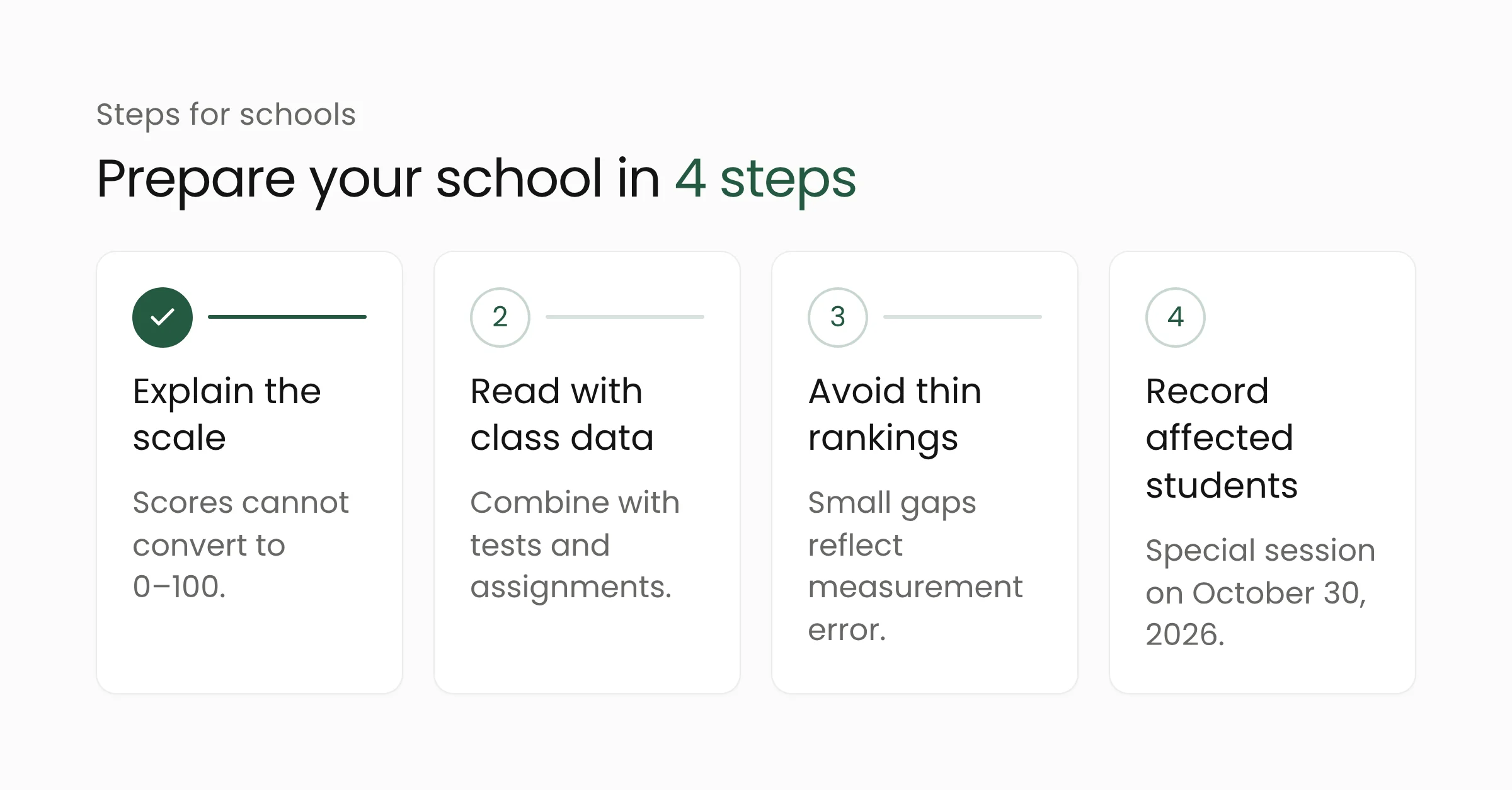
- Prepare a short explainer for students and parents. Make clear that the score is not a percentage correct and cannot be converted to the 0–100 scale. A one-page note can prevent confusion when results are shared.
- Read scores alongside classroom data. Combine TKA scores with test grades, assignments, and teacher notes for each subject. A pattern that holds across several sources is more reliable than a single number.
- Avoid rankings based on small gaps. Group students by achievement category or by broad score bands. Rankings decided by a few points are easily wrong because of measurement error.
- Record students affected by disruptions. Following ministry guidance, problems that prevent a student from sitting the test on schedule are recorded in an official incident report and coordinated through the provincial education office or the regional office of the Ministry of Religious Affairs.
For education offices and foundations that run many schools, TKA results can also feed analysis. Breakdowns by school, subject, and achievement category can show where teacher training or student support is most needed. That work depends on clean data and readable reports, the kind of project handled through data analytics services.
Schools that run their own digital exams can also start recording answers question by question. With that data, teachers can see which questions are too easy, too hard, or poor at separating students, the same principle the TKA applies at a far larger scale.
Frequently asked questions
Does a TKA score of 600 mean 60% of answers were correct?
No. The ministry says the 200–800 scale is a reporting format that accounts for question characteristics. A score of 600 does not mean the student answered 60% of questions correctly.
Are the 2026 TKA questions harder because the scale changed?
According to the ministry, the scale change does not mean the questions are harder or that students have improved. Difficulty is set by question design, while the scale only determines how results are displayed.
What score earns the Distinction designation in the senior high TKA?
Senior high and vocational students receive the Distinction designation if they score 725.00 or higher on every subject, according to BBPMP Jawa Timur, citing Ministerial Decree No. 56 of 2026.
Closing thoughts
The 200–800 scale brings TKA scoring in line with how large-scale tests measure ability. It also calls for more careful explanations to students and parents. Schools that prepare their explainers and classroom data now will be better placed when results are released. Merakit helps schools organize digital exams and learning data through its education technology solutions.
Sources
- Kemendikdasmen, Kemendikdasmen Jelaskan Skala Skor TKA 200–800 untuk Menggambarkan Kemampuan Akademik Murid, October 24, 2026
- BBPMP Jawa Timur, Skor TKA SMA/SMK Berubah Jadi 200–800, Ini Penjelasan Kemendikdasmen, October 2026
- Kemendikdasmen PKPLK Directorate, Kemendikdasmen Pastikan Kesiapan Pelaksanaan TKA 2026, Termasuk di Daerah Terdampak Bencana, October 2026
- Kompas.com, Seperti Ini Mekanisme Penilaian TKA SMA Sederajat 2026, October 28, 2026
- Jawa Pos, Kemendikdasmen Gunakan Skala Skor 200-800 dalam TKA Jenjang SMA untuk Asesmen, October 26, 2026
- Jawa Pos, TKA Hari Kedua Sempat Terkendala, Kemendikdasmen Siapkan Jadwal Ulang, October 28, 2026