Blog Supercomputers
TOP500 November 2026: Fewest New Supercomputers on Record
On this page· 7 sections
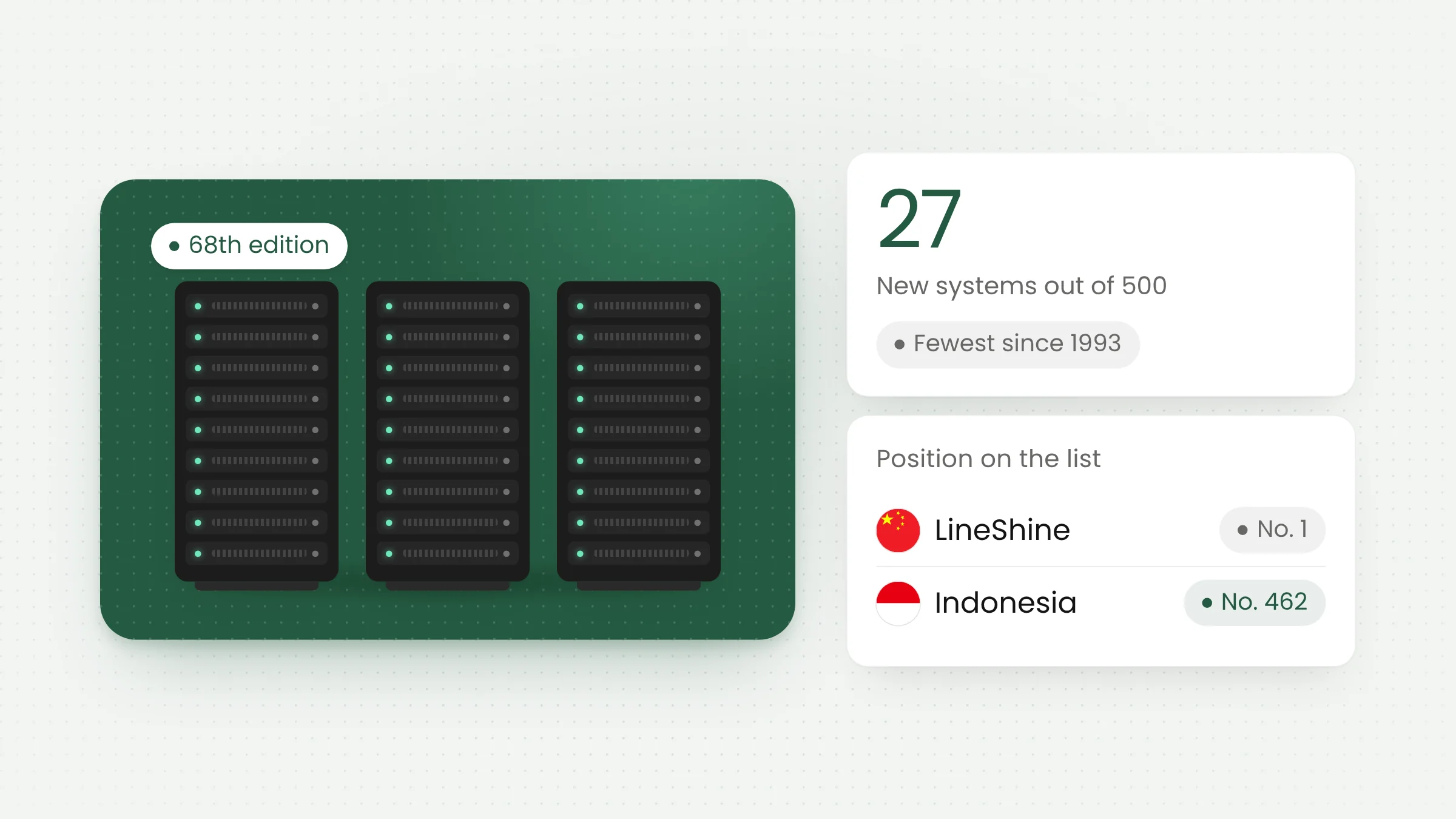
The November 2026 TOP500 list contains only 27 new supercomputers, the fewest since the ranking began in 1993. The top ten is unchanged and China’s LineShine remains No. 1. Indonesia’s only entry, the ASEAN-Korea HPC facility in Cibinong, slipped from No. 435 to No. 462.
An unchanged top ten since June
The TOP500 ranks the 500 fastest supercomputers in the world and is published every June and November. The 68th edition was announced on November 16, 2026 at the SC26 conference in Chicago. In the official release, the list’s authors said the ten leading systems kept their June order.
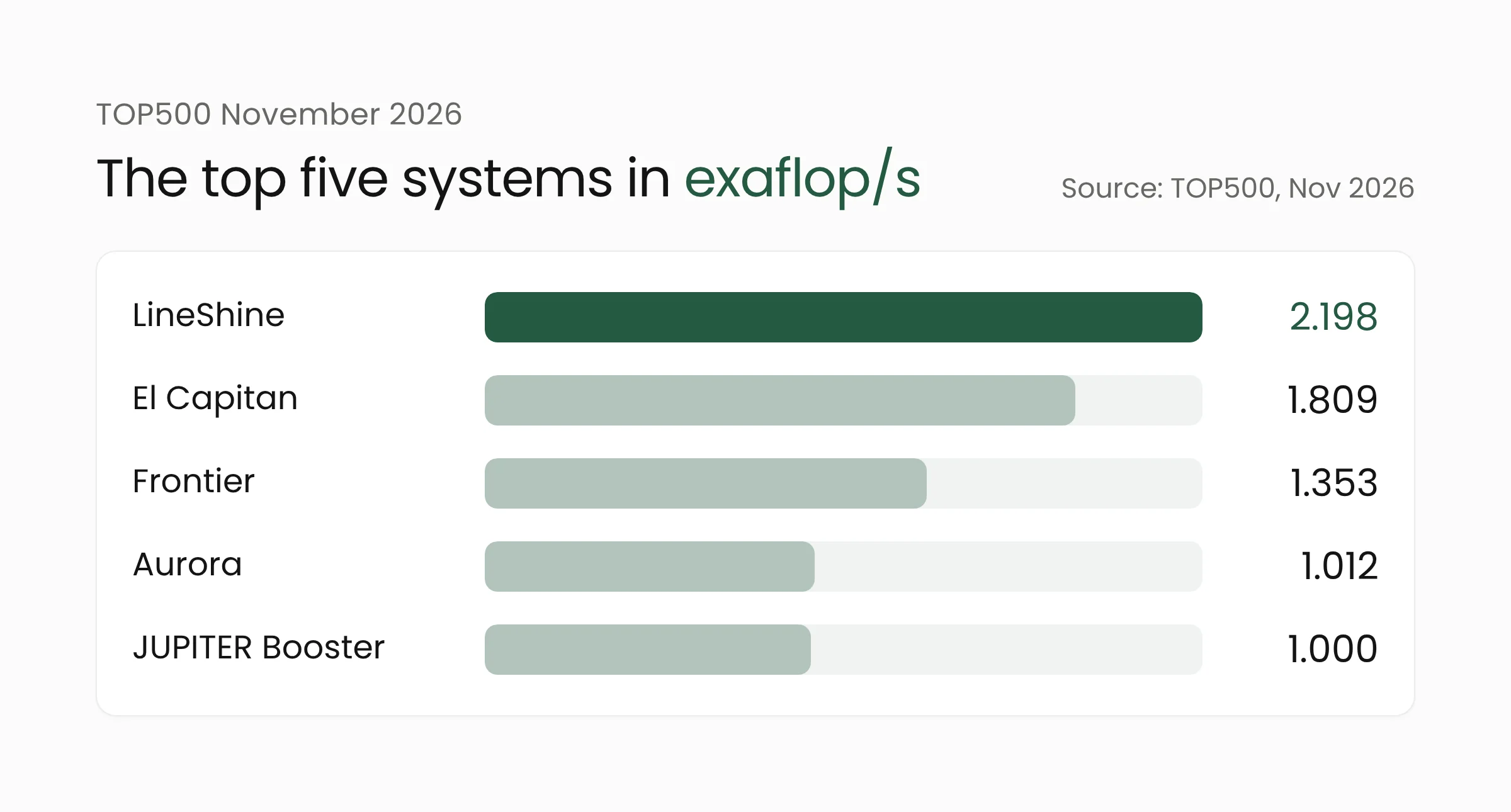
LineShine, at the National Supercomputing Centre in Shenzhen, holds first place with 2.198 exaflop/s. One exaflop equals 1,000 petaflops, and one petaflop is a quadrillion calculations per second. El Capitan at Lawrence Livermore National Laboratory is second at 1.809 exaflop/s, followed by Frontier (1.353), Aurora (1.012), and Germany’s JUPITER Booster (1.000). Those five are the only systems at one exaflop or above.
HPC7, Eagle, HPC6, Fugaku, and Alps fill positions six through ten. Eagle belongs to Microsoft Azure, and Hardware Busters notes that it is the only cloud system in the top ten. The outlet also describes LineShine, which took the top spot from El Capitan in June 2026, as the first Chinese system to lead the list since Sunway TaihuLight in 2017.
How the TOP500 measures speed
The ranking is based on the High Performance Linpack (HPL) benchmark. According to the TOP500’s own description, the test asks a computer to solve a very large system of linear equations in 64-bit precision. The project acknowledges that no single number can reflect the overall performance of a system.
Companion benchmarks fill in the picture. On HPCG, designed to reflect data-intensive applications, LineShine also leads with 22.00 petaflop/s. On the mixed-precision HPL-MxP test, El Capitan is in front at 16.7 exaflop/s, ahead of Aurora (11.6) and Frontier (11.4). On the Green500 energy-efficiency ranking, the KAIROS system in France stays first at 73.28 gigaflop/s per watt, and that top ten did not change either.
Only 27 new systems out of 500
Of the 500 systems, 27 are new, or 5.4 percent. The TOP500 calls this the lowest turnover in the history of the list and well below the normal movement between editions.
Performance inside the list still rose. The system at No. 500 now delivers 2.857 petaflop/s, up 7.3 percent from 2.662 petaflop/s in June. The threshold at No. 50 climbed 12 percent to 55.81 petaflop/s, and the No. 100 threshold went from 21.85 to 22.74 petaflop/s. Combined performance across all systems grew 4.4 percent to 19.57 exaflop/s. Systems using accelerators such as GPUs increased from 275 to 291, or 58.2 percent of the list.
The TOP500 reads those figures as a sign that more of the improvement is coming from additions and upgrades below the very top. The highest-ranked newcomer is HANGANG at the KISTI Supercomputing Center in South Korea, at No. 12. The HPE Cray EX254n system pairs NVIDIA Grace CPUs with GH200 Superchips and delivers 342.6 petaflop/s. Two places lower, StorageReview reports, is another debut: Lux at Oak Ridge National Laboratory.
New hardware is going to AI factories
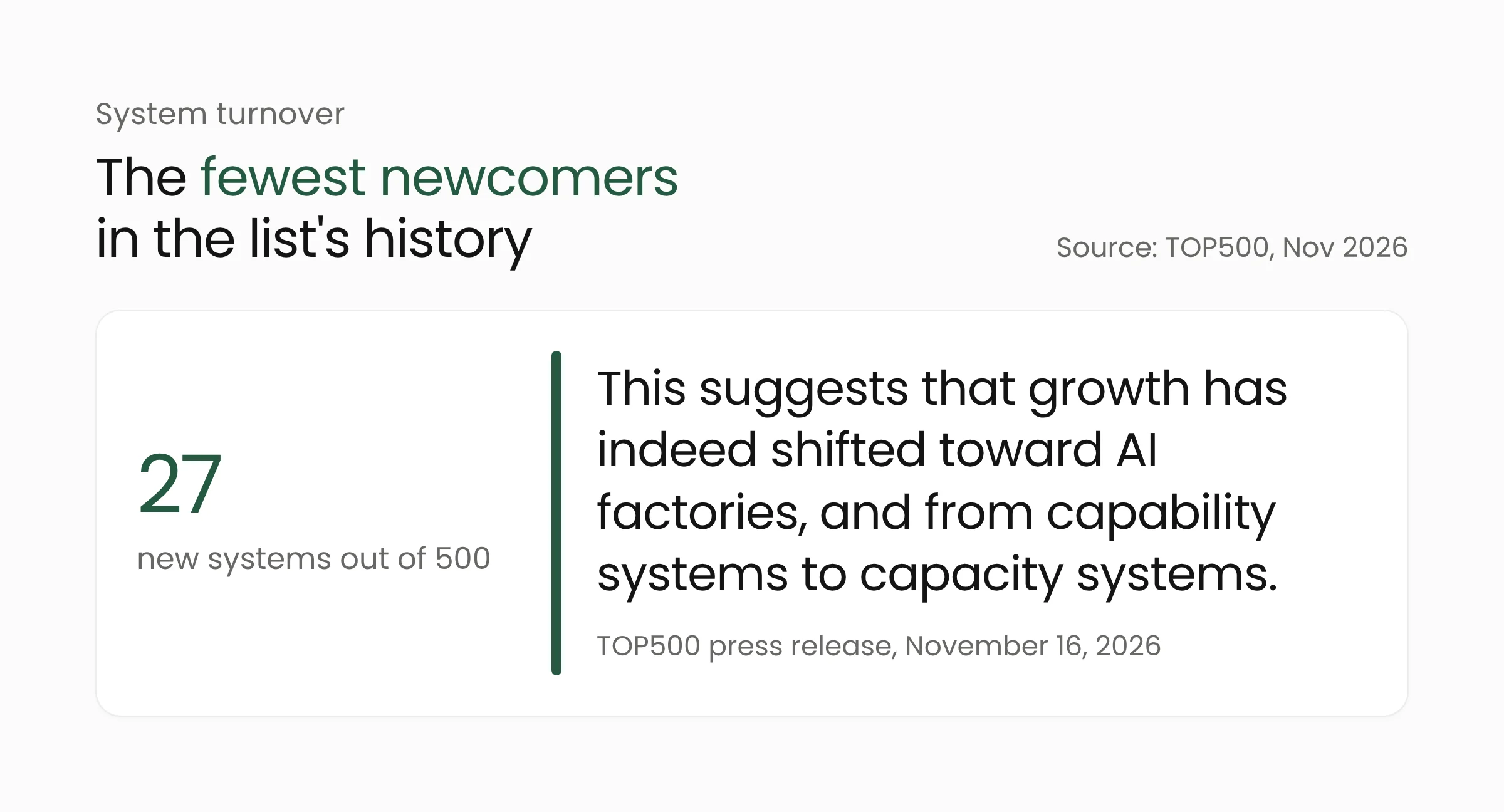
The computing hardware market is booming, which raises the question of where new machines end up. The TOP500 release answers with data from research group Epoch AI. Quarterly additions to global AI computing capacity have grown roughly 2.5 times per year, and cumulative capacity has passed the equivalent of 15 million NVIDIA H100 GPUs. As of the fourth quarter of 2025, five major U.S. hyperscalers owned an estimated 71 percent of global AI compute, much of it in very large clusters often called AI factories.
The TOP500 sums it up in one sentence: “This suggests that growth has indeed shifted toward AI factories, and from capability systems to capacity systems.”
A capability system is one large machine pointed at a single enormous calculation, such as a climate simulation. A capacity system serves many medium-sized jobs at once, such as training and running AI models for many customers.
Hardware Busters adds its own analysis. The outlet argues that operators of AI training clusters have little reason to halt work for hours to run Linpack, and that much of their hardware is tuned for lower precision anyway. The largest privately owned systems are therefore never benchmarked in public. The outlet still regards the TOP500 as a consistent public record of scientific supercomputing.
The ASEAN-Korea HPC facility at No. 462
The full November 2026 list includes one system from Indonesia, recorded as ASEAN-Korea HPC Facility in Indonesia. It runs on Lenovo ThinkSystem SR675 V3 servers with AMD EPYC 9335 processors and NVIDIA H200 GPUs, has 9,472 cores, and delivers 3.10 petaflop/s. On the June 2026 list, the same system sat at No. 435 with the same score.
Other systems got faster while this one stayed the same. Its margin over the entry threshold is now about 0.24 petaflop/s.
Indonesia’s National Research and Innovation Agency (BRIN) said in its announcement that the facility was inaugurated on June 18, 2026 at the B.J. Habibie Building in Jakarta. The hardware arrived on April 21, 2026 and is housed at the Soekarno Science and Technology Area in Cibinong. BRIN lists the theoretical peak at 4.28 petaflop/s, while the TOP500 records 4.29.
The facility is part of the Korea-ASEAN Digital Innovation Flagship Project (KADIF) and was built with KISTI, the same institute that operates HANGANG. IDN Times reports funding of US$10 million over four years, from 2024 to 2028. BRIN says the facility is open to researchers, industry, policy analysts, and development planners across ASEAN, for work that includes climate modeling, disaster mitigation, food and energy security, healthcare, and AI application development.
Where other Southeast Asian countries stand
Our review of the official list found four Southeast Asian countries. Singapore has seven systems, led by ASPIRE 2B (GPU partition) at No. 47 with 66.40 petaflop/s. Vietnam has two, FPT AI Factory Vietnam at No. 59 and Viettel AI Platform at No. 67. Thailand also has two, the higher at No. 155. The United States, for comparison, has 163.
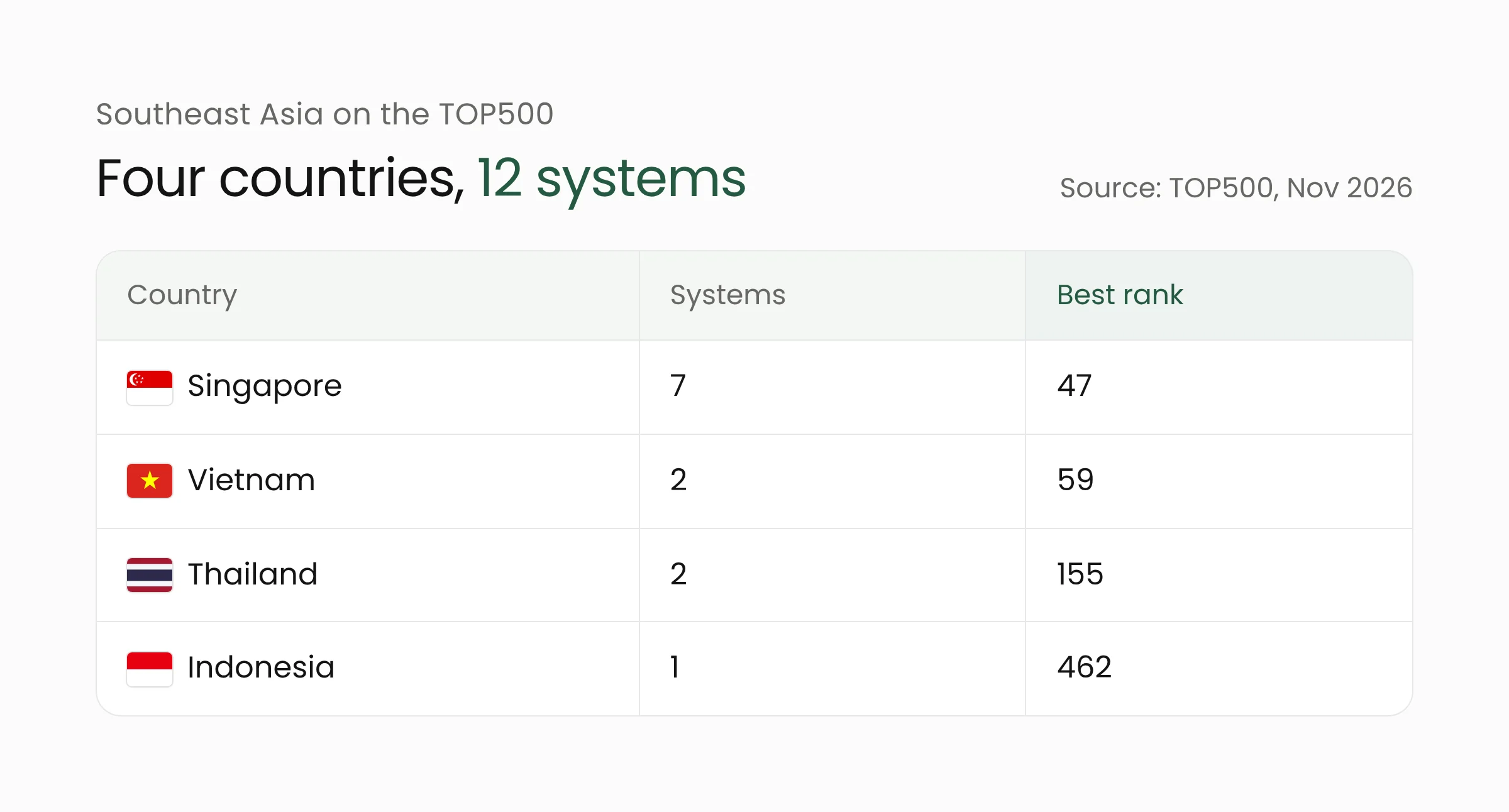
Both Vietnamese systems carry AI factory or AI platform in their names, in line with the shift the TOP500 describes. Export policy also shapes GPU purchases in the region, as covered in our article on the U.S. license rule for AI chips bound for Indonesia.
What this means for research and data teams in Indonesia
A TOP500 rank does not measure how useful a machine is to its users. For universities, research institutes, and companies weighing their compute needs for AI or simulation, the following considerations matter more than the ranking.
- Size the need from your own workload. HPL tests one kind of calculation in 64-bit precision. AI model training generally runs at lower precision and follows a different pattern. Test your own jobs on the machine on offer before committing.
- Decide whether you need capability or capacity. Few organizations need a single enormous calculation. Most run many medium-sized jobs, which can be served by renting GPUs through cloud computing services when they are needed.
- Use shared facilities. BRIN says the Cibinong facility is open to researchers and industry. Teams with seasonal demand can ask BRIN about the application procedure before buying their own hardware.
- Account for power and cooling. The TOP500 list records LineShine drawing 42,220 kilowatts. Even at a far smaller scale, electricity and cooling belong in the budget from the start, next to the price of the hardware.
- Prepare the data and the team first. Rented or purchased GPUs do little good when the data is not in order. A machine learning development project is better started with clean data, a measurable goal, and small experiments, with compute capacity added as results come in.
Frequently asked questions
What is the TOP500?
The TOP500 is a list of the 500 supercomputers with the highest scores on the High Performance Linpack benchmark. The project began in 1993 and is updated every June and November, alongside the HPCG, HPL-MxP, and Green500 rankings.
Does Indonesia have a supercomputer on the TOP500?
Yes, one. The ASEAN-Korea HPC Facility in Indonesia, in Cibinong, is No. 462 on the November 2026 list with 3.10 petaflop/s. In June 2026 it was No. 435.
Why are the big tech companies’ AI data centers missing from the list?
The TOP500 only includes systems whose benchmark results are reported. The list’s authors believe hardware growth has shifted to AI factories owned by hyperscalers. Hardware Busters suggests the operators of those clusters are reluctant to pause work for a Linpack run that takes hours.
Closing
The November 2026 edition shows a quiet top and a rising entry threshold. The TOP500 expects the next change at the top once the next generation of large systems reports measured results. For Indonesia, No. 462 marks an early presence on the list, and its value will be decided by the research the facility produces. If your team is sizing compute for an AI or analytics project, the Merakit team is ready to talk.
Sources
- TOP500 Leadership Holds Steady as New System Turnover Falls to a Historic Low, TOP500, November 16, 2026
- TOP500 List, November 2026, TOP500, November 2026
- TOP500 List, June 2026, TOP500, June 2026
- The Linpack Benchmark, TOP500, accessed November 22, 2026
- TOP500 List Adds Just 27 New Systems, the Fewest Ever, as Growth Shifts to AI Factories, Hardware Busters, November 18, 2026
- SC26 Roundup: Record-Low TOP500 Turnover, StorageReview, November 19, 2026
- Indonesia Jadi Lokasi Fasilitas ASEAN–Korea High Performance Computing, BRIN, June 18, 2026
- BRIN dan Korea Resmikan Fasilitas HPC ASEAN-Korea 4,28 PFlops, IDN Times, June 28, 2026