Blog Chip Design
OpenAI Uses AI for Chip Design, Claims Up to 14% Gain at AMD
On this page· 7 sections
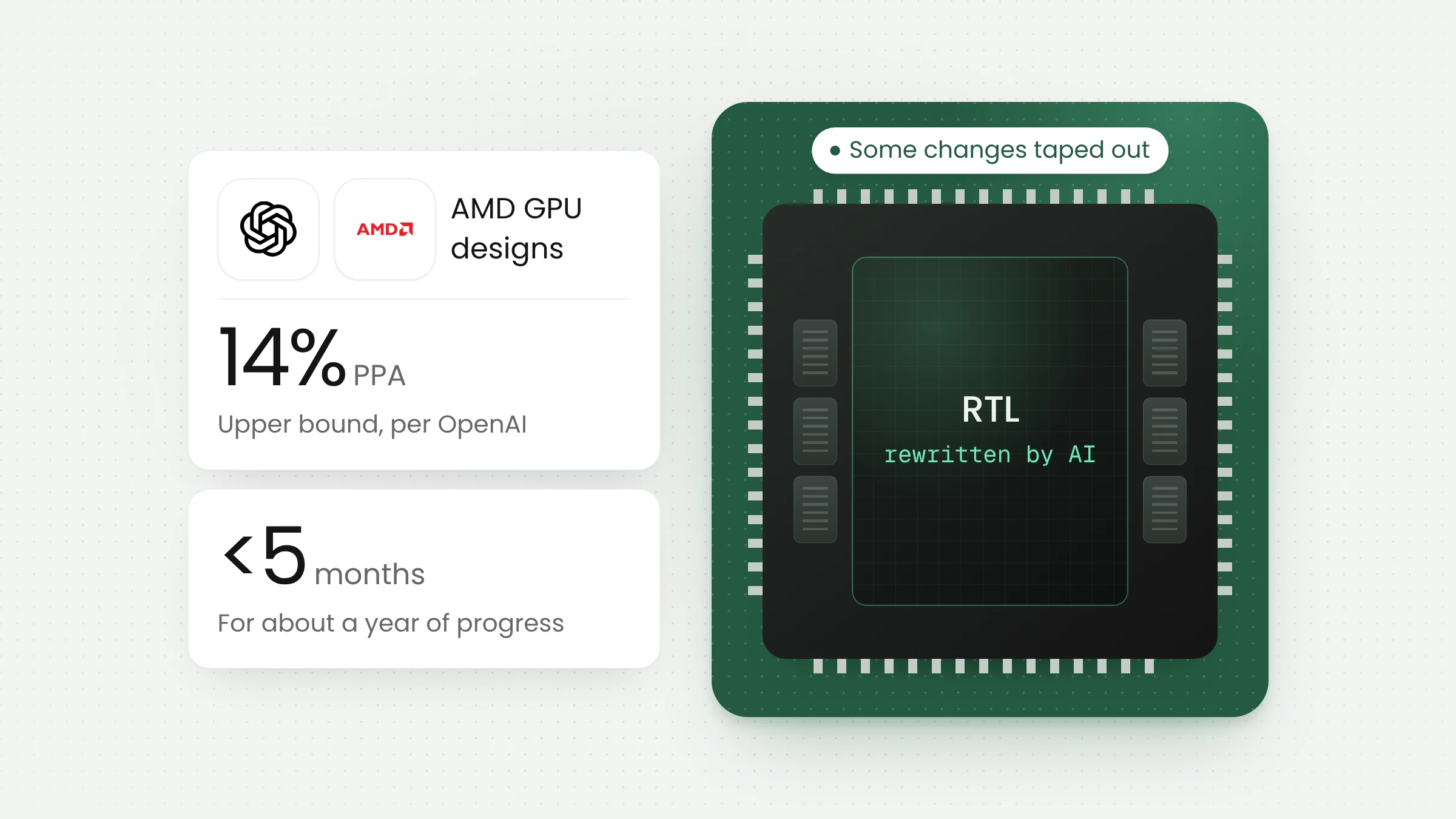
OpenAI said on November 18, 2026 that its AI models are now helping to design chips. According to the company, the models improved power, performance, and area (PPA) by up to 14% on AMD’s flagship GPU designs and shrank key parts of Jalapeño, OpenAI’s own inference chip. Some of the changes are already in an AMD design sent for manufacturing.
What OpenAI claims about AMD’s GPU designs
In a research post titled Advancing chip design with OpenAI models, OpenAI said its models worked on blocks of AMD GPU circuitry that engineers had already optimized heavily. The best result was a PPA gain of up to 14% over those baselines, as reported by The Next Web.
PPA stands for power, performance, and area, the three main measures in chip design. A circuit that uses less power, runs faster, or takes up less silicon lowers both manufacturing and operating costs. On a chip produced in the millions, a gain of a few percent is worth a great deal.
OpenAI described the work as roughly a year of progress achieved in under five months. According to Analytics India Magazine, AMD included some of the changes in a recently taped-out design, meaning the final design has been sent to the factory to be fabricated. Other changes went into production design files for future versions.
The second result concerns processors. AMD independently verified single-digit percentage PPA gains across key blocks of its upcoming next-generation flagship CPU, using designs written with OpenAI’s models. Of all the figures in the announcement, the CPU result is the only one AMD is reported to have checked itself.
How the models change a chip design
Modern chips are not drawn transistor by transistor. Engineers describe circuits in a hardware description language such as SystemVerilog. This code, known as RTL (register-transfer level), defines how a circuit computes, handles control operations, and moves data.
OpenAI’s models rewrote that RTL code. They tried other ways to build a circuit, split calculations across pipeline stages, and shared hardware between functions. Each proposal was then run through electronic design automation (EDA) tools from Synopsys to confirm that the block still behaved the same way and to measure the effect on power, speed, and area.
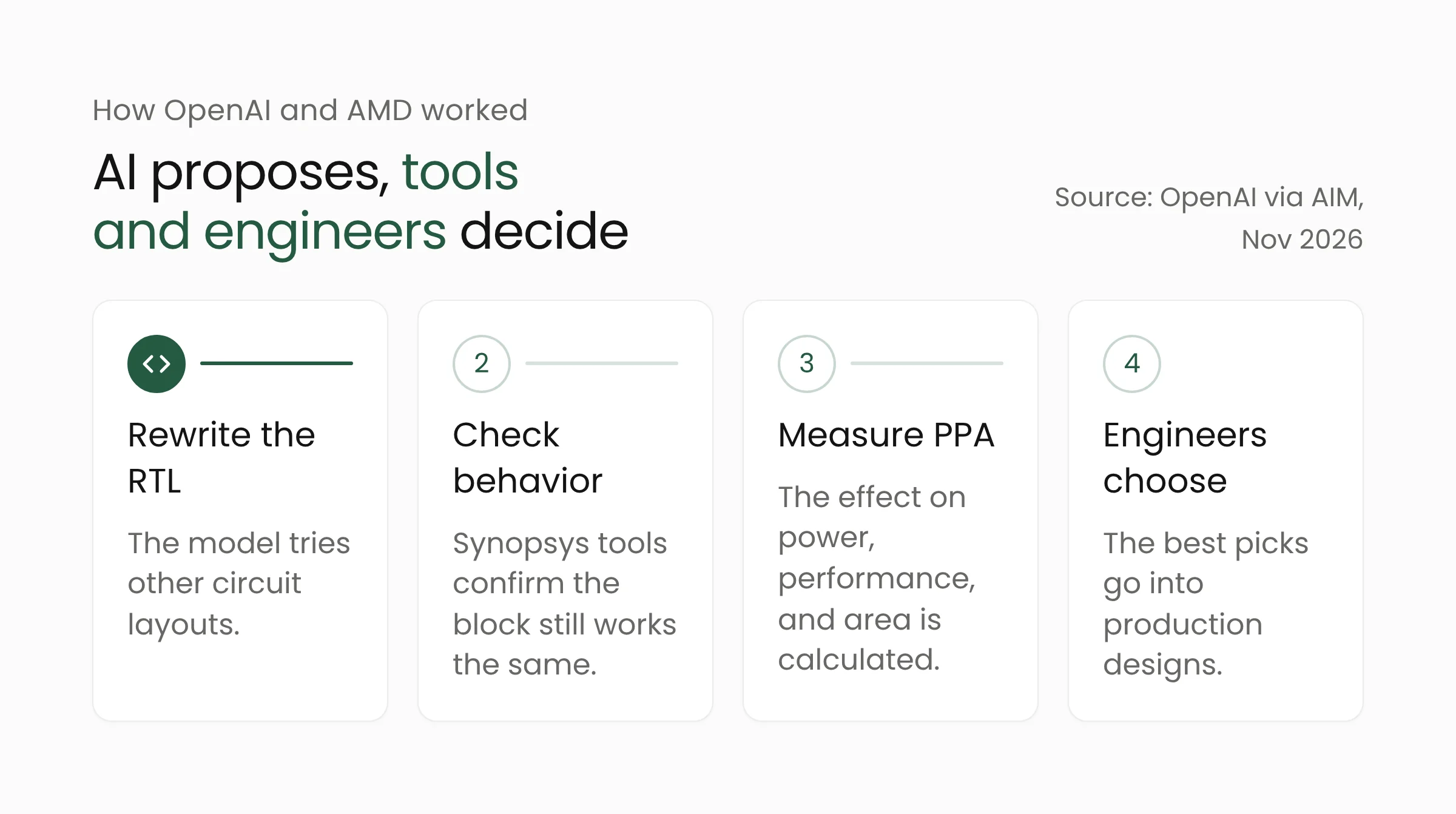
The order of the work matters. The model’s job is to propose many alternatives quickly, while the final call rests with verification tools and engineers. According to The Next Web, OpenAI’s chip chief, Richard Ho, said last month that he does not yet fully trust design changes made by AI. Every change is therefore checked.
Jalapeño, OpenAI’s first chip
OpenAI also used its models on Jalapeño, its first in-house inference chip. The Next Web reports that Jalapeño went from design to manufacturing in nine months. Model-suggested changes reduced standard-cell area by about 13% in the vector unit and about 10% in the matrix unit, and those changes worked in finished silicon.
Tests on open-source processors
To compare its models, OpenAI tested five model generations on two small open-source processors. The newest, GPT-6.2 Astra, scored highest both when improving existing designs and when building a processor from a written specification. OpenAI acknowledged that the second task was easier because the models could leave out features that the original designs included.
The limits of the claim and the role of Synopsys
The 14% figure needs careful reading. According to 24/7 Wall St., it is a ceiling measured on specific GPU blocks. OpenAI did not say how much of it came from power savings, higher performance, or smaller area. The figure also does not show how much faster a finished AMD GPU would run.
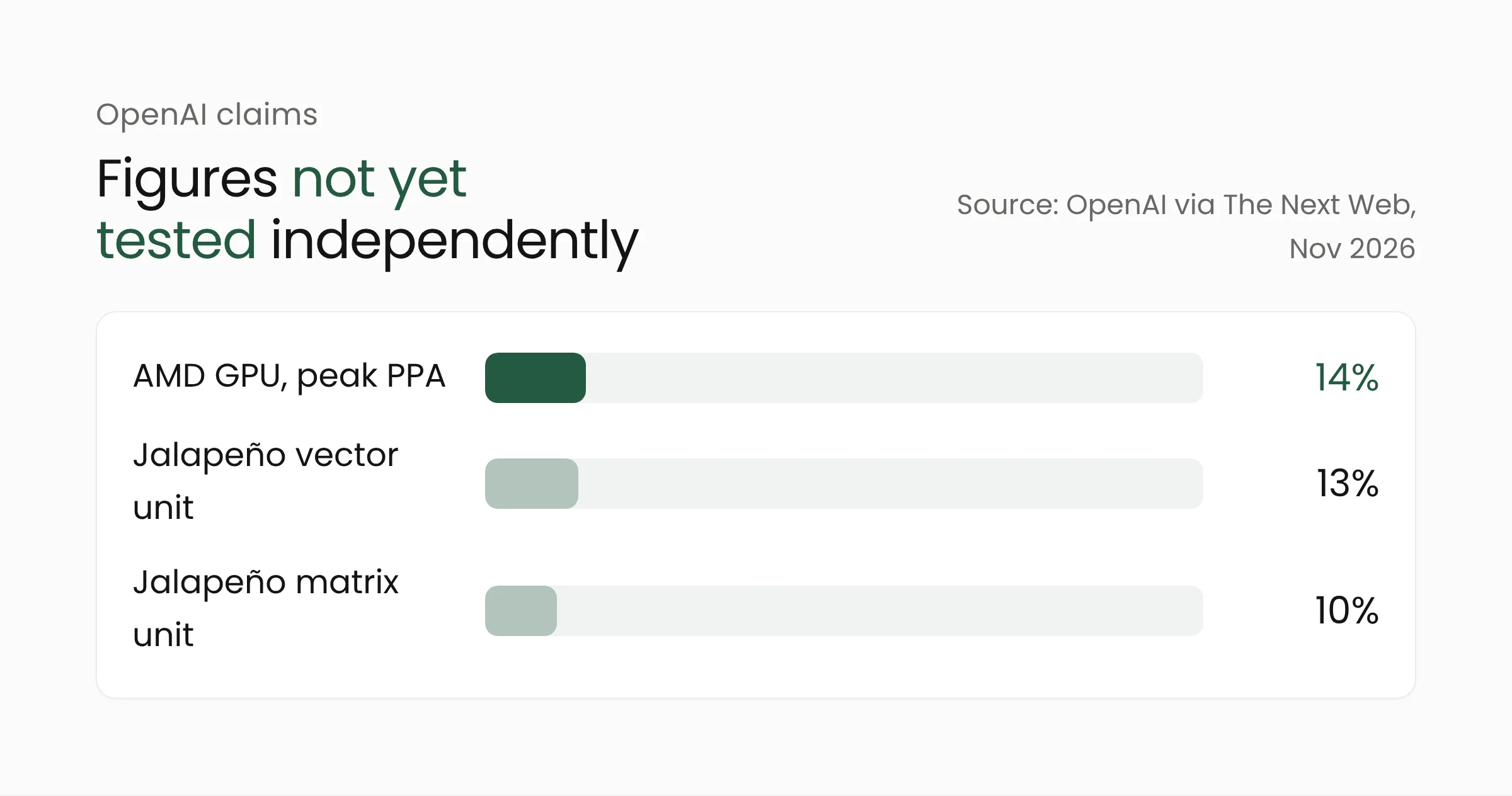
There are three more caveats. First, the performance figures and AMD’s confirmation come from OpenAI’s own post and have not been tested independently. Second, no measurements from finished AMD silicon have been reported, and a taped-out design is still a long way from a product on sale. Third, the two companies have close business ties. Since October 2025, OpenAI has agreed to use up to six gigawatts of AMD GPUs and holds the right to buy up to 160 million AMD shares.
AMD chief executive Lisa Su responded on social media and praised the engineers at both companies. According to 24/7 Wall St., AMD has not issued a separate formal statement.
GPT-Synopsys still relies on verification tools
Synopsys makes the EDA software used by many of the world’s chip designers. On September 30, 2026, Synopsys and OpenAI announced a partnership to develop GPT-Synopsys, an AI model trained for chip design tasks, from describing circuits in code to laying out billions of transistors.
According to Reuters, as republished by The Star, OpenAI pays a subscription fee to train the model on Synopsys tools. When Synopsys customers use the product, the two companies share revenue based on how much the model improves a chip’s design. Synopsys chief executive Sassine Ghazi said the model’s output is still checked by traditional verification tools because the model “needs these guardrails in order to check the physics.”
If GPT-Synopsys becomes a product, other chip designers will be able to buy it as well. In 24/7 Wall St.’s analysis, that could limit AMD’s head start as OpenAI’s early partner to a matter of months.
What this means for industry in Indonesia
Few companies in Indonesia design their own chips. One recent example is the Chip Merah Putih prototype for e-passports from Peruri and ITB. The working pattern in OpenAI’s announcement applies more widely, though, especially to factories and engineering teams that have started using AI to write machine code, sensor firmware, or PLC logic for production lines.
Several practices from this case can be applied:
- Start with small, measurable blocks. OpenAI and AMD worked on specific circuit blocks rather than a whole chip. In a factory, the equivalent might be one firmware module for a temperature sensor or the logic for a single packaging machine.
- Build automated checks first. AI proposals are only useful when a tool can confirm that behavior has not changed, such as simulation, regression tests, or test-bench runs. Without those checks, every proposal must be reviewed by hand and the time savings disappear.
- Record a baseline before claiming results. Measure power use, cycle time, or memory footprint before a change, so any improvement can be shown with your own numbers.
- Keep engineers in charge. Log every change and the reason it was accepted, so the team can trace the source of a problem if something fails in the field.
- Protect design data. Before uploading designs to an AI service, check the contract: whether data is used for training, how long it is kept, and who can access it.
This approach fits industrial automation projects that combine sensors, machine data, and quality control. For teams that want to build their own models for narrow engineering tasks, machine learning development can help prepare the data, test tools, and ways to measure results.
Frequently asked questions
Can AI now design chips without engineers?
No. In the OpenAI and AMD case, the models proposed changes to RTL code, Synopsys tools checked that they were correct, and engineers chose which changes to use. Synopsys has also said the model’s output must still pass traditional verification tools.
Will AMD’s next GPU be 14% faster?
That cannot be concluded yet. The 14% figure is the upper bound of PPA gains on specific GPU blocks, with no breakdown of power, performance, and area. No measurements from finished AMD chips have been reported.
What is the Jalapeño chip?
Jalapeño is the first inference chip OpenAI has designed in-house. According to OpenAI, its AI models helped design it and reduced standard-cell area by about 13% in the vector unit and 10% in the matrix unit.
Conclusion
OpenAI’s announcement shows AI models working inside a strict engineering process: proposing many alternatives, with every proposal tested by verification tools and chosen by engineers. The 14% figure still has to be proven on chips that ship, but the working pattern can be studied now. If your team wants to try AI on engineering work or a production line in a measurable way, the Merakit team is ready to talk.
Sources
- Advancing chip design with OpenAI models, OpenAI, November 18, 2026
- OpenAI says its AI found 14% gains in AMD’s flagship GPU design, The Next Web, November 18, 2026
- OpenAI, AMD Use AI to Cut Chip Design Process From a Year to Under 5 Months, Analytics India Magazine, November 19, 2026
- OpenAI Says Its AI Improved AMD’s Best Chip Design by Up to 14%, 24/7 Wall St., November 19, 2026
- Synopsys, OpenAI strike deal to develop AI model for chip design work, Reuters via The Star, October 1, 2026