Blog Data Centers
Southeast Asia Data Center Curbs and the Indonesia Outlook
On this page· 7 sections
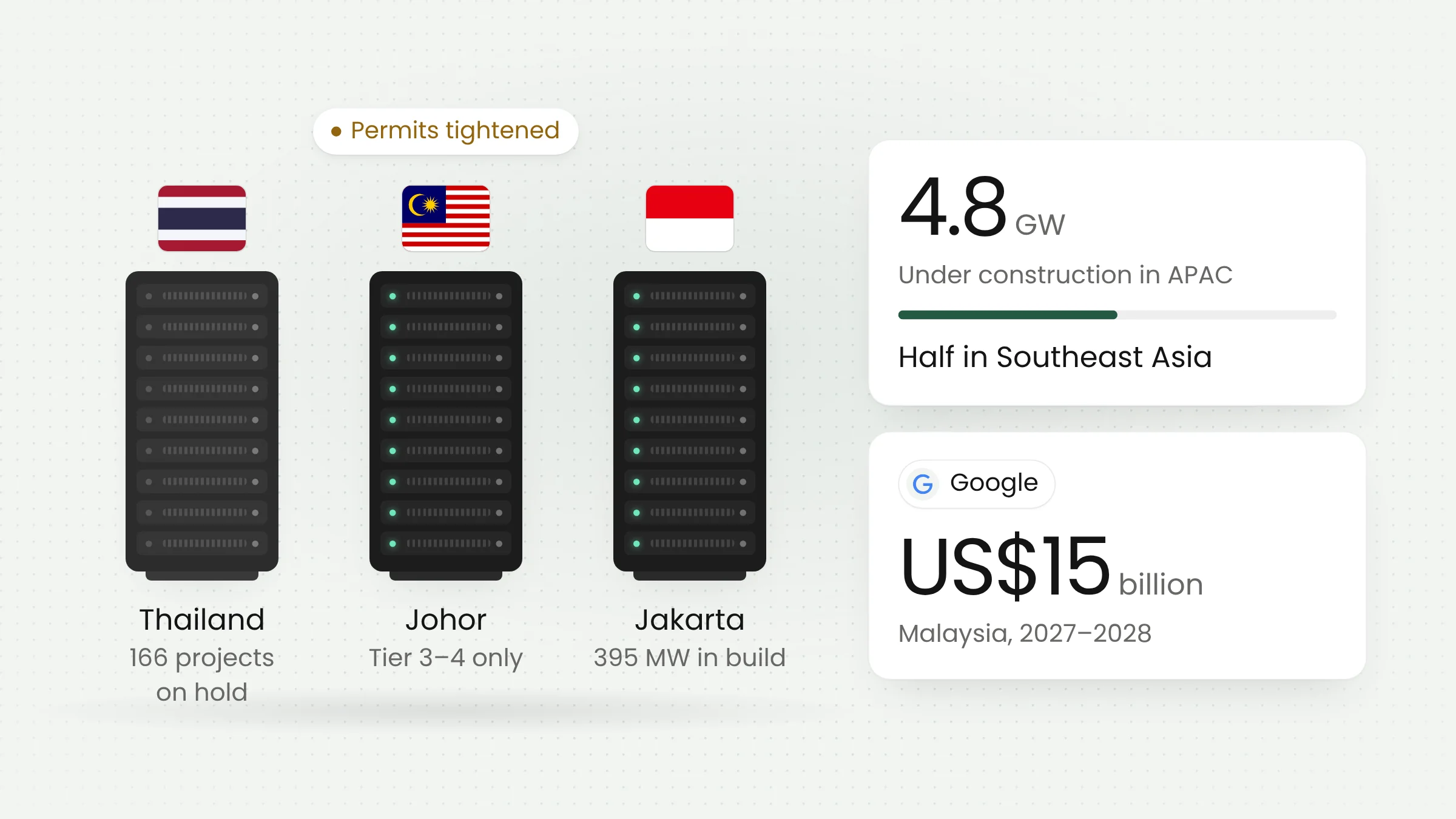
Southeast Asia’s data center build-out has entered a screening phase. Thailand has frozen 166 projects while it writes water, power and safety standards, Johor now approves only Tier 3 and Tier 4 facilities, and Google is still lining up US$15 billion for Malaysia. Jakarta, with 395 MW under construction, sits in the middle of that contest.
Thailand freezes 166 projects while it writes the rules
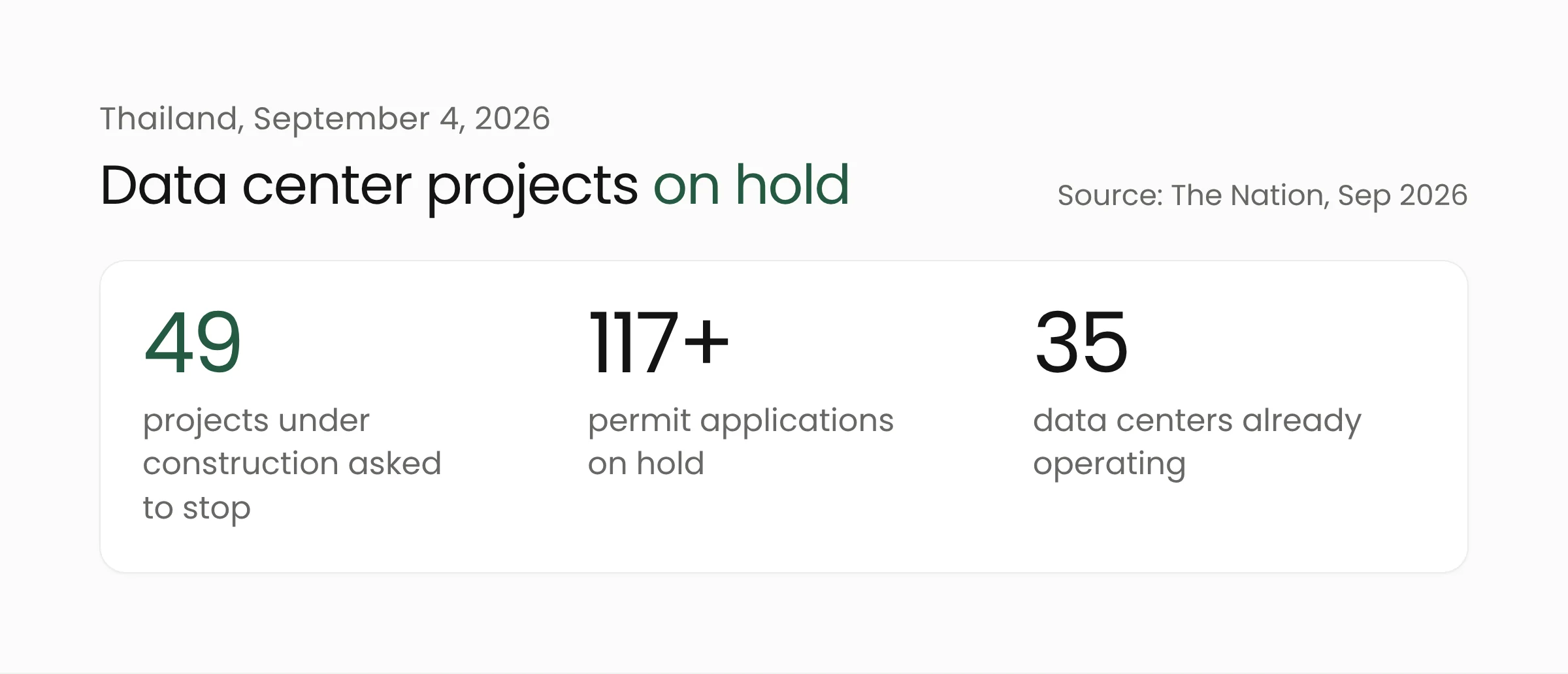
According to The Nation, Thailand’s national data center policy committee decided on September 4, 2026 to pause construction of about 49 projects already under way and to hold decisions on more than 117 pending applications, 166 projects in total. Data gathered by the National Economic and Social Development Council (NESDC) from 16 agencies showed 35 data centers already in operation.
The government said the move was not meant to turn away foreign investment. Its reasoning was that information on each project’s water and electricity needs was scattered across many agencies and was not good enough for oversight. The committee set up four subcommittees (economics, infrastructure, sites and buildings, and environment) and asked for water and power tariffs for data centers that reflect their actual cost.
The shape of the new rules is now emerging. The Nation reported on October 25, 2026 that the data center board will review a draft ministerial regulation on November 27, 2026. It would require operators to reuse at least 80% of monthly cooling-tower blowdown water, install meters and file monthly water-balance reports, and it defines a data center as a building drawing at least 0.5 MW of power. The rule would take effect 180 days after publication, and existing facilities would get one year to comply.
On timing, NESDC secretary-general Danucha Pichayanan said new applications are expected to reopen in early 2027 once the criteria go to cabinet, Reuters reported via The Star. On November 6, 2026, Prime Minister Anutin Charnvirakul met Ruth Porat, president and chief investment officer of Alphabet and Google. The Nation said Google shared its views on the planned water and electricity rules, while the government offered a one-stop permit service that uses AI at every stage.
Johor screens projects as Google adds billions in Malaysia
Malaysia has taken a different route. The state of Johor, across the causeway from Singapore, stopped approving Tier 1 and Tier 2 data centers in November 2025, W.Media reported. Tiers describe how resilient a facility is. Tier 3 and Tier 4 sites have backup power and cooling paths, so maintenance can be carried out without shutting servers down.
Johor’s government considers Tier 1 and Tier 2 facilities heavy water users. New applications now go to a dedicated coordinating committee that weighs water and power use, environmental impact, water and power usage effectiveness, fiber availability and water-saving cooling. Data centers must also use reclaimed water and can only be built in designated industrial zones.
The screening has not stopped large investments. On November 4, 2026, Google announced plans to invest about US$15 billion in Malaysia across 2027 and 2028. According to The Next Web, the money will expand its Elmina campus in Selangor and fund new campuses in Selangor and Negeri Sembilan. Google also said it will add more than 1 GW of clean power capacity and fund a US$160 million reservoir and treatment plant in Negeri Sembilan, expected to supply 65 million liters of drinking water a day. Its economic impact figures, including more than 37,000 construction jobs a year, are Google’s own estimates and have not been independently verified.
Both countries are following a similar pattern. Large investors keep arriving, but approval now depends on water supply, power and benefits for local communities.
Where Jakarta stands on the regional capacity map
Cushman & Wakefield put the Asia Pacific data center development pipeline at a record 26.5 GW in the first half of 2026. Of that, 4.8 GW was under construction, and about half of it was in Southeast Asia, led by Malaysia (1,039 MW) and Thailand (859 MW).
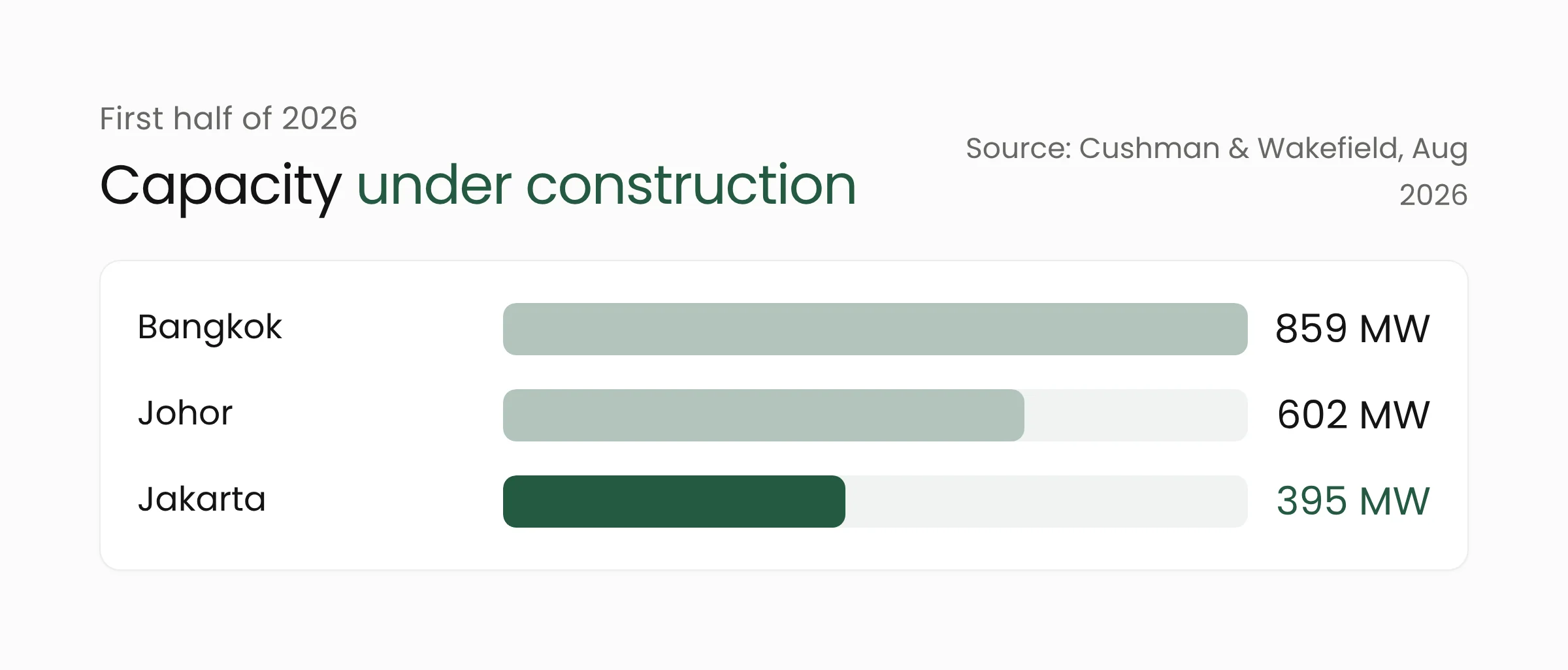
Jakarta had a 1,699 MW pipeline, up 56%, with 395 MW under construction, up 112%. For comparison, Johor had 602 MW and Bangkok 859 MW under construction. “AI and cloud investment across Asia Pacific has entered a phase of rapid, power-constrained execution,” said Andrew Green, head of Cushman & Wakefield’s Asia Pacific Data Centre Group. In other words, projects are moving fast, and the pace is set by how quickly power can be delivered.
With Thailand holding permits and Johor filtering projects, some investors may look at other markets, including Jakarta and Batam. The same question is already being asked in Indonesia. Speaking at a CNBC Indonesia event on November 3, 2026, Ismail, secretary-general of the Ministry of Communication and Digital Affairs (Komdigi), asked how much of the country’s data center capacity actually serves Indonesian needs, and warned against using up domestic power and water to serve other countries, CNBC Indonesia reported.
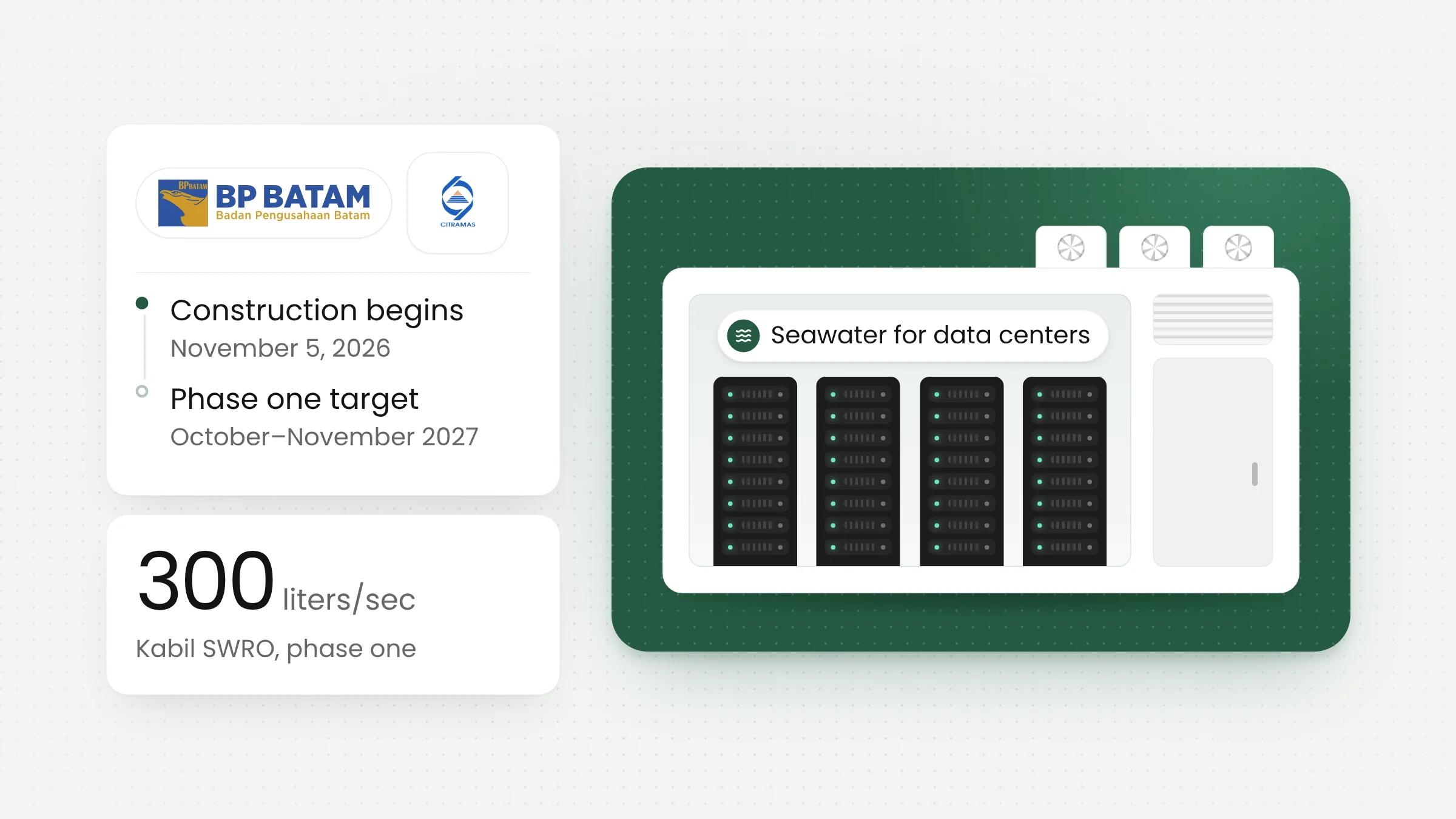
Water is already a practical issue in Batam, where a seawater treatment plant to supply data centers is now under construction in the Kabil industrial estate, as covered in our piece on the Kabil SWRO plant for Batam data centers. Last month, an AI data center project in Jatiluhur was also halted because its permits were incomplete. Both cases show that environmental permits and resource supply now set the schedule, as they do in Thailand and Johor.
What this means for organizations using the cloud
For banks, hospitals, online retailers or government agencies that rent rack space (colocation) or cloud services in Jakarta, rule changes next door affect capacity and pricing indirectly. A few steps are worth taking now.
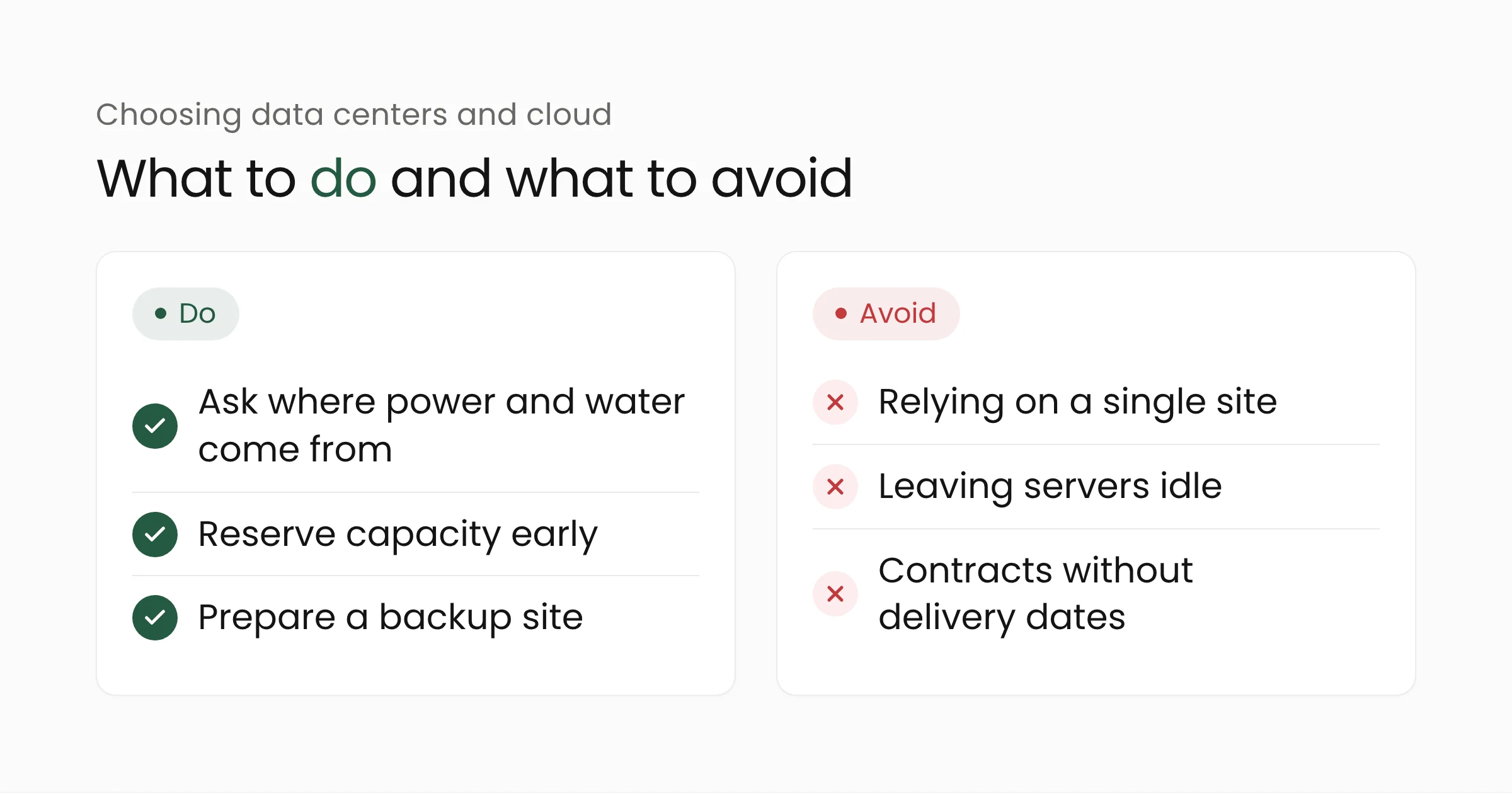
- Ask where the power and water come from. Ask your provider to explain its power supply, backup plans and efficiency metrics such as PUE (the ratio of total facility power to the power used by IT equipment). Johor already makes water and power efficiency a permit condition, and other markets may follow.
- Reserve capacity early. If your applications will need more racks or servers in the next 12 to 24 months, start the conversation now and get delivery dates written into the contract.
- Avoid depending on one site. Design systems that can move to another zone or location, and test restoring from backups regularly. A delayed project in one city should not take your service down.
- Cut unnecessary load. Idle virtual machines, duplicate data and backups without retention limits add to the bill and to power demand. Cleaning them up costs less than renting new capacity.
Merakit’s cloud computing services team can help map workloads, compare colocation and cloud options, and build a recovery plan that does not rely on a single site.
Frequently asked questions
Is Thailand closing its doors to data center investment?
No. The Thai government said the policy is not meant to reject foreign investment. Projects are on hold until minimum environmental and social standards are set, and new applications are expected to reopen in early 2027.
What is the difference between a Tier 3 and a Tier 1 data center?
Tiers describe resilience. Tier 1 and Tier 2 sites have few or no redundant paths, so maintenance often requires downtime. Tier 3 and Tier 4 sites have backup power and cooling paths, so services keep running while one path is being repaired.
Will cloud prices in Indonesia go up?
No cloud provider in Indonesia has announced a price increase linked to these rules. What is already visible is tighter power and water conditions across the region. Organizations should review contracts, reserve capacity early and make their workloads more efficient.
Conclusion
Southeast Asia’s data center boom has not stopped, but the rules are getting more detailed. Thailand is drafting water and safety standards, Johor only accepts more resilient and water-efficient sites, and Malaysia still attracts large investments with added conditions. For Indonesia, the question is shifting from how many megawatts get built to who uses them and how much power and water they consume. If your organization is weighing server locations or a cloud strategy for the next two years, the Merakit team is ready to help.
Sources
- The Nation: Thailand halts data centre construction and approvals pending rules (September 4, 2026)
- The Nation: Thai data centre board to review 80% cooling-tower wastewater reuse rule on November 27 (October 25, 2026)
- The Star (Reuters): Thailand sets new rules for data centres as applications surge (October 28, 2026)
- The Nation: Google and Thailand discuss data centre investment and AI skills (November 6, 2026)
- W.Media: Johor stops approving Tier 1 and Tier 2 data centers due to water overuse (November 28, 2025)
- The Next Web: Google will spend $15B on data centres in Malaysia over two years (November 4, 2026)
- Cushman & Wakefield: APAC Data Centre Update H1 2026 (August 5, 2026)
- CNBC Indonesia: Data Center Sedot Sumber Daya, Komdigi Dorong Nilai Tambah Buat RI (November 3, 2026)