Blog Industrial Automation
Standard Bots AI Lets Factory Workers Program Robots
On this page· 7 sections
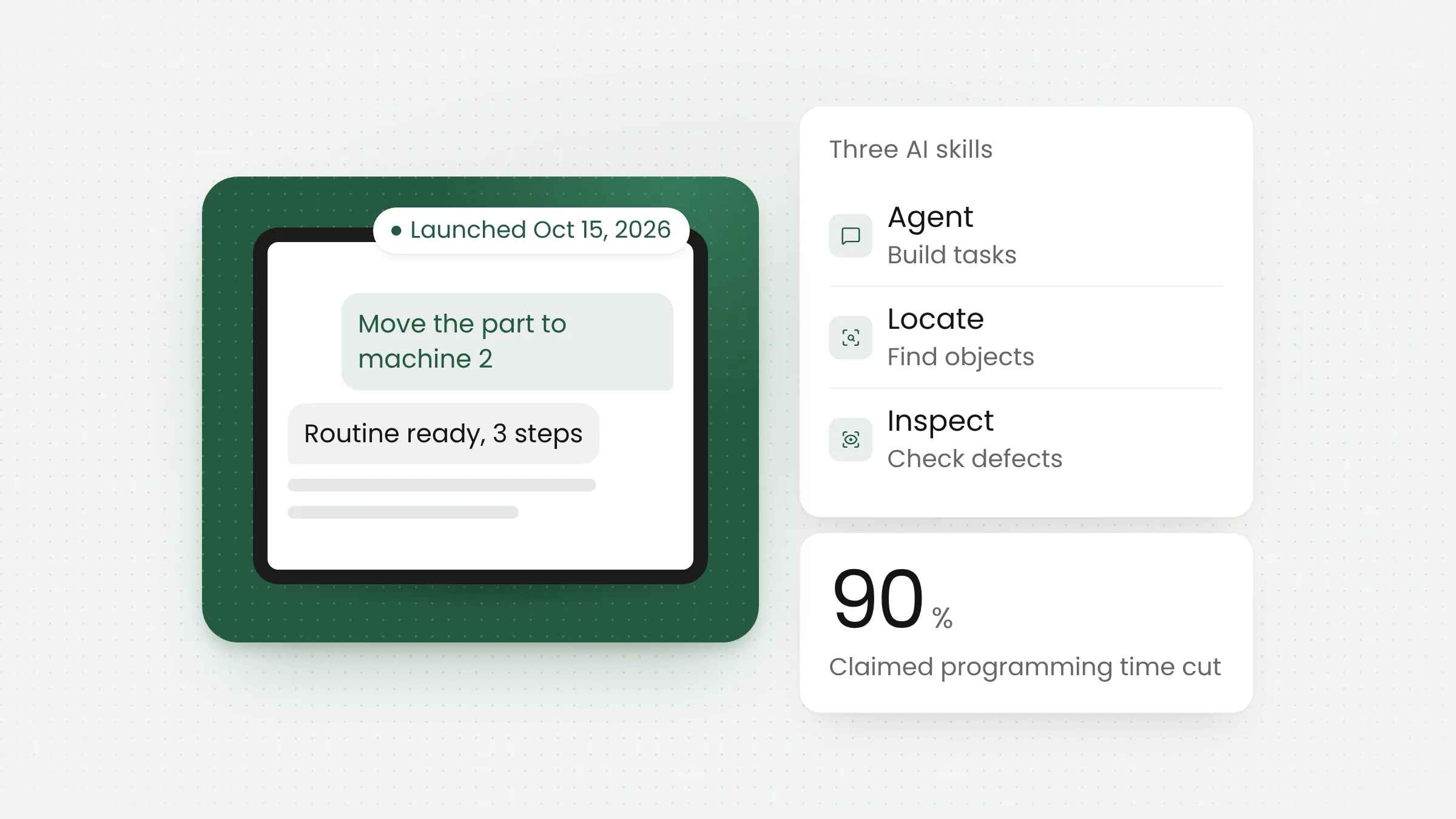
Standard Bots launched Standard Bots AI on October 15, 2026, a platform that lets factory workers program a robot arm from an iPad through text conversation, with no code and no outside integrator. The platform is available now. Its price has not been announced.
What Standard Bots launched
Standard Bots is a maker of AI-native industrial robots based in Glen Cove, New York. According to the company’s press release, the new platform has three skills: Agent, Locate, and Inspect. The aim is for production-line workers to set up complex robot tasks in minutes from an iPad, without custom fixtures and without hiring an integrator.
An integrator is a firm that installs robots, connects them to other machines, and tunes the program. Leif Jentoft, Standard Bots’ head of applied AI, said integrators can cost about a million dollars and take months to tune a system. That figure comes from the company.
Technology writer John Koetsier, in his write-up, framed the launch as “vibe coding” for robots: users describe what they want in everyday language and the system builds the program. He also noted that integrators were often more expensive than the robot itself.
How Agent, Locate, and Inspect work
Each skill handles one part of the job, from building a routine to checking the result.
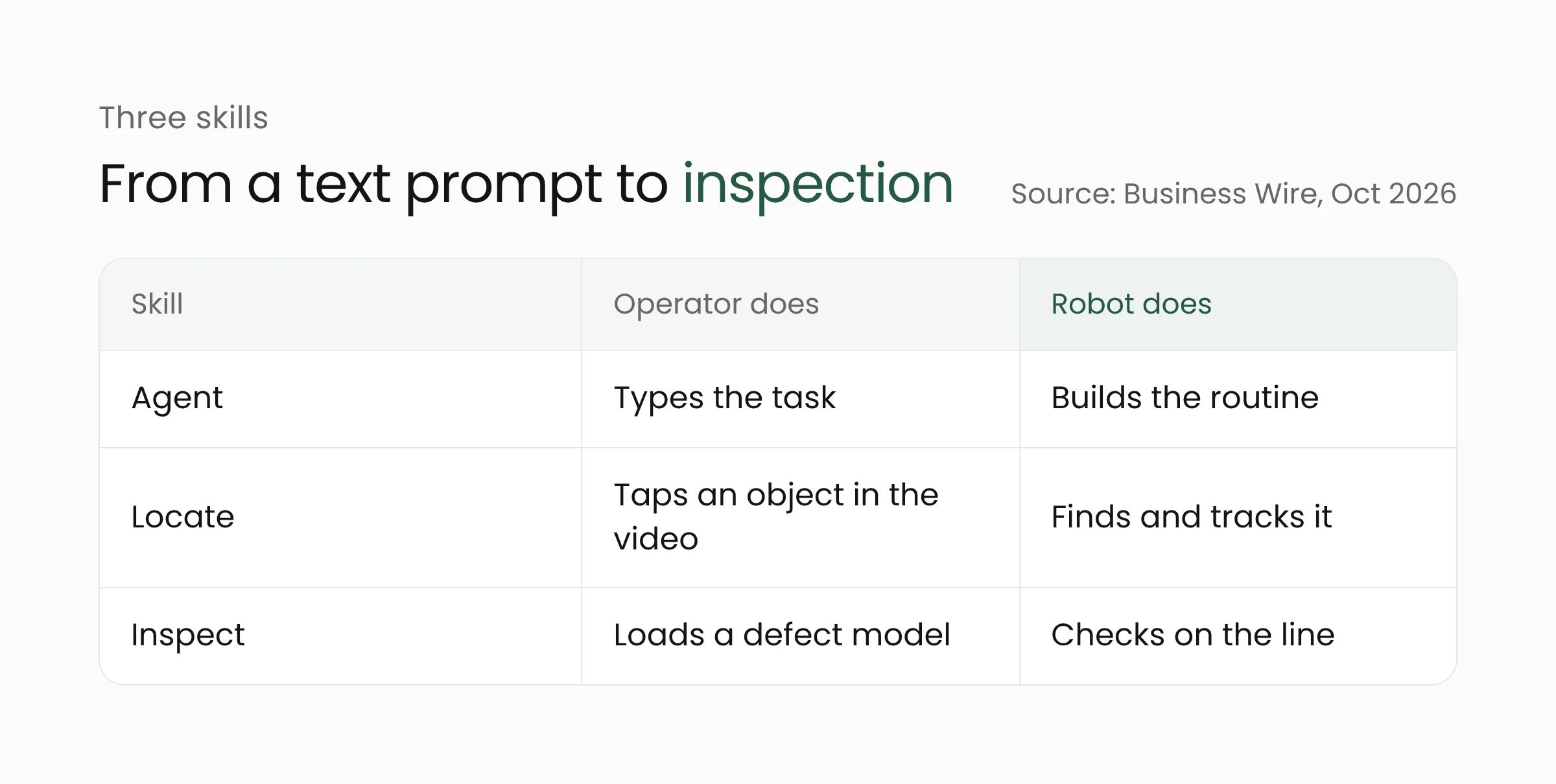
Agent is a conversational assistant that builds and edits robot routines from text prompts. The company says Agent was trained on Standard Bots’ user manuals and best practices, and that it asks about the user’s setup before building a program. Users need no programming or robotics experience.
Locate changes how a robot finds things. An operator taps or types the name of an object in the robot’s video feed, and the robot finds it, tracks it, and moves around it. Standard Bots claims this cuts programming time by 90 percent because waypoints no longer have to be defined by hand. The skill is aimed at high-mix work, with many product variants in small batches.
Inspect checks quality using computer vision models trained on a customer’s own parts, for example to find scratches. It was developed with Roboflow, and customers can load their own inspection models. Inspection can run in-line or at a dedicated station.
Claims, pricing, and the limits of the evidence
Standard Bots says its robots deploy and pay back twice as fast as the industry standard. It names Sunoco, Lockheed Martin, NASA, and the U.S. Army among its customers, along with hundreds of other manufacturers. The only customer quoted in the press release is Path Machining Automation, a contract machining firm in the Minneapolis-St. Paul area, which said the technology helps it compete. Every performance figure in the launch comes from the company, and the sources we read contain no independent testing.
A Runtime Wire report on launch day raised the main open question: whether workers can safely adapt routines in real production, or only build them faster in a demo. The sources we read also do not mention availability in Indonesia, after-sales support, or pricing for the AI platform.
Robot prices are listed on the Standard Bots website. When we read it, Spark (7 kg payload, 900 mm reach) started at $29,500, Core (18 kg, 1.3 m) at $39,500, and Thor (30 kg, 2 m) at $49,500. The page carries no date.
Why small factories are the target
The press release cites National Association of Manufacturers (NAM) data that nearly 200,000 of the 240,000 manufacturers in the United States have fewer than 20 employees. It also cites Deloitte and the Manufacturing Institute, which project 3.8 million new manufacturing workers will be needed by 2033, with 1.9 million of those jobs at risk of going unfilled. The company says only 6 percent of U.S. manufacturers use robots today.
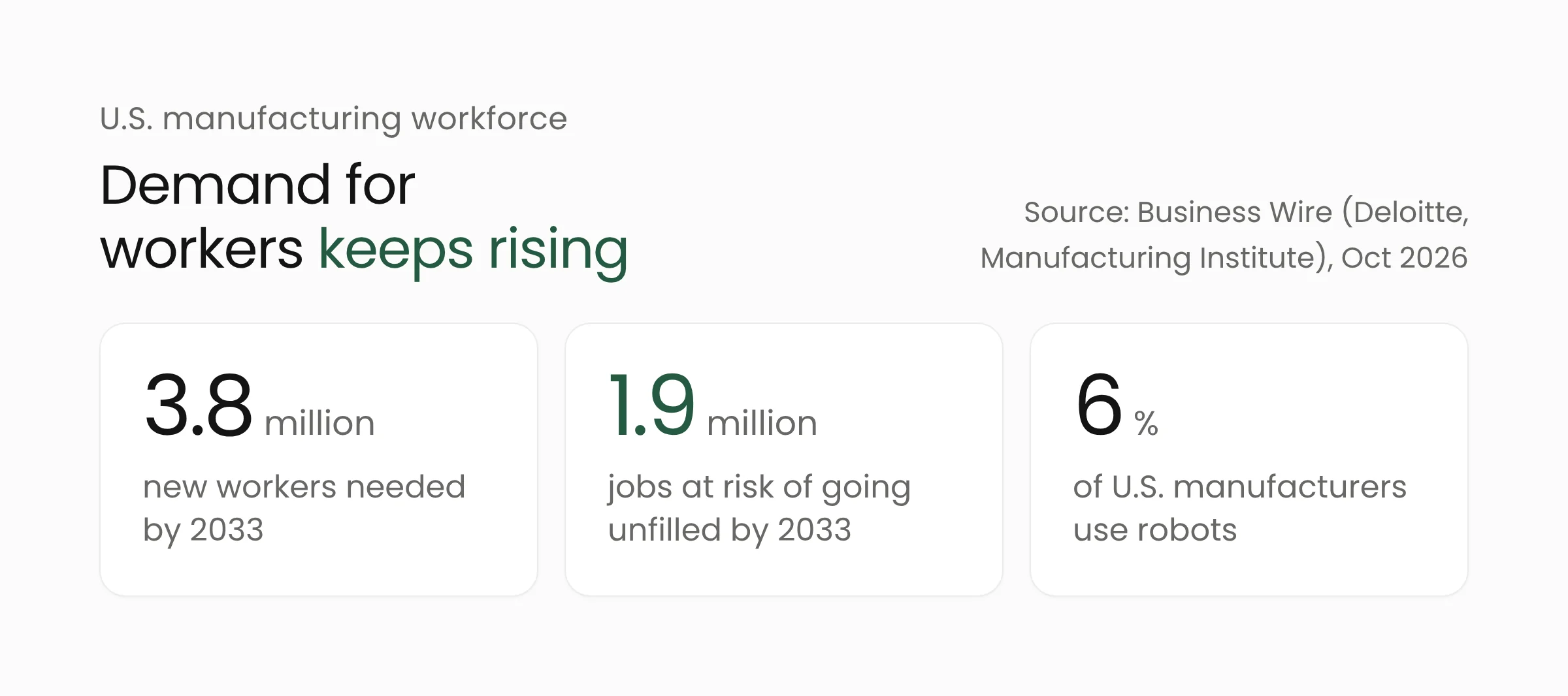
These figures describe the United States. We found no equivalent numbers for Indonesia in the sources, so they are best read as a sign of direction rather than a measure of the local market. Standard Bots also says it is building its own foundation models while letting customers bring theirs, so they are not locked into a single vendor.
Another approach
Standard Bots has competitors chasing robots whose tasks change quickly. Startup Industrial Next, which presented at TechCrunch Disrupt 2026, teaches new tasks through simulation and demonstration. It claims a production line can be retooled in minutes rather than weeks, and announced an evaluation partnership with the BMW Group Technology Office. Its figures come from the founders, and the source we read has no independent verification. Both companies point the same way: the programming burden is shifting from specialists to operators.
What this means for factories and workshops
For factories in Indonesia, this news is not yet a reason to buy a robot. It is more useful as a way to judge readiness: whether there is repetitive work that fits, and whether people on the shop floor are ready to operate it.
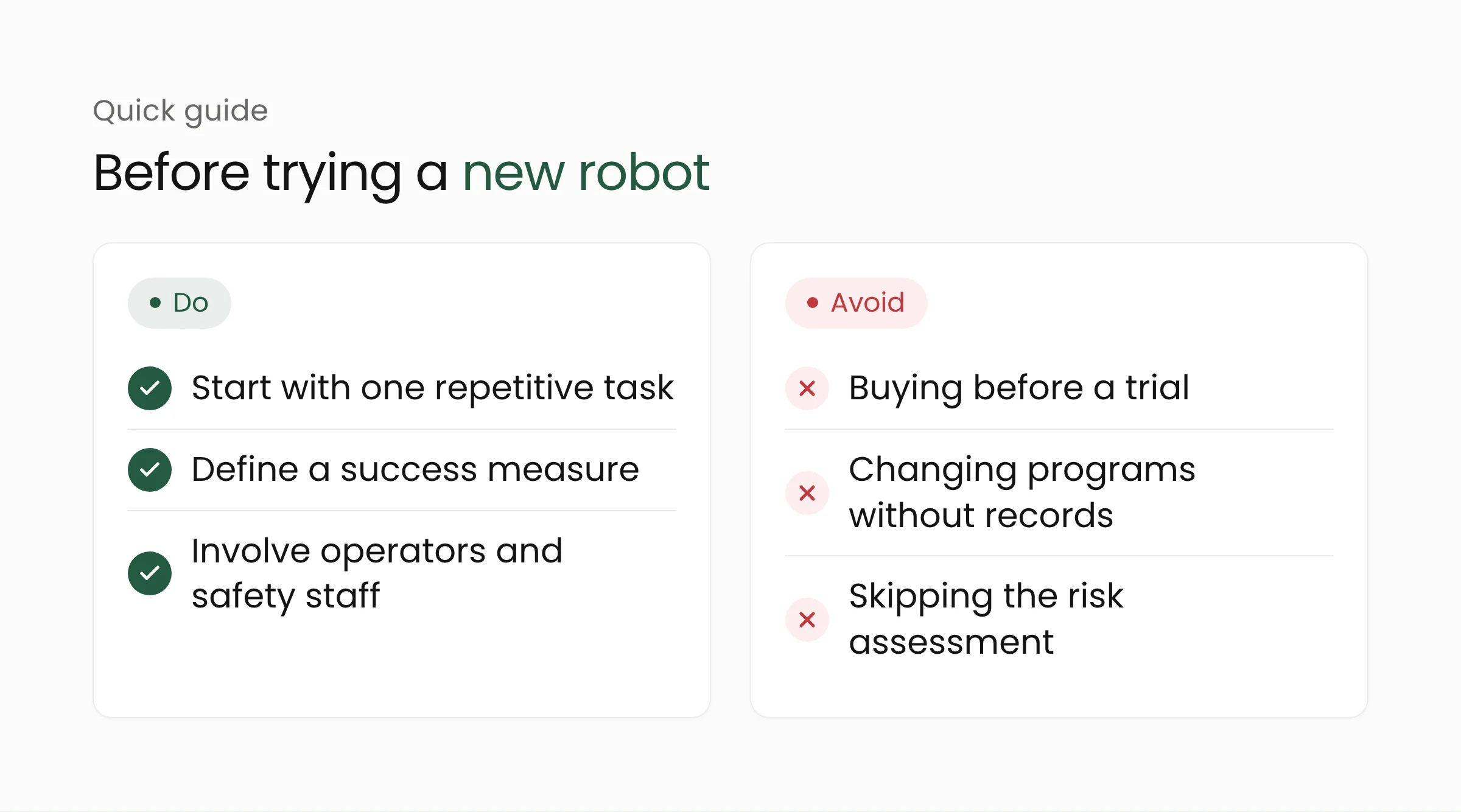
Start with one repetitive task that is easy to measure, such as moving parts between machines or inspecting the surface of finished goods. Decide in advance how success will be measured: defect count, cycle time, or labor hours saved. Without that, vendor claims are hard to compare with results on your own floor.
Involve operators and safety staff from the start. Letting operators change routines themselves speeds up adjustments, but every change still needs a risk assessment and clear motion limits. Ask the vendor who is allowed to change a program, how changes are recorded, and how the robot returns to a previous version.
Look at the data and network around the robot as well. A robot that uses cameras, vision models, and an AI assistant generates production data that must be stored and governed. Sensors, machines, and monitoring on a production line are usually built together with IoT and AI services, and the topic is covered further on our industrial automation page. For a look at how workspace data is used to train robots, see also our article on Hesai Kosmo.
Frequently asked questions
Is Standard Bots AI really no-code?
According to Standard Bots, yes: workers build tasks through an iPad and text conversation. The claim has not been tested independently, and the sources we read do not explain how far workers can go with very complex tasks without a technician’s help.
How much does Standard Bots AI cost?
Pricing for the AI platform has not been announced in the sources we read. Robot prices are on the product page: from $29,500 for Spark, $39,500 for Core, and $49,500 for Thor.
Is the robot safe for workers with no robotics training?
The sources we read do not detail the safety setup. Runtime Wire calls safety when workers change routines in real production an open question. Factories still need to run their own risk assessment before operating the robot.
Conclusion
The launch of Standard Bots AI shows where industrial robotics is heading: programming once done by integrators is being handed to operators. So far the evidence is company claims, so trials on the factory floor will decide its value. If you are evaluating automation for a factory or workshop, the Merakit team can help map which tasks are worth trying and which data to prepare. Explore our Industrial Automation Solutions.
Sources
- Standard Bots Enables Any Manufacturing Worker To Be A Robot Operator with New AI Platform, Business Wire press release, October 15, 2026
- Standard Bots lets factory workers program robot arms from an iPad, Runtime Wire, October 15, 2026
- You Can Now Vibe Code A Robot: Standard Bots, John Koetsier, October 15, 2026
- Industrial Next wants factory robots to switch tasks in minutes, not weeks, TechCrunch, October 13, 2026
- Standard Bots website, robot prices, no publication date