Blog Machine Learning
Trajectory Opens a Platform for Experts to Train AI Models
On this page· 7 sections
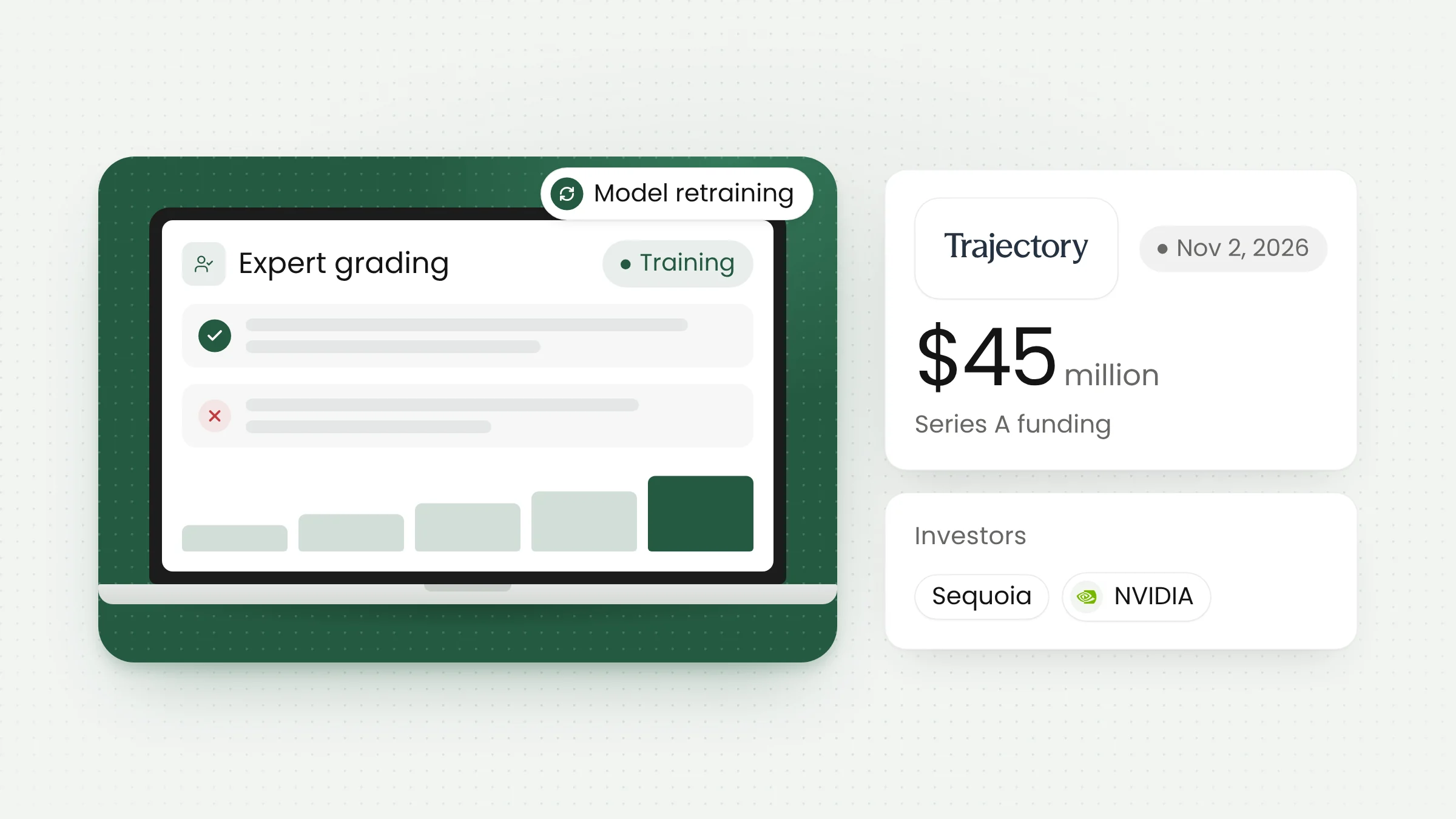
AI startup Trajectory opened its continual learning platform to the public on November 2, 2026, and announced a $45 million Series A. The platform lets experts such as lawyers or financial analysts grade a model’s answers, then uses those grades to retrain the model so it gets better at specialized work.
The idea targets a common problem for organizations that use AI. General models are capable, but they do not learn from their mistakes on the job. Teaching them to do so has usually required an in-house research team or expensive consultants.
What Trajectory launched
In its launch post, Trajectory describes the product as the first self-serve platform for post-training on production data. Organizations can sign up and start training without talking to a sales team first. The announcement does not list pricing.
Sequoia led the Series A at a $300 million valuation, with participation from NVIDIA, Bessemer Venture Partners, and Bain Capital Ventures. According to TechCrunch, the company was founded about a year ago and has 18 employees. Its website puts total seed and Series A funding at $60 million.
The founders are Ronak Malde, Michael Elabd, and Arjun Karanam, who met as classmates at Stanford. Malde was among the Windsurf researchers Google DeepMind acqui-hired, Elabd also worked at DeepMind, and Karanam previously worked on generative foundation models at Apple.
Early users include Harvey, an AI platform for legal work, and Rogo, an AI platform for financial analysts. Both use Trajectory to post-train open source models for tasks such as reviewing a particular type of contract or valuing a company with a specific method. Mercor, Decagon, and NVIDIA are also named as customers.
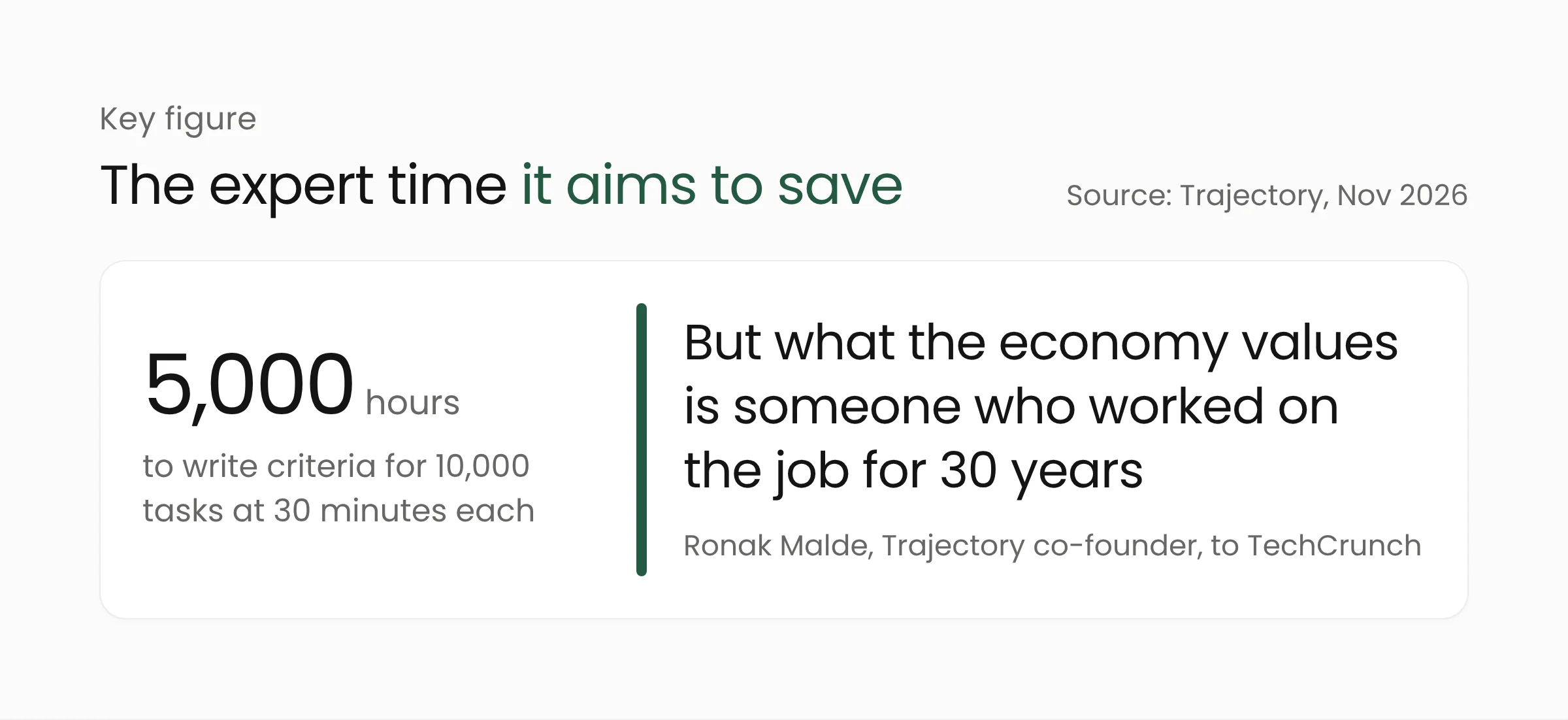
Malde compared foundation models to a very smart PhD student who is always starting a new job. “But what the economy values is someone who worked on the job for 30 years,” he told TechCrunch.
Competitors in post-training
Trajectory has company. TechCrunch reports that it sees Thinking Machines Lab, the maker of Tinker, as a direct competitor. Tinker offers a programming interface for fine-tuning and reinforcement learning on open-weight models. Other rivals include Applied Compute, which was valued at $3.25 billion last month, and Prime Intellect, which helps companies build and train their own AI agents.
Trajectory’s pitch is about who does the training. Tinker is an API for technical teams, while Karanam says Trajectory built an interface that makes post-training accessible to nontechnical customers.
How continual learning works on Trajectory
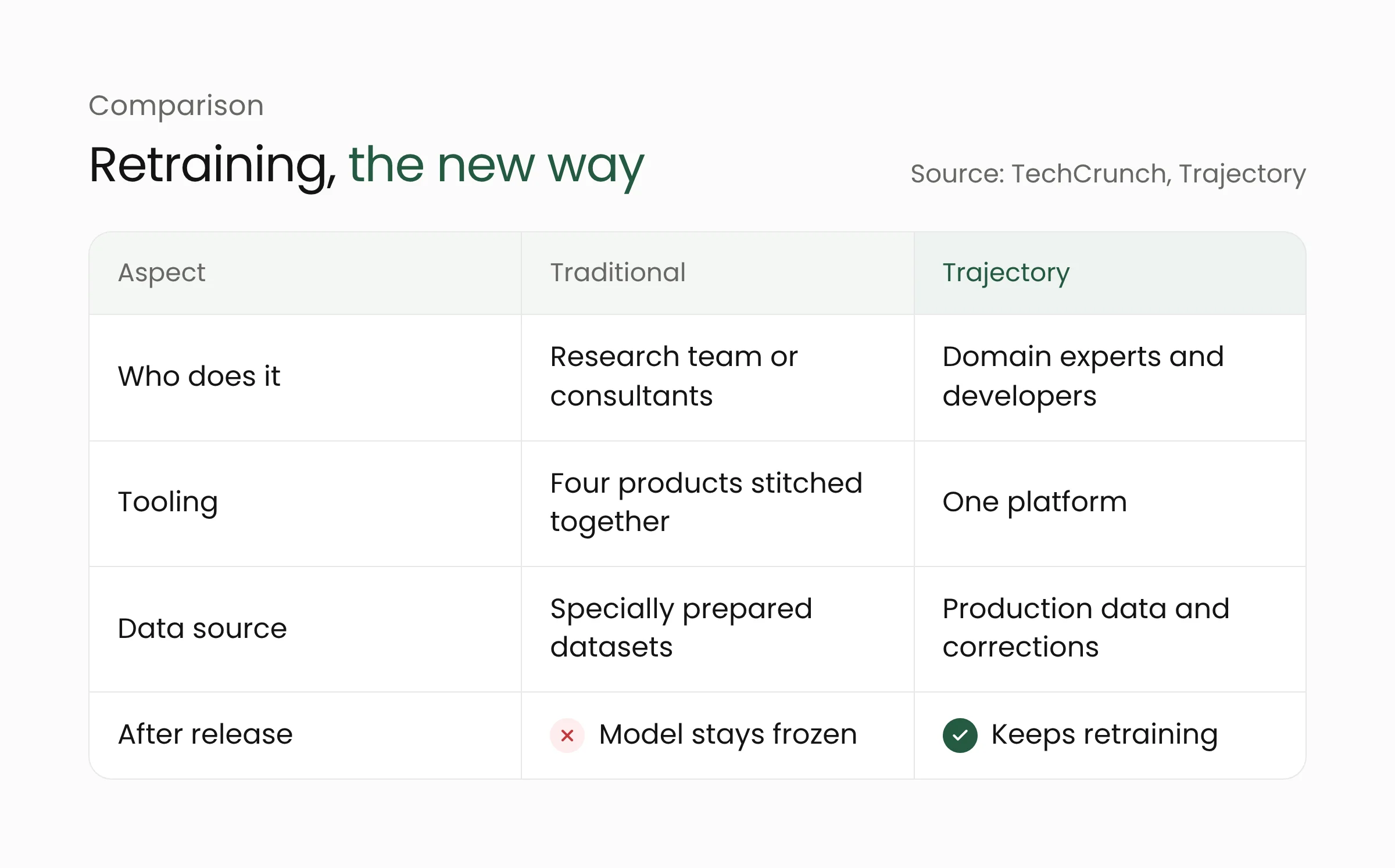
Continual learning describes models that keep improving from the work they do, much like an employee who gets better with experience. Most deployed models are effectively frozen at release, so the same mistakes can repeat until a new version ships.
On Trajectory, an organization starts with an open source model and connects the platform to its application. The platform collects traces, corrections, and edits from everyday use. That data, together with examples of answers experts consider good, is used to retrain the model.
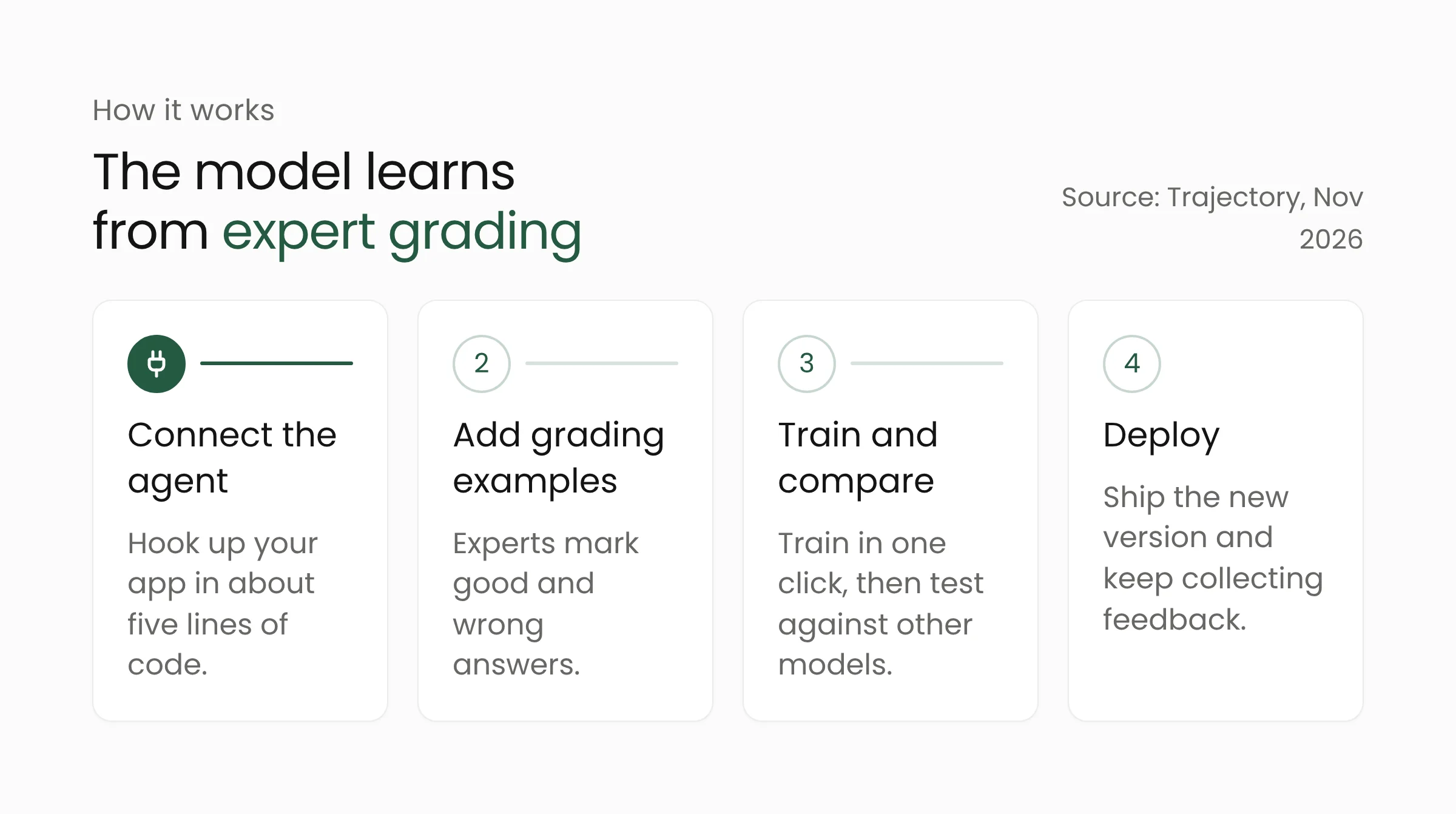
According to Trajectory, users plug in a set of tasks along with a way to score them. Training and deployment each take one click. The company says integration takes about five lines of code and replaces four products that teams usually stitch together themselves: sandboxes, evaluations, training, and deployment.
Two research previews
The platform ships with two features labeled research previews. Continual Grading learns how an expert grades from a few examples and applies that standard across the rest of the production data, which reduces manual labeling. Group Size 1 trains on real interactions after a model ships, without months spent building training environments.
The problem Continual Grading addresses is concrete. In its research report, Trajectory estimates that writing grading criteria for 10,000 tasks at 30 minutes each takes 5,000 hours, or about two and a half years of one expert’s time.
Reported results and their limits
Trajectory shared several results. One customer reportedly trained more than eight models for long, complex agentic tasks in two weeks. Working with NVIDIA and Harvey, the company also post-trained Nemotron 3 Ultra on legal tasks within 24 hours of the model’s release.
The most striking claim involves a small model. Trajectory says a Nemotron Lightning model rose from 0% to an 8.3% all-pass rate on Harvey’s LAB benchmark, which counts the share of legal tasks that meet every grading criterion. The company says that score matches Anthropic’s Opus 5.5 at 100 times lower cost and 3.8 times the speed. These are Trajectory’s own figures and have not been independently tested.
The 8.3% figure also needs context. The benchmark is strict, so even the best models complete only a small share of tasks perfectly. In an August 2026 report, Trajectory itself noted that with five tasks per legal practice area, the resolution of the results is coarse.
The Continual Grading report is also candid about limitations. On the τ³-Bench benchmark, a grader built from 60 labeled tasks ranked 80.3% of response pairs the same way as the original graders. On legal tasks in Harvey-LAB, scalar grading accuracy fell below 60%. Trajectory notes that legal grading is hard in itself, since Harvey’s expert grader agrees with itself only about 86% of the time.
Safety is part of the discussion too. The approach resembles recursive self-improvement, the idea of AI systems improving their own capabilities. Elabd argues, as quoted by TechCrunch, that keeping humans in the training loop makes Trajectory’s method safer than fully autonomous self-improvement.
What this means for your organization
For organizations in Indonesia, the news points to a shift in how AI is used. Model choice still matters, and an advantage now also depends on how well internal expertise is turned into training data. Consider a legal team reviewing hundreds of partnership agreements, claims analysts at an insurer, or customer service staff at a telecom operator. Their daily judgment is training material competitors do not have.
A few steps are worth considering now.
- Pick one narrow task. Start with work whose output can be judged clearly, such as summarizing contract clauses or sorting customer complaints. Broad tasks make progress hard to measure.
- Write down what a good answer looks like. Ask experts for a handful of correct and incorrect answers with the reasons behind them. Platforms like Trajectory use exactly these examples to learn how experts grade.
- Review production data before training on it. Conversation traces often contain customers’ personal data. In Indonesia, processing that data falls under Undang-Undang Nomor 27 Tahun 2022 tentang Pelindungan Data Pribadi (Law No. 27 of 2022 on Personal Data Protection), so the legal basis, masking, and storage location should be settled first.
- Add evaluation and approval gates. Test every new model version against a fixed question set and have an accountable owner approve it before users see it.
Organizations can also weigh open-weight models running on their own servers, as covered in our piece on Mistral Large 4 and self-hosted AI. Pairing open models with retraining gives more control over data and cost, but it also demands discipline in running the training cycle.
For teams without AI researchers, preparing data, designing grading criteria, and building evaluation pipelines are the core of machine learning services. That work often shapes results more than the choice of platform.
Frequently asked questions
What is continual learning?
Continual learning is an approach in which an AI model keeps learning from the work it does after release. User feedback and expert grades are collected and used to retrain the model regularly, so it improves at specific tasks.
Can Trajectory be used without programming skills?
Partly. Experts can provide grading examples and review results through the platform’s interface, but connecting an application to the platform still needs a developer. Trajectory says integration takes about five lines of code.
How is continual learning different from regular fine-tuning?
Fine-tuning is usually done once or occasionally with a specially prepared dataset. Continual learning turns retraining into a routine cycle that draws on everyday usage data, with expert judgment setting the direction.
Conclusion
Trajectory’s launch reflects a move of model training from large labs toward organizations that understand their own work. Its reported results still need independent testing, but preparation can start now: choosing a task, defining grading standards, and cleaning up data. If your team is considering AI that learns from daily work, Merakit can help plan the first steps.
Sources
- TechCrunch: Trajectory raises $45M to make AI model training accessible to nontechnical experts (November 2, 2026)
- Trajectory: Own Your Value Function, Introducing the Trajectory Platform (November 2, 2026)
- Trajectory: Continual Grading (November 2, 2026)
- Trajectory: Continual Learning Cheap Enough to Meter (August 11, 2026)
- Thinking Machines Lab: Tinker
- JDIH BPK: Law No. 27 of 2022 on Personal Data Protection