Blog Education Technology
UAE's Mira AI Assistant Will Explain School Data to Parents
On this page· 7 sections
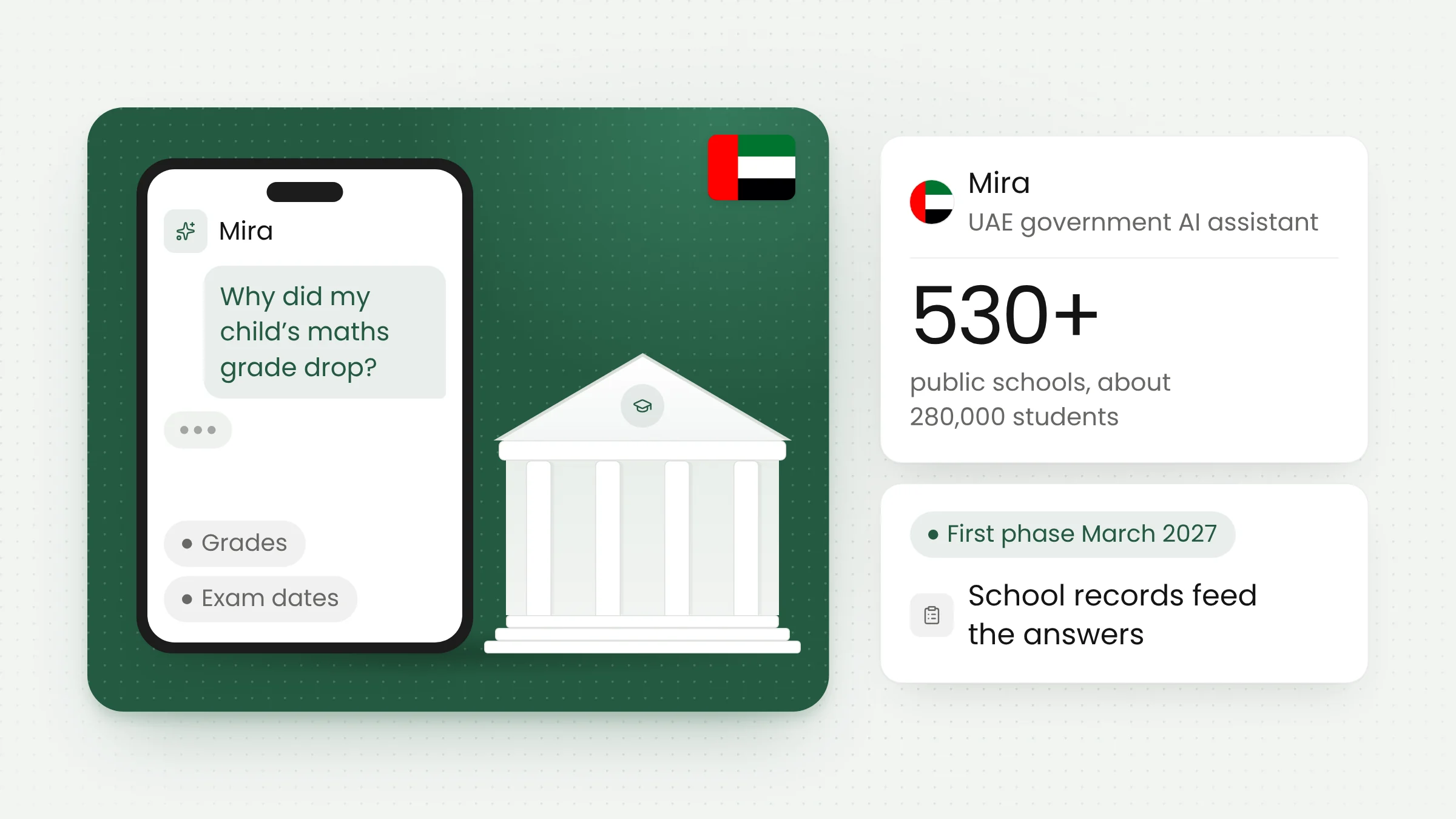
The United Arab Emirates introduced Mira, an AI assistant for government services, on 23 November 2026. One demonstration was aimed at parents of public-school students, who will be able to ask about grades, exam dates and behaviour in a single conversation. The first phase of Mira services is scheduled for March 2027.
The education piece drew attention because of a detail Education Minister Sarah Al Amiri gave to Semafor. Parents will be able to ask Mira why their child is falling behind in a subject and how to close the gap. The answer is built from records that schools already keep and that seldom reach home.
Mira is presented as one entry point to government
Mira was launched at a UAE Government event at Expo City Dubai, witnessed by Sheikh Mohammed bin Rashid Al Maktoum, Vice President and Prime Minister of the UAE. The official account calls it the UAE Government Concierge Agent, a personal assistant that guides people through their dealings with the state.
Users explain what they need in their own words. Mira identifies the right service and guides them to completion. Depending on the service, users can review their details, confirm a request and finish the transaction in the same conversation. Cabinet Affairs Minister Mohammad Al Gergawi said people would no longer need to search for a service or know the steps involved.
Several ministers showed examples. A business owner renews employee work permits. A resident renews a passport or Emirates ID. A patient describes symptoms in a video conversation and Mira prepares a structured summary for the doctor before the consultation. According to The National, one demonstration was conducted in Tagalog to show that Mira serves a population drawn from many countries.
Mira belongs to a framework the UAE Government announced in 2026 to deploy agentic AI across 50% of federal government sectors, services and operations within two years. Agentic AI refers to systems that carry out a sequence of steps on a user’s behalf and go beyond answering questions. We covered a comparable approach in the United States in our article on Google’s AI agent package for government agencies.
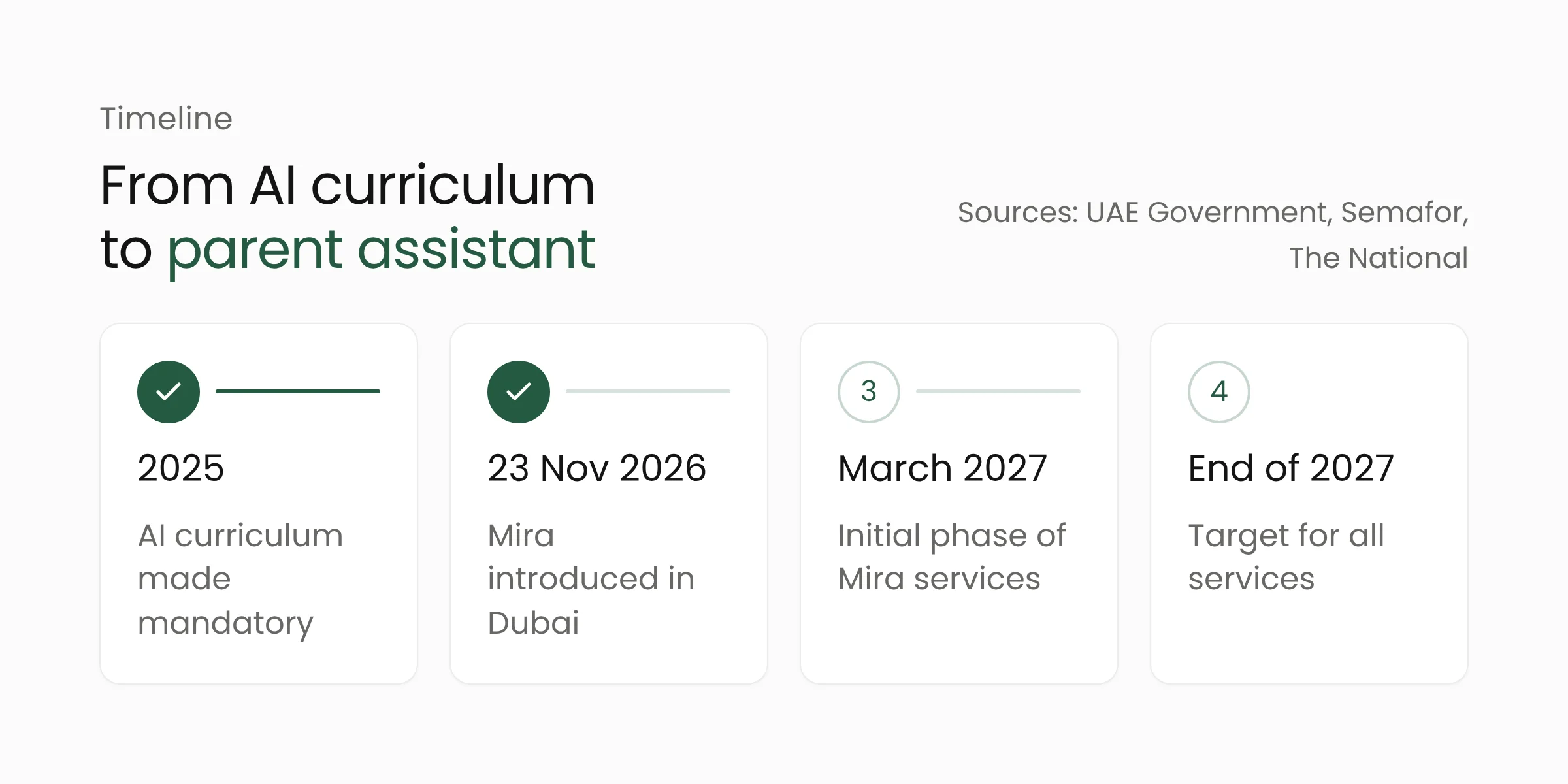
The official account mentions only an initial phase in March 2027, with additional services to follow. The National reported that Mira is expected to cover all government services by the end of 2027 after a phased rollout. That end-2027 target does not appear in the official account.
How Mira helps parents
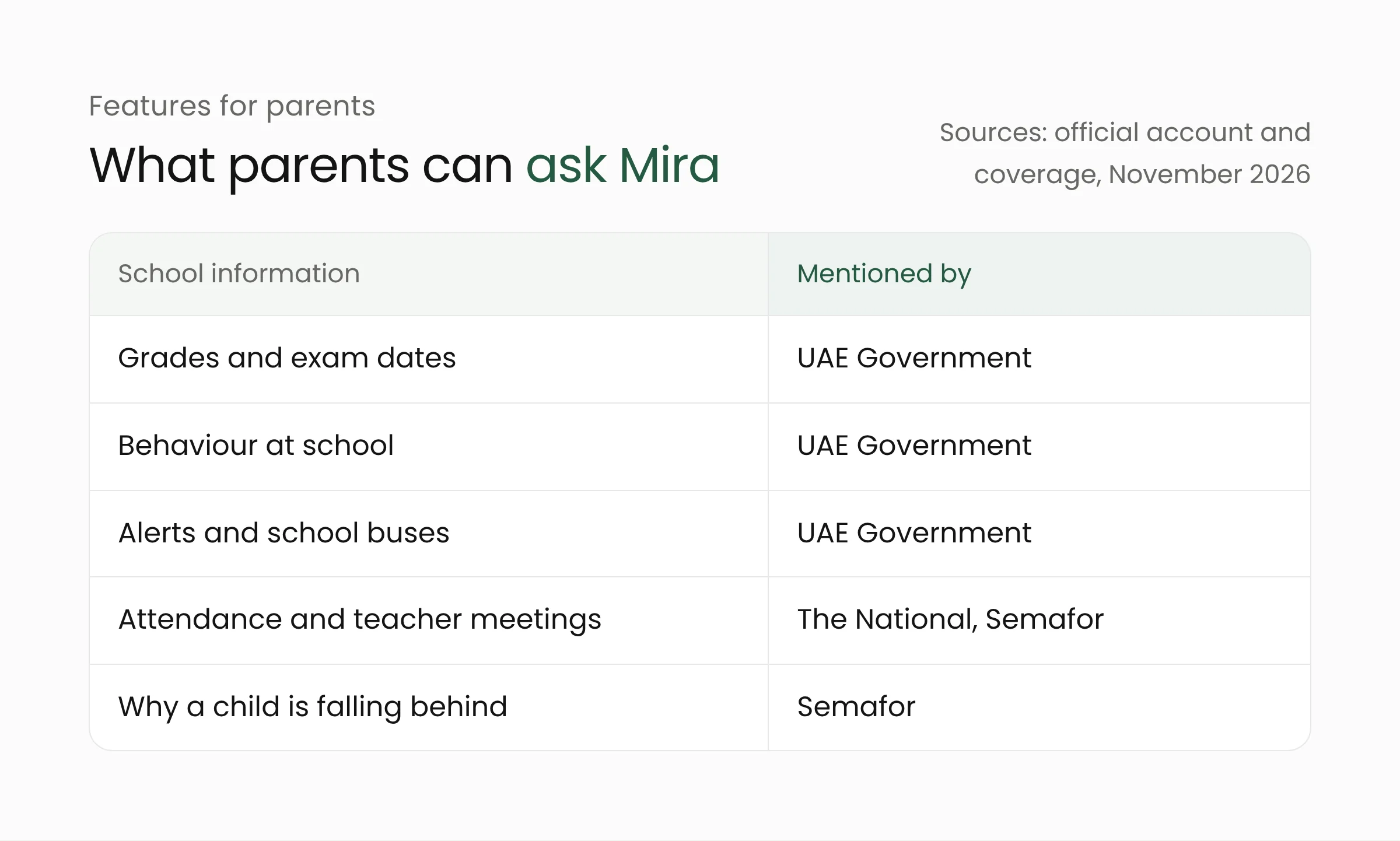
In her demonstration, Al Amiri showed parents following their children’s academic progress, checking grades and exam dates, and seeing how their children behave at school. Parents can also receive alerts and track school buses. Having the information in one place, she said, “helps parents support their children at the right time” and strengthens communication between families and schools.
The National and Semafor added two more functions from the minister’s remarks: reviewing attendance and arranging meetings with teachers.
Records schools already keep
Explanation is what separates Mira from an ordinary grades portal. Al Amiri told Semafor that Mira draws on data schools already collect, including classroom observations, project results and benchmark assessments that parents rarely see.
Semafor gave the example of a parent whose child struggles in mathematics. The parent could ask which topics need attention and receive a more focused answer than earlier assessment methods provided. A report card says a grade has dropped. Observation notes and assessments can show which part of the material has yet to be mastered.
Coverage and timing
The Ministry of Education will roll Mira out across more than 530 public schools serving about 280,000 students, Al Amiri told Semafor. The UAE has 1.1 million students in total. The rest attend private schools, which are under no obligation to adopt Mira.
On timing, the sources differ slightly. Semafor wrote that parents can use the feature starting in March. The official account says only that the initial phase of services will be available in March 2027 and does not list which services belong to that phase. Data Phoenix noted that start dates for individual school features and the first participating schools have yet to be announced.
Mira arrives a year after the UAE made an AI curriculum mandatory. According to Semafor, the curriculum began in fall 2025 in all public and some private schools, from kindergarten through grade 12, and about a quarter of first-year classes dealt with ethics. This year the same ministry removed devices from sixth-grade classrooms in four core subjects. Al Amiri reasoned that students at that age have the greatest chance of closing gaps in reading, writing and mathematics. AI is being promoted for administration and communication with parents, while core lessons in that grade return to books and paper.
What has yet to be explained
The launch consisted of demonstrations and a schedule. Several important points remain unanswered.
The technology behind it. The official account refers to agentic AI and names neither a model nor a vendor. Nothing has been said about where data is processed.
Protection of children’s data. Grades, attendance and above all behaviour records are sensitive personal data about minors. The official account does not explain who can see Mira’s answers, how long conversations are stored, or how the system confirms that the person asking is the student’s parent or guardian. Data Phoenix also observed that privacy was left unaddressed.
Accuracy of explanations. Saying why a child is falling behind is harder than displaying a number. Language models can produce a convincing explanation from thin data. There is no information so far on pilots, error rates or whether teachers review an answer before it reaches a parent.
Private schools. Most UAE students attend private schools that are free to skip Mira. The effect for most families depends on each school’s decision.
Every benefit described above is a claim by the UAE Government and has yet to be tested independently.
What this means for schools
The UAE is a small country with a centralised public-school system, so its model cannot be copied wholesale. The problem Mira targets is familiar in Indonesia too. Grades sit in a report-card application, attendance in a register or an attendance device, homeroom notes in separate files and announcements in group chats.
Schools, foundations and education offices can draw several points from Mira’s design.
- Put the data in order before thinking about AI. Mira depends on records that already exist and are connected. An assistant placed on scattered or inconsistent data will only deliver wrong answers faster. The first step is to store grades, attendance and teacher notes in a uniform format tied to a single student identity.
- Decide which information should reach parents. Teacher observation notes are written for internal use. Before opening them up, a school needs to agree on which notes are shared and how they are worded, so that parents receive something they can act on.
- Make sure only a parent or guardian can ask. Indonesia’s Undang-Undang Nomor 27 Tahun 2022 tentang Pelindungan Data Pribadi (the Personal Data Protection Law) requires that children’s personal data be processed under special arrangements and with the consent of a parent or guardian. Identity verification and access logging are basic requirements on any channel.
- Keep teachers in the loop. An explanation of a child’s learning difficulty should be open to review by the homeroom teacher, particularly in the early stages. Mira’s option to arrange a meeting with a teacher points the same way.
- Start with questions that have a definite answer. Exam dates, attendance and the position of a school bus have a single answer that is easy to verify. Explaining why a student is behind requires far more mature data and testing.
An education technology solution that brings academic data, attendance and parent communication together provides a base that works with or without AI. The Indonesian government is preparing its own guardrails for AI in schools, as we wrote in our article on sector-specific AI guidelines and child protection.
Frequently asked questions
Can parents use Mira now?
No. The UAE Government says the initial phase of services will be available in March 2027, with more to follow. Semafor reported that features for public-school parents begin the same month, but start dates for individual school features and the first participating schools have yet to be announced.
Is Mira only for school matters?
No. Education is one of several areas that were demonstrated. Mira is designed as a single entry point to UAE Government services, including passport and Emirates ID renewals, work permits, healthcare appointments, university applications and services for industrial investors.
Which AI model does Mira use?
That has yet to be announced. The official account refers to agentic AI without naming a model or a vendor.
Closing
Mira points to a new direction for public services: people state what they need, and the system adapts. In education, its appeal lies in school data finally reaching parents in a form they can act on. Questions about privacy, accuracy and the underlying technology will be answered only after March 2027.
Schools in Indonesia can gain the benefit without waiting for an AI assistant. Orderly academic data and regular communication with parents are valuable on their own. Merakit School, which is still in preparation, is designed for that need, and its progress can be followed on the Merakit School page.
Sources
- Mohammed bin Rashid witnesses launch of new UAE Government services model, AI concierge agent ‘Mira’, Protocol Department Dubai, 23 November 2026
- UAE launches AI assistant to track children’s learning, Semafor, 24 November 2026
- UAE unveils government AI assistant called Mira to boost public services, The National, 23 November 2026
- UAE unveils Mira AI assistant, previews school features, Data Phoenix, 24 November 2026