Blog AI Guidelines
Sector-Specific AI Guidelines and Kids: Prep Your School
On this page· 10 sections
- 1What was announced in early October 2026
- 2New rules to protect children from AI
- 3Why schools and universities should pay attention
- 4What is still unclear
- 5What this means for your organization
- 6What a one-page policy looks like
- 7Three common mistakes
- 8Frequently asked questions
- 9Start with a one-page policy
- 10Sources
Indonesia’s government is preparing sector-specific AI guidelines for healthcare, education, and financial services, along with dedicated rules to protect children from AI risks. For schools and universities the message is practical: classroom AI use will get more specific guardrails, and it pays to draft your own ground rules now.
What was announced in early October 2026
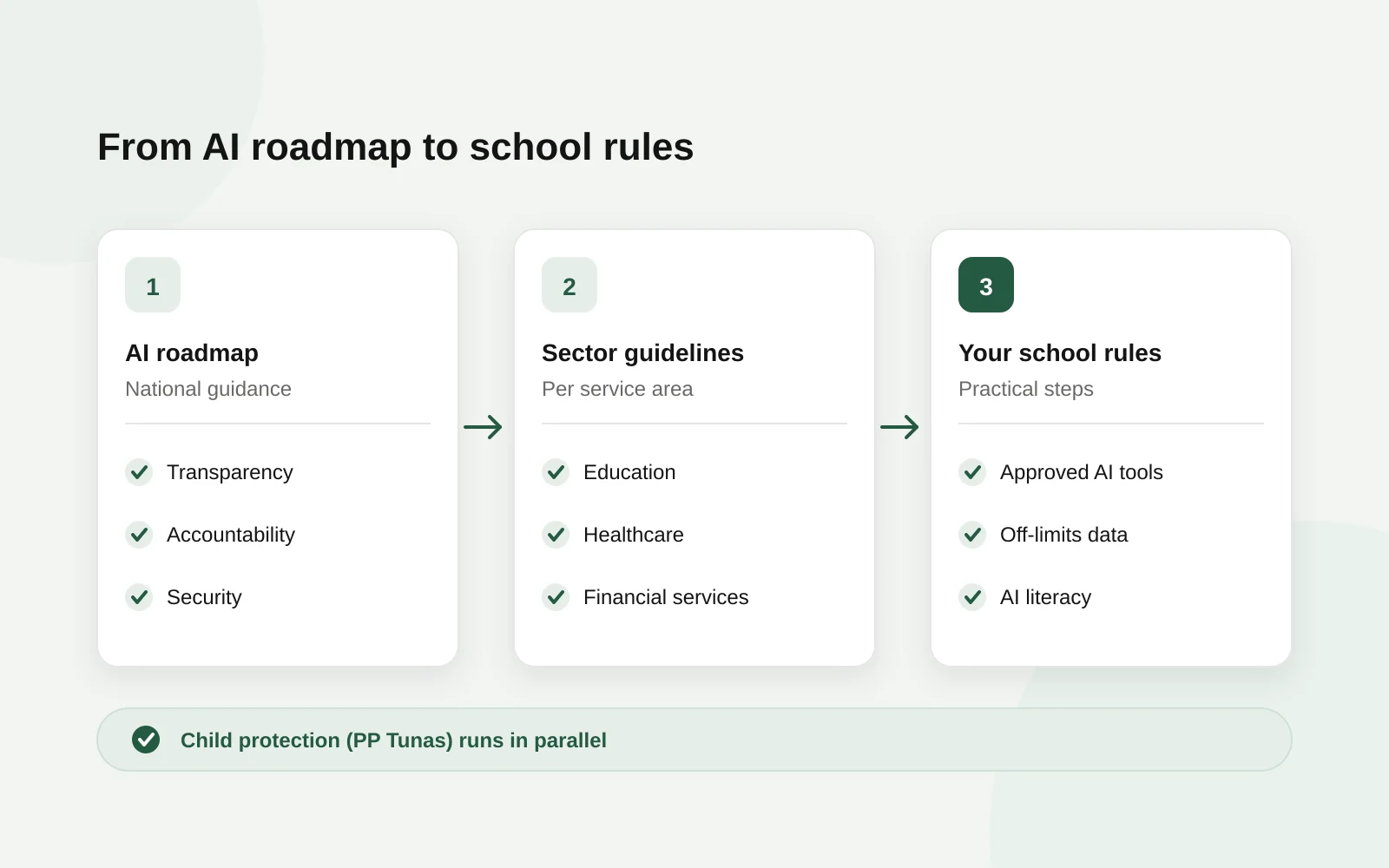
According to Niaga.Asia on 8 October 2026, Deputy Minister of Communication and Digital Affairs Nezar Patria said ministries and agencies will turn the National Artificial Intelligence Roadmap into sector guidelines. He named healthcare, education, and financial services as sectors that need their own guidance.
The reasoning is simple: AI covers too much ground for a single uniform rule. Nezar stressed that the national roadmap works as shared direction, not as detailed binding rules. The draft Presidential Regulation (Peraturan Presiden) behind the roadmap is still under inter-ministry discussion and, per the same report, being processed at the State Secretariat for harmonization with the Ministry of Law.
The roadmap sets out principles for responsible AI, with emphasis on transparency, accountability, and security. The government also highlighted preventing bias and discrimination in large language models (LLMs), the engines behind the chatbots many students already use for homework.
New rules to protect children from AI
A day earlier, Communication and Digital Minister Meutya Hafid announced plans for specific rules on child protection from AI risks. Katadata reported that these build on Peraturan Pemerintah Nomor 17 Tahun 2025 tentang Tata Kelola Penyelenggaraan Sistem Elektronik dalam Pelindungan Anak (Government Regulation No. 17 of 2025 on electronic system governance for child protection), known as PP Tunas.
A few details from that report:
- Full compliance with PP Tunas is targeted for March 2027, and Meutya asked platforms not to wait for that deadline.
- The ministry is detailing seven risk categories for children: contact, content, addiction, security, consumer, physical and physiological conditions, and mental health.
- Indonesia joined a global coalition on children’s rights and protection in the age of AI. Its roadmap covers safety by design, testing standards, AI literacy, and handling deepfakes.
- On the platform side, TikTok reportedly deactivated around 9 million accounts of users under 16, while around 22.5 million child accounts were moved to Teen Account features.
PP Tunas has been enforced since late March 2026. Kompas TV noted that the government wrote to several platforms, including YouTube, TikTok, Facebook, Instagram, Threads, X, Bigo Live, and Roblox, asking for compliance commitments and action plans.
Why schools and universities should pay attention
These two stories can sound like they are aimed at big tech, not at schools. But the direction matters. A sector guideline for education will eventually become the reference when schools decide whether students may use AI, how teachers use it, and which student data may flow into third-party services.
Picture a private junior high school in Tegal where teachers have started using a chatbot to draft practice questions. Today that is each teacher’s judgment call. Once a guideline lands, the principal will likely face sharper questions: which tool, what data was uploaded, and who is accountable if the answer is wrong.
Universities face similar questions at a different scale: when AI may help with a thesis, how lecturers check originality, and whether students should disclose AI use.
What is still unclear
Some things cannot be confirmed from the available reports. The draft roadmap regulation has not been reported as signed, so the education guideline has no shape or deadline yet. We also found no details on who will draft the education guidance or how it will apply to private schools and madrasahs.
So avoid rigid policies right now. The sensible move is to build foundations that will be useful whatever the final wording says.
What this means for your organization
Here are practical steps you can start without waiting for final rules.
Schools and universities. Write a one-page AI use policy: permitted purposes, what is off limits (for example uploading grades or students’ personal data to public chatbots), and who to contact after an incident. Involve teachers and parent representatives so the rules feel reasonable. For assessment, make sure grading does not depend on tasks AI can easily do; Merakit Exam is built for supervised testing that supports this.
Government agencies and education offices. Take stock of AI use in your teams, including the unofficial kind. Staff using chatbots without the office knowing is the governance gap most often missed. A consultation on artificial intelligence can start from mapping these use cases.
Edtech companies and services for children. Check whether your product collects data from minors, how parental consent is requested, and whether age verification exists. March 2027 sounds far off, but changing sign-up flows and data handling usually takes months.
Every organization. Treat AI as a data processor. Decide what data may and may not go in, and keep a list of approved tools. Cybersecurity and personal data protection duties still apply, including Undang-Undang Nomor 27 Tahun 2022 tentang Pelindungan Data Pribadi (Law No. 27 of 2022 on Personal Data Protection).
What a one-page policy looks like
It does not need complicated legal language. A useful policy usually answers five questions. Which AI tools has the school approved? What may teachers and students use them for? What data must never go in? How do students acknowledge AI help in their work? Who do they contact when something goes wrong?
Write it in everyday language, share it with teachers and parents, and review it every semester. A living document like this is easy to adjust when official sector guidelines arrive, and it shows your school takes student safety seriously.
Three common mistakes
First, banning AI outright. Total bans usually end in quiet use that is harder to oversee. Clear rules work better than prohibitions nobody follows.
Second, leaving everything to the vendor. The school remains responsible for student data, whatever tool is used. Ask where data is stored and who can access it.
Third, forgetting literacy. The global coalition Indonesia joined lists AI literacy as one of its pillars. Teachers and students need to understand that AI can be wrong and biased, not just how to operate it.
Frequently asked questions
Has the AI guideline for education been published?
There is no report that it has. The government has only said it will draft sector guidelines based on the national roadmap, whose draft Presidential Regulation is still in process.
Does PP Tunas apply to schools?
PP Tunas mainly places duties on electronic system operators. But schools that run learning platforms or apps used by children should check whether their service counts as an electronic system and how children’s data is handled.
Should schools ban AI chatbots?
Nothing in the reports we read requires that. A healthier approach is clear usage rules, task design that fits, and teaching students to check AI answers.
Start with a one-page policy
Official guidance may still be months away, but the need is already in classrooms. A short, honest AI use policy will make it easier to adjust once formal guardrails arrive.
If you would like to talk through safe AI use at your school, university, or agency, our team is happy to chat via the contact page, no strings attached.