Blog Cloud Computing
Nvidia GPU Tracking Rule and What It Means for Cloud Users
On this page· 7 sections
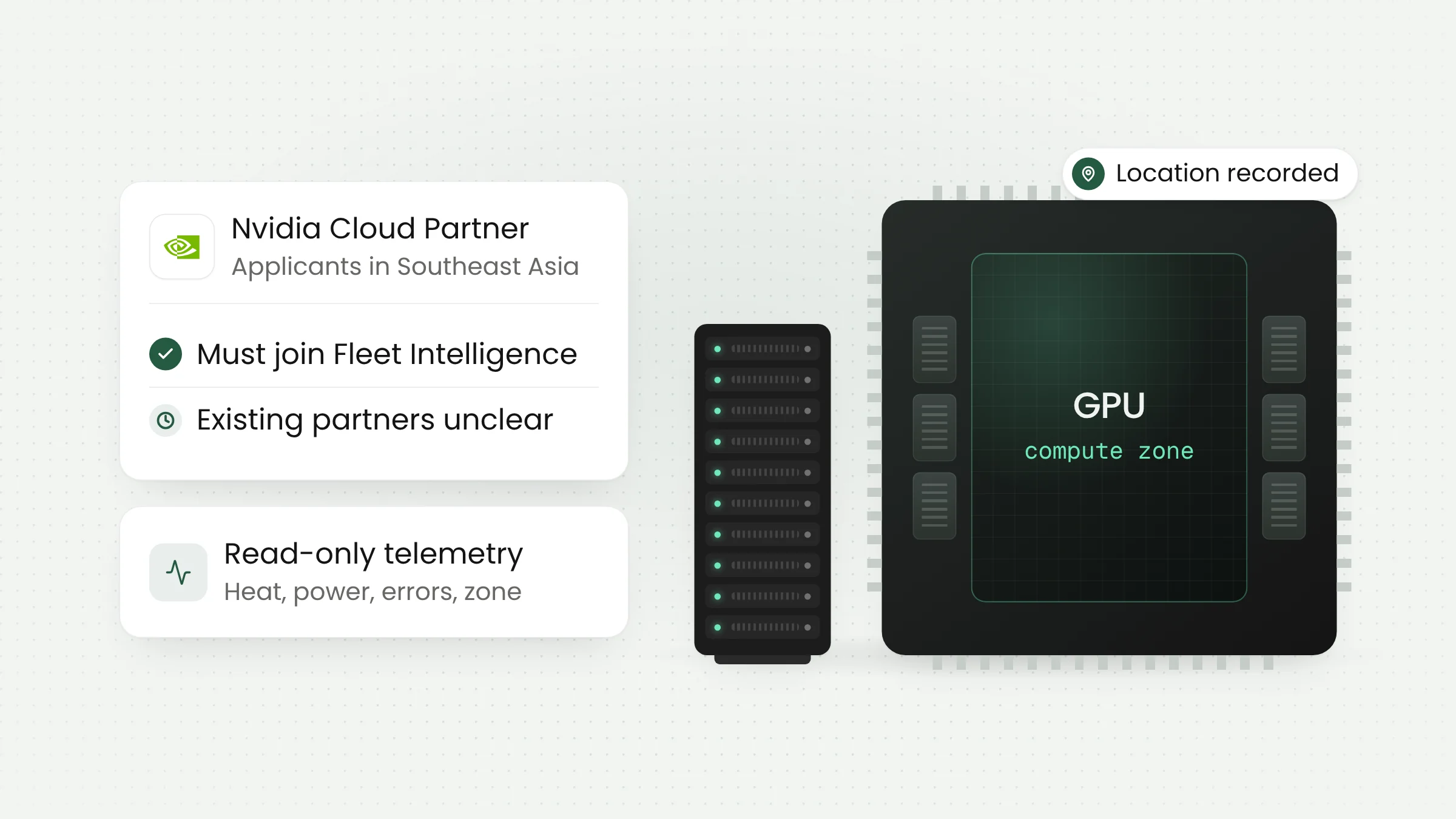
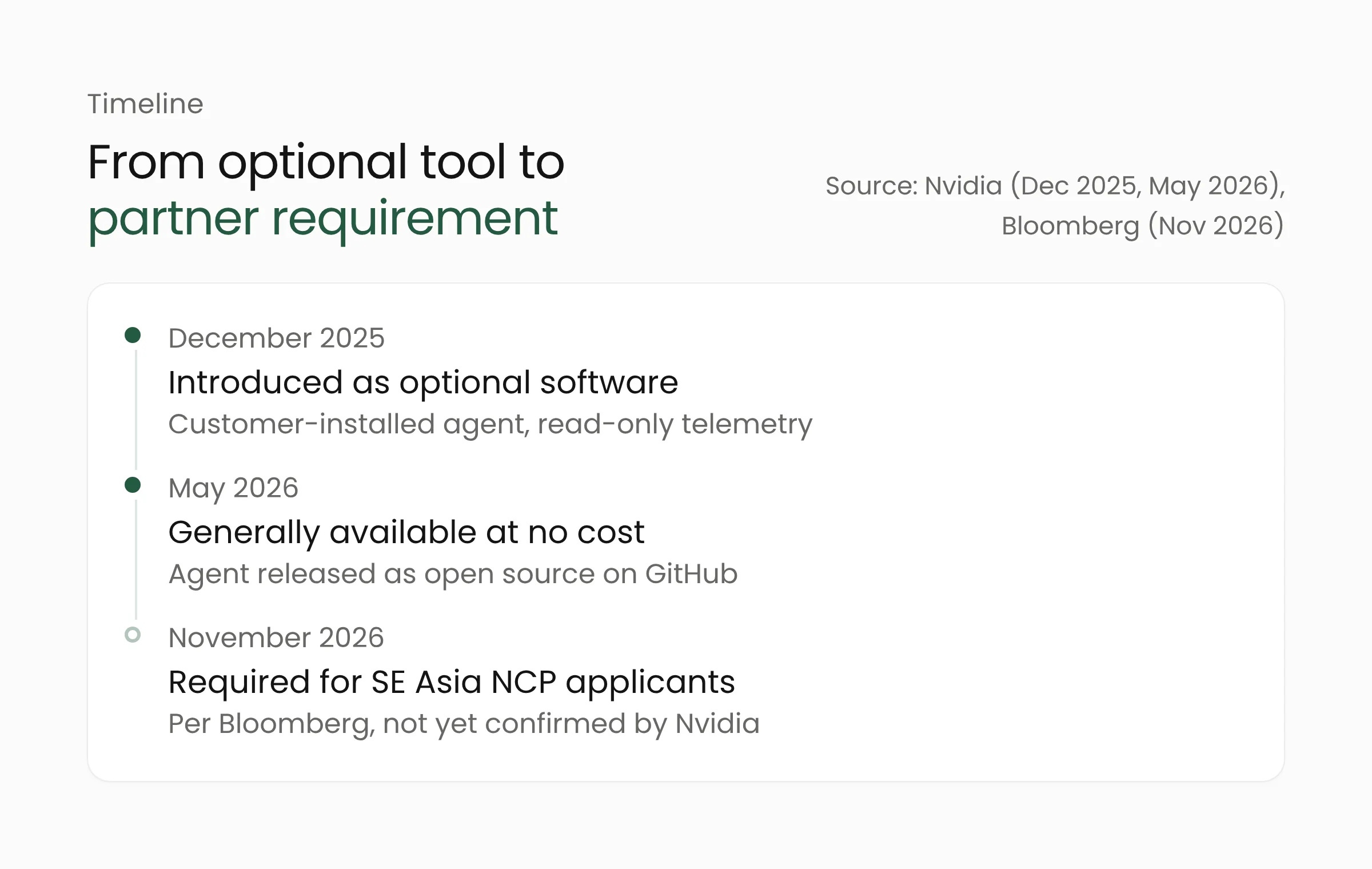
Nvidia is making GPU tracking a condition for cloud providers in Southeast Asia that want to become Nvidia Cloud Partners (NCPs). Bloomberg reported on November 6, 2026 that applicants must enroll their hardware in Fleet Intelligence, a monitoring service that can record where each AI accelerator is located.
Bloomberg based its report on people familiar with the requirement, and the story was summarized by Tom’s Hardware and TipRanks. Nvidia had not commented when the reports were published. The policy matters for Indonesia, where GPU cloud capacity keeps growing and more organizations rent GPUs to train or run AI models.
A new condition for Nvidia’s cloud partners in Southeast Asia
NCP status is Nvidia’s formal recognition for cloud providers that rent out GPU capacity. According to Tom’s Hardware, it brings a public endorsement from Nvidia and preferred access to AI chips that remain in short supply. That makes the status a useful lever for getting partners to accept extra rules.
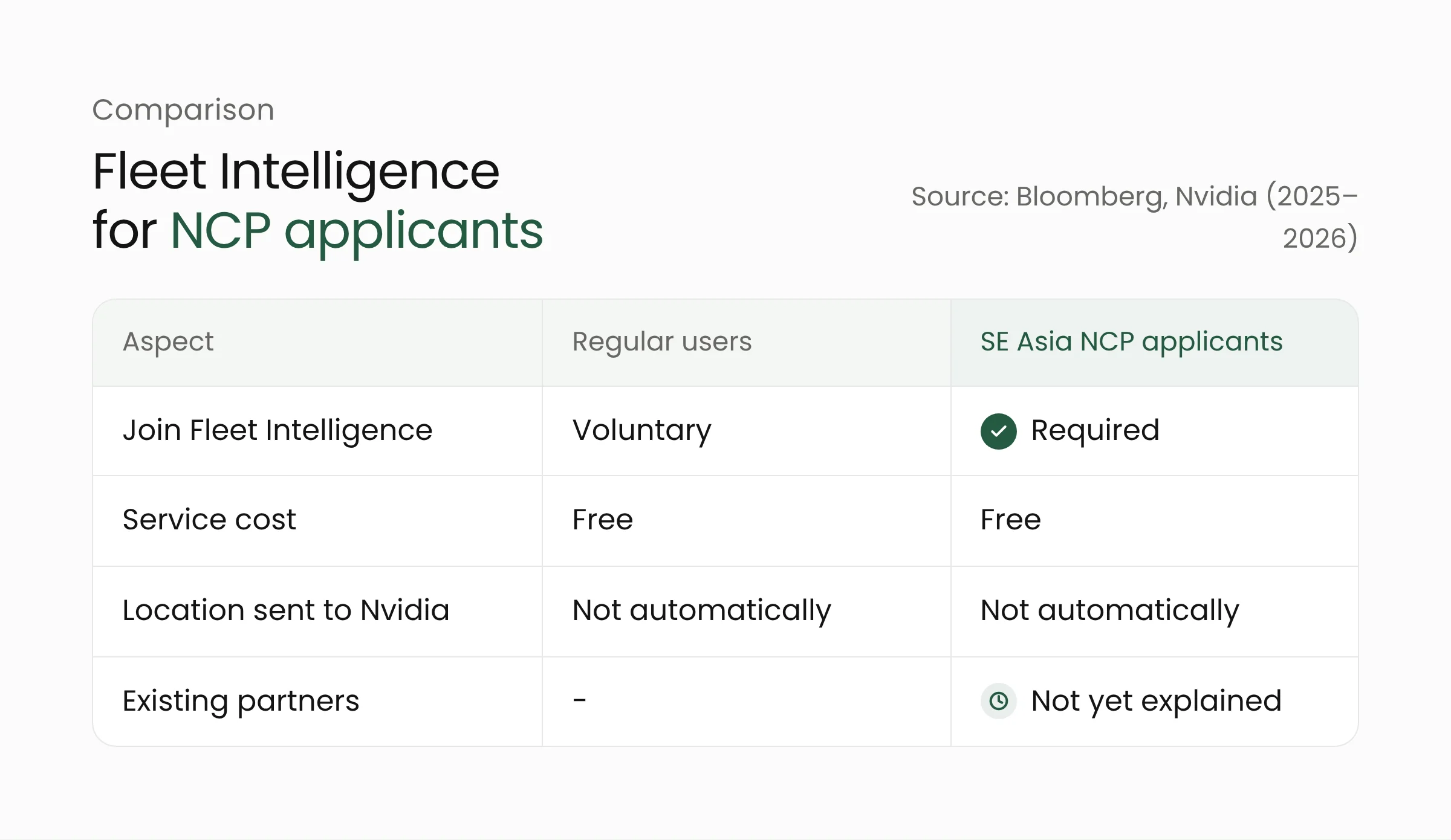
The extra rule is enrollment in Fleet Intelligence. Outside the NCP requirement, using the service remains voluntary. Tom’s Hardware also noted that Nvidia does not automatically receive location data from every customer that runs the software. TipRanks reported the same point: participants are not automatically required to share location data with Nvidia or the U.S. government.
Several details are still unannounced. Nvidia has not said whether existing NCPs must enroll to keep their status, or whether the requirement will later extend beyond Southeast Asia. Until the company issues a statement, providers and their customers should treat the specifics as media reports.
How Fleet Intelligence works
Nvidia first described the service in a blog post on December 10, 2025 as optional software for managing GPU fleets in data centers. Customers install an agent on their own servers, and the agent streams telemetry to a portal on NVIDIA NGC. Operators can then track power draw, utilization, memory bandwidth, interconnect health, thermal hotspots, configuration consistency, and early signs of failing parts.
On May 11, 2026, Nvidia announced on its developer blog that Fleet Intelligence was generally available. It is offered at no cost to owners, operators, and tenants of Nvidia data center GPUs. The agent is published as an open source project on GitHub for auditability, and Nvidia says it is read-only and does not change host configuration.
What the agent collects
The Fleet Intelligence documentation splits the collected data into two groups. The first is machine metadata, such as GPU serial numbers, hostnames, private and public IP addresses, driver versions, and CPU and GPU models. The second is recurring metrics from NVIDIA Data Center GPU Manager, including temperature, power draw, GPU memory usage, and error records.
The documentation does not list workload data, such as model inputs or outputs, among the collected data. Location appears in the form of compute zones, which group servers in the same physical or cloud location. Operators can view fleet utilization globally or zone by zone.
How location is estimated
The tracking does not rely on special hardware inside the chip. Sources told The Register in December 2025 that the method is fairly simple: the service measures network response time from a server to Nvidia and compares it with a lookup table. If the response time does not match the reported location, the hardware may be somewhere else.
Nvidia has repeatedly described the service as monitoring only. In its December 2025 post, the company wrote, “NVIDIA GPUs do not have hardware tracking technology, kill switches and backdoors.” Fleet Intelligence’s attestation feature, which verifies that a GPU is genuine, supports only the Vera Rubin and Blackwell architectures, while monitoring also covers Hopper.
AI chip export controls and Indonesia’s position
The policy stems from U.S. export rules. Chinese companies may not buy advanced AI accelerators without a license, yet U.S. authorities believe billions of dollars of such hardware has reached Chinese buyers through third parties, with Southeast Asia serving as a transit route, as Tom’s Hardware summarized.
Fleet Intelligence is one of several steps Nvidia has taken. Bloomberg reported that Nvidia removed half of the Asian companies from its list of pre-approved buyers. According to the Financial Times, as cited by TipRanks, Nvidia has also told cloud providers not to rent more than half of their Nvidia computing capacity to Chinese customers.
Indonesia sits inside the region in question. One local provider that already holds NCP status is Lintasarta. According to detikInet, Lintasarta has held the status since May 2024 and launched its GPU Merdeka service with eight Nvidia H100 SXM GPUs per server on infrastructure located in Indonesia. Because Nvidia has not addressed existing partners, it is unclear whether providers like this must join Fleet Intelligence.
Data center capacity in Indonesia is also expanding, including NTT DATA’s JKT2A facility in Jakarta, which opened in early November, while Danantara is planning locally made data center chips and equipment. New providers that want to rent out Nvidia GPUs with official partner status will likely face the tracking requirement from day one.
What this means for organizations using GPU cloud
GPU cloud users in Indonesia range widely: AI startups training language models, banks running fraud detection models, universities using GPUs for research, and hospitals testing medical image analysis. For them, the policy does not change how GPUs are used day to day. It changes what they should ask their providers.
For organizations that rent GPUs
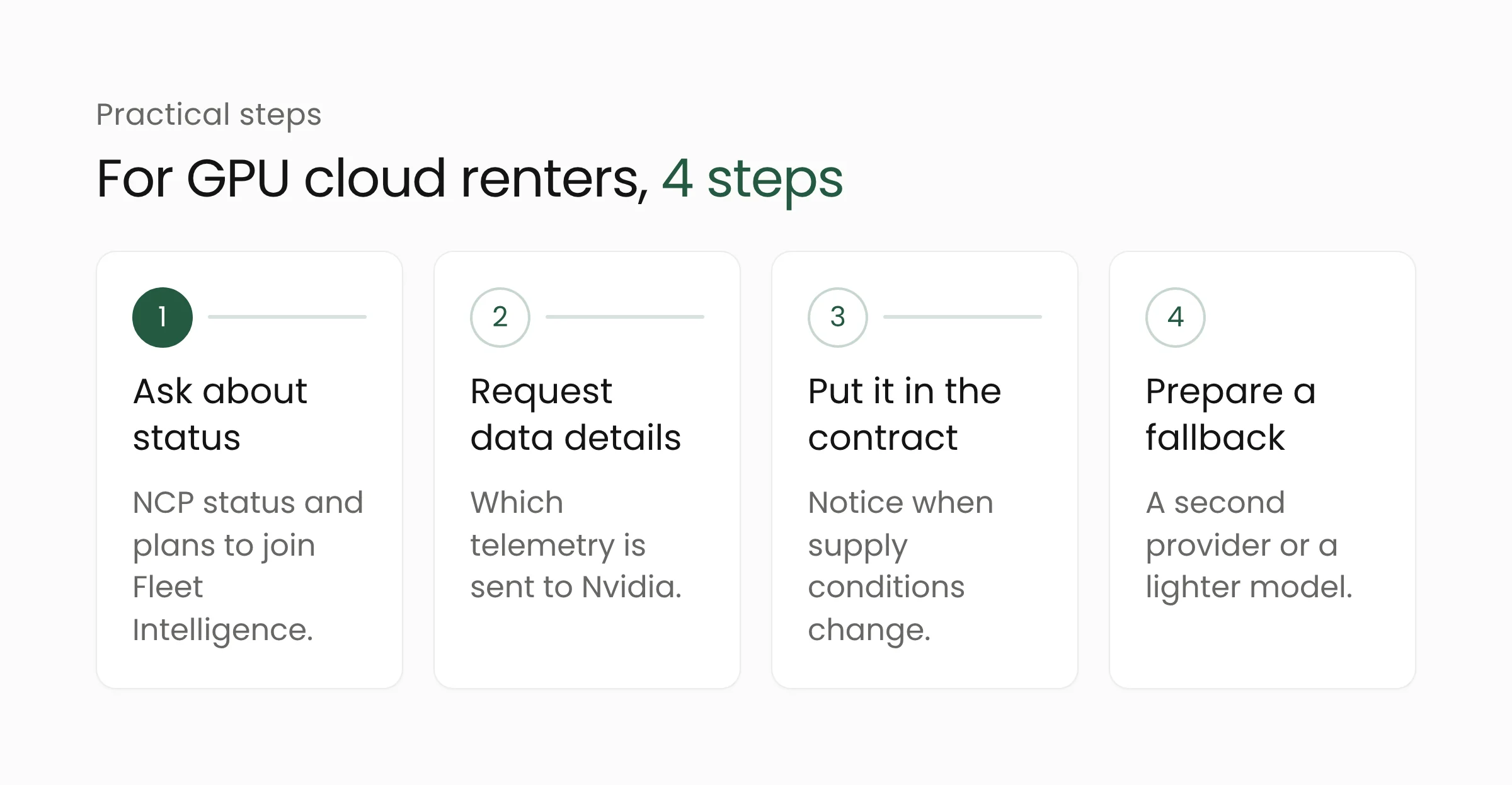
- Ask your provider whether it holds NCP status and whether it has enrolled, or plans to enroll, in Fleet Intelligence. The answer helps you judge how reliable its GPU supply will be.
- Request a written explanation of the telemetry sent to Nvidia. The official documentation describes hardware data, but your legal and security teams should still confirm that no workload data leaves the servers.
- Put this in the contract or service level agreement, including an obligation for the provider to notify you when supplier policy changes affect available capacity.
- Prepare a fallback, such as accounts with more than one provider or a lighter model, so AI projects do not stall if GPU supply at one provider tightens.
Merakit’s cloud computing services help organizations choose providers, design multi-provider architectures, and assess supply risks like this before a project starts.
For organizations that run their own GPU servers
Universities, banks, and companies that own GPU servers are not affected by the NCP requirement. Still, Fleet Intelligence is worth considering as a free monitoring tool for GPU temperature, power, and errors in a single dashboard. Since version 1.3.0, it also lets organizations share their data with an invited cloud provider, for example to speed up troubleshooting.
Installing the agent should go through an internal review. The agent stores enrollment credentials on the server, so access to that directory needs to be restricted. Organizations also need to decide who may view their GPU fleet data. If you are preparing infrastructure for AI solution development, monitoring and compliance questions like these are best answered at the design stage.
Frequently asked questions
Can Nvidia shut down GPUs remotely?
According to Nvidia, no. The company says its GPUs have no kill switches, backdoors, or hardware tracking. It describes Fleet Intelligence as read-only telemetry that cannot change GPU configurations.
Do GPU cloud customers have to install Fleet Intelligence?
Not according to current reports. The requirement applies to cloud providers in Southeast Asia that want Nvidia Cloud Partner status. The agent runs on GPU servers managed by the provider, so tenants do not need to install anything on their side.
Is model data or customer data sent to Nvidia?
The Fleet Intelligence documentation lists only machine metadata and hardware metrics, such as GPU serial numbers, IP addresses, temperature, and power draw. Workload data is not listed. For certainty, ask your provider to explain how its agent is configured.
Conclusion
The GPU tracking requirement for prospective Nvidia cloud partners in Southeast Asia shows that export compliance now helps decide who gets AI chip supply. For users in Indonesia, the most useful steps are understanding where their GPU provider stands and preparing a backup plan. If your organization is planning AI infrastructure in the cloud, the Merakit team is ready to help map out the options.
Sources
- Tom’s Hardware: Nvidia tightens tracking of AI GPUs in Southeast Asia as Chinese chip smuggling draws scrutiny, report claims (November 6, 2026)
- TipRanks: Nvidia Tightens Chip Tracking in Southeast Asia to Curb China Smuggling (November 6, 2026)
- Bloomberg: Nvidia Boosts Chip Tracking in Southeast Asia to Fight Smuggling (November 6, 2026)
- NVIDIA Blog: Opt-In NVIDIA Software Enables Data Center Fleet Management (December 10, 2025)
- NVIDIA Technical Blog: Introducing NVIDIA Fleet Intelligence for Real-Time GPU Fleet Visibility and Optimization (May 11, 2026)
- NVIDIA Fleet Intelligence documentation: Data Collection Rationale and Cross-Organizational Data Sharing
- The Register: Nvidia’s unreleased infrastructure management service isn’t for tracking GPUs, but it can (December 10, 2025)
- detikInet: coverage of the GPU Merdeka launch by Lintasarta and NVIDIA (August 22, 2024, in Indonesian)