Blog Cloud Computing
Project Suncatcher: Google Gets First AI Response from Orbit
On this page· 8 sections
Google says its Project Suncatcher prototype satellite has run an AI model on a data-center-class TPU in orbit and sent the answer back to Earth. It is the first AI response from a TPU in space and an early step in Google’s research into solar-powered AI data centers in orbit.
A haiku from orbit
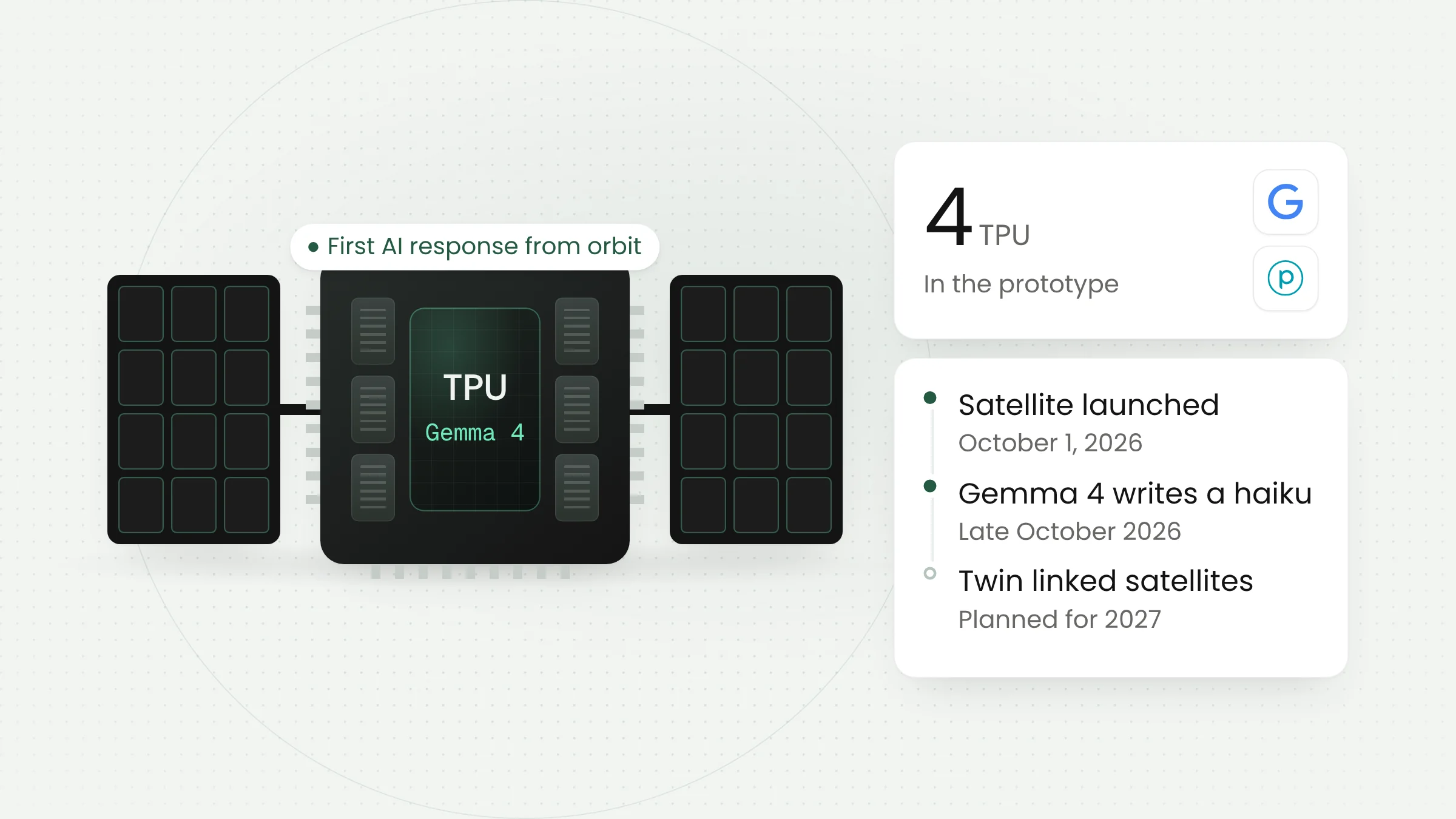
Travis Beals, the Google Research senior director who leads the project, announced the result in a Google blog post on October 30, 2026. The prototype launched on October 1, 2026. Over the following weeks the team completed commissioning, which meant powering up the host computer and the TPU trays and running early machine learning tests.
Google calls the milestone its Hello World moment. During a ground-station pass, the team sent a prompt to the Gemma 4 open model running on board and asked it to write a haiku about being in space. The poem came back as the satellite passed over Svalbard, Norway, confirming that the full chain worked.
Google CEO Sundar Pichai described the sequence on X, as reported by The Hans India: a command goes up to orbit, the TPU boots, the prompt runs, and the response comes back down. After the haiku, the team tried other prompts, including space-themed limericks and requests for telemetry on the satellite’s payload systems.
A TPU, or Tensor Processing Unit, is the AI chip Google designs for its own data centers to train and serve models. Running a chip of that class in orbit is a different task from flying a small onboard computer, because it draws far more power and produces far more heat.
A fridge-sized satellite with four TPUs
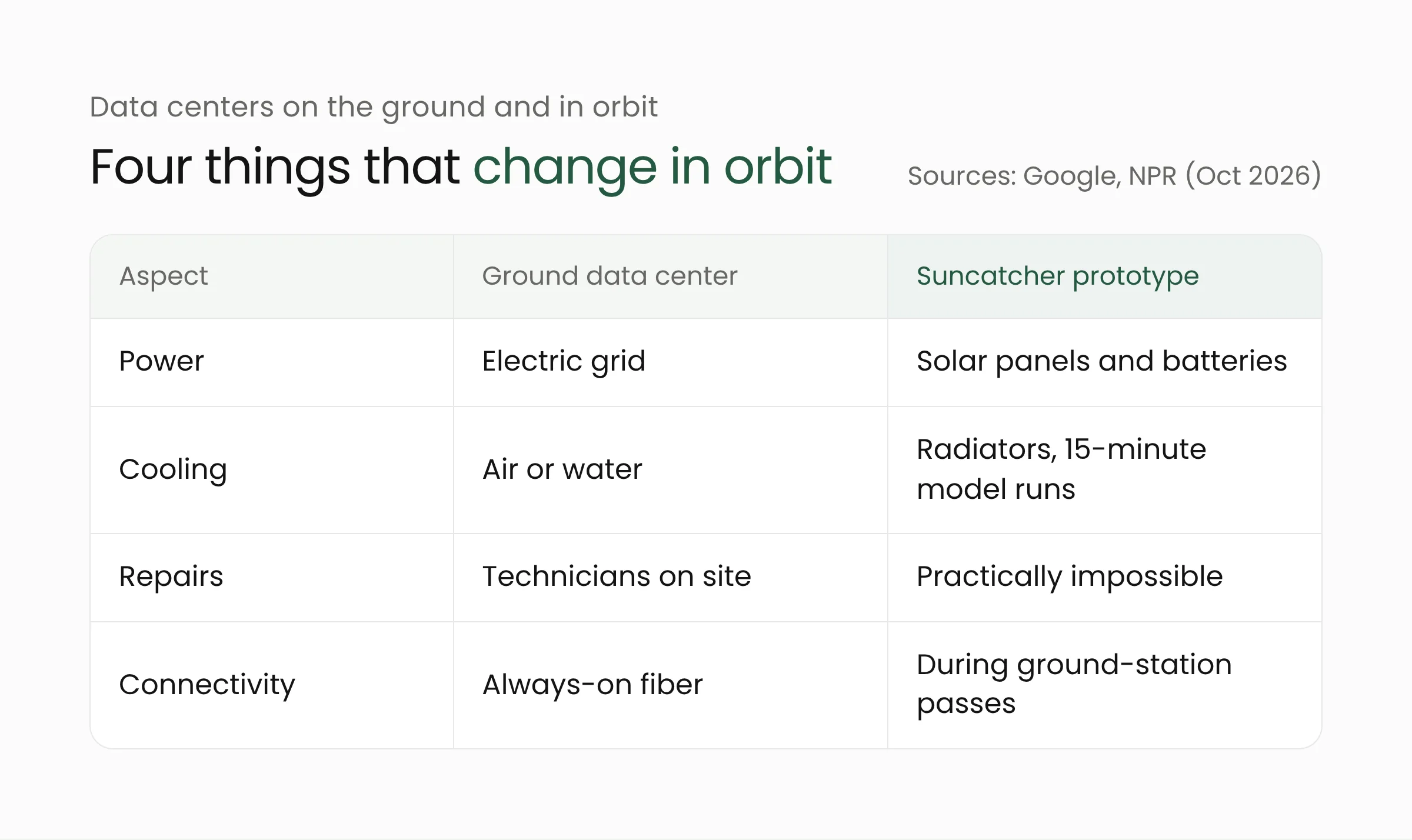
According to NPR’s coverage of the launch, the satellite is roughly the size of a refrigerator, flew on a SpaceX rocket, and was developed with Planet, the Earth-imaging satellite company. It carries four TPUs, and the goal is to keep it operating for a year.
One detail shows how early this stage is. NPR reported that the Gemma model runs for only 15 minutes at a time because of heat management limits. The prototype also sits in a standard orbit and relies on batteries. Later satellites are planned for a sun-synchronous orbit without batteries.
A sun-synchronous orbit follows the line between day and night on Earth, so the solar panels stay in sunlight almost all the time. In the original Project Suncatcher design, published on November 4, 2025, Google said a solar panel in the right orbit can be up to 8 times more productive than on Earth.
The design for a data center in orbit
The November 2025 design laid out the long-term goal. Google modeled an illustrative cluster of 81 satellites at a mean altitude of 650 km, with a cluster radius of 1 km. The distance between nearest neighbors would swing between roughly 100 and 200 meters, and the satellites would be linked by lasers so they could work as a single data center.
The links between satellites are the hardest part. To behave like one data center, the satellites need extremely high-bandwidth connections, which is why the design calls for flying them in very tight formation. Google is aiming for optical links that carry tens of terabits per second. In a bench-scale lab demonstration, a single transceiver pair reached 800 Gbps each way, or 1.6 Tbps in total.
Launch cost is the other condition. Google expects prices could fall below $200 per kilogram by the mid-2030s. At that level, Google said, the cost of launching and operating a space-based data center could become roughly comparable to the energy costs of an equivalent data center on the ground, measured per kilowatt per year.
Radiation testing before launch
Before launch, Google tested its Trillium (v6e) TPU under a 67 MeV proton beam to simulate radiation in orbit. The HBM memory began to show irregularities after a dose of 2 krad(Si), nearly three times the 750 rad(Si) expected for a shielded five-year mission. A single chip showed no hard failures from total ionizing dose up to 15 krad(Si).
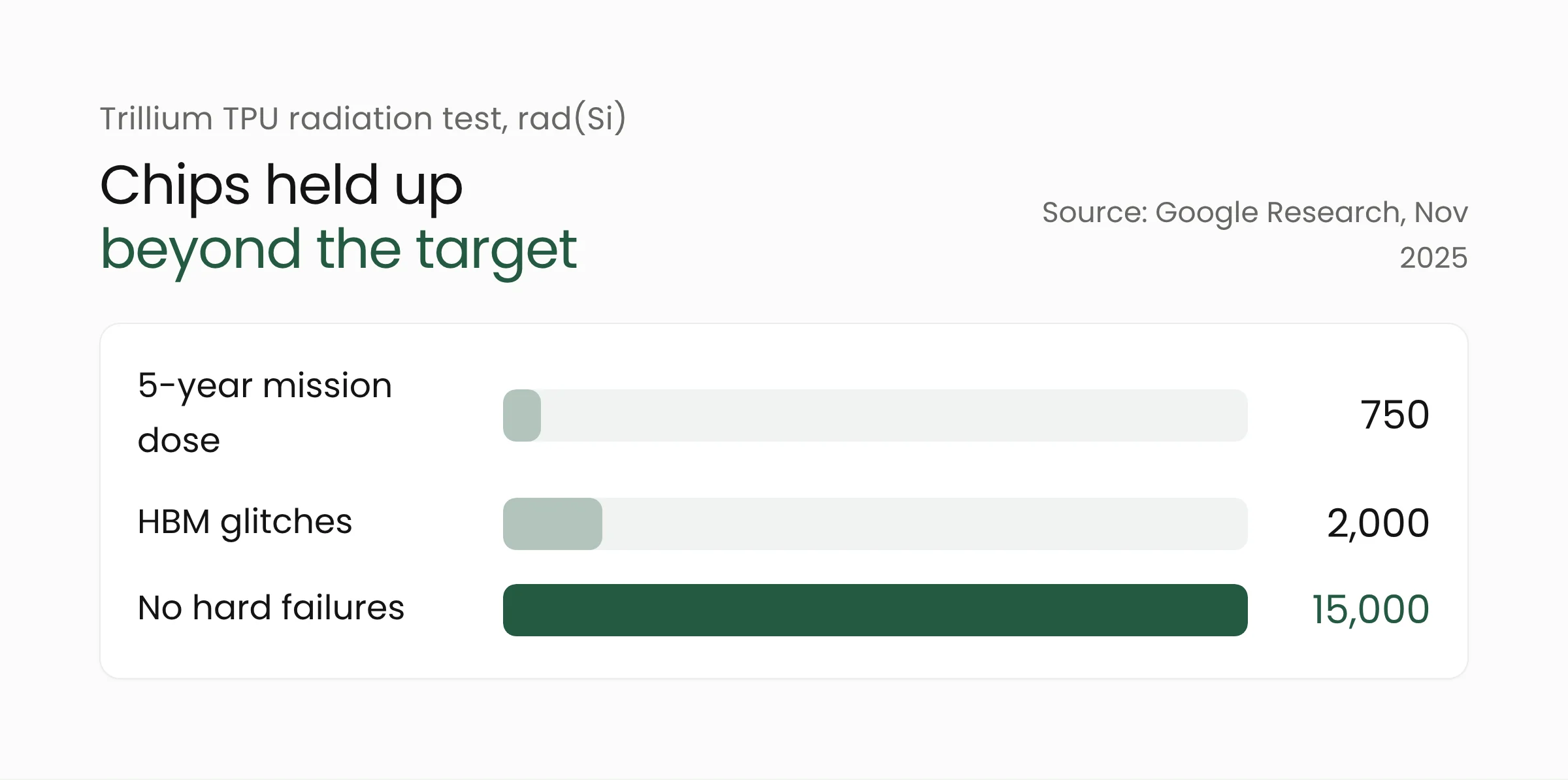
Those lab results now face real conditions. Google’s post says the next step is to test how the TPUs perform under thermal stress and radiation exposure in orbit. The milestone after that is a pair of interconnected satellites in 2027.
The schedule has shifted slightly since 2025, when Google said it would launch two prototype satellites with Planet by early 2027. In practice, one satellite has been in orbit since October 2026, and two more are planned for next year.
Rivals and expert doubts
Google is not alone. NPR noted that the startup Starcloud launched a spacecraft carrying an Nvidia H100 chip last November and ran an AI model from orbit. SpaceX has also said it expects to deploy orbital AI compute satellites as early as 2028.
Power is the driving force. AI data centers need enormous amounts of electricity, and in many places supply has become a bottleneck, as seen when Amazon’s Nvidia racks sat waiting for power. NPR also reported that Pichai expects Google’s 2026 capital spending to reach $180 billion to $190 billion, more than six times the 2022 level.
Beals himself is not promising quick results. “I don’t see this being something where it’s cheaper to do this in the next five years,” he told NPR. He calls the project a moonshot, a long-term research bet that may not pay off, and does not expect orbital data centers to replace those on the ground any time soon.
Other experts point to engineering limits. Brandon Lucia, a professor at Carnegie Mellon University, told NPR that more computation means dumping more heat into a confined environment. There is no air or water for cooling in a vacuum, so heat can only leave through heavy radiators. Lucia said the cost and complexity of maintenance in orbit could be 10 to 100 times higher than on the ground. NPR also flagged emissions from rocket launches and debris from satellites burning up on reentry.
What this means for cloud users in Indonesia
For the next several years, the AI capacity that Indonesian organizations use will still come from data centers on the ground. Project Suncatcher is worth following, but it does not yet belong in budgets or architecture plans. A few lessons apply today.
First, account for the power and cost of AI from the start. Google’s search for energy in orbit shows that electricity and cooling are now real limits on AI computing. When choosing a provider, ask about GPU or TPU availability in the nearest region, expansion plans, and hourly pricing. A cloud computing team can help map which workloads need large accelerators and which run fine on standard instances.
Second, match model size to the task. The satellite runs Google’s open Gemma model rather than its largest model, because power and heat are limited. The same logic holds on the ground. Many jobs, such as classifying documents, summarizing reports, or answering internal questions, can be handled by smaller and cheaper models. Large models can be kept for work that truly needs them.
Third, design for connections that come and go. The satellite can only talk to Earth during ground-station passes, so it has to work on its own between contact windows. Devices on palm oil plantations, mine sites, ships, or monitoring posts in areas with weak signal face a similar situation. Running AI directly on the device and syncing results when a connection is available is a pattern that can be built through IoT services.
Fourth, plan for remote maintenance. Hardware that is hard to reach, whether in orbit or at a remote site, needs health monitoring, remote software updates, and a fallback when a component fails.
Frequently asked questions
What is Project Suncatcher?
Project Suncatcher is Google’s long-term research effort to run AI computing on solar-powered satellites fitted with TPU chips and linked by lasers. Its goal is to find out whether AI data centers in orbit could become a practical option in the future.
Are Google’s AI services now running from space?
No. The satellite is a prototype for testing hardware durability. Google services such as Gemini and Google Cloud still run in data centers on the ground, and Beals does not expect computing in orbit to be cheaper within the next five years.
When is the next stage?
Google plans to test the TPUs under thermal stress and radiation in orbit in the coming months. The next milestone is a pair of interconnected satellites in 2027 to test networking between satellites.
Closing
A haiku from orbit is a small technical proof, but it shows how seriously technology companies are looking for new energy sources for AI. While the next tests play out, organizations in Indonesia can start with something closer to home: running their AI workloads efficiently on the cloud they already use. If you are planning AI infrastructure, the Merakit team can help you map out the steps.
Sources
- We’ve received our first response from the Project Suncatcher prototype satellite, Google, October 30, 2026
- Google launches Project Suncatcher, a step towards AI data centers in space, NPR via WUNC, October 1, 2026
- Exploring a space-based, scalable AI infrastructure system design, Google Research, November 4, 2025
- Google’s Project Suncatcher achieves first AI response from space, The Hans India, October 31, 2026