Blog Industrial Robots
US Targets Industrial Robot Imports: What Factories Face
On this page· 8 sections
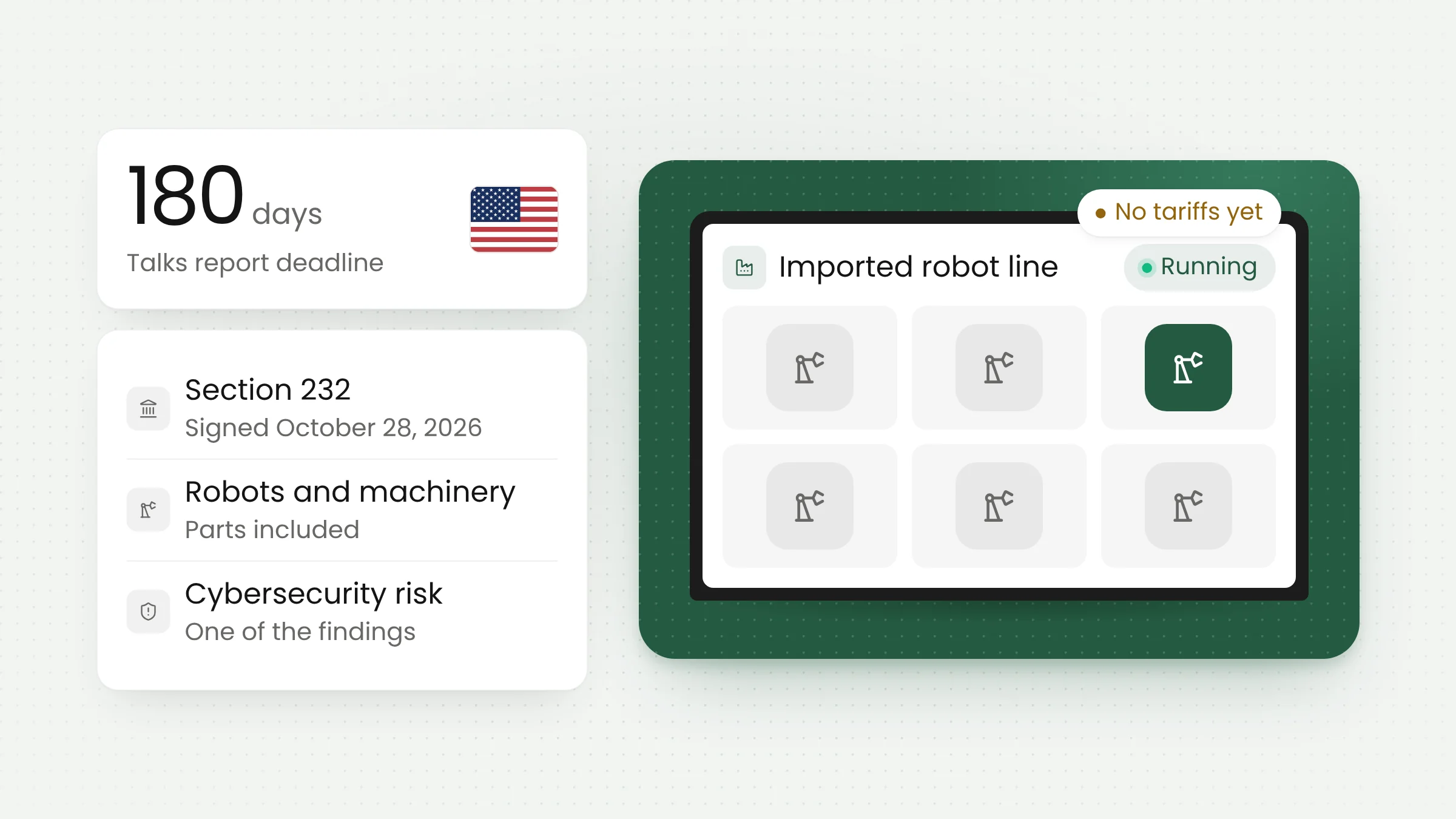
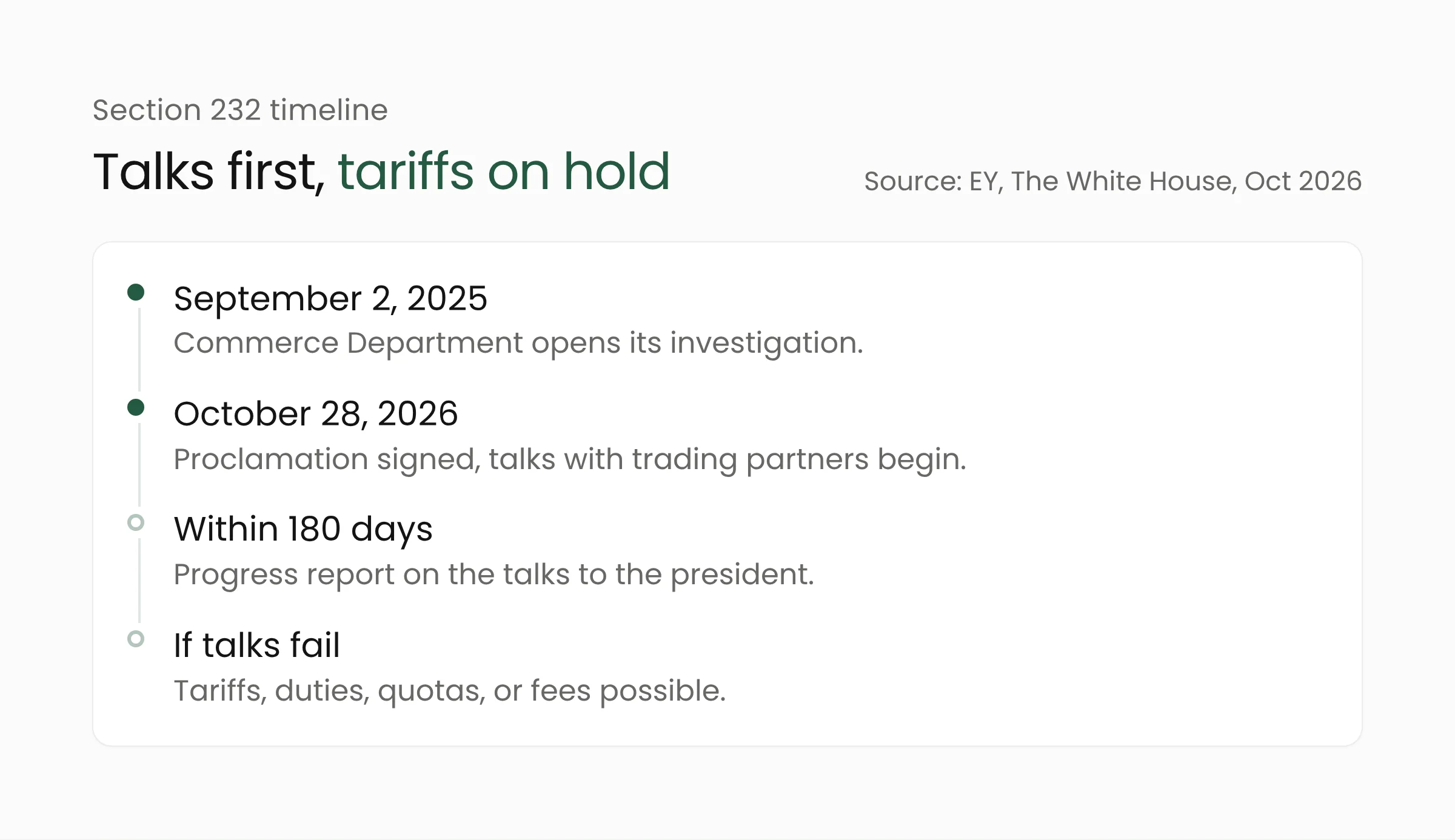
The United States has declared that imports of industrial robots, industrial machinery, and their parts and components threaten national security. A proclamation signed by President Donald Trump on October 28, 2026, stops short of tariffs. Instead, Washington is opening negotiations with trading partners and wants a progress report within 180 days.
What the October 28 proclamation says
The proclamation, titled Adjusting Imports of Robotics, Industrial Machinery, and Their Parts and Components into the United States, was issued under Section 232 of the Trade Expansion Act of 1962. That provision lets the US president adjust imports judged to threaten national security. According to the White House fact sheet, the president concurred with the Commerce Department’s finding that these goods are entering the country in quantities and under circumstances that threaten to impair national security.
The first remedy is diplomacy. The Secretary of Commerce and the US Trade Representative (USTR) are directed to pursue new agreements, or continue existing talks, with trading partners. Supply Chain Dive identifies them as Commerce Secretary Howard Lutnick and USTR Jamieson Greer. They must update the president on progress within 180 days of the proclamation.
If no agreement is reached within that window, or if an agreement is not carried out or proves ineffective, the president can go further. Summaries from KPMG and EY list the options as tariffs, duties, quotas, fees, and a program to encourage investment in domestic production. Existing Section 232 tariffs on steel, aluminum, and copper remain in place, so machinery with significant metal content is still subject to those duties.
Five findings from the Commerce Department
The Commerce Department opened its investigation on September 2, 2025, according to EY. Its report rests on five main findings:
- Defense. Robots and industrial machinery are used to build defense systems, from aircraft to munitions.
- Critical infrastructure. The proclamation says these goods are used across all 16 US critical infrastructure sectors.
- Import reliance. The US relies on imports for most types of robots and industrial machinery, and import values have grown over the past decade.
- Cybersecurity. Machinery from certain foreign entities is seen as a cybersecurity risk because it routinely processes and stores sensitive data.
- Domestic capacity. US industry does not yet produce enough robots and machinery to meet national security needs.
The fourth finding matters to plant managers everywhere. Modern industrial robots sit on networks, receive software updates, and are often reachable by vendors for remote maintenance. In practice, a robot is also a computer that needs to be secured.
US industry still depends on imported robots
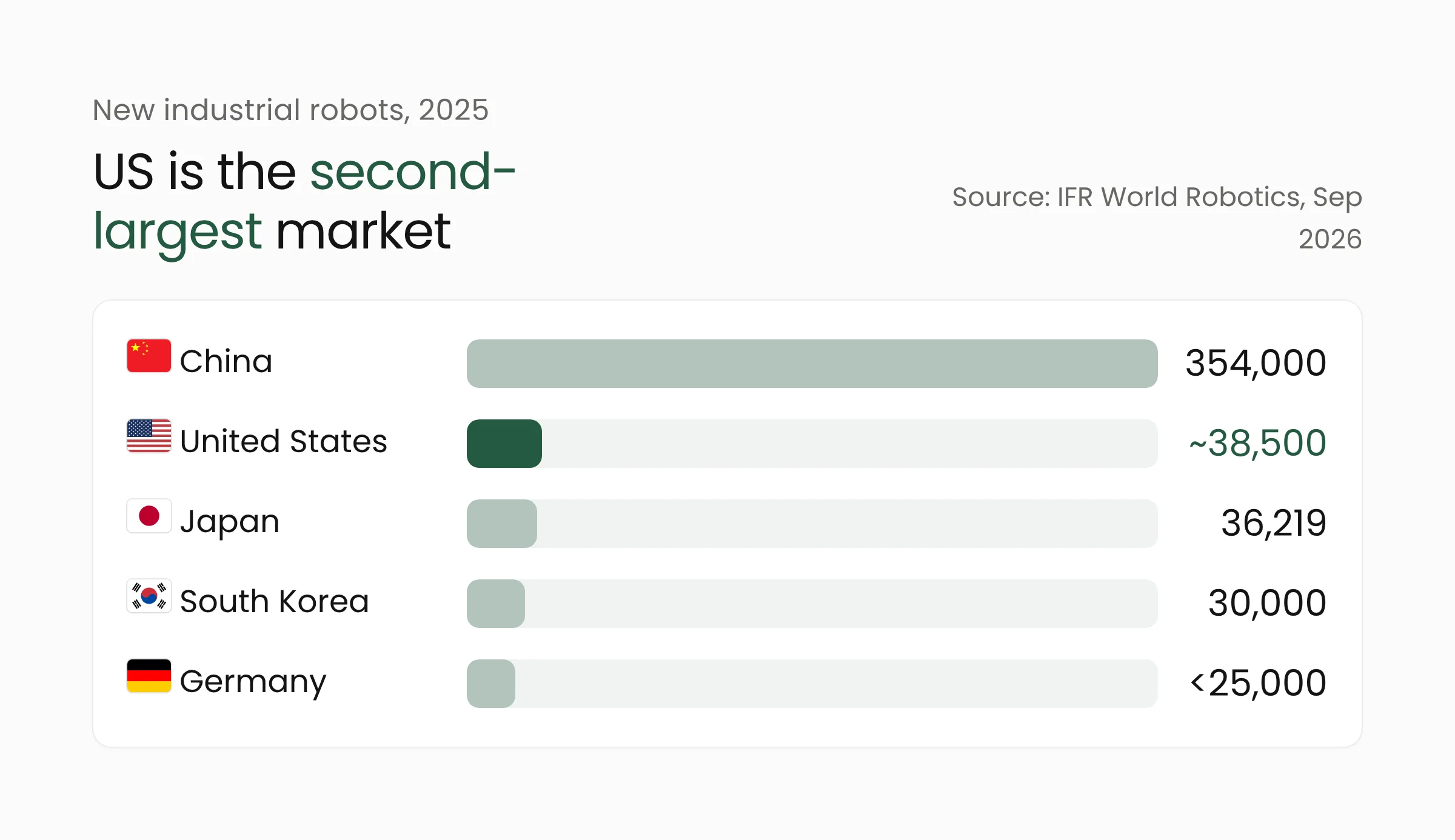
The policy touches a large market. The World Robotics 2026 report from the International Federation of Robotics (IFR) counted almost 38,500 new industrial robots installed in the US in 2025, up 12 percent. That made the US the second-largest market, far behind China, which installed 354,000 units, or 59 percent of the global total. Worldwide installations topped 600,000 units, and the number of robots operating in factories reached a record 5 million.
Kompas.com, summarizing Ars Technica, reported that General Motors, Ford, Tesla, Boeing, and Lockheed Martin are among the companies using imported robots from FANUC, ABB, Yaskawa, or KUKA, suppliers based in Japan, Switzerland, and Germany. The proclamation itself acknowledges that domestic manufacturing investment is growing but has not yet caught up with demand.
Some suppliers are already moving. The Robot Report noted that FANUC, Teradyne Robotics, and Yaskawa have announced US manufacturing investments. The publication also described competition with China as the backdrop for both this investigation and earlier Federal Communications Commission (FCC) restrictions on foreign-made robots. Thompson Hine dates the FCC’s addition of advanced robotic devices to its Covered List to August 2026, while Kompas.com places the ban on new robot models in July 2026.
Talks first, tariffs possibly later
This is a familiar pattern. According to EY, the administration took a similar route for wind turbines in a proclamation dated October 22, 2026. Supply Chain Dive also points to a July 2026 order to negotiate over commercial aircraft, jet engines, and parts. Elsewhere, Section 232 has been used to impose tariffs on cars and auto parts, drones, and polysilicon.
Analysts see the move as a signal of intent. “This shouldn’t be read as a new robotics tariff today, but it is a clear indication of the direction of travel,” Ash Sharma, vice president of research at Interact Analysis, told The Robot Report. He added that future tariffs, quotas, or other measures could affect pricing and localization decisions, including for components.
Robert Little, former chief of robotics strategy at Novanta, focused on components. He told the same outlet that what worries him most are gaps in the domestic US supply of components such as sensors, actuators, precision gears, and encoders. Those parts decide whether a robot can be built and serviced on time.
EY added that the proclamation does not yet list the products or tariff codes (HTSUS) it covers. Future treatment could also vary by country of origin, since outcomes depend on talks with each trading partner.
What this means for factories in Indonesia
The policy only governs imports into the US. Even so, there are three ways it could reach plant managers and exporters here.
The first involves manufacturers that export industrial machinery or parts to the US. The proclamation covers components, and no country of origin has been exempted. Exporters should start mapping which products could fall under robotics, industrial machinery, or their parts, and follow the negotiations closely.
The second involves factories that buy robots. If US tariffs eventually take effect, global robot makers may rethink where they build and how they price. The direction is still unclear, so a sensible step is to make sure purchase and maintenance contracts spell out pricing, spare part availability, and the length of software support.
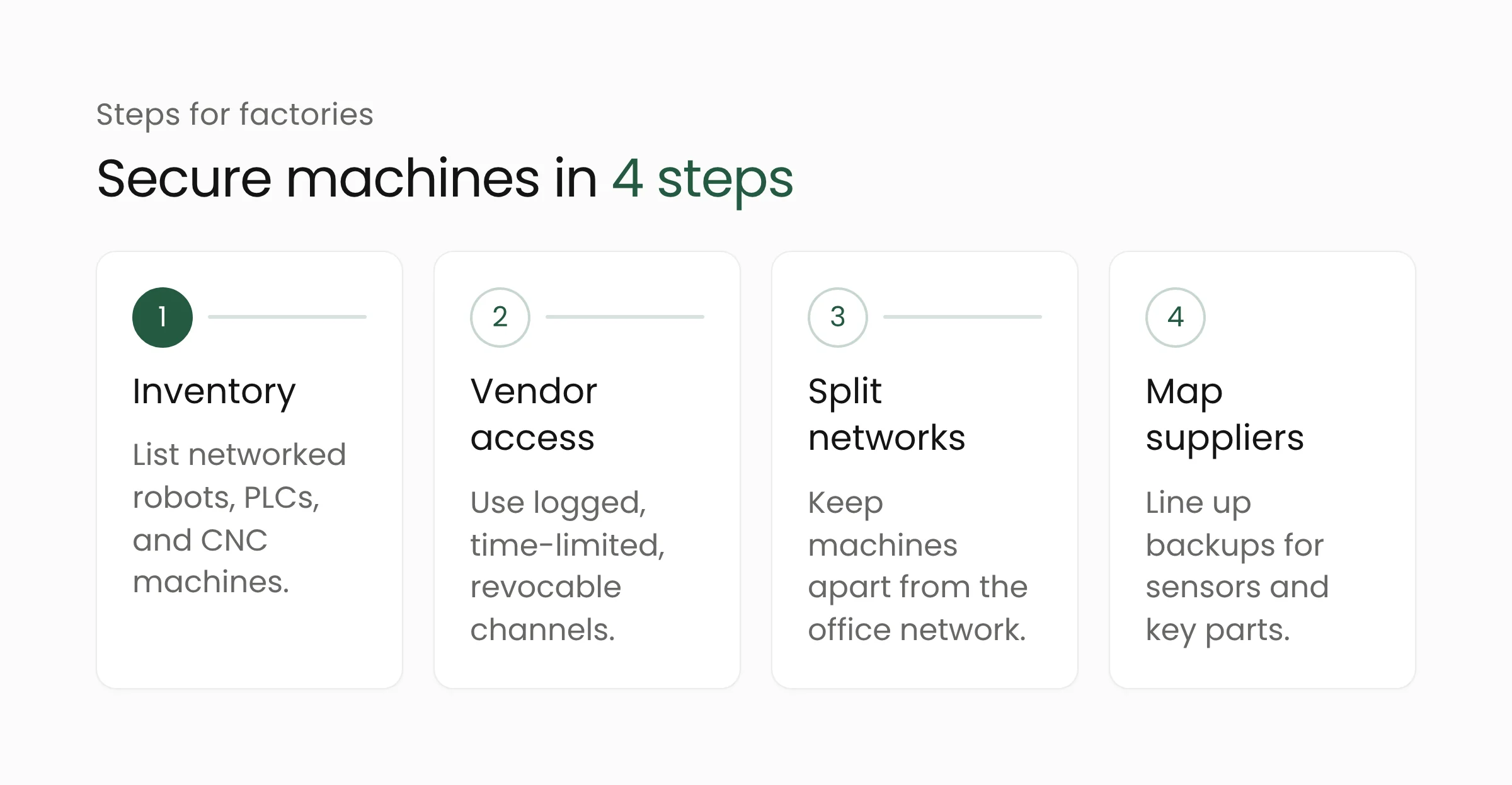
The third is the cybersecurity of factory machines. The security rationale Washington cites applies to any plant: networked robots and machines handle production data and can become an entry point for attackers. A few basic steps can be taken now:
- Inventory connected machines. List every robot, PLC, and CNC machine on the network, with its manufacturer, country of origin, and software version.
- Limit vendor remote access. Make sure outside maintenance access runs through a logged, time-limited channel that can be revoked, instead of a connection that stays open.
- Separate the production network. Keep the machine network (OT) apart from the office network, with clear traffic rules between the two.
- Map component suppliers. Know where your sensors, actuators, and critical spare parts come from, and line up alternatives for the parts you replace most often.
These steps belong in any sound industrial automation program, whatever direction trade policy takes. On the security side, device monitoring and access control can be designed together with a cybersecurity team. If your plant is just starting with collaborative robots, our story on factory robots programmed from an iPad shows how these machines are becoming easier to run, and how many more of them now connect to the network.
Frequently asked questions
Has the US imposed tariffs on imported industrial robots?
No. The October 28, 2026 proclamation does not impose new tariffs, duties, or quotas. New tariffs would only become possible if talks fail to produce an agreement, or if an agreement is not implemented or proves ineffective.
When is the next decision expected?
The Commerce Secretary and USTR must report on the negotiations to the president within 180 days of October 28, 2026. A date for any follow-up decision has not been announced.
Are robots from specific countries banned from the US?
This proclamation does not ban imports. It covers robots, industrial machinery, and components from any country, and treatment may differ depending on the talks with each country. Separate restrictions on certain robotic devices come from the FCC through its Covered List.
Conclusion
The US move shows that industrial robots are now treated as a supply chain issue and a security issue at the same time. For factories in Indonesia, this is a good moment to review machine inventories, vendor access, and component suppliers before the tariff picture becomes clear. If you want to map the connected machines on your production lines, the Merakit team is ready to help.
Sources
- The White House: Fact Sheet, President Donald J. Trump Adjusts Imports of Robotics, Industrial Machinery, and their Parts and Components (October 28, 2026)
- The White House: Proclamation, Adjusting Imports of Robotics, Industrial Machinery, and Their Parts and Components (October 28, 2026)
- The Robot Report: White House makes Section 232 determination regarding foreign-made robots (October 29, 2026)
- Supply Chain Dive: Trump opts for trade talks over tariffs for robotics, industrial machinery (October 29, 2026)
- EY Tax News: US concludes Section 232 investigation into robotics and industrial machinery imports (October 29, 2026)
- KPMG: President Trump directs Commerce, USTR to negotiate over imports of robotics, industrial machinery and parts (October 2026)
- Thompson Hine SmarTrade: President Directs Section 232 Negotiations on Robotics and Industrial Machinery Imports (October 2026)
- Kompas.com: Trump Sebut Impor Robot Industri Ancam Keamanan Nasional (October 31, 2026)
- IFR: Five Million Robots now Operate in Factories Globally (September 24, 2026)