Blog Robotics
Hesai Kosmo: A 3D Spatial Camera for Training Robots
On this page· 7 sections
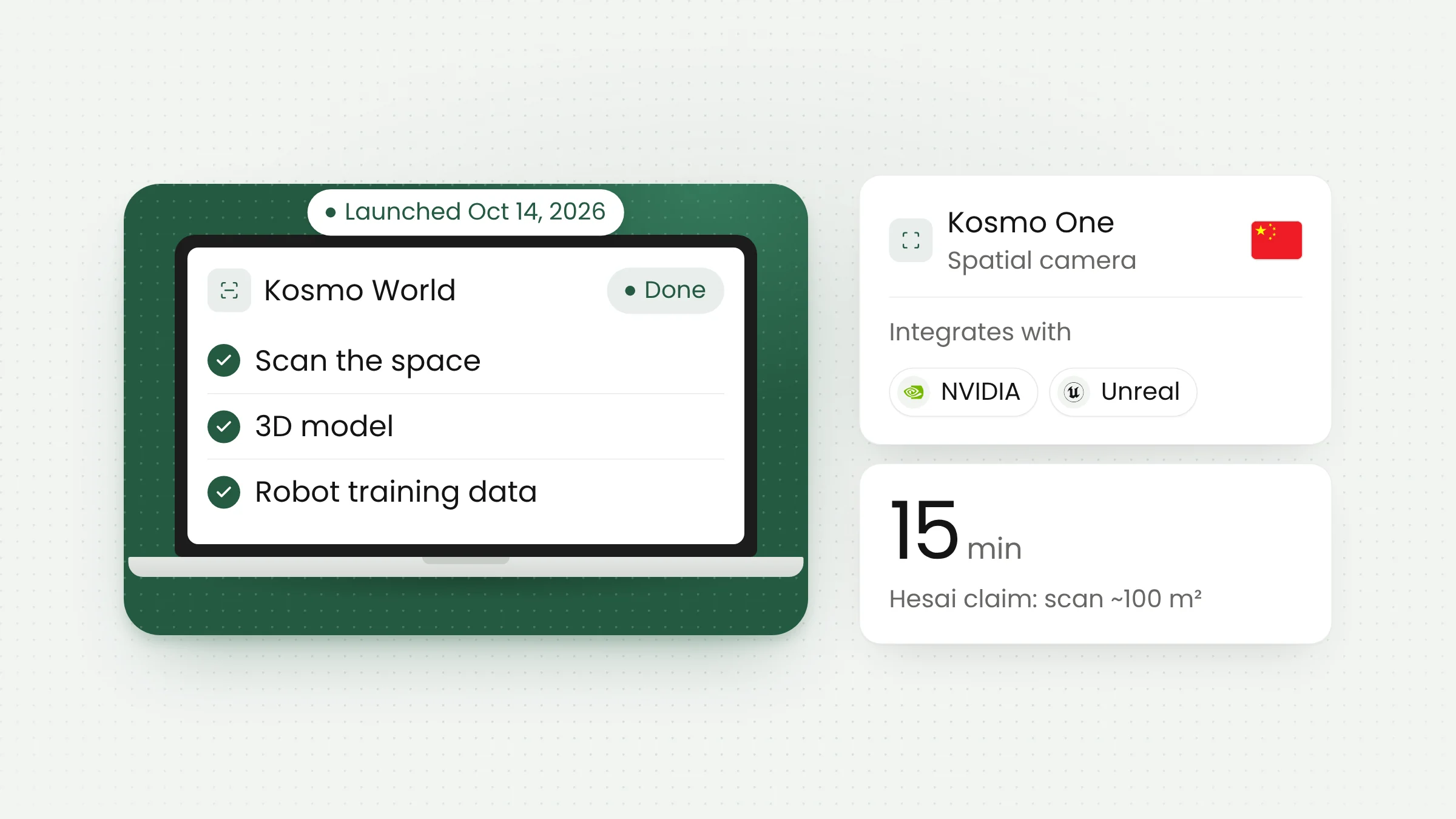
Hesai Group launched Kosmo in Shanghai on October 14, 2026, a system that scans real spaces into 3D models for training robots. Kosmo pairs a spatial camera, Kosmo One, with a cloud platform, Kosmo World. Hesai has not announced pricing or availability.
What Hesai launched in Shanghai
Hesai is best known for lidar, sensors that measure distance using reflected laser light, for autonomous vehicles. With Kosmo, the company is moving toward another need: data for training robots. The launch took place at Hesai’s factory in Shanghai. According to Reuters, the device combines lidar sensors and cameras to help developers collect real-world spatial data.
Hesai calls Kosmo One the world’s first AI spatial camera with 8K imaging, a claim the company bases on public information as of October 2026. It combines high-resolution lidar, a one-inch image sensor, and an inertial measurement unit. Geometry, color, texture, and camera position are recorded with microsecond-level synchronization. Capture resolution reaches 8K, while exported files top out at 6K, as Unite.AI notes.
Kosmo World is the cloud platform that processes the scans. Hesai describes two business models: bundled hardware and software for robotics, media, and other industries, and a service that produces real-world spatial data at scale for developers of world models and physical AI. The Hesai press release does not state a price, release date, or sales region.
Kosmo was previewed earlier. Hesai showed it as an AI spatial camera in April 2026 and scheduled its official launch for the second half of 2026, according to Hesai’s July 2026 post. The October 14 event added product details and partners.
How Kosmo works, from scan to training data
A robot trained in simulation needs a virtual space that resembles its workplace. Building that space by hand takes a team of 3D modelers and a long time. Kosmo tries to shorten the process in four stages.
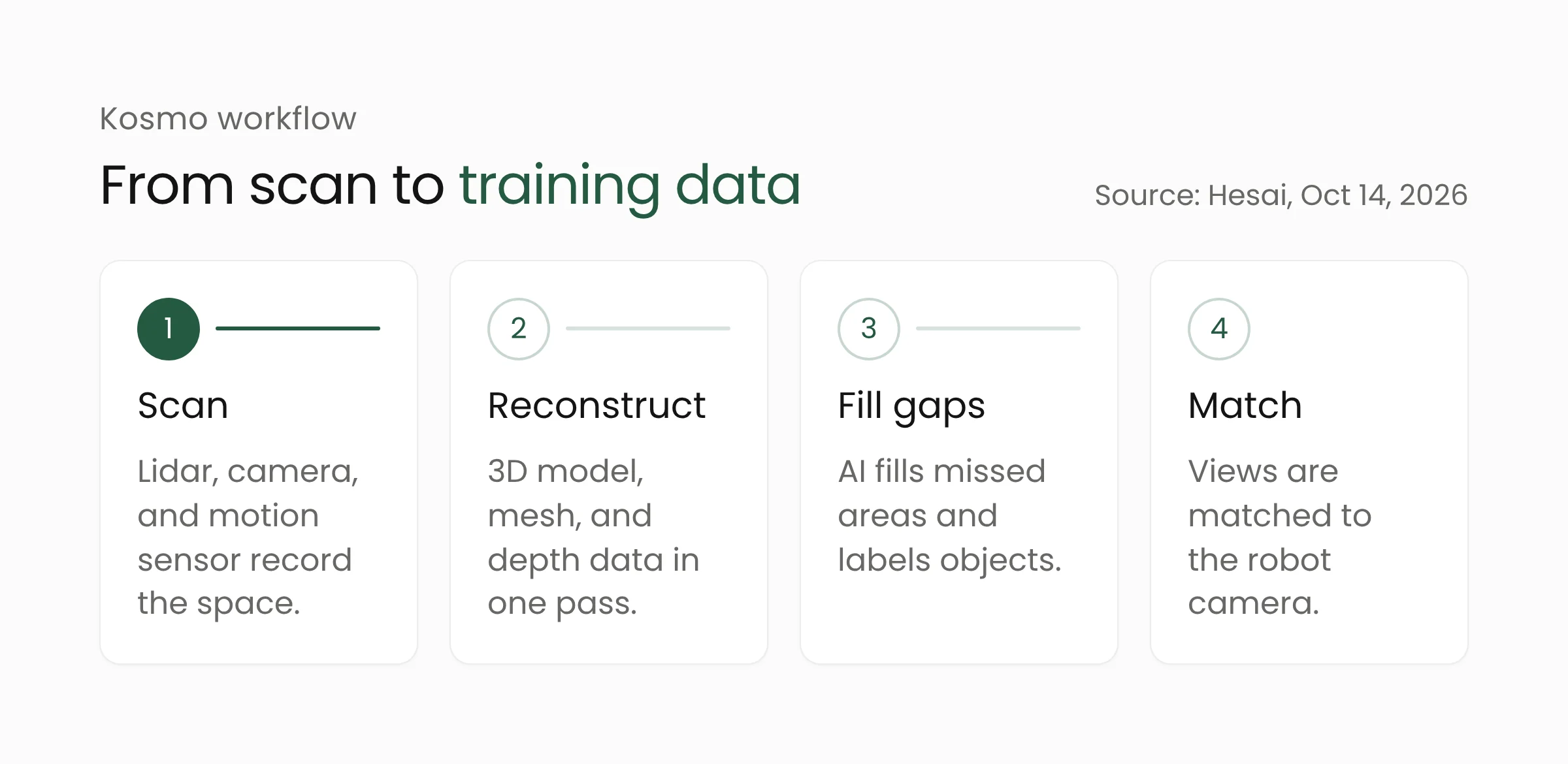
First comes the scan. One operator walks the space with Kosmo One, and Hesai says an indoor area of about 100 square meters can be scanned in roughly 15 minutes, depending on layout. Second is reconstruction with 3D Gaussian Splatting, a technique that builds a scene from many small colored blobs. In one pass, Kosmo World produces splat data, a surface mesh, and a depth map. Hesai claims millimeter-level geometric accuracy without detailing the test conditions.
Third, generative AI fills areas the scanner missed and reconstructs materials and textures, while semantic segmentation labels individual objects. Fourth, the space is adapted to the characteristics of a specific robot camera. Hesai says this narrows the gap between simulation and the real world, a long-standing obstacle when robots move from virtual rooms to the factory floor.
The output can move into software already used in industry. Hesai lists integrations with NVIDIA Isaac Sim and Isaac Lab for robot simulation, and with Unreal Engine, RenderMan, and Houdini for visual production. From a single scanned space, Hesai says, Kosmo can generate more than 10,000 training trajectories.
The claims and their limits
Hesai brings several numbers. All of them come from the company, and the sources we read contain no independent verification.
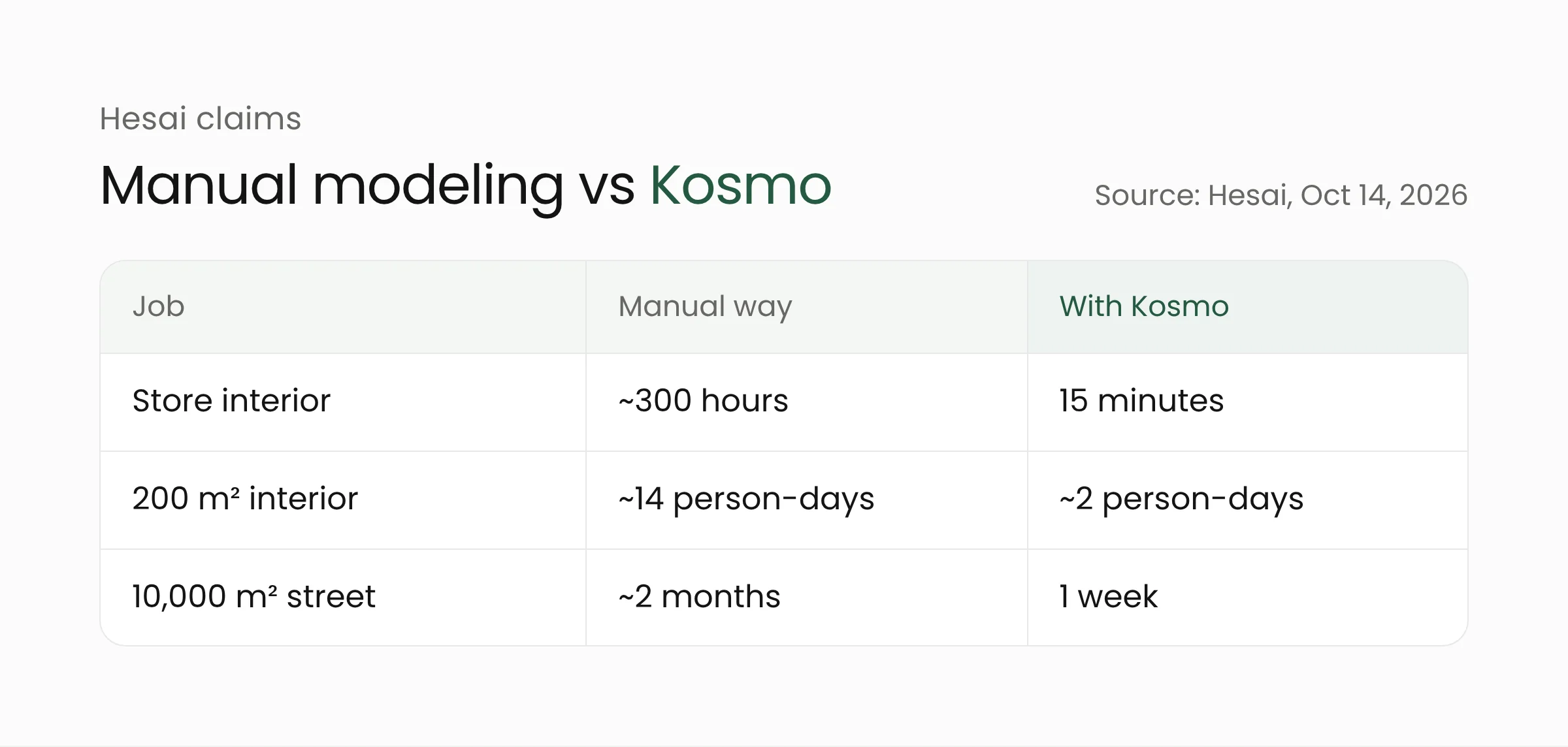
The most cited example is a Dairy Queen store in Shanghai. Hesai says manual 3D modeling of that space took a professional team about 300 hours, while scanning and reconstruction with Kosmo took 15 minutes. A Sharpa Wave robot serving ice cream in the store reportedly reached a 99% task success rate, with its failure rate falling to one-tenth of the earlier level. Reuters notes that the 99% figure is Hesai’s claim and has not been independently verified.
Some context belongs next to that number. Reuters describes Sharpa as a startup founded by Hesai’s co-founders that operates independently of Hesai. The result also comes from a single location, so it says little about performance in more varied spaces. In film and architecture examples, Hesai says a 10,000 square meter European street that would take about two months to build as a physical set can be scanned and edited in one week, and a 200 square meter interior that takes about 14 person-days with traditional CG modeling can be done in about two. The “manual” baseline in each case is Hesai’s own.
On customers, Hesai says it has signed agreements with Chinese robotics companies but did not name them and declined to give revenue projections. The two strategic partners announced are Galbot and Dexmal. CEO David Li told Reuters there is a significant gap in high-quality spatial data for training robots, and that most robots today are still limited to functions such as greeting guests, waving, or dancing.
Skeptical readers have reason to wait. The time savings depend on the baseline the vendor chose, and the millimeter accuracy comes without stated test conditions. Kosmo is worth judging only after tests in more varied environments and with pricing in hand.
What this means for your factory or warehouse
Kosmo is built for robot developers, and there is no information yet on availability in Indonesia. Still, the direction it points to matters for factories, warehouses, and distribution centers starting to think about automation. A few considerations to begin with:
Decide what the spatial data is for. A 3D model of a production floor can support layout planning, simulation of transport-robot routes, or staff training. Each purpose needs different accuracy and formats, so the goal should be clear before choosing a scanner.
Ask for evidence under conditions like yours. Accuracy and speed claims are often tested in clean, well-lit rooms. A dusty factory floor with reflective surfaces and constant movement is a different test. Ask for a pilot on one line before rolling a device out across sites.
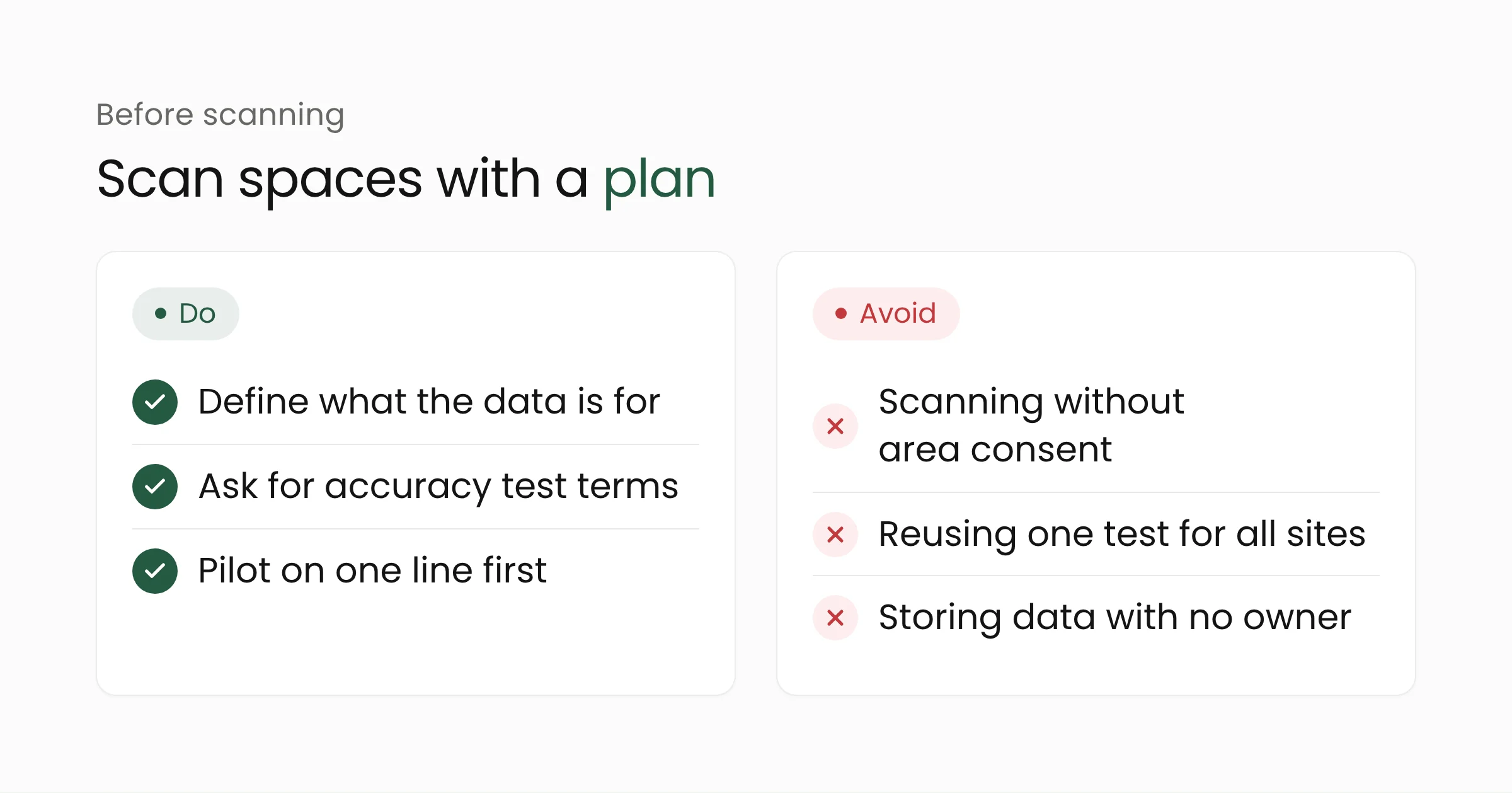
Set consent and ownership rules for scan data. A scan can capture people, documents on desks, or computer screens. Decide who may scan, which areas are excluded, and who is responsible for storage. This is our governance suggestion, not a requirement from Hesai.
Prepare the data pipeline early. Scans are large and must be moved, labeled, and stored in an orderly way to be reusable. That is where data analytics work and cloud infrastructure decide whether the data is useful. Connected devices on the factory floor fall under IoT, and the broader idea of virtual models of real assets is covered in our digital twin explainer.
For companies drawing up an automation roadmap, the lesson is about sequence. Well-organized, documented spatial data is needed before robots are introduced. This topic sits close to industrial automation.
Frequently asked questions
What is Hesai Kosmo?
Kosmo is a Hesai system made up of the Kosmo One spatial camera and the Kosmo World cloud platform. Together they turn physical spaces into digital 3D environments for training robots, developing world models, and creating visual content.
How much does Kosmo cost and when is it available?
Not announced. Hesai’s press release gives no price, release date, or availability region, and Reuters notes that Kosmo’s pricing was not disclosed.
Is the 99% robot success rate proven?
Not independently. The figure comes from Hesai and relates to a single Dairy Queen store in Shanghai, where a robot from Sharpa, a startup founded by Hesai’s co-founders, operates. Tests at more sites are needed to judge it.
Conclusion
Kosmo shows that the robot problem is shifting toward supplying accurate, affordable spatial data. The claims are interesting but still await independent tests and pricing. If your organization is planning automation or workspace modeling, we would be glad to talk about the data and infrastructure to prepare.
Sources
- Hesai via PR Newswire: Building the Data Infrastructure for Physical AI, Hesai Launches Kosmo 3D World Data Engine (October 14, 2026)
- Reuters: China’s Hesai launches spatial camera to boost AI-powered robotics adoption (October 14, 2026)
- Unite.AI: Hesai Launches Kosmo to Turn Real-World Scans Into Robot Training Data (covers the October 14, 2026 launch)
- Hesai: Kosmo Spatial Intelligence Platform at WAIC 2026 (July 20, 2026)