Blog Drone Delivery
Zipline Raises $1.5B, Walmart Adds 300 Drone Delivery Sites
On this page· 7 sections
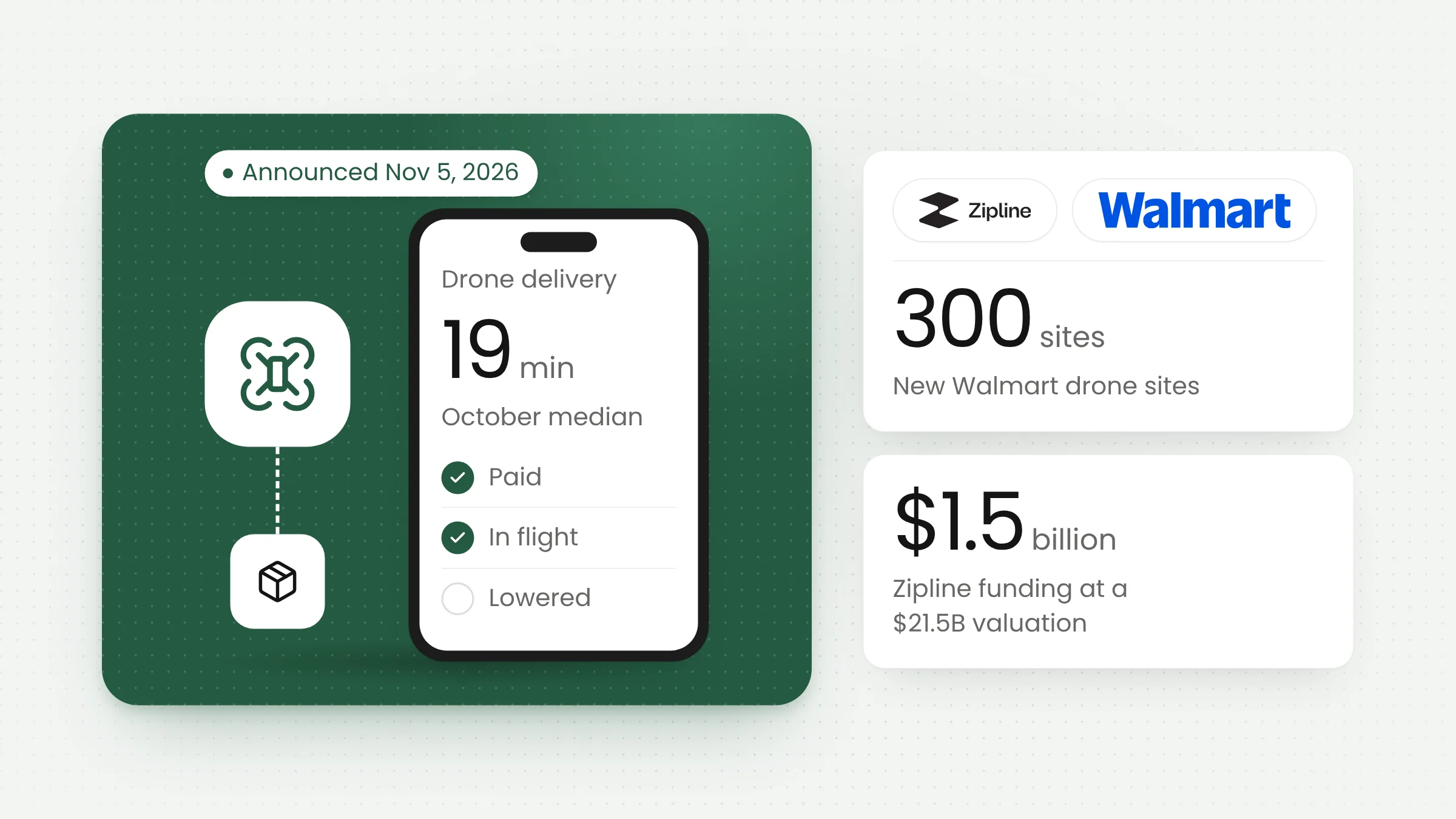
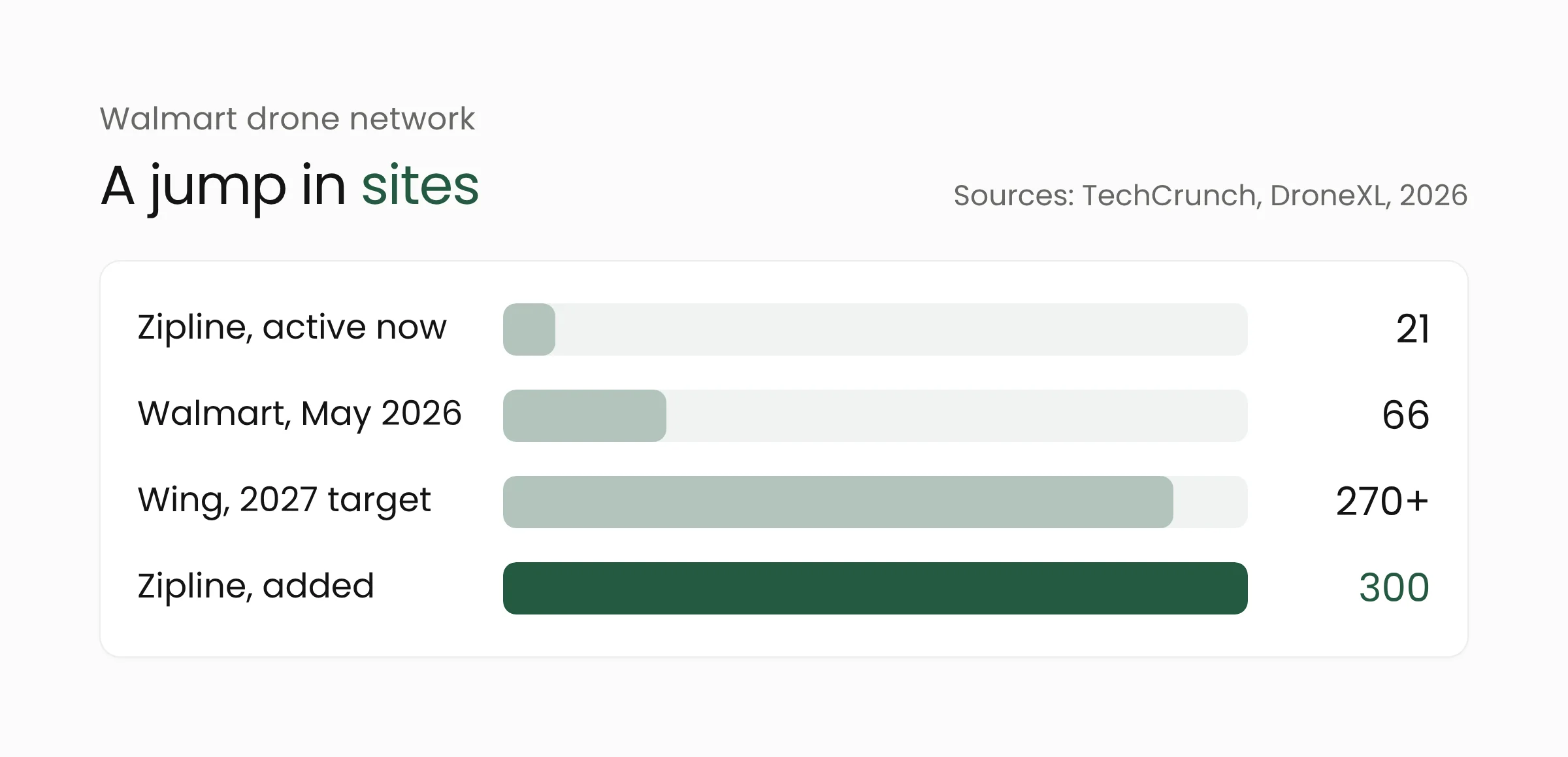
Drone delivery company Zipline announced a $1.5 billion funding round at a $21.5 billion valuation on November 5, 2026. The same day, Zipline and Walmart signed a multi-year agreement to add 300 drone delivery sites across the United States, a big step up from the 21 sites the two companies run today.
For retailers, the news matters for two reasons. Drones are starting to be treated as part of the store network, and the figures Zipline released show what ultra-fast delivery is chasing: shorter waits and extra orders.
The funding round and the Walmart deal
According to Zipline’s announcement, the round was led by Paradigm, WCM Investment Management, and Layer Global. Valor Equity Partners, Fidelity Management & Research Company, Uber, Tiger Global, J.P. Morgan, ARK Invest, and Salesforce Ventures also took part. Zipline says the money will go toward expanding its US manufacturing, hiring, and building a nationwide drone delivery network.
The valuation jump is steep. DroneXL puts the new figure at about 2.8 times the $7.6 billion valuation from January 2026. Across 2026, Zipline has raised roughly $2.3 billion in three tranches: more than $600 million in January, a $200 million extension in March, and the new $1.5 billion.
The Walmart agreement drew the most attention. The two companies have worked together since 2021, and TechCrunch reports they currently operate 21 active sites. The new deal adds 300 sites, with room to grow further. Neither company has said which states will be served, when the first new sites open, or what customers will pay.
Walmart also works with another drone operator. In May 2026, its combined program with Zipline and Alphabet’s Wing ran from 66 stores in four states. Wing separately plans to reach more than 270 Walmart store locations by 2027, according to DroneXL.
How Zipline’s drone delivery works
Zipline flies two aircraft. TechCrunch reports that Platform 2 handles home delivery, carrying up to eight pounds within a 10-mile radius. Platform 1 serves long-range deliveries for enterprises, businesses, and governments, covering 120 miles round trip.
Platform 2 does not land in a customer’s yard. TechStartups explains that the drone hovers about 330 feet up and lowers a delivery pod on a tether. That keeps the aircraft away from people, fences, and power lines.
For the customer, the flow resembles any delivery app. The order is paid, packed at the store site, and flown to the address. The difference is that the fleet flies autonomously, and every flight produces location, timing, and status data. That data is what lets Zipline report delivery times in such detail.
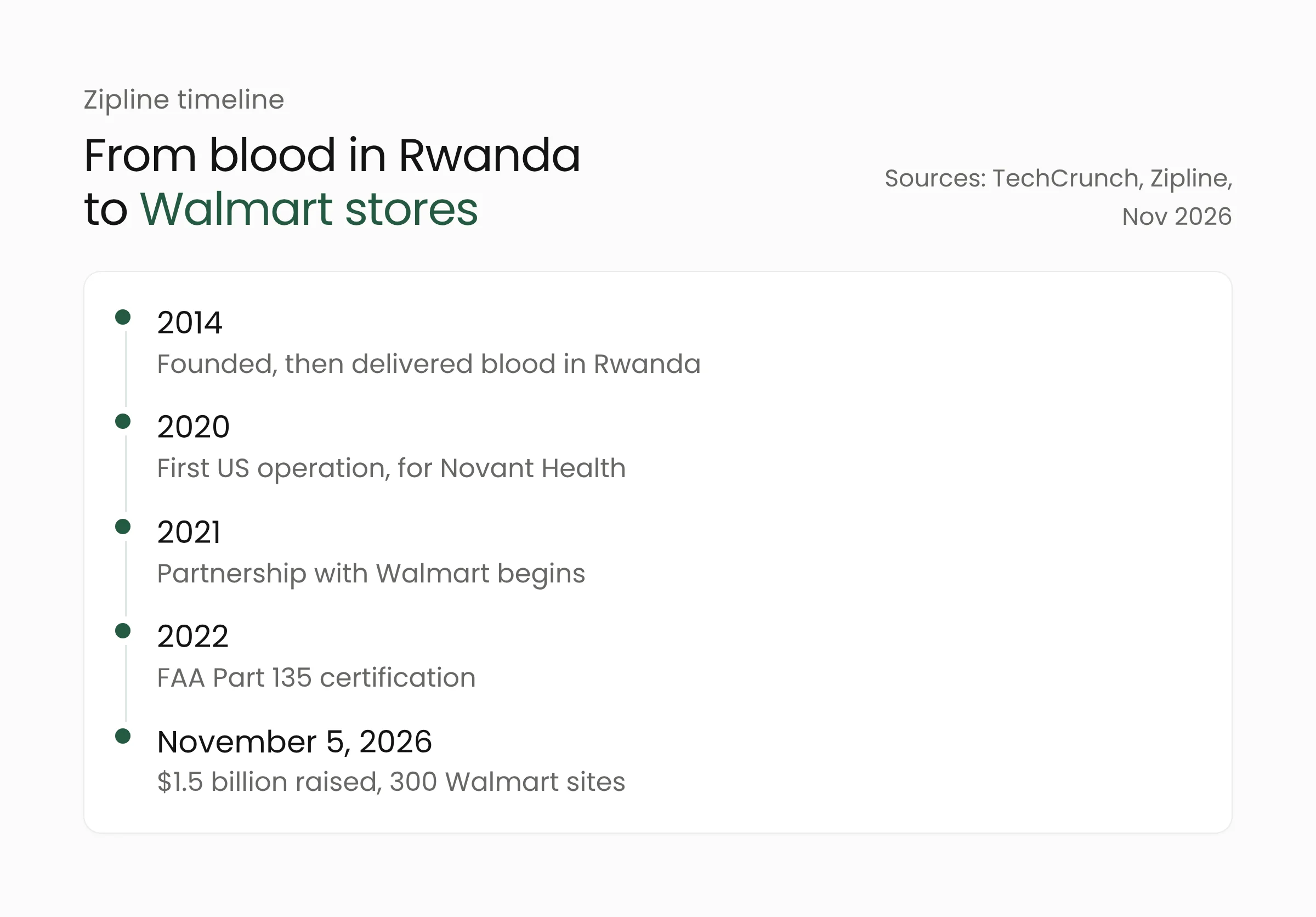
The model grew out of healthcare. TechCrunch notes that Zipline was founded in 2014 and began by delivering blood in Rwanda before expanding to Ghana and Nigeria. Its first US operation, in 2020, delivered medical supplies for Novant Health in North Carolina. Zipline now delivers food, retail goods, agricultural products, and health products in five African countries, several US cities, and Japan.
Performance claims and flight approvals
Zipline’s performance figures
Zipline shared a set of operating numbers. The company says it completed more than one million deliveries in the Dallas-Fort Worth area in 2026. In October, the median order arrived 19 minutes after checkout, compared with more than 30 minutes for traditional delivery. For bakery orders, the median was 10 minutes.
Zipline also claims drone delivery adds sales for partner restaurants. Between March and October, Zipline’s share of delivery revenue at a group of restaurants rose from 10.8% to 34.9%. That group’s delivery sales grew 26%, with 80% of the increase coming from Zipline orders.
These figures are company claims. DroneXL points out that Zipline picked the restaurant group from its longest-tenured partners and did not disclose its size. Zipline also cites 150 million commercial autonomous miles without a safety incident. Meanwhile, DroneXL has reported two Zipline drones coming down under parachute in Texas, in Greenville on July 26 and near Houston in September, with no injuries. None of these numbers has been independently audited.
For comparison, Walmart reports an average of 23 minutes from order to drop across its whole drone program, which Zipline and Wing operate. That is measured differently from Zipline’s median, so the two figures cannot be compared directly.
Flight approvals set the pace of expansion
Fresh capital does not guarantee that 300 sites will open quickly. Zipline currently flies under the FAA Part 135 certification it received in 2022. Flights beyond a pilot’s visual line of sight, the basis of longer drone deliveries, still need approval site by site.
A new FAA rule known as Part 108 is meant to make such flights routine. According to DroneXL, the final rule reached the White House regulatory review office on July 10 and was still listed as pending review on November 5. Until it is published, each new Walmart site needs its own approval.
Other limits remain. Noise and neighborhood objections are still an issue, and payloads are limited to light goods. Zipline says a new flight profile introduced in October cuts sound exposure per flight by 68%, but that figure comes from the company’s own modeling. In Texas, an environmental assessment under way would raise Zipline’s ceiling from 30,000 to 220,000 deliveries a day across five metro areas if approved.
What this means for retailers
Zipline has not announced plans to operate in Indonesia, and the country’s drone rules are still taking shape. In October 2025, CNBC Indonesia reported that the Ministry of Transportation was preparing drone operating rules covering remote pilots, registration, and operating authorization. Even so, the operating model behind the Zipline and Walmart deal offers lessons Indonesian retailers can apply now, whatever vehicle carries the order.
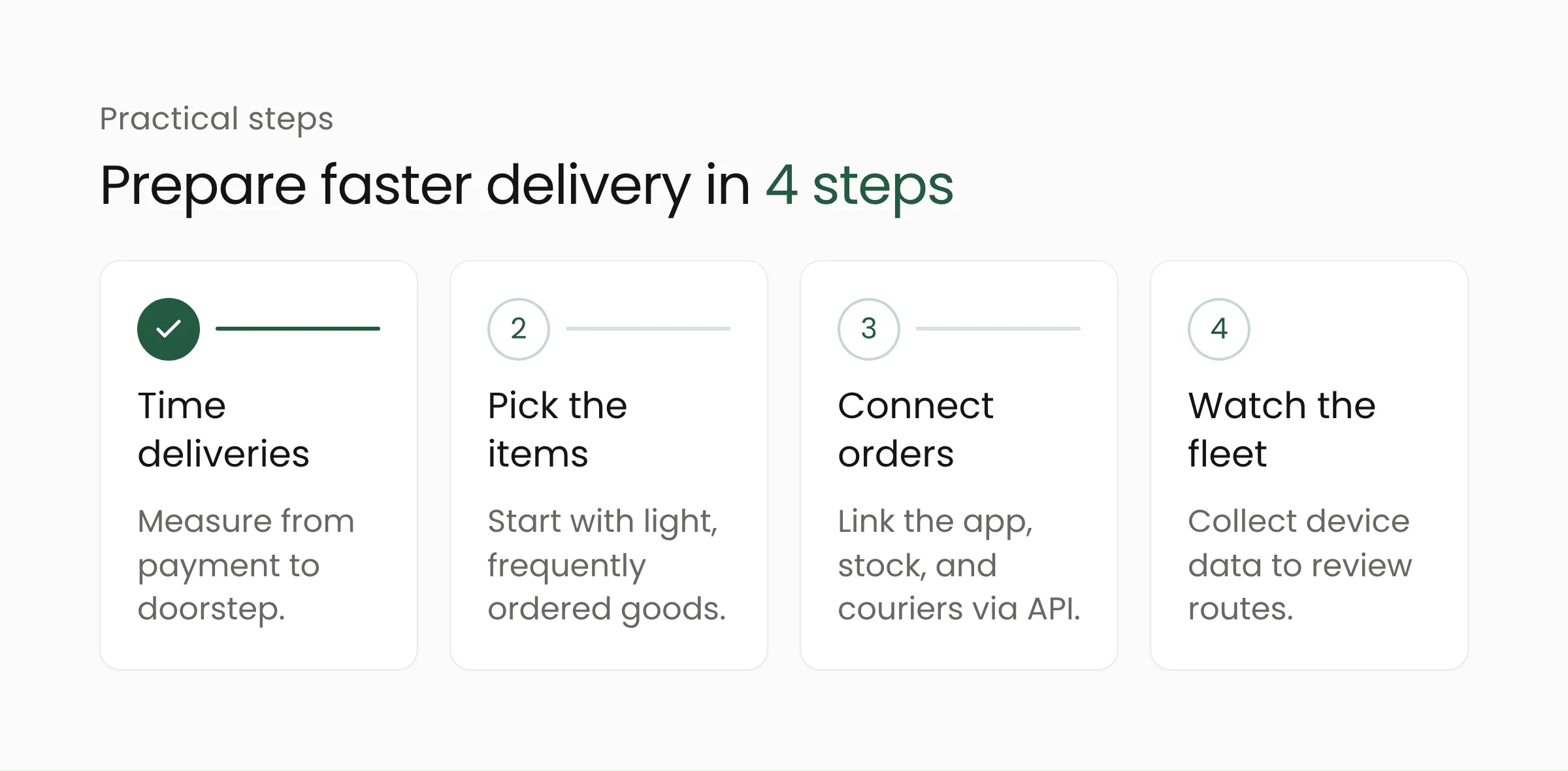
- Time every delivery from payment to doorstep. Zipline sells its service with a 19-minute median. A store that does not measure its own delivery times will struggle to judge whether in-house couriers, ride-hailing partners, or another option pays off.
- Pick the items that suit ultra-fast delivery. Zipline’s home delivery drone carries about eight pounds, so it handles light, impulse purchases such as cold medicine or groceries. Sales data can show which products are most often ordered in small quantities.
- Connect orders, stock, and delivery in one flow. Zipline is integrated with Uber Eats, and restaurant chain Wonder is building storefronts and kitchens designed for Zipline drones. API integration lets orders from every channel flow straight into stock and delivery systems. A flow like this can be built step by step with a retail management solution that links checkout, inventory, and online orders.
- Monitor the fleet with device data. Drones, electric scooters, and delivery vans can all send location and status data in real time. With Internet of Things (IoT) services, that data can feed a monitoring dashboard and then be analyzed with data analytics to review routes and peak hours.
The healthcare angle is relevant too. Zipline says its national network in Côte d’Ivoire is expected to serve more than 2,200 health facilities and 12 million people. For an archipelago like Indonesia, delivering medicine and lab samples to remote areas is one of the most relevant uses, provided permits and supporting infrastructure are in place first.
Frequently asked questions
Does Zipline operate in Indonesia?
No plans have been announced. According to TechCrunch, Zipline currently operates in five African countries, several US cities, and Japan.
How much can a Zipline drone carry?
The Platform 2 home delivery drone carries up to eight pounds, or about 3.6 kilograms, within a 10-mile radius. For comparison, the Wing drone that Walmart also uses carries less than three pounds, or about 1.4 kilograms.
When will the 300 new Walmart sites open?
That has not been announced. Zipline and Walmart have not named a schedule or the states to be served, and each site still needs FAA flight approval.
Closing thoughts
A $1.5 billion round and 300 Walmart sites show drone delivery moving from pilots toward large networks, even as flight approvals and operating costs remain open questions. For retailers in Indonesia, the nearest lesson is about data: measured delivery times, connected inventory, and a fleet that can be monitored. The Merakit team is ready to help you build retail and fleet monitoring systems that fit your business.
Sources
- Zipline: Zipline Raises $1.5 Billion to Build Nationwide Drone Delivery Network (November 5, 2026)
- TechCrunch: Zipline hits $21.5B valuation as Walmart expands bet on drone delivery (November 5, 2026)
- DroneXL: Zipline Raises $1.5 Billion as Walmart Signs for 300 More Drone Sites (November 5, 2026)
- TechStartups: Zipline raises $1.5 billion at $21.5 billion valuation to expand drone delivery across the U.S. (November 5, 2026)
- DroneXL: Walmart Hits 1M Drone Deliveries, 40% This Quarter (May 31, 2026)
- CNBC Indonesia: Kemenhub Ancang-Ancang Siapkan Aturan Pengoperasian Drone (October 23, 2025)