Blog Artificial Intelligence
What AEYE-DS AI Retinal Screening Means for Primary Care
On this page· 7 sections
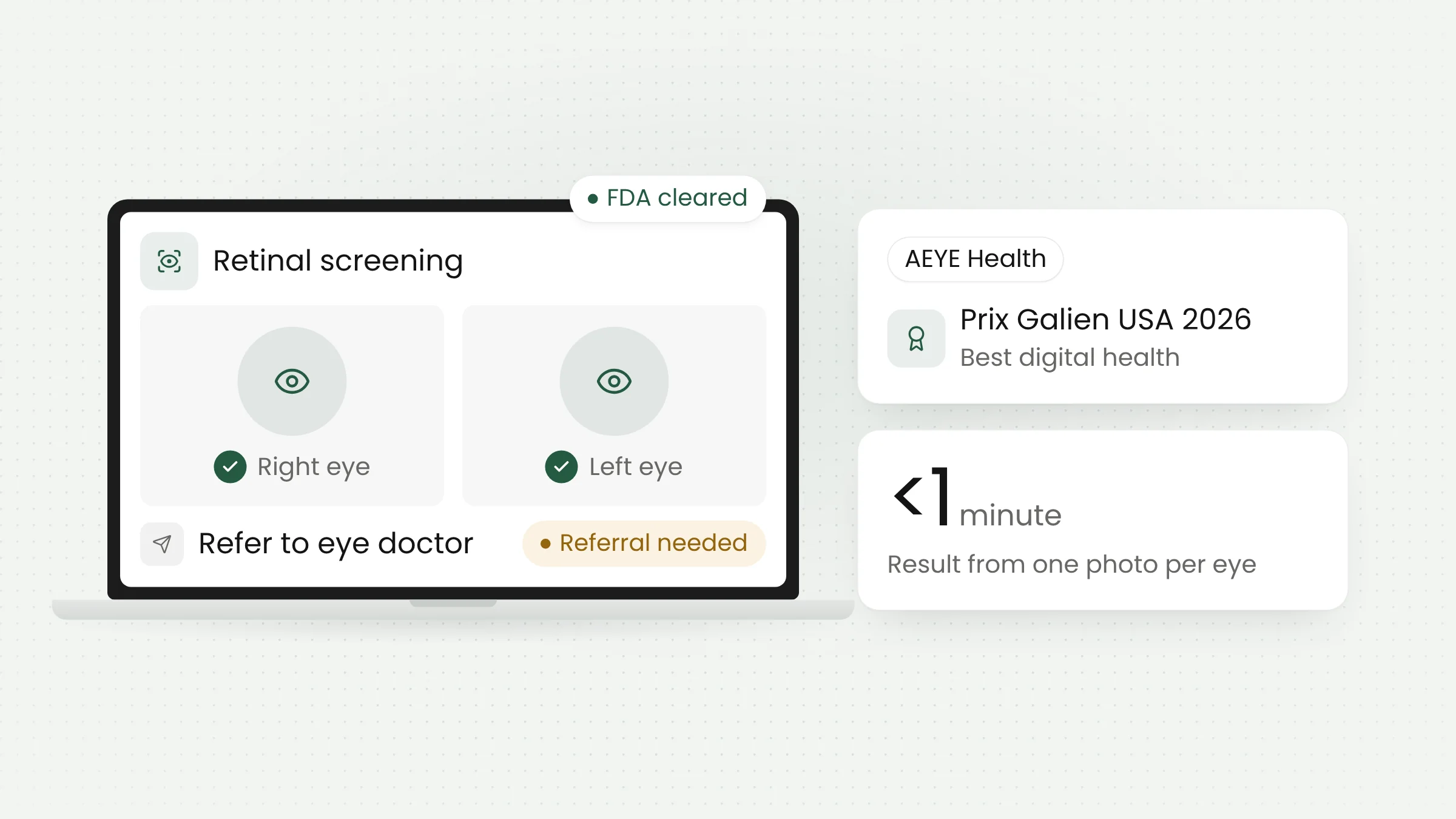
AEYE-DS, AEYE Health’s AI system for diabetic retinopathy screening, has won the 2026 Prix Galien USA award for Best Digital Health Solution. The system reads one retinal photo per eye and returns a result in under a minute without an eye specialist, as Indonesia’s Health Ministry prepares retinal screening at community health centers.
Diabetic retinopathy is damage to the blood vessels of the retina caused by long periods of poorly controlled blood sugar. It often has no symptoms in its early stages, yet it can lead to blindness. Regular retinal exams are recommended for people with diabetes, and one of the obstacles has been the limited number of ophthalmologists.
AEYE-DS wins the 2026 Prix Galien USA award
The Galien Foundation announced the 2026 Prix Galien USA winners in a press release dated October 30, 2026. This year marked the 20th edition of the awards, with eight categories spanning pharmaceuticals, biotechnology, medical technology and digital health. AEYE-DS (AEYE Diagnostic Screening) took the digital health category, while Guardant Health’s Shield blood test won Best Medical Technology.
According to Eyewire News, which reported the win on November 4, 2026, AEYE-DS was selected from 25 nominees in its category. The Jerusalem Post describes AEYE Health as an Israeli-American digital health company led by co-founder and chief executive Zack Dvey-Aharon.
The award stands out because AEYE-DS works autonomously. The software reaches its own conclusion from the retinal photo, and the result does not need to be reviewed by a doctor before it is reported. Many other medical AI tools act as assistants: they flag findings on an image and a clinician makes the call.
How retinal screening works without an eye doctor
An AEYE-DS exam starts with a fundus camera, a specialized camera that photographs the back of the eye. A nurse or medical assistant takes one retinal image of each eye. Eyewire says the images are captured without dilating drops, while AEYE’s 2022 announcement said dilation is rarely required.
The AI software then analyzes the photos. The result arrives in less than a minute and states whether the patient shows signs of diabetic retinopathy that warrant referral to an eye specialist. Patients who screen positive are sent for further examination, and those who screen negative do not need to queue for a specialist.
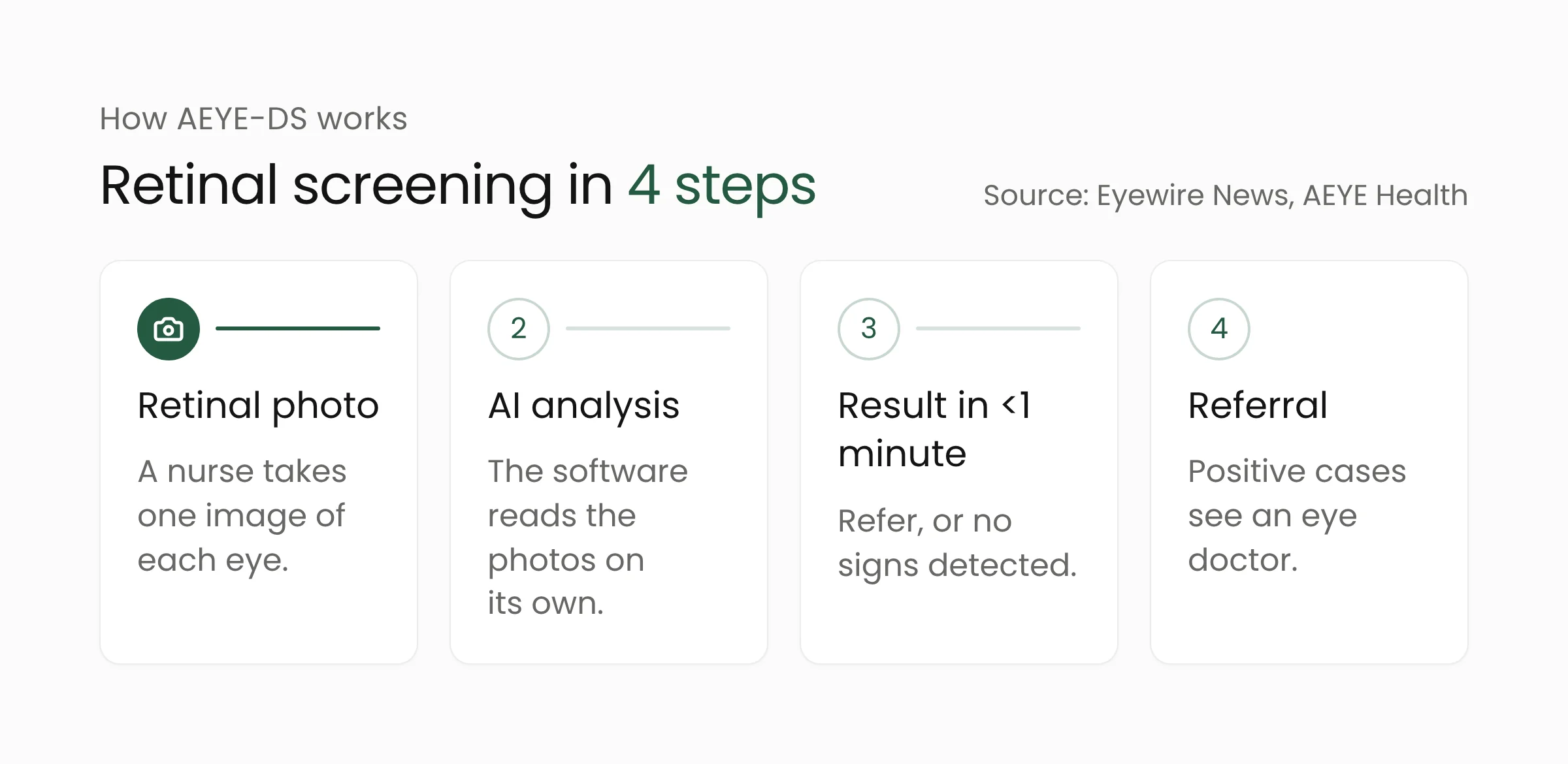
AEYE-DS received 510(k) marketing clearance from the US Food and Drug Administration in two stages. The first clearance came in November 2022 for use with the Topcon NW-400 tabletop camera. The second was announced by Optomed on April 30, 2024 for the handheld Optomed Aurora camera. Optomed called the combination the first handheld AI screening solution to obtain FDA clearance.
The handheld option matters for care outside hospitals. A tabletop camera usually stays fixed in one exam room, while a handheld one can travel to small clinics, pharmacies and mobile screening events. Eyewire reports that AEYE-DS is already in use across dozens of US health systems and hospitals, and that it connects to electronic health records for documentation and referrals.
Clinical results and their limits
AEYE-DS was evaluated in three prospective, controlled, multicenter phase 3 trials involving more than 1,200 patients. According to Eyewire, sensitivity ranged from 92% to 93% and specificity from 89% to 94%. More than 99% of patients produced images the system could analyze.
Sensitivity measures how many patients who truly have retinopathy are detected. Specificity measures how many healthy patients are correctly told they are negative. With sensitivity around 92%, roughly 8 in 100 patients with the disease could still be missed, so regular screening remains necessary.
These figures come from the company and from the trials behind the US clearance. Performance in other populations, with other cameras and in different exam rooms needs to be shown in separate studies. AEYE is also developing AEYE-X, a research platform it says can assess more than 100 health indications from retinal images, though it remains investigational and has not been cleared.
Indonesia prepares retinal screening at health centers
The AEYE-DS story is relevant to Indonesia because of the country’s large diabetes burden. Citing International Diabetes Federation data, CNN Indonesia reported that more than 20 million Indonesians live with diabetes, a figure projected to exceed 30 million by 2045. The same report said more than 73% of people with diabetes in Indonesia have not been diagnosed.
The Health Ministry is preparing to link its free health check program, Cek Kesehatan Gratis (CKG), for people with diabetes to retinal screening at community health centers (puskesmas), JawaPos reported in July 2026. The effort is part of the Diabetic Retinopathy Initiatives (DRIVE) consortium, which brings together the ministry, Universitas Gadjah Mada and Roche Indonesia.
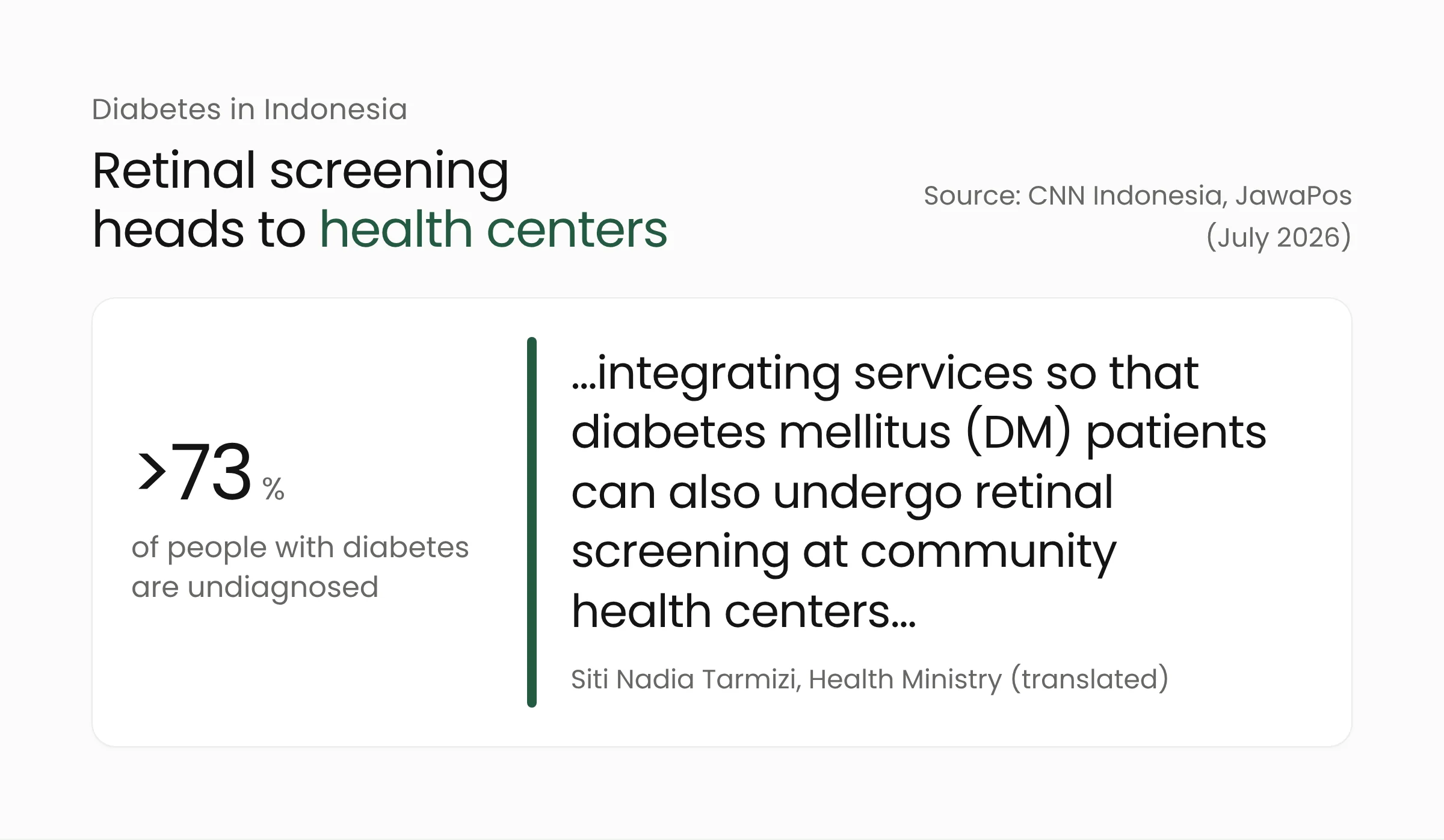
Siti Nadia Tarmizi, the ministry’s director for non-communicable disease prevention and control, told reporters that the ministry is integrating services so that patients with diabetes can also be screened for retinal damage at community health centers, in order to widen access to early detection.
Em Yunir, chair of the Indonesian Society of Endocrinology (PERKENI), added that the large number of undiagnosed patients is a major challenge for preventing complications. Retinal screening in primary care can help find patients earlier, provided that results lead to referral and treatment.
The sources we reviewed do not say which devices or image-reading methods community health centers will use, and there has been no announcement that AEYE-DS will enter Indonesia. Its experience in the United States still offers a useful picture of the technical needs and workflow of AI-based retinal screening in primary care.
What this means for clinics and health centers
For community health centers, primary care clinics and hospitals that want to expand retinal screening, the biggest lessons concern the workflow around the AI tool. The following points are worth considering from the planning stage.
- Set up the referral path first. Screening only helps if patients who test positive quickly get an appointment with an eye specialist. Decide which hospital receives referrals, how appointments are booked and how follow-up attendance is tracked.
- Confirm approvals and local evidence. AI-based medical devices need a distribution permit from Indonesia’s Health Ministry before use in the country. Ask vendors for performance data, especially results in Asian patients and on the camera you plan to use, then run a pilot at a few sites.
- Train staff to photograph the retina. Image quality determines the analysis. Staff need to know when to retake a photo and what to do if the system cannot read an image.
- Connect results to medical records. Screening results should be stored in the electronic medical record and readable by the doctor who receives the referral. Indonesia’s experience integrating SATUSEHAT records with national health insurance claims shows why consistent data formats matter.
- Protect patients’ retinal images. Retinal photos are health data covered by Indonesia’s Personal Data Protection Law (Undang-Undang Pelindungan Data Pribadi). Decide where images are stored, who may access them and how long they are kept.
Building a system like this draws on artificial intelligence services for the model and its validation, along with software that links the camera, medical records and referral scheduling. For another example of AI in primary care, see our piece on the Eko CORE 300 AI stethoscope.
Frequently asked questions
Does AEYE-DS replace eye doctors?
No. AEYE-DS is designed for screening, which means sorting out the patients who need referral. Full diagnosis, staging and treatment of diabetic retinopathy remain the work of ophthalmologists.
Is AEYE-DS available in Indonesia?
There has been no official announcement about marketing AEYE-DS in Indonesia. Its current clearance is from the FDA for the US market, and any medical device entering Indonesia requires a distribution permit from the Health Ministry.
How accurate is AI retinal screening?
In AEYE-DS clinical trials with more than 1,200 patients, sensitivity was 92% to 93% and specificity was 89% to 94%. Those figures come from the company, and performance in other populations needs separate testing.
Conclusion
The award for AEYE-DS shows that autonomous AI is gaining acceptance for narrow, measurable medical tasks such as reading retinal photos. In Indonesia, that momentum meets plans for retinal screening at community health centers. Success will depend on approvals, local validation and referral pathways that actually work. If your organization is planning digital health services, the Merakit team can help through our healthcare solutions, from planning to data integration.
Sources
- The Galien Foundation (via MedDeviceGuide): 2026 Prix Galien USA award recipients (October 30, 2026)
- Eyewire News: AEYE Health Wins 2026 Prix Galien USA Award (November 4, 2026)
- The Jerusalem Post: AEYE Health and the Prix Galien USA award (November 6, 2026)
- PR Newswire: AEYE Health receives FDA clearance for AI-based autonomous screening for referable diabetic retinopathy (November 15, 2022)
- Optomed: Optomed Aurora with AEYE has received FDA clearance in the US (April 30, 2024)
- JawaPos: Kemenkes prepares CKG diabetes screening integrated with retinal screening (July 21, 2026)
- CNN Indonesia: 73 percent of people with diabetes undiagnosed (July 21, 2026)